ChatGPT · Full Text
Contents
Trustful Surrender to Divine Providence
A patristic and Thomistic study of omnipotent providence, willed permission, freedom, agency, culpability, and charity
The Question Beneath Every Other Question
The decisive test of surrender is not whether one can accept a delay, an illness, or a disappointment. It is whether “Thy will be done” remains true when another will has done evil—without making God the offender, the offender innocent, or the sufferer passive. If Providence is weakened to protect human freedom, evil acquires a territory God does not rule. If human agency is weakened to protect Providence, repentance, justice, and resistance become theatrical. Either error makes trust impossible.
Beneath both lies one question: How does the causality of the Creator relate to the causality of creatures? God and the human person are not rival agents competing for a share of one effect. The Creator gives being and causal power; creatures truly act through the powers they receive. Once those orders are confused, a metaphysical error becomes a spiritual and pastoral wound. Providence turns into fate, freedom into independence, surrender into acquiescence, or discernment into an anxious attempt to decode a hidden script. Catholic faith accepts none of these substitutions.
God’s rule and creaturely freedom are not rival powers. His one eternal will infallibly governs all things without causing moral evil or destroying created freedom. God gives the positive reality by which a creature acts; the sinful defect arises from the creature’s failure to order that act to the good. No sin escapes or defeats God’s wisdom, justice, or mercy. Trustful surrender is therefore neither passivity nor optimism. It is the freedom to do the good entrusted to us, oppose the evil charity requires us to oppose, and place every uncontrollable result under the Father Almighty revealed in Christ.
The short treatise received—and bounded
The English volume Trustful Surrender to Divine Providence is a devotional anthology. Its first part extracts Jean-Baptiste Saint-Jure’s The Knowledge and Love of Our Lord Jesus Christ; its second presents an extract from St. Claude de la Colombière. Its governing spiritual claim begins with a decisive fence: “apart from sin,” no event escapes God’s will or permission. Properly understood, that is not a division between strong action and weak tolerance: what God does not produce as good can occur only under a knowing permission enclosed within his omnipotent government. The anthology then teaches conformity through ordinary vexation, illness, loss, family duty, interior trial, prayer, and hope.
This article receives the anthology as a teacher of spiritual vision, not as a technical manual whose every compressed phrase is a doctrinal formula. Its opening exception for sin is decisive: the malice belongs to the wrongdoer, never to God. Thomistic theology can say that a physical loss is willed incidentally when it is inseparable from a good God positively wills; the freely offered Passion is the unique saving summit of this truth. But another person’s sin never authorizes us to tell a victim that God positively desired the injury or to claim knowledge of his hidden reason. What can always be confessed is that neither the injury nor its consequences escaped his government. The anthology’s best practical order is equally important: first keep God’s commandments, obey legitimate authority, and perform the duties of one’s state; then receive what Providence decides beyond one’s power. Its section on recourse to prayer makes surrender active and petitionary rather than mute.
Yet devotional intensity needs dogmatic grammar. When the anthology calls God the cause of an illness or says that God is “responsible” for an injury, the language must be read through the distinction it itself announces and through the Church’s explicit teaching: “God is in no way, directly or indirectly, the cause of moral evil” (CCC 311). God never supplies the malice; no created event falls outside his government. That qualification will govern every page that follows.
The foundational rule
Receive the event as held within Providence; judge the act by truth and moral law; oppose the evil when charity assigns that duty; forgive the person without calling the sin good; entrust the outcome to God. None of these verbs cancels another.
Providence: The Wisdom of Love Ordering All Things
Surrender rises or falls with the God to whom one surrenders. Submission to sheer power would be servility; confidence in sheer benevolence would be wishful thinking. Christian trust rests in the Father Almighty: power without rival, wisdom without error, goodness without defect, and love revealed in the crucified and risen Son.
The Father Almighty: power without rival or defect
The Creed names omnipotence among the divine attributes. God’s power is universal, and creation and history remain wholly subject to him (CCC 268–269). Job confesses, “I know that you can do all things, and that no purpose of yours can be thwarted” (Job 42:2); the Psalmist and Paul likewise confess his accomplished will (Ps 113B[115]:3; Eph 1:11).
Omnipotence is neither arbitrary force nor one attribute bargaining with another. In the absolutely simple God, power, essence, will, wisdom, justice, and goodness are one (CCC 271; Vatican I, Dei Filius, ch. 1). Hence God cannot lie or sin, not because some external law overpowers him, but because defect is not an achievement of power. To sin is to fail in perfect action; God cannot fail precisely because he is omnipotent (ST I, q. 25, a. 3 ad 2).
The experience of evil therefore tests faith in the Father Almighty at its center. God may appear absent or unable to stop what he condemns, but the Cross and Resurrection reveal a power neither defeated by suffering nor contaminated by sin (CCC 272–278). The strict alternatives are not an interventionist deity or a helpless observer. They are the Catholic confession—omnipotent wisdom governing free causes—and its denials: a rival power, an autonomous enclave, or a God who produces wickedness as wickedness.
Not foresight alone, but the order to an end
Divine Providence is often reduced in imagination to God’s advance awareness of events, as if eternity were only a perfect observatory. Catholic doctrine says more. Providence is the disposition by which God guides creatures toward their ends; government is that order carried into effect (CCC 302–308; ST I, q. 22, a. 1). God knows creatures as their Creator and cause, not because he waits for reality to report itself (ST I, q. 14, aa. 8, 11). He gives being, sustains it at every moment, gives created powers their power to act, and orders their operations within the one created whole.
Vatican I confesses that Providence reaches all things, including what will occur through the free action of creatures (Dei Filius, ch. 1; DS 3003). The universality matters. A deity who controlled only religious episodes, or who could be defeated by created initiative, would not be the Creator. The tenderness matters just as much. Jesus does not infer neglect from transcendence: the Father numbers hairs and attends the sparrow, knows bodily need, and commands his children to seek first the kingdom rather than become slaves of tomorrow (Matt 6:25–34; 10:29–31).
The Psalms therefore teach trust by holding sovereignty and praise together: the Lord does what he wills, and his mercy endures. Wisdom “reaches mightily from one end of the earth to the other, and orders all things well” (Wis 8:1). Providence is concrete and immediate, extending from the least thing to the greatest event (CCC 303–304). Its absolute particularity is not arbitrary domination or rivalry with created causes, but the government of infinite wisdom and goodness.
Creation gives creatures the dignity of causes
God’s greatness is displayed not by doing away with created powers but by causing them. The Catechism says that he gives creatures “the dignity of acting on their own,” of being causes for one another and co-workers in his plan (CCC 306–307). A stone really falls, fire really heats, a physician really heals, a judge really sentences, a mother really consoles, and a person really chooses. To call these secondary causes is not to call them unreal, unimportant, or temporally second. It marks their received and limited power.
Here a basic rule prevents confusion:
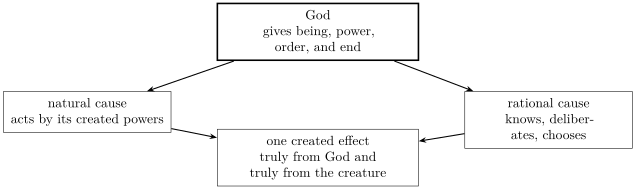
The diagram does not mean that every effect has one natural and one rational created cause. It shows the grammar: primary causality grounds rather than displaces secondary causality. “God wrote the book” and “the human author wrote the sentence” do not divide authorship into rival percentages, though the literary analogy remains imperfect. At the level of being, the creature has nothing unreceived; at the level of created operation, it acts through powers genuinely its own. Hence the same good act can be wholly dependent on God as first cause and wholly the person’s act as responsible secondary cause.
Aquinas expressly rejects occasionalism, the view that fire does not truly heat or a creature does not truly act. Such a world would display less, not more, divine power. God works in every agent by giving its power, conserving it, applying it to action, and ordering its effect; each cause nonetheless contributes according to its own mode (ST I, q. 105, a. 5). Providence is not God’s jealousy of creatures. It is the condition of their fruitfulness.
Providence includes contingency
If God knows and wills infallibly, must every event be necessary? Only if one confuses the certainty of the first cause with the mode of the proximate cause. God’s perfectly efficacious will causes not only that effects occur but how: necessary effects through necessary causes, contingent effects through contingent causes, and free acts through rational wills. Aquinas therefore says that the divine will is always fulfilled without destroying contingency; it causes an order in which genuine contingency belongs (ST I, q. 19, aa. 6, 8; q. 22, a. 4; q. 23, a. 6).
This does not make God uncertain. It makes the created effect contingent in its proper order. My choosing otherwise is a real potency while I deliberate; if I choose, my act is mine and not a compelled event masquerading as consent. God’s eternal knowledge is not an earlier event pushing mine. His causal presence is more inward than created compulsion because he causes the agent, the act’s positive actuality, and its voluntary mode. “In him we live and move and have our being” (Acts 17:28) does not mean that we are masks on God’s face; it means that finite being and operation never become self-subsistent.
One divine will, differently related to its effects
God has no strong will that acts and weaker will that merely permits. In Thomistic terms, the will of good pleasure (voluntas beneplaciti) names his one simple, eternal act properly; the will of sign (voluntas signi) names created directives and effects—precept, prohibition, counsel, operation, and permission—from which Scripture and theology speak metaphorically of divine willing. Thus “willing to permit” belongs to the one good pleasure, while permission also names a sign from the creature’s side; no acts or faculties multiply in God (ST I, q. 19, aa. 1–5, 7, 9 ad 3, 11–12).
The following questions identify complementary truths within one decree, not four wills or four successive divine responses.
| Question being answered | What the one divine will establishes | What is denied |
|---|---|---|
| What does God effectively decree? | Whatever God absolutely wills—the classical “will of good pleasure”—is accomplished in the necessary, contingent, or voluntary mode he wills. | No creature surprises, coerces, or defeats the universal purpose. |
| What ought the creature choose? | By precept and prohibition God reveals the good rational creatures ought to choose and the evil they must refuse. A creature can disobey that moral order. | Disobedience does not make evil a divine object or frustrate God’s universal government. |
| How can sin occur? | God knowingly wills to permit a moral defect he could prevent; he sustains every positive actuality and fixes the bounds no creature can exceed. | Permission is not approval, helpless observation, secret complicity, or proper production of sin. |
Whatever the relation, every effect and consequence remains under Providence, which judges evil and causes good to arise from what it permits. The defect never becomes good, necessary to God, or the divine intention shared with the sinner.
The doctrinal boundary is dogmatic: God is not the author of sin, and no event escapes Providence. The analysis of the act and its defect, the one decree’s willed permission, and the mode by which the decree causes contingent effects are the Thomistic articulation adopted here. Trent anathematizes the claim that God produces evil works “not permissively only, but properly and of himself,” as though Judas’s betrayal were his work in the same manner as Paul’s vocation (sess. VI, canon 6; DS 1556). Augustine grounds the same distinction in omnipotence: nothing occurs unless the Almighty effects it or permits it; he permits willingly, and no creature defeats his universal purpose (Enchiridion 95–96, 100–102). Aquinas states the point exactly: God neither wills moral evil as evil nor simply wills that it not occur; he wills to permit it, and this permission is a good (ST I, q. 19, a. 9 ad 3).
Nor does God permit because freedom is a territory his power cannot enter. Common doctrine requires that God can prevent a particular sin and efficaciously bring a will to good without violating its freedom. Aquinas explains this by teaching that God alone moves the will inwardly, gives it its natural inclination, and thereby causes voluntary action to remain voluntary (ST I, q. 105, a. 4; I–II, q. 10, a. 4). Catholic schools dispute how divine efficacy, foreknowledge, grace, and free consent are coordinated; none may turn freedom into a veto over Providence.
Scripture gives two controlling examples. Joseph’s brothers intend evil while God intends the saving good accomplished through and against their intention (Gen 50:20). In the Passion, Christ freely offers himself within the Father’s saving plan, while the sinful agents remain responsible for the culpable aversion, hatred, and betrayal God never causes (Acts 2:23; 4:27–28; Heb 10:5–10; CCC 599–600, 606–614). One governed history can therefore contain radically different formal objects and intentions. Section 6 returns to its moral relations.
The doctrine does not provide an easy answer to pain. The Catechism insists that no quick answer suffices; the answer is the Christian faith as a whole—creation, sin, covenant, Incarnation, Cross, Spirit, Church, sacraments, conversion, judgment, and promised glory (CCC 309). Surrender is therefore Christological before it is psychological. Christians trust not an abstract control system but the Father whose Providence passes through Gethsemane and Calvary into Resurrection.
Two Regresses: The Line and the Living Hierarchy
A clarification of terms
“Regression” here is metaphysical, not statistical. It means tracing an effect backward through the causes on which it depends. The contrast requested for this study is best expressed in classical language as a distinction between an accidentally ordered (per accidens) series and an essentially ordered (per se) series. “Linear” and “hierarchical” are useful pictures if they do not replace that definition.
| Question | Linear / accidentally ordered | Hierarchical / essentially ordered | Why it matters |
|---|---|---|---|
| What orders the series? | Historical succession: an earlier cause generates a later cause with powers of its own. | Derivative causal power: an intermediate acts here and now only with power received in the relevant order. | Clock time is not the decisive difference; dependence is. |
| Example | A grandfather begets a father, who later begets a son after the grandfather has died. | A hand moves a staff that moves a stone; the staff moves instrumentally only while moved. | Removing an early ancestor does not cancel a descendant’s present generative power; removing the principal mover cancels the instrument’s present instrumental action. |
| Can members be genuine causes? | Yes; each parent acts through an intrinsic created power. | Yes; an instrument really moves the stone, and living secondary causes act by real intrinsic powers. | “Derived” does not mean imaginary. |
| What sort of first is required? | Metaphysics alone does not show a first event in time; Aquinas held temporal creation known by revelation, not demonstrated from motion. | A non-derivative source is required in the relevant order; an infinity of borrowers does not supply what none has of itself. | God is not inferred merely as a very old event but as present first Cause. |
The hand–staff example is intentionally narrow. A human will is not an inert stick, and God is not a bodily mover outside it. The example shows one feature only: intermediate causality can be real and derivative at once. Rational creatures receive an intrinsic principle of operation—intellect and will—and therefore act from within with knowledge of an end. In the Thomistic analysis adopted here, God not only creates and conserves that faculty but moves it inwardly to each exercise according to its rational mode. Precisely because the divine cause is more intimate than created power, it does not shove the will from outside.
Why an endless horizontal past would not replace God
Imagine that every temporal event has an earlier temporal event without a first tick. Aquinas did not think philosophy could disprove that hypothesis merely by counting backward; he held by faith that the world began, while arguing that reason cannot demonstrate a temporal beginning (ST I, q. 46, a. 2). This protects the doctrine of creation from a category mistake. “Created” does not first mean “happened a long time ago.” It means “has being from another.”
Even an everlasting lamp would need electricity while shining. Even an eternal world, if it were possible, would not possess existence through itself. Extending a horizontal sequence does not change the metaphysical status of any member. A million contingent beings, or an infinity of them, do not become subsistent being by addition. The question is not only, “What happened before this?” but, “Why is there any actual causal power, existence, order, or intelligibility in the series at all?”
The horizontal regress therefore answers questions within created history. It can be scientifically and historically indispensable: this storm arose from those atmospheric conditions; this institution from those decisions; this wound from that blow. Providence never authorizes skipping those causes. To discover the secondary cause is to discover something God truly caused to be a cause.
The hierarchical regress reaches the order of being
An essentially ordered regress traces borrowed causal actuality. If every member has the relevant power only from another, adding intermediate borrowers never gives the series a source. A brush can paint, but not without the painter in the instrumental order; a letter can communicate, but not without an intelligence in the semantic order. Intermediate causes can transform, specify, and transmit. What they cannot do is confer upon the whole series the very actuality that every member merely receives.
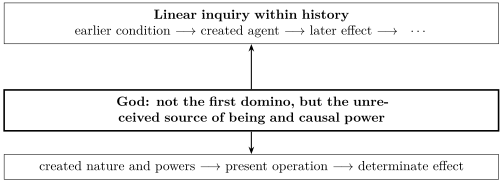
The vertical arrow is analogous, not spatial. God is not located above the weather, brain, law court, or will. Nor is he one explanatory object alongside them. He is first in the order of causality because created being and operation participate in actuality they do not possess through essence. Aquinas’s denial of an infinite regress applies here: if there were only intermediate movers with no first source of motion in the relevant order, nothing would be moving (ST I, q. 2, a. 3).
The term “first” is therefore metaphysical, not chronological. God has no received causal power, no unrealized potency, no need to be activated. Calling him uncaused is not an exception invented after applying a rule that everything has a cause. Whatever is actualized requires an actualizer in the relevant respect; more widely, whatever possesses being by participation requires a cause (ST I, q. 2, a. 3; q. 44, a. 1). Pure actuality and subsistent being are not instances of the dependent class.
Providence as a hierarchy of participation
This structure explains why Providence is neither fate nor rivalry. Fate imagines a univocal chain in which prior forces necessitate later events. Providence is the infallible order by which God gives diverse causes diverse modes: necessity to some operations, contingency to others, instinctive spontaneity to animals, and rational freedom to persons. Nothing defeats the universal order, precisely because the first Cause is present to each without becoming another item in its genus.
Within that Thomistic account, a free choice has two complete but noncompetitive causal descriptions:
-
From above: God creates and sustains the person, intellect, will, object, time, and power; he moves the agent inwardly to this exercise, causes the act’s positive actuality and voluntary mode, and can heal and elevate it by grace.
-
From within the created order: the person apprehends a good, deliberates about means, forms an intention, chooses, commands bodily powers, and acts.
Subtract God’s causality and no agent remains. Subtract the rational creature’s causality and this particular human act does not remain. The conclusion is not “God did it, therefore I did not,” or “I did it, therefore God did not.” It is: because God gives a rational creature its act according to its nature, I truly act and answer for the act as mine.
This is the metaphysical ground of surrender. The will need not reserve an ungoverned territory in order to be real. It can descend in explanation through every created cause, tell the truth about each, repair what can be repaired, and still rest in the unreceived Love who holds the entire order in being and whose purpose no created will can frustrate.
The True Nature of Free Will
Freedom is rational self-movement toward the good
Freedom is not first the power to contradict, detach, or keep every option open. It is the mode of action proper to a rational creature: the person knows an end under the aspect of good, deliberates about means, and moves himself by judgment and appetite. The Catechism calls it a power rooted in reason and will by which one performs deliberate actions on one’s own responsibility (CCC 1731). Irenaeus says that God made the rational creature free from the beginning so that obedience could be voluntary and praise or blame justly assigned (Against Heresies IV.37.1–5).
The will necessarily tends to good in the universal sense: no one chooses evil simply because it is evil, but under some apprehended aspect of pleasure, advantage, revenge, relief, loyalty, or self-assertion. Error and sin arise because a limited good is misperceived, disproportionately loved, or chosen against the order of reason and divine law. The thief wants possession, the coward safety, the proud person excellence. These are goods in abstraction; the disorder lies in willing them through an object or measure incompatible with the true whole.
Because no finite good exhausts beatitude, it does not necessitate the will merely by appearing. Reason can compare, deliberate, and judge; free choice elects among attainable means. Aquinas therefore locates free choice in the unity of reason and will: the cognitive power judges and the appetitive power chooses (ST I, q. 83). Freedom belongs to the person, not to an isolated faculty floating free of nature, body, history, truth, and grace.
Four freedoms that must not be collapsed
| Dimension | What it means | What wounds it | What perfects it |
|---|---|---|---|
| Natural freedom | The rational power of free judgment and choice, not erased even by sin. | Ignorance, coercion, fear, habit, passion, illness, social pressure can impede its exercise. | Truth, prudent deliberation, stable virtue, just conditions. |
| Freedom of exercise | Capacity to act or refrain where no necessity determines the act. | External violence or an incapacity that blocks execution. | Effective self-command and fitting opportunity. |
| Moral freedom | Mastery in choosing the good rather than servitude to disordered desire. | Vice and mortal sin; repeated choice narrows vision and makes evil easier. | Natural and infused virtue; repentance; ascetic discipline. |
| Freedom of glory | The healed and elevated will’s stable adherence to God, finally incapable of sin in beatitude. | It is unattainable by unaided nature and opposed by sin. | Grace, charity, perseverance, and the vision of God. |
This hierarchy corrects the claim that the ability to sin is freedom’s perfection. The possibility of defect accompanies finite freedom in the state of trial; it is not the essence of liberty. God cannot sin and is supremely free: the ability to fail in perfect action would be weakness, not an addition to omnipotence (ST I, q. 25, a. 3 ad 2). The blessed cannot turn from the Good seen face to face and are more free, not less. Augustine makes the progression vivid: humanity is healed toward the liberty in which it will be unable to sin, a will so filled by the highest Good that defection no longer attracts (Enchiridion 104–106).
Choice among finite means is real, and deliberation can leave the will open to alternatives; but bare indifference is not liberty’s perfection. A master musician is freer at the instrument because truthful habits have become connatural; a faithful spouse is not less free because adultery has ceased to present itself as a live possibility. Virtue does not make a person mechanical. It makes excellent action prompt, lucid, and joyful.
John Paul II gives this creaturely freedom its Christological measure. Freedom is a gift to be received and cultivated, not an absolute origin within the self; it is ordered through truth toward communion. The Crucified reveals its perfection not as maximal option but as self-gift in obedient love (Veritatis splendor 86–87). Surrender is therefore not freedom’s retreat under pressure. In Christ it is freedom’s highest act: the self possessed in truth and given in love.
Grace does not compete with freedom
Sin wounds the powers by which one knows and chooses the good. Grace does not merely offer information to an otherwise self-sufficient decider; it precedes, awakens, heals, elevates, and sustains the response. Yet the person is not inert. The Council of Trent teaches both that the sinner can reject divine inspiration and that he cannot move himself toward justifying righteousness without prevenient grace (sess. VI, ch. 5; canons 4–5). The Catechism calls justification cooperation between grace and freedom (CCC 1993), with God’s initiative first at every point.
Augustine states both poles without embarrassment: it is we who will when we will, and God makes us will the good; God operates so that we will and cooperates when, having been moved, we will and act (On Grace and Free Will 31–33). Aquinas supplies the metaphysical reason. God moves each nature in a manner fitting to it. To move a rational will as forced would be contrary to the mode God himself gives it; divine motion brings about a voluntary act as voluntary (ST I–II, q. 10, a. 4).
This article does not prescribe one Catholic school’s account of precisely how God’s infallible efficacy, noncoercive divine motion, and the creature’s real capacity to refuse divine inspiration are articulated together. It affirms the boundaries within which those schools reason: no saving initiative begins apart from grace; no grace makes God the author of sin; no merit earns the first grace; no genuinely human assent becomes a mere event without the person; and no divine knowledge is surprised.
Surrender is an act, not the absence of an act
In Gethsemane Christ reveals the form of holy freedom. In his human will he experiences the innocent natural inclination away from death; he prays that the cup pass; he adheres to the Father: “not my will but yours be done” (Luke 22:42). The two phrases do not reveal a sinful will being crushed. They reveal his natural human will freely adhering and subject to his divine will in obedience to the saving end (Third Council of Constantinople, DS 556; CCC 475). The human will of the Word is most truly human when perfectly filial.
Christian surrender shares that form by grace. It sees the feared good that may be lost, names the pain without pious disguise, petitions boldly, uses lawful means, and consents to remain a child if the cup is not removed. Resignation can be mere defeat; surrender is theological hope acting through charity. It does not say, “Nothing matters because nothing can be changed.” It says, “Every good matters, therefore I will do the good entrusted to me; the final fruit is the Father’s.”
Freedom’s paradox
The will is least free when it must possess outcomes in order to remain at peace, for then circumstances command it. The will becomes free when charity binds it to the unchangeable Good and prudence releases its finite action into Providence. Surrender narrows neither intelligence nor effort; it breaks the idol of control.
Agency and Culpability: Related, Never Identical
Providence does not blur moral history; it makes truthful judgment possible. Because created causes are real, the lie belongs to the liar, the wound to the one who inflicted it, the courageous refusal to the one who resisted, and the mercy to the one who forgave. Universal divine government is not a solvent poured over these distinctions.
Three different questions
Causal involvement asks what bodies, acts, omissions, conditions, or institutions contributed to an effect. Human agency asks whether conduct proceeded from the person as a voluntary human act, with relevant knowledge and control. Culpability asks how far an objectively disordered act or omission is morally imputable as blame. Causal involvement alone is not agency; agency alone does not settle guilt; the magnitude of harm does not by itself measure culpability.
The distinction is indispensable wherever Providence, trauma, coercion, addiction, social structures, or cooperation are discussed. A body can be used as a material cause without consent. A person can choose an act while knowledge is gravely impaired. A person can form a guilty will and fail to execute it. Another can cause foreseeable harm by a negligent omission without intending the harm. Outcomes alone do not measure the will; inward sincerity alone does not specify the moral object.
Two related analyses
Moral quality of the act: chosen object + intention + circumstances.
Imputability to the person: relevant knowledge + voluntariness + degree of consent.
The first identifies what kind of human act occurred; the second measures how far its good or evil is attributable to this agent.
This is analysis, not an algorithm for judging souls. God alone knows the heart without remainder. Human authorities must still make prudent judgments from evidence; confessors and clinicians possess different competencies; legal responsibility and moral culpability can overlap without being identical.
Voluntariness makes an act properly human
Aquinas defines the voluntary by an inward principle joined to knowledge of the end (ST I–II, q. 6, a. 1). A merely physical motion originating inside the body is not enough; digestion is not a moral act. Knowledge without an inward principle is not enough; if another physically moves my bound hand, the motion passes through me without being mine as a chosen use of the hand.
Augustine gives nearly the same test in vivid cases. A sleeper’s hand can be used to do harm; a conscious person’s hand can be forcibly bound and moved. Material involvement does not establish guilt. Conversely, an evil will can be culpable when execution fails, and one who deliberately caused his own incapacity cannot automatically convert foreseeable wrongdoing into innocence (On Two Souls 10–11). The examples anticipate the later grammar of voluntariness, antecedent fault, attempt, and coercion.
The Catechism states the pastoral rule: responsibility belongs to a person “to the extent” that acts are voluntary, and imputability can be diminished or even nullified by ignorance, inadvertence, violence, fear, habit, inordinate attachment, and psychological or social factors (CCC 1734–1735). The phrase “to the extent” forbids two extremes: treating every impaired act as fully deliberate or treating every influence as annihilating agency. Grave matter alone does not establish mortal culpability; full knowledge and deliberate consent are also required, and judgments about persons are entrusted to God’s justice and mercy (CCC 1857–1861).
A map of participation and blame
| Case | Causal involvement | Voluntary human agency | Culpability / distinction |
|---|---|---|---|
| Hand moved by direct physical force | The body is used in the physical sequence. | No voluntary act of the hand’s owner, absent prior collusion. | None for the forced motion. Being used is not consenting. |
| Choice under grave fear | The person’s conduct contributes to the effect. | A real but conditionally voluntary choice may remain. | Often diminished; fear influences the will without always eliminating agency. |
| Non-culpable ignorance | The person’s conduct brings about an effect. | Voluntariness can be absent or limited in the morally relevant respect because needed knowledge is absent. | Culpability can be diminished or absent; ignorance does not make objective disorder good. |
| Culpable ignorance or intoxication | Present behavior and an earlier self-incapacitation can both contribute. | Present agency may be impaired; the earlier neglect or intoxication can be voluntary. | Antecedent fault can ground responsibility for foreseeable consequences. |
| Entrenched habit or addiction | The person’s conduct can remain causally effective. | Mastery can be wounded in varying degree. | Neither automatically full nor absent; treatment, accountability, and compassion can coexist. |
| Evil intention, failed execution | The intended final harm does not occur. | A real interior choice and perhaps an external attempt occur. | Culpability can be grave even when Providence prevents the outcome. |
| Negligent omission | Nonperformance can leave a preventable condition in place. | Imputable agency exists where knowledge, ability, and duty were present. | Depends on foreseeability, gravity, and voluntary neglect; “I did nothing” can name the fault. |
| Victim’s involuntary response | A body or survival reaction can enter the physical sequence. | Being harmed, freezing, or suffering an involuntary bodily response is neither consent to nor agency in the abuse. | No guilt follows merely from what was suffered or involuntarily felt. |
The table cannot decide a case. It disciplines the questions. It also shows why surrender cannot mean declaring every causally involved person guilty or every voluntary agent innocent because Providence encompassed the event. Diminished culpability does not by itself erase objective harm, a fitting duty of repair, or proportionate protective consequences. God’s willed permission and human imputability answer questions in different orders.
Object, intention, and circumstances
Augustine’s “Love, and do what you will” appears after he contrasts a father’s corrective severity with a kidnapper’s caress. The external surface can deceive: gentleness may serve exploitation, severity may serve healing. He is right to insist upon the root and intention. Catholic moral theology adds an indispensable precision: the moral species of a human act comes from its chosen object as apprehended by reason, while intention and circumstances also bear moral quality (ST I–II, qq. 18–20; CCC 1750–1756).
Therefore a benevolent feeling cannot turn an intrinsically disordered object into charity. “I meant well” does not make adultery faithful, perjury truthful, torture corrective, or direct killing of the innocent protective. Conversely, an outwardly good object can be corrupted by vainglory or manipulation. To read Augustine faithfully is to distinguish formally different acts beneath a similar physical description, not to let intention dissolve objective moral order.
Charity does govern the virtues, but it does so by joining the person to God, the true last end. It cannot command an act contrary to the divine good it loves. Prudence determines the fitting means; justice renders what is due; courage endures cost; temperance orders desire. An impulse that silences these virtues is not theological charity merely because it feels intense.
The act as being and the sin as defect
The hardest application concerns God. If every creature and every exercise of created power depends on the first Cause, is God an agent of the sinner’s act? Aquinas answers by distinguishing the positive entity of the act from the privation of due order that makes it sinful (ST I–II, q. 79, aa. 1–2). God causes every action insofar as it possesses action and actuality; the deficient created cause alone contributes the failure of due moral order.
Consider a lie. Breath, vocal powers, concepts, the natural good of communication, and the act’s existence are positive realities; as such they depend on God. The will’s choice to signify contrary to the mind against the order of truth is a defect in the created use of those goods. A limp depends on the leg for its motion but on the leg’s defect for the defective gait. The power to walk is not the cause of lameness as lameness. Analogously, God causes no moral defect when he sustains the finite goods that the sinner disorders.
The analogy has limits: sin is a voluntary privation, not merely a physical malfunction. Where the defect is voluntary, culpability belongs to the created will in the measure of knowledge and consent, never to God. God neither falls short of a rule nor turns away from a higher end; the created will can fail to measure its act by the truth. No execution exceeds the bounds God eternally permits. He causes and sustains every positive actuality, while the defect arises from the created will insofar as it fails to measure the act by its due rule. God may restrain an act’s execution; he unfailingly judges every act; and he administers punishment and mercy according to perfect justice, without ever sharing the evil intention.
This is precisely where agency and culpability save the doctrine of surrender from abuse. The offender is a real secondary cause and can be guilty. The victim did not become guilty by being acted upon. God remains omnipotent Lord without becoming the offender. Providence infallibly governs the wounded history and, for those who love God, actually makes even this history serve final good without making the wound holy.
Surrender Before Evil and Suffering
Any theology of surrender that works only when events are pleasant is merely a theology of preference. Any theology that calls evil good in order to preserve confidence in Providence has preserved neither goodness nor Providence. The Christian claim is harder and more exact: evil remains evil, the creature remains answerable, and God remains Lord.
Evil is not one thing
The word “evil” can name different privations. Moral evil is the free creature’s failure of due order to reason, divine law, and the last end. Physical or suffered evil is the loss of a created good: health, safety, reputation, property, relationship, bodily integrity, or life. A just penalty is again distinct, for its privation can belong to an order of justice. These senses must not be collapsed into the claim that whoever suffers is being punished for a personal fault.
Christ rejects that inference. Neither the man born blind nor his parents sinned in the manner his questioners presumed (John 9:1–3); the Galileans killed by Pilate were not worse sinners because they suffered, nor were those crushed by the tower (Luke 13:1–5). All creation groans under corruption while awaiting redemption (Rom 8:18–25). Some suffering follows one’s sin, some another’s sin, some the finite interaction of natural causes, and much exceeds our power to assign a particular reason.
The Church commonly speaks of God permitting both physical and moral evil (CCC 324). Aquinas adds a specifically Thomistic precision. Moral fault is never willed as fault and is only permitted; natural corruption can be willed incidentally under the good of created order, and just punishment under the good of justice (ST I, q. 19, a. 9; q. 49, a. 2). This does not identify every suffering as punishment or disclose the formal good under which a particular tragedy is governed. It prevents the moral defect of sin, natural loss, and judicial penalty from being treated as one thing.
God is never the cause of the moral defect. On the Thomistic account adopted here, “permission” is not an interval in which he ceases to act. God, who could prevent the defect or move the will to good without violence, eternally and wisely wills to permit it here. In the same providential act he causes every positive actuality, sets bounds no creature can exceed, and subjects the resulting history to his justice and government. The moral disorder proceeds only from the deficient created will. It occurs against God’s command, never outside his omnipotent order.
The Catechism’s statement that God “respects” created freedom cannot mean that freedom is an enclave his power cannot enter. God causes the will’s being and exercise more inwardly than any creature can and can turn it freely toward good. Permission is therefore a sovereign judgment, not reluctant deference to an autonomous power. Catholic doctrine fixes the universal government, the reality of free cooperation, and God’s innocence of sin; Catholic schools dispute the precise account by which divine efficacy, grace, foreknowledge, and created liberty are coordinated.
Why permission is not complicity
The hardest objection can now be stated without evasion: if God knows a sin, can prevent it, and nevertheless permits it, why is he not complicit? A complete theodicy is not available to us. The Catechism rejects a quick answer and says that the whole Christian faith—creation, sin, covenant, Incarnation, Spirit, Church, sacraments, and final beatitude—constitutes the answer (CCC 309). Any argument that makes one tragedy transparent has claimed more than revelation gives.
But the central distinctions exclude complicity. A human accomplice and the sinner are fellow creatures under the same moral law; the accomplice assists, commands, approves, or culpably withholds an intervention that is owed. God neither shares the evil object nor owes creation the act of creating or preserving it on terms supplied by a creature. He gives and sustains every positive good, forbids the defect, judges it without error, and orders the history it wounds to a good the sinner neither intended nor produced. The Passion is the controlling case: the murder of the innocent Son remains the greatest moral evil, while the Father’s gift and Christ’s self-offering are saving love. One event contains formally different acts; divine government does not make their objects interchangeable (Acts 2:23; 4:27–28; CCC 599–600).
This answer establishes innocence and hope; it does not disclose why this permission occurred here. The demand for that explanation is often the cry of grief, not an intellectual defect. Faith may answer it with lament rather than a theory. What it may not say is that God was unable to prevent the sin, that he approved it, or that the sufferer must identify its hidden purpose before trust becomes possible. The final vision, not present speculation, is where Providence becomes fully intelligible (CCC 314).
One event, four moral relations
When Joseph is sold, at least four relations must be distinguished.
-
The brothers’ relation: they choose betrayal from envy and remain guilty.
-
Joseph’s relation: he suffers an injustice he did not choose; later he acts prudently, tests, forgives, and provides.
-
The created causal history: merchants, famine, political office, dreams, storage, travel, and recognition really contribute.
-
God’s providential relation: without sharing the evil intention, God eternally governs the whole and positively orders it toward preservation and reconciliation: “you meant evil against me, but God meant it for good” (Gen 50:20).
The grammar reaches its summit in the Passion. The Father gives the Son; the Son gives himself; Judas hands him over; authorities condemn; soldiers execute; disciples flee; the women remain; Joseph of Arimathea buries. The external history belongs to one saving mystery, but the moral acts are not one act. Herod, Pilate, the nations, and Israel do what God’s hand and plan had determined within the Passion, while the sinful agents remain responsible (Acts 4:27–28; CCC 599–600). Augustine notices the decisive point: Father, Son, and Judas can be said to “hand over” Christ, yet charity makes the Father’s and Son’s self-gift saving while avarice makes Judas’s betrayal wicked (Tractates on First John VII.7). The Resurrection manifests an undefeated Providence without retroactively blessing treachery.
Acceptance does not ratify the wrongdoer
Acceptance is not a feeling, instant psychological integration, or consent to ongoing danger. It is the gradual, graced refusal to make the impossible undoing of the past a condition of remaining with God, while truth and charity still govern every present response. It does not say that the event’s moral defect was good, that the human cause does not matter, or that future harm should be allowed.
| Surrender says | Surrender does not say | Charity may require |
|---|---|---|
| This evil did not defeat God or place its history outside his rule. | God committed, approved, or commanded the sin. | Name the wrong precisely; preserve evidence; report it. |
| No wound can force me outside the possibility of grace and final good. | The wound is small, deserved, or emotionally easy. | Lament; seek sacramental, medical, psychological, legal, or pastoral help. |
| I relinquish vengeance and final judgment to God. | Justice, boundaries, restitution, and consequences are unchristian. | Protect another; leave danger; seek a restraining or judicial remedy. |
| I ask for the offender’s conversion and refuse hatred. | Reconciliation requires immediate access, trust, or restored office. | Forgive as a will toward the person’s true good while prudence governs contact. |
| I will obey God in the next possible act. | I must discover the secret reason God allowed this. | Act on known duties and tolerate not knowing the hidden design. |
This distinction is especially necessary when power is unequal. Advice about surrender given to a victim but not repentance and restitution to an offender becomes a weapon. Catholic surrender never transfers the sinner’s culpability to the sufferer. It never makes another’s access to my body, children, home, money, office, or confidence a proof of forgiveness.
The limits of knowing why
Saint-Jure and La Colombière repeatedly invite the reader to trust that trials lie within an order from which omnipotent goodness causes good. This can be medicine against the fantasy of a pointless universe. It becomes presumption if one claims to know the particular temporal benefit God selected in every tragedy. Job’s friends speak too confidently about reasons; God answers from a wisdom larger than their formulas. The Catechism says the ways of Providence are often unknown until the end (CCC 314).
The safe claim is both stronger and humbler: no created evil becomes good, no evil escapes God’s permission and limit, and no evil defeats any good he absolutely wills. Faith further holds that God causes a good to arise from every evil he permits, although the form of that good may remain hidden until eternal life (CCC 324). Romans 8:28 is addressed to those who love God and are called according to his purpose; it promises actual divine operation toward final good, not a demand that the sufferer call every isolated event beneficial on sight.
Nor does 1 Corinthians 10:13 promise that unaided psychological powers will never be overwhelmed by any trauma. It speaks of temptation and of God’s faithful provision of an escape so that one may endure. The verse therefore may not be used to tell traumatized people that their suffering lay within unaided psychological capacity. In danger, another person, medicine, rest, a locked door, a court order, the police, a therapist, a confessor, or flight may be ordinary secondary causes Providence gives for safety; that pastoral claim is not presented as the verse’s direct exegesis.
Against fatalism and Quietism
Fatalism makes outcomes follow from blind or impersonal necessity. Providence is the personal order of wisdom and love that includes contingent and free causes. Quietism, in its condemned forms, treated spiritual passivity as perfection: petition, active resistance to temptation, concern for virtue, and deliberate acts could be dismissed as obstacles. Innocent XI’s Caelestis Pastor (1687; DS 2201–2269) rejected propositions that made the soul inanimate, unconcerned with salvation and virtue, unwilling to petition, or passive before temptation.
The Catholic opposite is not anxious activism. It is cooperation. Prudence discerns the good and the means (CCC 1806). Prayer is a gift and a determined response that entails effort (CCC 2725). Filial trust perseveres in asking (CCC 2734–2741). Christian life joins prayer to works and works to prayer (CCC 2742–2745).
The devotional anthology, read as a whole, belongs on this active side. It places commandments and duties first, permits reasonable remedies and counsel, devotes a major section to persistent prayer, and describes surrender as doing what lies within one’s power before yielding the result. Its occasional command to deny “discussion” can safely be received here as relinquishing sterile counterfactual rumination after prudent judgment, not surrendering reason, conscience, or safeguards.
The test of authentic abandonment
If “surrender” makes truth less truthful, duty less binding, prayer less urgent, the vulnerable less protected, repentance less concrete, or charity less active, it is counterfeit. Providence gives secondary causes their dignity; trust uses them without worshiping their success.
The Patristic Grammar: Freedom Received, Healed, and Returned
Patristic breadth is not an authority count, and the Fathers do not all answer later scholastic questions in one vocabulary. They do, however, display a stable grammar. Creation is good; rational creatures receive a genuine power of willing; evil arises as defection rather than a substance made by God; foreknowledge does not compel sin; grace does not render exhortation meaningless; and no evil will defeats the omnipotent Providence that judges and orders what free creatures wound.
Irenaeus: voluntary obedience and maturation
Against Gnostic systems that distributed people into fixed spiritual kinds, Irenaeus insists that humanity was made free from the beginning. Divine commands, counsels, rebukes, rewards, and judgments would be unintelligible if the human person lacked a power of voluntary response (Against Heresies IV.37.1–7). Freedom is not granted so that good and evil become equivalent options. It makes love and obedience personal and permits the creature to mature into likeness.
Irenaeus therefore joins agency and finality. The image of God is not autonomy from God; it is a received dignity ordered toward communion. The creature is not saved by discovering an uncreated spark immune to history, but by hearing, obeying, and growing under the Word. Surrender, in this key, is neither regression to infancy nor erasure of the person. It is the mature return of a received power to its giver.
Gregory of Nyssa: evil as recession from the good
Gregory grounds self-rule in the divine image: a rational creature possesses an inward, self-directing principle (Great Catechism 5). Yet freedom does not create the good. Evil arises when the will recedes from the beautiful and the good, as blindness is a privation of sight rather than a positive rival substance (chs. 5–8). The image can turn because it is created; it can be restored because the Creator’s goodness is not defeated by the turn.
This privation account prevents a dualism that would make evil an independent power God must negotiate with. It also prevents a voluntarism that would make whatever is chosen good by being chosen. The will’s grandeur is measured by the Good it can receive, not by an alleged power to legislate reality.
Chrysostom: trust is freedom from servile anxiety
Preaching on Christ’s command not to be anxious, John Chrysostom does not praise idleness. He contrasts the Father’s care and the dignity of persons with the slavery of multiplying worries over what cannot be secured (Homilies on Matthew 22.1–4). Birds do not preach improvidence; flowers expose the vanity of treating anxious accumulation as sovereign. Human beings still work, give, seek the kingdom, and practice virtue. What they renounce is the fantasy that tomorrow is saved by worry.
This distinction is ascetically exact. Care is an act of love directed to a real good through possible means. Anxiety, in the sense criticized here, tries to possess the future before it exists. Providence frees care from idolatry. A parent plans because the child matters; the parent surrenders because neither planning nor parenthood is God.
John Damascene: foreknowledge without compulsion
John of Damascus gathers an unusually precise late-patristic dossier. A voluntary act proceeds with knowledge and from the agent; force and non-culpable ignorance can make an act involuntary, while ignorance produced by one’s earlier fault need not excuse (Exposition of the Orthodox Faith II.24). Choice remains in our power even when execution can be prevented (II.25–26). This cleanly separates inward agency from outward success.
Providence is God’s care by which things receive a fitting issue (II.29). John distinguishes good pleasure from permission and denies that divine foreknowledge predetermines wicked acts: God knows what is within our power without compelling virtue or willing malice (II.30). Read within the Church’s full doctrine of universal Providence, his distinction denies that malice is a divine object or product. The future is not opaque to God, yet knowledge does not become a vice that steals the creature’s act.
Gregory the Great: Job sees through, not past, secondary causes
Job names the Lord as giver and taker even though raiders, fire, wind, and the accuser occupy the narrative. Gregory the Great reads this not as denial of secondary causes but as wisdom that penetrates beneath them to a willed permission within sovereign government (Moralia in Iob II.18.31). The accuser’s malice remains his; Job’s worship refuses to let the creature become ultimate.
Such sight is morally dangerous if detached from the whole book. Job laments, argues, rejects false accusations, and demands truth. His confession does not silence grief, excuse the raiders, or validate his friends’ retributive theory. It locates every secondary cause within a sovereignty whose wisdom Job cannot yet survey.
Augustine: two freedoms held together by grace
Augustine’s anti-Manichaean works defend the created will against a cosmic substance of evil; his anti-Pelagian works defend grace against the self-saving will. These are not two Augustines to be selected at convenience. In City of God V.9–10 he places human wills within the divinely known order of causes: they are real causes of human actions; God alone is the unmade cause, while created causes both make and are made. In On Grace and Free Will he argues that scriptural commands show real choice and scriptural prayer shows its need of grace.
The mature synthesis is not a compromise halfway between autonomy and determinism. Created freedom is real because it is created; saving freedom is healed because it is graced. The person truly wills, and God makes the bad will good without making it cease to be will. Augustine can therefore locate sin “in the will” while praying for the gift by which the will delights in the good.
Augustine also makes permission an assertion of omnipotence rather than its embarrassment. Nothing happens unless the Almighty either effects it or permits it; God can withhold permission as readily as he effects what he wills (Enchiridion 95–96). Permission is therefore willing, just, and good. Created wills can contradict God’s command, but none can hinder his universal purpose or make the Almighty unwillingly endure an event (chs. 100–102). This is the patristic heart of the stricter formula: moral evil is against God’s precept, never outside his Providence.
These witnesses converge upon a spiritual law: the creature’s return to God does not erase the route of secondary causes, deliberation, discipline, prayer, and obedience. Grace reaches the root and makes each human power more itself by ordering it to the truth for which it was made.
“Love, and Do What You Will”: Augustine’s Rule in Full
The exact sentence and the text it interprets
The famous sentence is five Latin words: Dilige, et quod vis fac—“Love, and do what you will” (Augustine, In epistulam Ioannis ad Parthos tractatus VII.8; PL 35, col. 2033). It is not “do whatever you happen to want.” It is not the longer hybrid “do what thou wilt under love, against such there is no law.” The latter combines an Augustinian idea with Galatians 5:23 and, in its wording, invites comparison with a later occult slogan. Precision restores the doctrine.
Augustine is preaching on 1 John 4. The love in question begins not with the self’s preference but with God’s initiative: God loved us and sent his Son; therefore we love one another. It is dilectio or charity—the Spirit-given participation by which one adheres to God and wills the neighbor’s true good. Its pattern is the self-offering of Christ, its object includes the concrete brother, and its fruit reveals whether one abides in God.
The imperative order is everything:

“Love” is not a decorative condition added after sovereign choosing. It names the new root from which willing proceeds. “Do what you will” describes the breadth and spontaneity of a will healed at its source. The sentence is daring because charity is demanding, not because morality is thin.
One surface, different acts
Augustine prepares the maxim through moral contrasts. Father, Son, and Judas can each be said to hand Christ over; the outward phrase is similar, the intentions and formal acts utterly different (VII.7). A father’s corrective severity and a kidnapper’s caress can again reverse surface appearances (VII.8). One must therefore attend to the root, mind, and will, not judge moral quality from softness alone.
The lesson is not that intention magically changes every object. It is that a thin physical description does not yet identify a complete human act. “Touching,” “striking,” “giving,” “withholding,” and “speaking” can name materially similar motions whose objects, relationships, ends, and circumstances differ. Later Catholic moral analysis makes this explicit: object, intention, and circumstances must all be good; an evil object cannot be justified by a benevolent end (CCC 1750–1756).
Augustine’s ancient example of paternal correction must also be read under justice and the dignity of the child. It cannot license rage, humiliation, disproportionate force, or abuse by calling them love. Augustine’s own sequel says charity corrects “without bitterness,” loves what God made in the person, and opposes the error the sinner made (VII.11). Genuine charity seeks healing through a means prudence can judge proportionate; an abuser’s self-description does not settle the matter.
Charity is not sentiment and not sincerity alone
Augustine explicitly warns that love is not tame listlessness. It can keep silence or cry out, correct or spare. The pairings matter because no single temperament monopolizes charity. A conflict-averse person cannot identify love with avoidance; an aggressive person cannot identify it with confrontation. Charity supplies the end; prudence, justice, courage, and temperance shape the act.
Nor is charity mere sincerity. One can sincerely desire a disordered good, sincerely mistake possession for care, or sincerely make another person serve one’s own need. The theological virtue has an objective measure: God loved above all for his own sake and the neighbor loved in God. It fulfills the commandments because it adheres to the Good they express, not because a private feeling exempts the lover from them (Matt 22:34–40; Rom 13:8–10; ST II–II, q. 23, a. 8; q. 25, a. 1; q. 26, aa. 1–2).
This is why Benedict XVI could gloss Augustine’s rule as the freedom of a will anchored in Christ and truth. One who loves Christ can do what he wills because, through love, his will is united with God’s—not because autonomy has become absolute (First Vespers for Saints Peter and Paul, 28 June 2008). Freedom and responsibility remain indivisible.
“Against such there is no law”
The separate phrase belongs to Paul. After warning the Galatians not to use freedom as an opportunity for the flesh, he commands service through love and identifies the works of the flesh. The fruit of the Spirit is love, joy, peace, patience, kindness, goodness, fidelity, gentleness, and self-control; “against such there is no law” (Gal 5:13–23).
Paul is not abolishing moral norm. The Spirit produces what the law aims at and the flesh resists. Those who belong to Christ crucify disordered passions and walk by the Spirit (5:24–25). There is no law against such fruit because the fruit is conformity to the divine good. The Spirit writes the law inwardly and gives its fulfillment the form of filial freedom.
Augustine and Paul can therefore be joined theologically, though not misquoted as one source:
The synthesis
Under charity, do what you will; for charity does not leave the will as it found it. It receives the will from the Creator, heals it by grace, binds it to truth, orders it through the virtues, and makes it fruitful in service. Against such fruit there is no law because divine love is the law’s fulfillment, not its rival.
A will under love is a will surrendered to Providence
Charity unites the two halves of this article. Metaphysically, the will is a received secondary cause. Morally, its freedom is perfected by adherence to the supreme Good. Spiritually, it can entrust outcomes because its treasure is no longer identical with any finite outcome. The person whose root is charity can speak or be silent, act or wait, correct or spare, petition or accept—not arbitrarily, and without making self-protection the final norm.
The maxim is thus an examination of conscience before it is a permission: What do I love? What good am I actually choosing? Is the neighbor a person to be served or material for my project? Would I still call this love if truth frustrated my preference? Have I used Providence to escape duty, or control to escape trust? A will unable to submit these questions is not yet the will Augustine sets free.
At the deepest point, Dilige is itself gift and command. God gives what he commands without acting in place of the lover. Grace plants and quickens the root; the person truly bears fruit. Here the mystery of Providence and freedom becomes life: “work out your salvation” because “God is at work in you, both to will and to work” (Phil 2:12–13).
A later resemblance: what history does and does not establish
Aleister Crowley’s Thelemic formulas—“Do what thou wilt shall be the whole of the Law” (Liber AL I.40) and “Love is the law, love under will” (I.57)—are close enough in vocabulary to Augustine’s maxim that a reader may reasonably ask about their relation. Resemblance, however, is not proof of direct descent. The checked evidence establishes a more limited history:
Rabelais’s sixteenth-century Abbey of Thélème supplies a major intervening occurrence of the will-formula. Crowley’s 1904 text does not name Augustine. In “The Antecedents of Thelema” (1926), Crowley later acknowledged both Augustine and Rabelais, expressly denied that Augustine’s context carried the meaning of Liber AL, and called Rabelais “far more important.” Graham John Wheeler’s history confirms this multiple genealogy. The evidence therefore establishes retrospective comparison, not direct borrowing from Augustine in 1904.
The theological difference can be stated without overclaiming the history. Crowley denied that “will” meant every passing appetite and interpreted it as a person’s “True Will.” Yet his order still is not Augustine’s Christian order. Augustine begins with the God who first loves, gives charity by grace, reveals the good, and thereby heals willing; Crowley’s maxim places love “under will” within a Thelemic system that does not accept that Christian grammar of Creator, revelation, sin, grace, and beatitude. The two orders are therefore incompatible, and their word order expresses an inversion.
Historically, then: a documented retrospective comparison, not a proven direct textual corruption. Theologically: two incompatible orders of love and will. Augustine does not place love beneath autonomous willing; he places willing beneath charity, and charity beneath neither creature nor preference, because charity comes from God.
A Rule of Trustful Surrender
The doctrine must survive contact with the next hour. Saint-Jure and La Colombière move from Providence to duties, trial, and petition; the metaphysical ascent must likewise return to the next act. Authentic surrender has three inseparable movements: obey the known good, employ the entrusted means, and abandon the result. Omit the first and surrender becomes lawless. Omit the second and it becomes inert. Omit the third and action becomes an attempt to be God.
First: obey the known good
God’s revealed will has priority over guesses about his hidden plan. The commandments, the moral object, the neighbor’s dignity, the duties of one’s state, and a well-formed conscience cannot be suspended because an outcome looks providential. One may never choose evil so that good may come. No interior impression of “peace” makes injustice loving.
Before asking what an event means, ask:
-
What good is certainly commanded or what evil certainly forbidden?
-
What persons and duties has God actually entrusted to me?
-
What facts remain unknown, and which competent counsel can clarify them?
-
What action is possible, proportionate, prudent, and charitable now?
This order protects the soul from magical providentialism. A coincidence can prompt attention; it cannot repeal moral law. A closed door may be an invitation to wait, try another lawful means, seek counsel, or accept an ending. It is not self-interpreting revelation.
Faith itself has moral content and does not become lived faith until it passes into action (Veritatis splendor 88–89). The first act of surrender is therefore not to call an event providential but to let Christ’s truth judge what one is about to do.
Second: employ the entrusted means
Secondary causes are gifts of Providence. Work, medicine, therapy, law, education, budgets, boundaries, elections, tools, friendship, sacraments, spiritual direction, and petitionary prayer are not failures of trust. The farmer who prays for bread still sows; the sick person who asks healing can seek a physician; the threatened person can lock a door; the penitent must repair what can be repaired.
One should act diligently without demanding omnipotence from diligence. Prudence chooses means under incomplete knowledge; it cannot guarantee results. The surrendering person therefore gives full attention to the act while refusing to make peace depend upon control of the fruit.
Third: abandon the result
Abandonment becomes most visible where control ends, but it accompanies rightful agency from the start. I cannot control another person’s conversion, a diagnosis, the market, the weather, a verdict, the success of an apology, the hour of death, or the final fruit of ministry. I can influence some of these and must sometimes try; influence is not possession.
To abandon the result is to confess that success and failure alike remain under the Father’s actual government and that neither can frustrate any good he absolutely wills. It is not apathy about failure. Grief, appeal, correction, and renewed effort may be the very means Providence now gives. The interior release concerns the claim that this finite outcome must occur for God to be good or for my life to remain offerable.
| What is before me | What I own | What I do not own | Form of surrender |
|---|---|---|---|
| A past sin of mine | Confession, contrition, restitution where possible, changed conduct. | Power to make the past not have happened or to force another’s trust. | Receive mercy; bear unavoidable consequences without despair. |
| Another’s sin against me | Truth, safety, proportionate resistance, renunciation of vengeance, protection of others. | The offender’s repentance, a particular judicial result, instant emotional healing. | Entrust judgment to God while using just means. |
| A difficult decision | Facts, counsel, prayer, moral limits, prudent choice. | Certainty unavailable to a finite mind; immunity from every cost. | Choose the good one can discern and release counterfactual tyranny. |
| Illness or danger | Reasonable care, treatment, help, preparation, petition. | Guaranteed cure, timing, or felt consolation. | Ask boldly; receive help; unite what remains to Christ. |
| Ordinary frustration | The next courteous, patient, useful act. | Weather, delay, another’s temperament, mechanical failure. | Practice on the small matter the freedom needed for the large. |
| A good work | Fidelity, skill, correction, intercession, perseverance. | Recognition, measurable fruit, another’s response. | Let the work be an offering rather than proof of self. |
Surrender in sin, suffering, and anxiety
After personal sin, surrender must not become self-excuse. Say neither “Providence made me do it” nor “my failure has defeated Providence.” Name the object, confess the fault, receive absolution, repair the harm, accept just consequences, and trust that grace can write holiness through repentance. Felix culpa is praise of the Redeemer, never praise of the fault.
When suffering another’s sin, surrender must not become self-blame. Establish safety; tell the truth to fitting persons; seek justice and care; pray as possible. Forgiveness is the will that the offender be delivered from evil and restored to the good. It does not require pretending innocence, suppressing evidence, waiving all consequences, or restoring unsafe intimacy.
In anxiety, distinguish a solvable task from an uncontrollable future. Give the task a concrete time and next action; give the future to God. If symptoms are disabling or persistent, seeking clinical care is not spiritual failure. Grace ordinarily reaches embodied persons through embodied means.
When no meaning is visible, refuse invented revelation. Christ permits “Why?” on the lips of prayer. The Psalms complain within covenant. One can consent to be held before one can call an event intelligible. Faith sometimes takes the form of not fleeing from God while the reasons remain hidden.
Prayer as a secondary cause
Prayer does not inform an ignorant God or persuade a reluctant Father. He wills effects together with the petitions by which they are sought. Aquinas therefore treats prayer as a real secondary cause within immutable Providence (SCG III.95). Jesus both teaches “Thy will be done” and commands persistent asking. The same filial relation speaks both sentences.
Petition genuinely helps constitute the history God eternally wills because he freely appoints it as a secondary cause; it also changes the petitioner because charity is exercised. It remains fruitful when the requested temporal form is withheld because the Spirit intercedes toward the true good (Rom 8:26–27). Surrender without petition can become fatalism. Petition without surrender can become an attempt to hire divine power for a private plan.
St. Ignatius of Loyola’s Suscipe
Take, Lord, and receive all my liberty, my memory, my intellect, and all my will — all that I have and possess. Thou gavest it to me: to Thee, Lord, I return it! All is Thine, dispose of it according to all Thy will. Give me Thy love and grace, for this is enough for me.
A brief examination
At day’s end the practice can be tested without scrupulous arithmetic:
-
Did I call something “Providence” in order to avoid truth, effort, or responsibility?
-
Did I call something “freedom” that was really servitude to fear, resentment, pleasure, or control?
-
Where did I exercise real agency today, and where did I assume guilt for what was never mine?
-
Did love govern both correction and mercy, speech and silence?
-
What repair remains mine tomorrow? What outcome must be returned to God tonight?
This examination keeps the article’s central distinctions joined. Agency without surrender becomes control; surrender without agency becomes evasion. Objective morality without attention to culpability becomes harsh; attention to culpability without objective morality becomes confusion. Love without truth becomes sentiment; will without love becomes domination.
The Eucharistic end of surrender
Christian abandonment is finally not a technique for lowering anxiety. It is participation in Christ. The Son receives everything from the Father and returns everything in thanksgiving. At the Supper he takes the cup and names it the New Covenant in his Blood; in Gethsemane he asks that the cup of the Passion pass, yet freely accepts the Father’s saving will. What he suffers he freely offers. In him passivity becomes offering without ceasing to be suffering, and action becomes obedience without ceasing to be free.
The Eucharist teaches the creature’s true metaphysics in an irreducibly sacramental mode: by consecration the whole substances of bread and wine are changed into Christ’s Body and Blood, while Christ makes the Church’s received gifts and thanksgiving serve divine communion (CCC 1376; Trent, sess. XIII, ch. 4). The analogy is limited. A surrendered life resembles Eucharistic thanksgiving and self-offering, not the mode of sacramental conversion. Received being, graced freedom, prudent work, permitted wound, repentance, and hope are gathered into Christ’s filial act without ceasing to be creaturely.
Mary’s fiat has the same form. It is no blank passivity: she questions, consents, travels, serves, ponders, intercedes, stands, and prays with the Church. Her will is not erased by grace but made fruitful beyond natural measure. The saints’ surrender is therefore dense with deeds.
The final principle
Do the good that love makes yours. Refuse the evil that truth reveals. Repent of the defect that is yours; relinquish the guilt that is not. Use every fitting cause Providence entrusts, then surrender every fruit to the Father whose will no creature defeats. Freedom then ceases to mean distance from God. It becomes the creature’s glad power to receive all from Love and, in Christ, return all as love.
Scope, Sources, and Qualifications
Reader, scope, sources, and limits
This is a systematic and spiritual-theological article for serious lay study. It seeks the doctrinal architecture beneath a practice of surrender: Scripture supplies the grammar; councils and the Catechism of the Catholic Church mark governing boundaries; Fathers show the mystery prayed and contested; Aquinas gives a causal and moral analysis; Jean-Baptiste Saint-Jure and St. Claude de la Colombière supply a compact ascetical school. A short clarification of Augustine’s later resemblance to Aleister Crowley’s formulas states only the history the sources establish and keeps theological comparison distinct from textual genealogy.
The article does not decide the permitted disputes between Thomists, Molinists, and other Catholic schools over how divine foreknowledge, providential concurrence, grace, and free consent are coordinated. Nor is it a diagnosis, a direction for one endangered person, or permission to remain within violence. Flight, defense, reporting, treatment, lament, prosecution, and the protection of dependents can be works of justice and charity. A sufferer who cannot yet feel peace has not thereby failed God. The Cross permits lament; surrender concerns the will’s filial adherence amid feeling, not the production of a serene mood.
| Source class | Function in this article | Governing use |
|---|---|---|
| Sacred Scripture | Inspired, normative witness read within the Church; the article’s exegesis remains identified as exegesis. | Joseph, Job, Gethsemane, the Passion, Pauline freedom, and Johannine charity. |
| Magisterium | Defined doctrine and other authoritative teaching, calibrated by document and locus rather than flattened into one rank. | Omnipotence, universal Providence, God’s innocence of moral evil, authentic freedom, moral acts, and the priority of grace. |
| Patristic witness | Evidence of received Christian grammar and exegesis; breadth is not a mechanical authority count. | Irenaeus, Gregory of Nyssa, Chrysostom, Augustine, Gregory the Great, and John Damascene. |
| Spiritual witness | Saintly or ascetical teaching received for prayer and practice, not treated as a technical definition or magisterial act. | Saint-Jure and La Colombière on duties, trial, petition, and abandonment. |
| Thomistic theology | Aquinas’s specifically theological causal articulation, employed within the doctrinal boundaries above and not treated as definition where permitted Catholic schools disagree. | Primary and secondary causality, willed permission, voluntary action, the act and its defect, and essentially ordered causes. |
| Editorial synthesis | This project’s source-grounded integration or prudential application, attributable to the article alone. | The paired-regress diagram, the agency / culpability map, and the bounded theological comparison of Augustine and Crowley. |
The full audit identifies exact loci, online witnesses, rejected claims, and outstanding review in the repository source record. Linked public translations are working study texts, not critical editions; online evidence was checked through 13 July 2026. This publication is therefore a source-audited working article; it has not received independent theological review or ecclesiastical approval.
References
Sacred Scripture
-
Gen 50:15–21; Deut 30:15–20; Sir 15:11–20; Wis 8:1, 11:20–26, 12:13–18; Job 1:20–22, 2:9–10, 42:2; Pss 22(23), 113B(115):3, 134(135):6; Prov 16:9, 19:21; Matt 6:9–34, 10:28–31, 22:34–40, 26:36–46; Luke 10:25–37, 13:1–5, 22:39–46; John 9:1–3, 13:34–35, 15:1–17, 19:10–11; Acts 2:22–24, 4:27–28, 17:24–31.
-
Rom 5–8, especially 8:18–39; 1 Cor 10:13 and 13; Gal 5:1, 13–26; Eph 1:11, 2:8–10; Phil 2:12–13; 1 Thess 5:16–18; Heb 10:5–10; Jas 1:12–18, 4:13–17; 1 Pet 4:19, 5:6–7; 1 John 3:11–24, 4:7–21.
-
Direct phrases are concise working renderings checked at the named loci; no extended modern Bible translation is reproduced.
Councils, Magisterium, and authoritative synthesis
-
First Vatican Council, dogmatic constitution Dei Filius (1870), ch. 1, DS 3001–3003: the one simple God is omnipotent and infinite in intellect and will; Providence encompasses all things, including events arising from creatures’ free action; official Latin text.
-
Third Council of Constantinople (680–681), exposition of faith, DS 556; CCC 475: Christ’s natural human will is neither suppressed nor opposed to his divine will but freely adheres to it in obedience. Council of Trent, sess. VI, Decree on Justification (1547), chs. 1 and 5; canons 4–6, 17, DS 1521, 1525, 1554–1556, 1567: the fallen will is wounded rather than extinguished; prevenient grace and real cooperation. Canon 6 expressly condemns making evil works God’s proper and per-se production rather than permission, as though Judas’s betrayal were his work in the same manner as Paul’s vocation. Trent sess. XIII, ch. 4, DS 1642, governs the article’s brief statement of transubstantiation.
-
Second Vatican Council, pastoral constitution Gaudium et spes (1965), no. 17: authentic freedom as knowing choice of the good rather than license, healed by grace; official English text.
-
Catechism of the Catholic Church, nos. 268–278 (universal, loving, wise, and mysterious omnipotence), text; 295, 301–324 (creation, concrete and immediate Providence, secondary causes, and the good God causes from permitted evil), text; 599–600 and 606–614 (the Passion, divine plan, Christ’s self-offering, and free agents), text; 1376 (transubstantiation); 1730–1748 (freedom and responsibility), text; 1750–1761 (sources of morality); 1806 (prudence); 1857–1861 (grave matter, knowledge, consent, and judgment of persons); 1989–2002 (grace and freedom); 2725, 2734–2745 (effort, filial trust, and persevering prayer).
-
John Paul II, encyclical Veritatis splendor (1993), nos. 34–41, 78–89: freedom participates in divine wisdom; intention does not erase the moral object; creaturely freedom is perfected as self-gift in Christ; faith has moral content and must pass into action; official English text.
-
Innocent XI, apostolic constitution Caelestis Pastor (1687), especially condemned propositions 2, 7–8, 12–14, 17, 31, 35, 37, and 40 (DS 2202, 2207–2208, 2212–2214, 2217, 2231, 2235, 2237, 2240) concerning inert passivity, concern for salvation and virtue, petition, temptation, and deliberate acts. Used to bound surrender against Quietism; working English text.
-
Benedict XVI, First Vespers of Saints Peter and Paul (28 June 2008), on Augustine’s maxim, a will united to Christ, truth, freedom, and responsibility; official English text.
Patristic witnesses
-
St. Irenaeus of Lyons, Against Heresies IV.4.3 and IV.37.1–7, on rational creatures as free, voluntary obedience, exhortation, praise, and blame; working English texts.
-
St. Gregory of Nyssa, Great Catechism 5–8, on the divine image, self-rule, and evil as recession or privation; working English text.
-
St. John Chrysostom, Homilies on Matthew 22.1–4, on Matt 6:25–34, work, care, and freedom from anxious servitude; working English text.
-
St. John Damascene, Exposition of the Orthodox Faith II.24–30, on voluntary and involuntary acts, choice and execution, Providence, permission, foreknowledge, and non-compulsion; working English text.
-
St. Gregory the Great, Moralia in Iob II.18.31, on Job’s confession of divine governance through the narrated secondary causes. The image is used as spiritual exegesis, not to erase the raiders’ or accuser’s agency; working English text.
-
St. Augustine, In epistulam Ioannis ad Parthos tractatus VII.7–11, especially VII.8, Dilige, et quod vis fac, PL 35, col. 2033; working English text. The passage’s 1 John 4 context and moral contrasts control its interpretation.
-
Augustine, City of God V.9–10 and XII.7–9 (foreknown order of causes, human wills, and deficient evil), Book V and Book XII; On Grace and Free Will 2–5, 31–33 (commands, grace, willing, and cooperation), text; Enchiridion 11, 95–102, 104–106 (omnipotent willed permission, the undefeated divine purpose, and freedom perfected), text; On Two Souls 10–11 (force, prior fault, intention, and guilt), text.
Thomistic metaphysical and moral framework
-
St. Thomas Aquinas, Summa theologiae I, q. 2, a. 3 (first cause in an essentially ordered series); q. 14, aa. 8, 11 (divine knowledge as causal and extending to singulars); q. 19, aa. 1–12, especially aa. 4, 6, 8, 9 ad 3, and 11–12 (the one simple divine will, its infallible efficacy, contingent mode, willed permission, and signs of will); q. 22, aa. 1–4 (Providence and its execution through secondary causes); q. 23, aa. 5–6 (first and secondary causality, certainty and contingent mode); q. 25, a. 3 (omnipotence and the inability to fail or sin); q. 44, a. 1 (participated being and cause); q. 46, a. 2 ad 7 (per se and per accidens series); qq. 48–49 (privation, moral fault, natural corruption, penalty, and the limp analogy); q. 83, aa. 1, 3–4 (free judgment, reason, and will); q. 103, aa. 5–8 (the universal government no creature defeats); q. 105, aa. 4–5 (God’s interior motion of the will and operation in every agent).
-
Aquinas, Summa theologiae I–II, q. 6, aa. 1–8 (voluntary and involuntary acts); qq. 9–10, especially q. 10, a. 4 (self-motion and divine motion of will without coercion); qq. 18–21 (object, intention, circumstances, and imputability); qq. 75–79, especially q. 79, aa. 1–2 (sin, ignorance, passion, and God causing the act’s actuality but not its defect); qq. 109–114 (grace, free consent, cooperation, and merit). Corpus Thomisticum Latin works; working English index.
-
Aquinas, Summa theologiae II–II, q. 23, a. 8; q. 25, a. 1; q. 26, aa. 1–2, on charity’s form, loving the neighbor in God, and the order of love.
-
Aquinas, Summa contra Gentiles III.67–74, 88–95, especially 70 (one whole effect from first and secondary agents in different orders), 73–74 (freedom and contingency), and 95 (prayer within Providence); De potentia q. 3, a. 7; Super librum De causis lect. 1.
-
The essentially / accidentally ordered comparison is presented as a Thomistic synthesis. “Linear” and “hierarchical” are this article’s explanatory labels and not quotations from Aquinas.
Spiritual witness and historical comparison
-
Jean Baptiste Saint-Jure, S.J., and St. Claude de la Colombière, S.J., Trustful Surrender to Divine Providence: The Secret of Peace and Happiness, trans. Paul Garvin (Charlotte: TAN Books, modern reprint; originally published in English in 1961). The compilation identifies Part I as extracts from Saint-Jure’s The Knowledge and Love of Our Lord Jesus Christ and Part II as material drawn from La Colombière. Used especially at Saint-Jure I.1–2 and III, and La Colombière I.1 and I.3; publisher record.
-
The volume bears a 1961 imprimatur. That judgment of freedom from doctrinal or moral error is not a magisterial canonization of every rhetorical phrase or a critical authentication of the compilation’s genealogy. The article’s technical qualifications are governed by the primary doctrinal sources above.
-
St. Ignatius of Loyola, The Spiritual Exercises, no. 234, First Point of the “Contemplation to Gain Love”: the boxed Suscipe reproduces without adaptation the English translated from the Spanish autograph by Father Elder Mullan, S.J., The Spiritual Exercises of St. Ignatius of Loyola (New York: P. J. Kenedy & Sons, 1914), printed p. 120, facsimile PDF p. 142. The edition records the Jesuit printing faculty, Remigius Lafort’s Nihil Obstat, and John Cardinal Farley’s Imprimatur of 25 April 1914; it also reproduces an expressly abridged English text of Paul III’s 31 July 1548 brief approving and praising the Exercises. The papal brief concerns the Exercises; the 1914 permissions concern Mullan’s edition. Neither makes this a liturgical formula or a modern official translation.
-
Mullan’s underlying 1914 United States text is public domain by publication date and remains received third-party material outside the project’s CC BY 4.0 grant. A CCEL re-typeset PDF was used only as a searchable cross-check; CCEL asserts separate rights in that file. This article incorporates neither verification PDF’s wrapper, images, layout, pagination, nor typesetting.
-
Aleister Crowley, The Book of the Law: Liber AL vel Legis (York Beach, ME: Red Wheel/Weiser, 2004), I.40, I.57, III.60; O.T.O. online text and manuscript links. Crowley’s “Duty” was also checked in the O.T.O. manuscript transcription. These are authoritative evidence for Crowley’s formulations, not neutral interpretations of them.
-
Crowley, “The Antecedents of Thelema” (1926), in The Revival of Magick and Other Essays, ed. Hymenaeus Beta and Richard Kaczynski (Tempe, AZ: New Falcon / O.T.O., 1998), checked against an unfinished online transcript, for his explicit retrospective acknowledgment of Augustine and Rabelais, his denial that Augustine’s contextual meaning is that of Liber AL, and his assignment of greater importance to Rabelais; Graham John Wheeler, “Do What Thou Wilt: The History of a Precept,” Religio 27, no. 1 (2019): 17–41, especially 17–22, stable record and PDF, for the multiple genealogy and historical qualification. These sources warrant comparison but do not establish direct borrowing from Augustine in 1904; the article’s limited theological contrast is editorial synthesis, not a claim of textual descent or a taxonomy of movements.
Last revised (UTC): 2026-09-24T15:27:14Z
Reuse and rights. To the extent Triptych holds the rights, project-created content and design are licensed under CC BY 4.0. Scripture, liturgical or official texts, received prayers or hymns, quotations, fonts, and other third-party material retain their own status; public-domain material remains public domain. Identify changes. Attribution implies neither Triptych nor ecclesiastical approval. See LICENSE and THIRD_PARTY.md in the source.