ChatGPT · Full Text
Contents
Freemasonry and the Catholic Church
History, principles, spiritual warfare, exorcism-prayer provenance, magisterial judgment, and current Latin canonical discipline
The Question and the Answer
What exactly is Freemasonry, and why has the Catholic Church judged membership incompatible with the faith for nearly three centuries? The question is easily damaged from opposite directions. Polemic can turn a diverse historical family into one omnipotent hidden directorate, attribute every revolution to a lodge, or repeat lurid inventions as though the Church needed them. Apologetic minimization can reduce the lodge to fellowship and philanthropy, ignore its initiations, obligations, sacred-law symbolism, and religious architecture, and treat the absence of an openly anti-Catholic resolution as proof of compatibility. Neither method is adequate.
The evidence requires five simultaneous truths. First, there is no one worldwide Masonic sovereign. Grand Lodges are autonomous; systems differ over belief in God, admission of women, political engagement, rites, recognition, and public purpose. Second, the family is not therefore an empty label. Across major forms one finds lodge government, staged initiation, symbolic building of a moral or spiritual temple, ritual obligations, graded disclosure, and a fraternity intended to cross confessional boundaries. Third, particular bodies and members have produced genuine works of charity, sociability, mutual aid, civic organization, and sometimes emancipation; other Masonic networks have assisted anti-clerical programs, exclusion, imperial power, patronage, or covert abuse. Historical judgment must identify which body, place, period, and mechanism is meant. Fourth, the Catholic prohibition is deeper than an empirical claim that every lodge plots against the Church. It concerns what membership formally asks a Catholic to do and what the system’s ritual treatment of religious truth does to the confession made in Baptism. Fifth, that sacramental contradiction belongs to real spiritual warfare without making every Mason a conscious Satanist or every descendant a bearer of a diagnosable curse. The Church, not private speculation, governs the extraordinary ministry of exorcism.
The Catholic judgment against Masonic membership is continuous in substance though its legal expression has changed. Its deepest grammar is baptismal: the Christian has renounced Satan, professed the triune God, and been incorporated into Christ; he cannot submit to an initiatic moral-religious order that brackets God’s revealed identity, treats contradictory confessions as ritually interchangeable or optional, and binds fraternity through obligations and symbolic rites outside the Church’s sacramental communion. This is an objective spiritual conflict, but not evidence that every Mason consciously worships Satan or that Masonic ancestry automatically transmits guilt, illness, or extraordinary affliction. Official exorcism, approved private prayer, and modern deliverance formulas have different authority and cannot be used interchangeably as doctrine or history.
What Freemasonry Is—and Is Not
A definition broad enough to be true and narrow enough to work
Freemasonry is a family of autonomous initiatic fraternal systems organized in lodges and degrees, using craft and Temple symbolism, ritual obligations, moral instruction, selective secrecy, and mutual recognition or non-recognition. This definition does not decide the Catholic judgment in advance. It records features by which organizations calling themselves Masonic can be compared.
The word family is indispensable. A lodge ordinarily works under a Grand Lodge or Grand Orient, but no universal headquarters commands all such bodies. Each sovereign jurisdiction decides its ritual, constitution, and relations with others. Recognition means that one Masonic body judges another sufficiently regular for intervisitation or formal relations. It is an internal juridical judgment, not civil registration, historical seniority, doctrinal orthodoxy, or Catholic moral approval.
The term initiatic is equally important. A candidate does not merely subscribe to a charity or attend lectures. He or she—where the body admits women—passes through staged ceremonies that change Masonic status and disclose moral-symbolic teaching. In the predominant Craft or Blue-Lodge pattern, the degrees are Entered Apprentice, Fellow Craft, and Master Mason. UGLE publicly describes them as three ceremonies concerned with equality and care for the needy, education and self-development, and the wise use of mortal life. The public summary is relevant; the ritual form is also relevant. A Catholic analysis asks not only whether the lesson “be charitable” is good but who ritually teaches it, under what image of God and human perfection, through what obligations, and within what fraternity.
Working definition
Freemasonry is neither simply “a religion” nor simply “a club.” Different Masonic bodies deny that they are religions, and many members practice a religion elsewhere. Yet major forms use initiation, sacred-law objects, prayer or invocations, moral-spiritual allegory, ritual obligations, and a Temple grammar that engages acts of religion. The Catholic question concerns that ritual and formative order, not a contest over a one-word sociological label.
Lodge, Grand Lodge, rite, and appendant body
A lodge is both a local body of members and, by extension, its meeting. A Grand Lodge or Grand Orient charters and governs lodges within a jurisdiction. A rite is an ordered ritual system. “Scottish Rite” and “York Rite” name appendant systems entered after Craft Masonry in many settings; their higher numbered degrees do not make them global superiors of every third-degree Master Mason. The Royal Arch has a different constitutional relation in England than in some American systems. Shriners, research lodges, youth orders, and social auxiliaries again have distinct membership and governance.
The historical reality is a network of sovereign institutions with family resemblances, schisms, diplomatic relations, borrowed symbols, and transnational recognition. Authority remains jurisdictional, while shared ritual forms and relationships permit coordination across institutional boundaries.
“Regular,” Continental, women’s, and co-Masonic obediences
The Anglo-American stream conventionally called regular is exemplified here by the United Grand Lodge of England. Its published principles require belief in a Supreme Being, the presence of an open Volume of Sacred Law, obligations taken upon or in full view of that volume, exclusively male membership in recognized Grand Lodges, sovereign control of the Craft degrees, and exclusion of theological and political discussion within the lodge. UGLE’s recognition rules and 1938/1949 statement of aims also deny the existence of a superior international Masonic authority.
The Grand Orient de France exemplifies an influential Continental or liberal stream. In 1877 it removed the constitutional requirement of belief in God and the immortality of the soul. Its current self-account affirms absolute liberty of conscience, refuses a dogmatic metaphysical affirmation imposed on members, and permits lodges to work with or without invocation of the Great Architect of the Universe. Some liberal obediences admit women or authorize mixed lodges; separate women-only Masonic obediences also exist. “Adogmatic” in this context does not mean the Catholic absence of a solemn definition. It means an institutional refusal to require a theistic metaphysical confession.
The division matters in two directions. One cannot refute UGLE by pretending that it admits atheists under its published rules; one cannot define the entire family by UGLE’s theistic requirement. Catholic incompatibility persists in both forms, but for partly different immediate reasons. An adogmatic lodge directly brackets whether God exists. A regular lodge requires a “Supreme Being” while refusing the lodge as a forum in which God’s revealed identity may govern the shared ritual order. Generic theism is not Trinitarian faith, and a sacred volume used as the candidate’s own “law” does not become the one public Revelation by placing Bibles, Qur’ans, Tanakhs, or other books in analogous ritual roles.
God, the Great Architect, and the Volume of Sacred Law
“Great Architect of the Universe” can be used by an individual Christian as a metaphor for the Creator; Scripture itself speaks of God as maker and builder (Heb 3:4; 11:10). The phrase is not intrinsically heretical. Its institutional function is the question. In a confessional Christian act, the metaphor refers to the Father, Son, and Holy Spirit, the one God who has spoken and acted in salvation history. In regular Masonry it supplies a shared designation under which members holding incompatible accounts of God can participate without resolving those differences. In liberal Masonry the symbol may be invoked or omitted.
The same formal issue governs the Volume of Sacred Law. Respect for another person’s conscience is good. Placing mutually contradictory texts in an equivalent initiatic role is a different act. If the Bible is used not as the Church’s inspired witness to the covenant fulfilled in Christ but as one member’s symbolic warrant alongside incompatible authorities, its ritual role has been changed. The Catholic does not cease believing the Bible; he is asked to inhabit a ceremony whose common meaning abstracts from what the Bible claims to reveal.
Secrecy, privacy, and obligation
Not everything private is sinister. Confession, voting, professional confidentiality, family intimacy, and legitimate state secrets show that disclosure has moral limits. Masonic bodies increasingly publish constitutions, buildings, charities, officers, and broad descriptions. “A secret society” can therefore be too blunt if it implies that membership itself is always unknown or that every meeting plans crime.
Yet selective secrecy remains constitutive where signs, words, modes of recognition, ritual details, or internal deliberations are reserved by degree and protected by promises or obligations. The moral questions are exact: What does the candidate promise before knowing later disclosures? What authority receives the promise? Is sacred language used? Does the obligation risk conflict with prior duties to God, Church, family, office, or civil justice? Are dramatic penalties merely symbolic, and if so what do the symbols form the imagination to accept? Catholic analysis need not allege literal enforcement of obsolete penalties to ask whether the ritual act itself is fitting.
Christ’s “let your word be Yes or No” and James’s parallel warning (Matt 5:33–37; Jas 5:12) do not absolutely prohibit every oath; Scripture and Catholic theology recognize grave and truthful oaths. Aquinas defines an oath as calling God to witness and therefore an act of religion (ST II–II, q. 89). Its very gravity sharpens the objection. One may not invoke God to ratify an unjust, unnecessary, disproportionate, deceptive, or religiously ambiguous bond. Nor may a later promise suspend duties already owed by Baptism.
Temple and hall
Masonic buildings have been called lodges, halls, centers, temples, and, in some appendant systems, shrines or cathedrals. Official Masonic explanations describe temple as a meeting building or a room ordered by Solomonic and craft symbolism. The symbolism warrants theological analysis according to its institutional use.
What Freemasonry is not identical with
The Bavarian Illuminati, founded in 1776 and suppressed in the 1780s; the Italian Carbonari; Rosicrucian currents; the medieval Knights Templar; occult orders; political clubs; and the illegal Propaganda Due network are not synonyms for Freemasonry. Persons, symbols, or organizational techniques sometimes crossed boundaries. Later rites sometimes claimed chivalric or ancient genealogies. Such contact must be proved rather than converted into identity. “Masonic” can name a real affiliation; it cannot serve as a solvent that turns every adjacent secret or initiatic body into one transhistorical institution.
Nor is Freemasonry simply Satanism. The Church judges the system incompatible with revealed religion, and Leo XIII interprets the conflict within Augustine’s two-cities theology. Catholic doctrine therefore permits a stronger statement than sociological description: a religious form contrary to Christ belongs objectively to the spiritual conflict between his kingdom and the powers of darkness. It does not follow that every Mason ritually worships Satan, knows himself to serve an anti-Christian project, is possessed, or belongs to an occult cult. Objective order, institutional act, personal intention, moral culpability, and extraordinary demonic affliction are five different predicates. False accusations injure truth and neighbor, and they make the actual doctrinal incompatibility harder to see.
From Operative Lodges to Speculative Masonry
Ancient symbols are not an ancient institution
Masonic ritual and literature look backward: to Solomon’s Temple, Euclid, Noah, medieval builders, chivalry, and sometimes the mysteries of antiquity. These genealogies give symbols a capacious moral world. They do not by themselves prove continuous corporate descent. A biblical type, a legendary charter, and a notarized institutional record answer different questions.
Professional histories locate the documentary formation of modern Freemasonry in early modern Britain, especially Scotland and England. Medieval craft organizations, building practice, guild regulation, and the manuscript “Old Charges” supplied vocabulary, legendary history, craft ideals, and modes of recognition. But the surviving evidence does not establish an unbroken Masonic Grand Lodge from Solomon, the Temple builders, the Templars, or an ancient mystery school. The responsible formula is development from operative and literary materials into a new lodge culture, not survival unchanged from remote antiquity.
Scotland: statutes, lodges, and accepted men
William Schaw’s statutes of 1598 and 1599 provide a firm documentary threshold. As royal master of works in Scotland, Schaw regulated masons, lodge organization, discipline, testing, and recordkeeping. The statutes do not display the whole later speculative system, but they reveal territorially rooted lodges and a symbolic-administrative culture from which later forms could grow. Scottish lodge minutes then permit historians to follow actual institutions rather than retrospective myth.
During the seventeenth century some lodges admitted men who were not working stonemasons. “Accepted” or non-operative membership did not happen everywhere at once, and its meaning changed. It joined craftsmen, local elites, antiquarian interests, sociability, patronage, and ritualized memory. David Stevenson’s work makes Scotland’s late-sixteenth- and seventeenth-century evidence central; Margaret Jacob places the later English and Continental development within print culture, learned sociability, religious conflict, and the Enlightenment public sphere. The accounts emphasize different centers of gravity without requiring a single-night invention.
Elias Ashmole’s diary entry for 16 October 1646 records his making as a Mason at Warrington and remains a famous English datum. It proves a learned non-operative admission by that date; it does not prove that the full eighteenth-century degree system already existed. The transition was layered: older craft words and forms acquired new allegorical, moral, and social functions.
1717, 1723, and the public constitution of a movement
The conventional English landmark is the meeting of four London lodges in 1717 and the formation of a Grand Lodge. Details of the earliest event were recorded later and deserve normal source caution, but the institutional consolidation in the ensuing years is secure. Grand Lodge created a center capable of chartering, discipline, standardization, public ceremony, charity, and expansion.
James Anderson’s Constitutions of the Free-Masons appeared in 1723 under Grand Lodge authority. It combined a legendary history, “Charges,” regulations, and songs. The first Charge sought a religious basis broad enough for men otherwise divided by confession: a Mason was to obey the moral law and not be a “stupid atheist” or “irreligious libertine,” while being left to the religion in which all men agree. That formula has been read against England’s recent confessional violence and the era’s projects of toleration. It helped make lodge sociability possible across some Protestant differences and beyond them.
For Catholic analysis, the historical motive and theological form must both be seen. Avoiding civil bloodshed over religion is a genuine good. A fraternity that asks revealed differences to become ritually non-governing, however, does not merely protect civil peace. It constitutes a shared moral space on a reduced religious denominator. The later Catholic objection to indifferentism is not an objection to neighbors living in peace; it concerns the transformation of religious truth within the lodge’s common act.
The 1723 book also demonstrates why a written constitution matters. Freemasonry was not only a diffuse mood of Enlightenment sociability. It had offices, jurisdiction, procedures, obligations, discipline, and a portable printed identity. Revised editions traveled with members, military units, merchants, migrants, administrators, and colonial networks.
Degrees, exposure, and consolidation
The familiar three-degree system developed during the first half of the eighteenth century. Early lodge practice was not instantly uniform. Rival exposures, catechisms, lectures, songs, and controversies show ritual taking shape. Printed exposures are evidence, but hostile or commercial publication, variant wording, and uncertain representativeness require care. The existence of a disclosed script does not make every line universal.
In England a rival Grand Lodge formed in 1751 and styled the older body “Moderns,” while calling itself “Antients.” The conflict concerned ritual practice, legitimacy, and relations with Irish and Scottish Masonry, not a simple old-versus-new chronology. Their union in 1813 created the United Grand Lodge of England. The 1815 constitutional settlement and later recognition principles helped define what Anglo-American “regularity” would mean: a male Craft system, a Supreme Being, the Volume of Sacred Law, the three degrees, sovereign Grand Lodge authority, and limits on lodge politics and theology.
Modern Freemasonry emerged through identifiable early modern institutions. Its rapid spread depended on print, patronage, mobility, empire, armies, ports, associational hunger, and reserved ritual. These mechanisms made a transnational fraternity historically influential.
Why the origins matter theologically
The origin question is not a doctrinal test by itself. A recent institution can be good; an ancient custom can be false. Yet historical clarity prevents symbolic claims from acquiring an authority they do not possess. Solomon’s Temple belongs to divine Revelation and the history of Israel. A modern lodge may use its architecture as allegory; it cannot inherit the Temple’s covenantal authority by reenactment. The Temple’s Christian fulfillment is Christ’s Body and the Church built of living stones (John 2:19–22; Eph 2:19–22; 1 Pet 2:4–10), not an initiatic fraternity constructed on a minimal common creed.
The medieval mason’s tools can support innocent moral analogies. Christianity has long spiritualized building, measure, stone, light, and pilgrimage. The decisive issue is not who first used a square or called God an architect. It is the whole ritual order in which the symbol now acts: what revelation governs it, what end it promises, what bond it creates, and whether Baptism can enter that bond without contradiction.
Expansion, Schism, and the Many Masonic Worlds
The eighteenth-century network
Freemasonry spread with extraordinary speed after the 1720s. Lodges appeared in Ireland, Scotland, the Continent, British North America, the Caribbean, India, and port cities around the Atlantic and Mediterranean. The mechanisms were ordinary enough to document and powerful enough to matter: military regiments carried lodge warrants; merchants and officials used fraternal introductions; print transmitted constitutions and exposures; aristocratic patronage conferred prestige; urban men sought durable association beyond household, parish, guild, and court.
The lodge offered a distinctive social technology. It joined ceremony and conviviality, equality within a bounded room and hierarchy by degree and office, moral language and reciprocal recognition. Men divided by rank or confession could call one another brothers without abolishing the social order outside. That temporary equality could train habits of deliberation and trust. It could also convert privileged access into patronage. The same network can be socially integrative for its members and exclusionary toward those kept outside.
Continental Masonry did not simply copy England. French, German, Dutch, Scandinavian, Italian, Iberian, and other bodies adapted ritual to local confessions, courts, philosophies, police regimes, and political conflicts. High-degree systems proliferated. Chivalric, Templar, hermetic, Christian, deistic, and rationalist interpretations competed. The label’s growing range was not proof that nothing united the bodies; it was evidence that a portable ritual form could host divergent programs.
Revolution: presence is not total causation
Freemasons were present in the American, French, Haitian, and Latin American revolutionary worlds, but the historical inference must be exact. A revolutionary’s membership does not prove that his lodge ordered the revolution. A symbol common to Masonic and republican culture does not prove secret command. Conversely, the absence of a world directorate does not mean lodges supplied no trust, language, contacts, shelter, or political education.
The American founding illustrates the distinction. Several prominent founders were Masons, Masonic public ceremonies accompanied civic construction, and lodge networks formed part of associational life. Yet the constitutional order also arose from English law, colonial assemblies, classical republicanism, Protestant traditions, natural-law argument, war, economic conflict, and many non-Masonic actors. “Masonry caused the United States” explains too much with too little evidence.
The French Revolution presents a sharper but still contested case. Eighteenth-century French lodges helped circulate sociability and Enlightenment language, and individual Masons occupied every political camp. Lodges were disrupted during the Terror; neither the Jacobins nor the revolutionary state can be equated simply with Masonry. Later French Masonic bodies became more programmatically political and anti-clerical, especially in the Third Republic. Projecting that later relationship backward as a fully formed 1789 command structure mistakes a genuine nineteenth-century conflict for an eighteenth-century master plan.
In Latin American independence movements, lodge-like and Masonic networks could connect officers, exiles, merchants, and intellectuals. Karen Racine’s documentary synthesis describes fraternity as a conduit for ideas and contacts while warning that membership was fluid and labels unstable. Independence had imperial, fiscal, military, racial, local, dynastic, and international causes. The right conclusion is network contribution in specified cases, not monocausal authorship.
The 1877 divide
The decisive modern divergence concerned whether a Masonic body must require theistic belief. The Grand Orient de France altered its constitution in 1877, replacing the obligation to affirm God and the soul’s immortality with liberty of conscience. Anglo-American regular bodies broke or withheld recognition. The division was religious and institutional: regularity came to include belief in a Supreme Being and use of the Volume of Sacred Law, while liberal or adogmatic Masonry claimed that imposed metaphysics violated absolute freedom of conscience.
The schism shows why “Masons believe in God” and “Masonry is atheistic” are both inadequate universal statements. Some obediences exclude avowed atheists; others make belief and unbelief equally admissible. It also reveals the deeper Catholic problem. If the lodge requires generic theism, revealed dogma is bracketed as a private specification of a common Architect. If the lodge refuses even generic theism, God becomes optional to the initiatic moral order. In neither case does the common ritual confess the triune God who calls the nations into the one Body of Christ.
French liberal Masonry became closely associated with laïcité, republican education, freedom of conscience, and at times organized anti-clerical policy. The Grand Orient’s own public identity is openly civic and political in a way UGLE rules reject. This difference must remain visible when reading nineteenth-century papal acts formed amid confiscation, restrictions on religious orders, secularizing education, and attacks upon the temporal and institutional liberty of the Holy See.
Empire and colonial society
British imperial Masonry linked settlers, officers, merchants, administrators, and local elites across distance. Jessica Harland-Jacobs shows how lodges supplied ritualized loyalty and associational cohesion to an empire whose formal administration was often thin. That network could cross some confessional and ethnic boundaries; it could also reproduce imperial rank, masculinity, racial categories, and restricted access.
Colonized subjects were not merely passive recipients. Local elites appropriated lodges for education, status, reform, nationalism, or opposition. In India, the Philippines, the Ottoman lands, Africa, and the Caribbean, the lodge could mediate between imperial membership and anti-imperial aspiration. The result was not one political tendency but a contested institution. A network created by empire could later assist critics of empire; a language of universal brotherhood could expose exclusions while retaining them in practice.
Prince Hall and the color line
Prince Hall and other Black men were initiated in 1775 through a lodge attached to British forces, and African Lodge later obtained a charter from the Premier Grand Lodge of England. Prince Hall Freemasonry became one of the oldest continuously active African-American institutional traditions. Its lodges supported mutual aid, leadership, education, abolitionist and civil-rights activity, funeral dignity, and community formation in a society that denied Black citizenship and fraternity.
Its history also exposes contradiction. Many white American Grand Lodges refused recognition to Prince Hall bodies for generations, and patterns remain jurisdictionally complex. Masonry’s proclaimed equality did not mechanically overcome racism. The institution furnished tools by which Black communities built autonomous strength, while the wider Masonic field reproduced the color line. Both propositions are historically necessary.
Women, co-Masonry, and the limits of universal brotherhood
Predominant regular Craft Masonry restricts membership to men, although UGLE now publicly cooperates with two women-only Masonic Grand Lodges. Continental and co-Masonic systems developed different policies, especially from the late nineteenth century onward. Adoptive lodges, women-only obediences, and mixed orders demonstrate that Masonic symbols and degrees were not inherently impossible for women; exclusion was an institutional choice tied to the form of fraternity a body intended.
Catholic analysis does not resolve the theological incompatibility by moving from a male lodge to a mixed one. The point is historical: “universal brotherhood” has always operated through admissions, jurisdictions, recognitions, and boundaries. Every claim of Masonic universality should therefore be read with the concrete answer to “who could enter, under whose authority, and on what terms?”
Persecution, decline, and reinvention
Authoritarian regimes have alternately suppressed, co-opted, or penetrated Masonic bodies. Fascist Italy prohibited Masonry before the later P2 scandal revealed a very different form of covert political abuse. Nazi Germany dissolved lodges, seized property, and folded Freemasonry into anti-Semitic “Jewish-Masonic” conspiracy propaganda. Communist governments often suppressed independent lodges; other regimes tolerated or used particular networks.
In many Western countries membership peaked in the twentieth century and later declined as the ecosystem of fraternal associations changed. Public charity, heritage outreach, websites, museums, family events, and revised explanations now seek transparency and recruitment. Other regions retain strong political or elite associations. The present institutional landscape is plural, and the local significance of particular bodies varies by place and period.
The historical rule
Never infer from “a Mason participated” directly to “Freemasonry caused.” Test at least three mechanisms: an official lodge or obedience decision; organized use of Masonic relationships or resources; and the counterfactual importance of that network among other causes. Where only membership is known, report membership. Where the lodge acted, name the lodge and act.
The Catholic Response, 1738–1983
Clement XII: secrecy, oaths, religion, and public order
Clement XII’s apostolic constitution In eminenti apostolatus specula, dated 28 April 1738, is the first universal papal prohibition directed at the lodges then spreading under names such as Freemasons. Its historical setting matters. The new associations admitted men of different religions, bound members by close secrecy and oaths, and generated suspicion among ecclesiastical and civil authorities. Clement cited the nature of the societies, the secrecy of their proceedings, the binding oath, civil prohibitions in several states, and other “just and reasonable causes” known to the pope. He forbade Catholics, under excommunication reserved to the Roman Pontiff, to enter, propagate, receive, conceal, or assist them.
The constitution should not be reduced to “the Church feared political secrecy.” Religious intermixture and an oath-bound society beyond ecclesial oversight were integral to the concern. Nor should every eighteenth-century inference be repeated without historical testing. The act establishes a juridical prohibition and papal judgment; it is not a modern ethnography of every later obedience.
Benedict XIV’s Providas Romanorum Pontificum of 18 May 1751 confirmed Clement’s act against claims that it had lapsed, reinforced its reasons, and emphasized the societies’ oath-bound secrecy, religious mixture, and danger to Church and civil commonwealth. Because Leo XII’s official Quo graviora reproduces both earlier texts, the early corpus can be checked in an official Holy See witness without relying on a polemical transcription.
Revolutionary secret societies and careful identity
Pius VII’s Ecclesiam a Jesu Christo (13 September 1821) directly condemned the Carbonari. It placed that society within a wider lineage of clandestine associations and described anti-ecclesial and political aims. Carbonari and Freemasons sometimes shared members, organizational forms, or opponents; they were not simply one organization. The document belongs in the materially direct corpus because the papal tradition and Leo XIII cite it within the developing secret-society problem, but the article retains its named object.
Leo XII’s Quo graviora (13 March 1825) gathered and confirmed In eminenti, Providas, and Ecclesiam a Jesu Christo, then addressed old and new clandestine sects. It is both an act in its own right and an official documentary anthology. Pius VIII’s Traditi humilitati (24 May 1829) and Gregory XVI’s Mirari vos (15 August 1832) treated a broader crisis of indifferentism, secret combinations, religious liberty as then formulated, and political-religious disorder. They illuminate the intellectual field but are not both Masonry-only constitutions.
The distinction protects historical truth. The Church confronted a real ecosystem of oath-bound societies, revolutionary cells, liberal clubs, and Masonic obediences in which boundaries could blur. A historian must not erase those boundaries precisely when explaining why contemporaries sometimes grouped the bodies.
Pius IX and the conflict of Church and liberal state
Pius IX returned repeatedly to secret societies and Freemasonry during an age of revolution, Italian unification, confiscation of ecclesiastical property, anti-clerical legislation, and the loss of the Papal States. Qui pluribus (9 November 1846) and the encyclical-allocution complex around mid-century treated rationalism, indifferentism, and anti-ecclesial combinations. The allocution Multiplices inter (25 September 1865) directly denounced the Masonic sect and renewed prior prohibitions and censures. Apostolicae Sedis moderationi (12 October 1869) reorganized censures and retained an excommunication for those joining Masonic or similar societies plotting against Church or legitimate civil powers.
The legal wording is important. Nineteenth-century discipline often connected named Masonic enrollment with a broader category of societies plotting against Church or state. The theological judgment included naturalism and indifferentism; the penal formulation also attended to conspiracy and hostile action. Later debate would turn on whether the practical-hostility condition limited which associations incurred a penalty, without thereby making compatible any lodge whose principles remained religiously objectionable.
Pius IX’s historical circumstances do not make his entire judgment a transient reaction to Italian politics. They do require that claims about confiscations, schools, revolution, and papal temporal power be located in their century. The doctrinal question of a Catholic’s participation in an initiatic religious-relativizing order remains even where a local lodge runs no political program.
Leo XIII’s sustained campaign
Leo XIII gave the Catholic case its most systematic treatment. Humanum genus (20 April 1884) analyzes Masonry through naturalism, religious indifferentism, secrecy, family, education, politics, and the Christian constitution of society. Dall’alto dell’Apostolico Seggio (15 October 1890) addressed the Italian conflict. Inimica vis and Custodi di quella fede, both dated 8 December 1892, spoke respectively to the Italian bishops and people about Masonic action and Catholic resistance. The pope’s wider social encyclicals supplied positive accounts of authority, marriage, labor, freedom, and political community rather than leaving condemnation without an alternative.
Leo’s pastoral response was not an invitation to counter-secrecy or vigilantism. In Humanum genus 30–38 he ratified the prohibition, urged public religious instruction, cooperation of clergy and laity, love of the Church, Christian associations, renewal of workers’ guilds, care for youth, charity, prayer, and the intercession of Mary, Michael, Joseph, Peter, and Paul. He answered a rival fraternity with the Church’s visible communion and the liberty, fraternity, and equality given in Christ.
The Leonine exorcism in the same chronology
On 18 May 1890, between Humanum genus and Dall’alto, Leo XIII authorized an Exorcismus in Satanam et angelos apostaticos. The official Acta Sanctae Sedis prints the prayer and the rescript granting an indulgence to bishops and priests who recited it while legitimately authorized by their ordinaries. The formula prays for the Church against demonic assault and contains the generic Latin phrase omnis congregatio et secta diabolica. It never names Freemasonry.
The chronology makes comparison reasonable: Leo interpreted anti-Christian naturalism within the conflict of the two cities and, in the same pontificate, supplied a solemn prayer against Satanic attack upon the Church. It does not make the prayer a secret commentary on one organization. The longer formula must also be distinguished from the short St. Michael prayer associated with the Leonine prayers after Low Mass. Claims that a private vision proves an anti-Masonic origin are absent from the 1890 official record consulted for this article and are not used as historical evidence.
This source changes the emphasis without changing the corpus boundary. The exorcism is not a papal anti-Masonic act and therefore does not enter Appendix 13’s controlling Masonic list. It belongs to the adjacent liturgical and spiritual-warfare record. Its authority is greater than that of any later private prayer; its lack of the Masonic name is correspondingly decisive.
The 1917 Code: a named automatic censure
Benedict XV promulgated the 1917 Codex iuris canonici; it took effect on 19 May 1918. Canon 2335 provided:
Nomen dantes sectae massonicae aliisve eiusdem generis associationibus quae contra Ecclesiam vel legitimas civiles potestates machinantur, contrahunt ipso facto excommunicationem Sedi Apostolicae simpliciter reservatam.
A close working rendering is: “Those who give their names to the Masonic sect or to other associations of the same kind which plot against the Church or legitimate civil powers contract by that very fact an excommunication simply reserved to the Apostolic See.” The Latin grammar and commentarial application generated questions about the reach of the relative clause. What is not doubtful is that the Code named the Masonic sect and attached an ipso facto reserved excommunication under the then-governing law.
This historical rule must not be applied as though still in force. The 1983 Code abrogated the 1917 Code (1983 CIC can. 6 §1, 1o) and changed the penal wording. A Catholic enrolled while the old law governed may need case-specific canonical and pastoral analysis; a general article cannot determine whether a censure was contracted, incurred validly, remitted, or still affected a person, because age, knowledge, voluntariness, occult or public status, later law, and acts of competent authority matter.
Dialogue, the 1974 letter, and the 1981 correction
In the decades around the Second Vatican Council, Catholics and some Masonic representatives held dialogues, especially in German-speaking countries. Participants examined whether particular lodges retained the anti-clerical or naturalistic features condemned earlier. The conversations generated hopes that differentiated judgments might be possible. They also permitted closer comparison of ritual and Christian faith.
A restricted CDF letter of 19 July 1974 to certain episcopal conferences was widely interpreted beyond its terms, as though Catholics could join any lodge not actively plotting against the Church. The CDF’s public declaration of 17 February 1981 corrected that reading. It stated that the then-current canonical discipline had not been changed, that excommunication and other penalties remained, and that episcopal conferences had not been authorized to issue public general judgments derogating from universal law.
The episode is instructive. Empirical differentiation is necessary: bodies really do differ. Yet practical non-hostility does not settle whether the ritual system itself is compatible. The CDF’s later doctrinal reflection explicitly moved the analysis beneath political action to the formative structure of Masonic membership.
The 1983 Code and the declaration on its eve
John Paul II promulgated the revised Latin Code on 25 January 1983; it took effect on 27 November. Canon 1374 no longer named Masonry. It provided a just penalty for joining an association that plots against the Church and an interdict for one who promotes or directs it. Some inferred that Masonic membership was no longer prohibited if no local plot could be shown.
On 26 November 1983, the day before the Code took effect, the Congregation for the Doctrine of the Faith, with John Paul II’s approval and order to publish, closed that inference. The negative judgment on Masonic associations remained unchanged because their principles had always been considered irreconcilable with Church doctrine. Membership remained forbidden. Faithful enrolled in them were “in a state of grave sin” and could not receive Holy Communion. Local ecclesiastical authorities were not competent to give a judgment on the nature of Masonic associations that would derogate from this declaration.
The legal form changed; the substantive prohibition did not. The Church ceased attaching to the word Masonic the same named automatic censure found in 1917 canon 2335, but she did not make membership morally permissible. Canon 1374 still governs an association that actually plots against the Church. The CDF declaration governs the distinct doctrinal and sacramental judgment on Masonic associations as such. Confusing those propositions either invents a current automatic excommunication or dissolves the current prohibition.
Reading Humanum Genus in Full
Genre, addressees, and architecture
Leo XIII addressed Humanum genus to the patriarchs, primates, archbishops, and bishops in communion with the Apostolic See. It is an encyclical exercising the papal teaching office, not a neutral history, a criminal indictment of each member, or a timeless sociological survey of every body later called Masonic. Its theological principles and universal prohibition carry authoritative weight; its empirical claims must be read according to their object, evidence, and nineteenth-century circumstances.
The encyclical has four movements:
| Paragraphs | Movement | Principal claim | Interpretive control |
|---|---|---|---|
| 1–8 | Two cities and papal continuity | The conflict belongs to the opposition of loves; predecessors repeatedly warned the Church. | Augustine’s theology supplies the horizon, not a membership census of conscious Satanists. |
| 9–11 | Organization and qualification | Secrecy, obligations, grades, and coordinated aims create danger; the judgment is generic, not a denial of individual variation. | Paragraph 11 must govern every attribution to persons. |
| 12–29 | Doctrinal and social diagnosis | Naturalism yields indifferentism and errors about God, grace, morality, marriage, education, authority, and society. | Specific historical claims require historical qualification; the doctrinal structure remains central. |
| 30–38 | Catholic remedy | Prohibition, teaching, visible Christian association, labor solidarity, youth formation, prayer, and return of those astray. | The answer is evangelization and charity, never persecution or counter-conspiracy. |
The two cities are two loves
Leo opens with Augustine’s City of God XIV.28: two loves form two cities, love of self to contempt of God and love of God to contempt of self. This is a theology of the whole fallen and redeemed history, not a claim that only card-carrying organizations inhabit one city. The two cities are intermingled in time; their full separation belongs to judgment. Every sinner experiences disordered self-love, and every ecclesial body contains members needing conversion.
Leo interprets the anti-Christian Masonic movement of his day as a concentrated historical agent of the earthly city’s project. Paragraphs 1–3 use severe spiritual language, including the kingdom of Satan. Catholic theology can affirm that every system set against Christ objectively participates in the conflict between his kingdom and the powers of darkness. It cannot leap from objective order to the claim that every individual consciously intends Satanic worship. Leo blocks that leap in paragraph 11.
Nor are the two kingdoms equal powers contending outside Providence. Satan is a creature; his action is dependent, limited, and unable to frustrate God’s final causality. The human agents whom he tempts remain genuine secondary causes with intellect, will, responsibility, and differing culpability. Calling a structure objectively anti-Christian neither absolves its architects by blaming demons nor attributes demonic possession to its ordinary members. The spiritual reading is most exact when it preserves divine sovereignty, angelic creatureliness, institutional causation, and personal moral agency at once.
There he says his account concerns the Masonic sect taken generically and the kindred associations confederated with it, not individual members. Some members, though not guiltless for entanglement, are neither partners in criminal deeds nor aware of ultimate aims; some affiliated bodies recoil from extreme conclusions or aim at lesser things under local circumstances. This is not a withdrawal of the institutional judgment. It is the moral distinction between a system’s principles, their historical logic, a body’s actual deeds, and a person’s knowledge and consent.
Naturalism as the master diagnosis
Paragraph 12 defines the doctrinal root as naturalism: human nature and reason made mistress and guide in all things, duties to God neglected or distorted, divine teaching and authoritative dogma rejected. Leo does not condemn nature or reason. Catholic faith holds creation good, natural law knowable, reason capable of truth, and grace perfective rather than destructive of nature. Naturalism here means a closed sufficiency of nature that excludes or subordinates supernatural Revelation, grace, sacraments, and the Church’s teaching authority.
This diagnosis explains why philanthropy does not answer the objection. A Masonic moral lesson may commend temperance, fidelity, charity, education, or civic duty. The question is whether moral formation is ordered to the supernatural end disclosed in Christ and made possible by grace, or whether the candidate is formed within a common ritual reason that must remain religiously indeterminate. A true natural virtue is good; treating it as a sufficient common salvific architecture is not.
Paragraphs 16–18 connect this naturalism to religious indifferentism. Admitting members of contrary religions under a common ritual form teaches, Leo argues, that religion is a matter of indifference and that the Catholic faith stands merely alongside alternatives. Regular Masonry may answer that each member is urged to practice his own religion and that theology is excluded to preserve harmony. The answer confirms rather than removes the formal problem: the shared Masonic act cannot let the truth of Christ determine its religious meaning. Liberal Masonry’s admission of belief or unbelief makes the reduction still more direct.
Grace, original sin, and moral formation
Paragraphs 19–20 contrast Christian supernatural virtue with a moral system independent of Revelation. Leo invokes original sin and the need to discipline passions under reason and grace. The point is not that non-Christians perform no naturally good acts, a proposition the Church does not teach. It is that the final healing and elevation of the human person cannot be achieved by an initiatic pedagogy of self-construction. No square can make straight what grace alone heals; no allegorical light can replace the Light who is Christ.
The encyclical’s rhetoric about public vice belongs to nineteenth-century apologetic and social observation. Individual causal claims must be tested. Secularization, pornography, family instability, or political violence cannot be assigned to a single institution merely because Leo saw them as fruits of a shared naturalistic order. His more durable theological claim is that a morality severed in principle from Creator, final end, sin, redemption, and grace lacks the complete truth about the acting person.
Marriage, education, and the state
Paragraphs 21–29 move from personal morality to institutions. Leo associates Masonic-naturalist programs with civil marriage and divorce, exclusion of religion from education, popular sovereignty detached from divine law, secular public order, anti-clerical legislation, and revolutionary politics. In Italy, France, and other Catholic societies, organized Masonic bodies and members did participate in such programs. The connection is historically real in specified cases.
Not every political formulation in these paragraphs can be carried into the present without the Church’s later magisterial development and changing constitutional circumstances. The Second Vatican Council teaches religious freedom as civil immunity from coercion grounded in the dignity of the person (Dignitatis humanae 2), while insisting that all persons remain morally bound to seek and adhere to religious truth (1–2). Legitimate secularity, constitutional democracy, equal civil dignity, and distinction of Church and political community are not identical with metaphysical naturalism or militant laïcité. Likewise, civil recognition of a person’s rights is not doctrinal approval of every belief.
Development does not vindicate the lodge’s religious structure. The Council’s liberty protects the person against coercion so that truth may be sought and embraced freely. It does not create a ritual fraternity in which contradictory claims about God must function as equivalents. Catholic tolerance is ordered to truth and the dignity of conscience; indifferentism says the truth of religion is irrelevant or inaccessible to the common order. The two must not be confused.
Secrecy, violence, and historical calibration
Paragraphs 9–10 contain the encyclical’s strongest accusations about secret direction, servile obedience, threats, and bloodshed. Some nineteenth-century revolutionary and clandestine networks did employ violent discipline, and Masonic-adjacent boundaries were not always neat. But modern historians cannot simply transfer every claim to every lodge. UGLE’s published current rules, for example, do not establish a command to commit crimes or literal enforcement of dramatic ritual penalties.
The honest reading neither suppresses Leo’s text nor universalizes beyond its evidence. His moral principle is sound: an organization that uses secrecy and obedience to shield unjust acts violates natural law; a promise cannot authorize crime. The historical application must name documented cases. P2 in Italy supplies an official example of clandestine Masonic-affiliated networking and institutional corruption. It does not prove that all Freemasonry operates as P2 did.
The positive counter-order
The final nine paragraphs are essential. Leo does not answer fraternity with isolation. He calls for religious truth taught publicly, knowledge and love of the Church, lay and clerical collaboration, Franciscan fraternity, guilds and worker associations, charity toward poor families, youth formation, prayer, and conversion. His alternative liberty is freedom of the children of God from sin; his fraternity begins in the one Creator and Father and is restored in Christ; his equality is the common dignity and end of persons lived through justice and charity.
The encyclical therefore exposes two rival ways of building. One constructs unity by setting revealed differences outside the common ritual bond. The other receives unity as a gift from the triune God in Christ and sends that communion outward in truthful charity. The Catholic response must embody the second. If parish life offers no serious brotherhood, intellectual formation, works of mercy, mentorship, or dignified public association, it has not made Masonry compatible; it has neglected goods that should be more fully present in the Church.
A disciplined use of Humanum genus
Retain Leo XIII’s theological diagnosis, universal prohibition, spiritual horizon, and positive remedy. Preserve paragraph 11 whenever speaking of persons. Test paragraph-specific political and criminal claims in their place and period. Read later Catholic teaching on religious liberty without converting it into indifferentism. Let official doctrine establish the reality of spiritual conflict, and do not use later private prayer language to make the encyclical say more than its object and evidence support.
Why the Principles Are Irreconcilable
The 1985 doctrinal reflection
The CDF’s 1985 Reflections on the Declaration concerning Masonic Associations explains why practical friendliness cannot resolve the problem. It takes seriously Masonry’s own description as a symbolic system of moral formation rather than attributing one propositional creed to every lodge. Precisely because the system offers an overarching symbolic-moral framework in which each member’s religious confession is relativized, membership can transform the believer’s relation to faith even without an explicit command to deny a dogma.
The reflection identifies two incompatible relations to God. Catholic faith is not one symbolic interpretation selected within a more comprehensive Masonic horizon. It is God’s self-disclosure calling for the obedience of faith, received in the Church and sacramentally embodied. Masonic belonging asks the Catholic to place that confession within a ritual superstructure whose common truths remain accessible apart from Christ and whose God-symbol must be available to mutually contradictory interpretations. The problem concerns form before it concerns hostility.
Revelation and the obedience of faith
God has not merely left humanity a general awareness of transcendence. The Father has spoken in the Son (Heb 1:1–2); Christ is “the way, and the truth, and the life” (John 14:6); the apostolic proclamation names no other saving name (Acts 4:12). Vatican I’s Dei Filius and Vatican II’s Dei Verbum teach that faith answers the God who reveals, with intellect and will under grace. Revelation has determinate content because its source is a living Person.
Catholic faith can recognize truths and goods outside visible ecclesial boundaries. It can cooperate with all persons in justice, scholarship, relief, and civic friendship. It cannot participate in a shared religious-symbolic order whose unity depends on not confessing what makes Christian faith itself. The lodge’s rule against theological discussion may produce social peace; within an initiatic ritual it also prevents the Christian claim from interpreting the common act.
The point is not that every conversation must be a sermon. A hospital board or fire brigade can unite around a limited temporal good without pretending to initiate members into a transcendent moral Temple. The more an association ritualizes ultimate meaning, sacred law, death, light, obligation, and human perfectibility, the less plausible it is to call religious differences irrelevant to its form.
The “Great Architect” and the doctrine of God
Natural reason can know that God exists and is cause of all (Rom 1:19–20; Vatican I, Dei Filius, ch. 2). Christians may call him architect. But “Supreme Being” is not a neutral container that becomes the Holy Trinity whenever a Catholic privately intends it. The one God is Father, Son, and Holy Spirit; the divine persons are not optional denominational additions to an otherwise complete generic deity.
In Catholic worship and religious obligation, the public identity of the one invoked matters. A shared title formally designed to cover Trinitarianism, unitarianism, deism, and other incompatible beliefs does not express their common possession of the same revealed act of faith. At best it identifies a thin natural-theological predicate. At worst it allows the word God to conceal incompatible referents. Either way, it cannot govern a Catholic initiatic bond.
Aquinas distinguishes natural knowledge of God from supernatural faith. Demonstrating that a first cause exists is not believing the mysteries God reveals (ST II–II, q. 1, aa. 1–5). Faith’s formal object is First Truth revealing. A candidate cannot protect that formal object merely by privately translating the Architect into Catholic terms while the rite’s common design excludes that specification.
Natural virtue, grace, and self-construction
Masonic craft symbolism often presents the member as rough stone to be shaped, a builder of character, or a participant in a moral Temple. Christianity can use all those images. Scripture calls believers living stones built upon Christ (1 Pet 2:4–10) and commands growth in virtue. Grace does not act instead of the person; it heals and elevates free cooperation.
The difference is first principle and final end. A Catholic is not initiated from darkness into saving light by a lodge. Baptism has already transferred him into Christ’s death and resurrection, sealed him with the Trinitarian Name, and incorporated him into the Church. Sanctification is participation in divine life through Christ, not a human work of moral architecture completed by esoteric progress. The virtues are formed by charity, whose object is God as he is and the neighbor in God (ST II–II, q. 23), not by a fraternity that must leave the revealed final end undefined.
This does not make Masonic members incapable of generosity or disciplined self-improvement. Grace and natural virtue are not monopolies of sociological visibility. It means a system of moral formation is radically incomplete when its common form abstracts from sin, redemption, supernatural beatitude, Christ, and sacrament. Praiseworthy natural acts cannot consecrate the order that contains them.
Temple and Church
The biblical Temple is not a free-floating archetype. It belongs to the covenant, sacrifice, priesthood, divine Name, and presence. Jesus identifies his Body as the Temple to be destroyed and raised (John 2:19–22). Through him the Church becomes God’s household, built upon apostles and prophets with Christ as cornerstone, a holy temple in the Spirit (Eph 2:19–22). The Eucharistic presence in Catholic churches is not a local instance of generic sacred space; it is the sacramental presence of the crucified and risen Lord.
Masonic Temple symbolism reorders biblical materials into a universal moral-initiation drama. It may honor Solomon and Scripture, but it does not receive their Christian fulfillment as the controlling public meaning. The Catholic problem is not architectural jealousy. It is rival symbolic incorporation. Baptism and Eucharist make a people in Christ; Masonic initiation creates a transconfessional brotherhood through a Temple whose unity must precede or bracket ecclesial confession.
Oaths, obligations, and prior allegiance
An oath invokes divine truth as witness. Aquinas therefore requires truth, judgment, and justice; an oath cannot bind to evil and should not be multiplied lightly (ST II–II, q. 89). A promise of secrecy is likewise limited by higher law. It never excuses concealment of abuse, crime, danger, injustice, or facts one is obliged to disclose. Dramatic self-penalties, even when explained as symbolic relics, use the imagination of mutilation or death to impress a reserved bond and deserve moral scrutiny.
The candidate’s prior obligations are decisive. Baptism is not one loyalty among peer loyalties. The Christian has renounced Satan, professed the triune God, and entered a visible communion with sacramental and moral duties. No later fraternity may receive an open-ended religious obligation whose meaning is disclosed progressively, place lodge solidarity above ecclesial communion, or reserve to itself judgment over what the baptized may confess.
Not every Masonic obligation contains every alleged abuse. The argument does not depend on a sensational line from an exposure. It rests on the known structure: an initiatic authority receives a serious promise, connected in regular systems with the Sacred Law and Architect, before the candidate possesses the whole degree sequence. The Catholic cannot cure the conflict by an interior reservation while externally enacting the bond. Mental reservation cannot transform an objectively contradictory religious act into a truthful one.
Two renunciations and the priority of Baptism
The ancient baptismal pattern joins exorcism, renunciation, profession, water, and ecclesial incorporation. Turning away from Satan is inseparable from turning toward Father, Son, and Holy Spirit. It is not a private protective technique but the negative face of faith: the catechumen rejects the lordship of the liar because Christ alone is Lord. Minor exorcisms prepare for that act; Baptism itself forgives sin and seals the new allegiance.
Masonic renunciation prayers should therefore be judged by, and subordinated to, Baptism. Where a former member rejects promises contrary to faith, the truth of that rejection comes from his prior belonging to Christ, not from discovering a more powerful esoteric counter-formula. Sacramental confession restores communion when personal grave sin has ruptured it. Renewal of baptismal promises publicly recalls the governing allegiance. A private deliverance prayer can assist those acts; it cannot replace them or make their efficacy depend upon naming every degree, penalty, demon, or ancestor.
This priority also tells the article what spiritual-war evidence can and cannot do. The Church’s baptismal and exorcistic tradition confirms that anti-Christian error is not spiritually neutral. It does not convert statements embedded in a modern prayer into historical facts about every rite or clinical facts about every sufferer. The supernatural order is known through Revelation and governed in the Church; it is not reconstructed from the apparent success of a formula.
Secrecy, knowledge, and the light of Christ
Christianity has disciplines of reserve. The ancient catechumenate disclosed sacramental mysteries through ordered initiation; pastoral confidentiality protects persons; contemplation recognizes truths beyond facile speech. The contrast with Masonry is therefore not “Christianity public, Masonry secret” in an absolute sense.
Christian mystery is God’s gift proclaimed for all nations and ordered to communion in truth. Catechumens advance toward one public Creed, one Baptism, and one Eucharistic Body. Masonic degrees reserve signs and knowledge within a fraternity whose transcendent reference is deliberately multivalent. The former deepens an identical revealed confession; the latter preserves a common ritual precisely across incompatible confessions.
John’s contrast of light and darkness must never be weaponized into a claim that every non-Catholic is consciously evil. It does identify Christ as the true Light who judges every initiatic claim to illumination (John 1:4–9; 8:12). A baptized person does not need a parallel ascent from symbolic darkness into light under an authority unable to name that Light publicly.
Religious liberty without indifferentism
Dignitatis humanae teaches that no person should be coerced in religious matters within due limits of public order. It simultaneously declares the enduring duty to seek religious truth and adhere to it, and leaves intact Catholic doctrine about the one true religion. Civil freedom concerns immunity from coercion; indifferentism concerns truth. The first protects the responsible act of faith; the second dissolves its objective claim.
Catholics can therefore defend the civil rights of Masons, oppose state persecution of lodges, work beside Masons for genuine temporal goods, and still obey the Church’s prohibition. Charity toward persons does not require ritual fraternity. Dialogue seeks truth; it does not need common initiation. Cooperation is specified by its object, proximity, necessity, scandal, and proportion, not by either total social isolation or uncritical affiliation.
The deepest incompatibility: two accounts of communion
Masonic fraternity commonly proposes that men divided by dogma can become brothers through a moral-symbolic order more basic than their confessions. Catholic communion proposes the reverse architecture: all true natural brotherhood comes from the Creator, but humanity’s definitive unity is a gift in the incarnate Son, effected through his Cross and Spirit, and sacramentally embodied in the Church. The supernatural does not destroy natural fellowship; it reveals and heals its end.
The Masonic project can include admirable desires: friendship across division, moral seriousness, ritual dignity, remembrance of death, service, and mutual aid. Those desires explain its attraction. They also show what Catholic communities must provide more fully. But the Catholic cannot accept a method that purchases fraternity by making the revealed identity of its source non-governing. The one Body cannot be a private interpretation inside a wider initiatic temple.
The doctrinal conclusion
The incompatibility does not rest on one password, one political party, one lurid ritual allegation, one modern deliverance prayer, or one era’s conspiracy. It arises from a whole relation: generic or optional God-language, sacred-law equivalence, progressive initiation, religious obligation, and a transconfessional moral Temple. Taken together, these contradict the baptismal renunciation and relocate Catholic faith from the public form of communion to one member’s permitted private interpretation. That is why practical friendliness does not remove the prohibition, and why the sound Catholic remedy is sacramental incorporation lived truthfully rather than a rival secret technique.
Spiritual Warfare, Exorcism, and the Masonic Name
The Church’s condemnation of Masonic membership is not exhausted by sociology. A baptized person really has been delivered from the dominion of darkness and transferred into the kingdom of the beloved Son (Col 1:13); he has renounced Satan, professed the triune God, and been incorporated into Christ. An initiation that places him under a religiously multivalent architect, a second passage from darkness to light, and progressively disclosed obligations is therefore not merely an imprudent club affiliation. It objectively contradicts the baptismal form of Christian life. In that exact sense the conflict is spiritual.
That conclusion does not authorize a second error: treating every Masonic member, family history, illness, temptation, or misfortune as evidence of extraordinary demonic action. The devil is a creature, not a rival first principle. Divine Providence remains sovereign; human beings remain responsible agents; natural, medical, psychological, social, and moral causes retain their integrity. The Church’s rites resist both rationalist denial and occult inflation. They name the enemy while denying him the power to explain everything.
Two initiations and two renunciations
The deepest contrast is between two initiations and two renunciations. Baptism renounces Satan, confesses Father, Son, and Holy Spirit, forgives sin, and incorporates the person into Christ’s visible Body. Masonic initiation constructs a transconfessional ritual fraternity whose common form cannot be governed by that confession. Catholic spiritual warfare therefore begins in Baptism and continues through faith, prayer, the sacraments, virtue, and obedience to the Church. Exorcism is a subordinate sacramental ministry exercised under ecclesiastical authority—not a secret counter-initiation, a historical shortcut, or a universal diagnosis of Masons and their descendants.
Five genres hidden by the phrase “an exorcism prayer”
Catholic sources use several kinds of prayer against evil. They differ in minister, authority, object, and evidentiary force. Collapsing them is the principal cause of confusion in claims about a “Masonic exorcism.”
| Genre | Minister and object | Ecclesial status | What it can establish |
|---|---|---|---|
| Baptismal and catechumenal exorcisms | The Church prays over catechumens and those to be baptized as part of Christian initiation. | Promulgated liturgy; distinct from the major exorcism of a possessed person. | The ordinary Christian grammar: renunciation of Satan, faith in the Trinity, liberation and incorporation in Christ. |
| Major exorcism | A bishop, or a suitable priest with his special and express permission, addresses a person judged possessed. | Reserved sacramental governed by CIC can. 1172 and the Roman Ritual. | The Church’s authoritative prayer and discipline in a concrete case; never a general historical proof about an association. |
| Supplication in particular circumstances | Authorized liturgical prayers concerning attacks upon the Church or extraordinary affliction of places or things. | The current ritual’s Appendix I; use is governed by the book and competent authority. | The Church can pray corporately against diabolic action without naming Freemasonry or diagnosing every opponent. |
| Private deliverance or renunciation prayer | A person petitions God, rejects sinful ties, or, where authority permits, a cleric prays for liberation. | May be sound private prayer; some books have publication approval. It is not thereby the Roman Ritual. | A pastoral author’s proposal and the devotion’s reception, not universal doctrine or independent proof of embedded claims. |
| Unofficial internet formula | Minister, text, edition, and authority often vary; labels such as “exorcist only” may be supplied by a ministry site. | No liturgical status follows from online circulation. | At most, evidence that a formula circulates in a contemporary ministry network. |
The distinction between deprecative and imperative language cuts across these genres. A deprecative prayer asks God to deliver; an imperative formula directly commands an evil spirit. The latter is not a spiritual technology made safe by copying words. Authority, vocation, the person prayed over, and the Church’s law matter. The CDF’s 1985 letter recalls that the faithful may not use the formula against Satan and the fallen angels published by order of Leo XIII, still less the complete exorcism. The current Roman discipline reserves the major rite and forbids improvising it. A webpage heading cannot confer the jurisdiction that canon law requires.
Leo XIII’s 1890 exorcism: official, but not Masonic by name
The most important historical control is the official record. The Acta Sanctae Sedis for 1890–91 prints an Exorcismus in Satanam et angelos apostaticos, “published by order of Leo XIII.” The formula invokes Christ’s authority, the intercession of Mary and Michael, and the Church’s divine commission. In its imperative portion it addresses
omnis congregatio et secta diabolica
The grammar is generic; the expression is not a Masonic proper name. The prayer concerns snares laid for the Church and assaults upon her liberty. The accompanying rescript, dated 18 May 1890, attached an indulgence for bishops and priests who recited it while legitimately authorized by their ordinaries.
The text does not contain masson, massonicus, “Masonry,” “Freemasonry,” or the name of a Masonic obedience. Its broad language can readily be read in the same spiritual and political world as Leo’s anti-Masonic teaching: Humanum genus preceded it in 1884, and Dall’alto followed in October 1890. Chronological and conceptual adjacency, however, is not textual identity. The official witness does not warrant calling it “Leo XIII’s exorcism of Freemasonry,” claiming that it was promulgated because of a revealed vision of a lodge, or using secta diabolica as though it were an encoded proper name.
It must also be distinguished from the short prayer to St. Michael ordered among the prayers after Low Mass. The familiar short prayer and the longer exorcism have related Leonine reception histories but are different texts with different liturgical and disciplinary histories. The current De Exorcismis et Supplicationibus Quibusdam, publicly presented in 1999, replaces the former chapter of the Roman Ritual. Its Appendix I supplies a supplication and exorcism for particular circumstances of the Church analogous to the Leonine material; the USCCB’s official presentation of the rite does not identify it as a Masonry-specific formula.
The modern prayer family that actually names Freemasonry
The best-known degree-by-degree prayer is modern and has a recoverable Protestant antecedent. Selwyn R. Stevens published Prayer of Release for Freemasons & Their Descendants; the text itself carries a first copyright date of 1994 and later revision dates. Public witnesses from 2004 onward and the National Library of New Zealand’s record for the expanded seventh edition identify Stevens and Jubilee Resources International. The prayer walks through alleged obligations and penalties of successive degrees, renounces named spiritual powers, rejects effects attributed to ancestors, and associates particular degrees with bodily or psychological afflictions.
Fr. Chad Ripperger later adapted this textual family for a Catholic deliverance-prayer collection. In a 2021 recorded interview about Deliverance Prayers: For Use by the Laity, he stated that the Freemasonry prayer had been drafted by a Protestant and that he had “Catholicized it,” removed Protestant expressions, changed it, and added material. Bibliographic records place the first edition of that lay collection in December 2016. The publisher states that the book carries an imprimatur from the Archdiocese of Denver; accessible front-matter records identify an edition approved by Archbishop Samuel J. Aquila on 23 May 2018.
That history corrects three widespread assertions. The long prayer is not an ancient Roman exorcism, is not a lost composition of Leo XIII, and did not arise independently as an immemorial Catholic formula. It is a modern Catholic adaptation of an earlier Protestant deliverance text. The adaptation may contain distinctively Catholic petitions and may be used pastorally in the circumstances intended by its compiler; its provenance must nevertheless remain visible.
Current ministry websites distribute related texts under several titles:
-
Prayer to Break the Freemasonic Curse, a long, degree-by-degree composite assigned by the St. Michael Center for Spiritual Renewal to Catholic exorcists;
-
Prayer to Break the Freemasonic Curse—Short Form, an abridgment that directs readers toward the Archdiocese of Manila Office of Exorcism;
-
Ratification Prayer for Freemasonry and Other Curses, assigned to priests and attributed on the page only to “a Dominican Friar”; and
-
lay or assisted-renunciation versions derived from the Stevens–Ripperger family, sometimes accompanied by instructions to recite the prayer before the Blessed Sacrament or with a priest.
The St. Michael Center is a Catholic nonprofit ministry led by Msgr. Stephen Rossetti; the Manila office is an archdiocesan ministry. Those facts deserve more weight than an anonymous repost. Neither fact makes every hosted text a universally promulgated liturgical book. The long, short, and ratification pages do not provide an ancient manuscript chain, a decree inserting the formula into the Roman Ritual, or an edition-level approval notice for every wording shown. The anonymous attribution of the ratification prayer is not enough to establish authorship, date, or approval.
These prayers are included through their identifiable titles, authors or attributions, earliest witnesses, intended ministers, authority status, content architecture, and stable source links. The complete modern formulas are not reprinted. They are copyrighted and repeatedly revised; some contain imperative commands assigned to restricted ministers; and detaching a web transcription from its exact edition would defeat the very provenance analysis this section requires. A historical-theological article should enable the reader to identify and evaluate the texts without becoming an unauthorized exorcism manual.
Provenance and authority matrix
| Text or family | Earliest verified witness | Names Masonry? | Status and intended user | Evidentiary use |
|---|---|---|---|---|
| Exorcismus in Satanam et angelos apostaticos | Acta Sanctae Sedis 23 (1890–91), rescript of 18 May 1890 | No; it contains omnis congregatio et secta diabolica. | Official Leonine formula; the rescript concerned bishops and duly authorized priests; later discipline restricts use. | Official Catholic demonology and prayer for the Church; not proof of a named Masonic rite. |
| Current Roman Ritual and Appendices I–II | Revised rite publicly presented 26 Jan. 1999; vernacular editions approved later | No Masonry-specific formula located in the official public inventory consulted. | Major rite reserved; Appendix I governed liturgically; Appendix II supplies private supplications. | Controlling present ritual categories and discipline. |
| Stevens, Prayer of Release for Freemasons & Their Descendants | Textual copyright begins 1994; revised public copies and later library record | Yes, explicitly and degree by degree. | Protestant or evangelical deliverance and renunciation composition; repeatedly revised. | Earliest verified ancestor of the modern long prayer family; not Catholic liturgy. |
| Ripperger, Prayers to Break the Freemasonic Curse | Lay collection first published Dec. 2016; 2018 approved edition; compiler’s 2021 account of adaptation | Yes. | Catholicized private deliverance formula in a prayer book advertised with a Denver imprimatur. | Evidence of a modern Catholic pastoral adaptation; contingent assertions require separate proof. |
| St. Michael Center long and short forms | Contemporary online ministry publication; short page links to Manila office | Yes. | Ministry texts assigned to specified users; not shown to be a Roman liturgical edition. | Evidence of current reception and abbreviation, not an independent ancient witness. |
| Ratification Prayer for Freemasonry and Other Curses | Contemporary St. Michael Center webpage | Yes. | Priest-facing prayer attributed only to an unnamed Dominican friar. | Present pastoral usage only; authorship, date, textual genealogy, and formal approval remain unverified. |
What an imprimatur says—and does not say
Canon 826 §3 requires the local ordinary’s permission for publication of prayer books. Under canons 829–830, ecclesiastical approval concerns the submitted original text or edition and the censor’s judgment that it contains nothing contrary to faith or morals. It does not automatically extend to a new translation, altered edition, excerpt, or website transcription. Nor does it make a private prayer part of the Roman Ritual, define its historical hypotheses, canonize its author’s pastoral diagnoses, or authorize a reader to perform a reserved exorcism.
This matters especially because the online variants are not textually inert. Long and short forms omit, add, or rearrange clauses; headings assign them to different ministers; derivative pages may not identify the exact approved edition. “Has an imprimatur,” “is prayed by an exorcist,” “appears on a Catholic ministry site,” and “is an official exorcism of the Church” are four different claims. Only the first three are established for particular witnesses in this modern family, and not all three for every witness.
Prayer language is not documentary proof
The long modern formula combines several kinds of proposition: Christian renunciation of sin; petitions to Christ; rejection of Masonic oaths; names or interpretations assigned to degrees; claims about demons; claims about curses passing through ancestry; and mappings between degrees and medical, anatomical, psychological, or social effects. A prayer can faithfully ask deliverance while containing prudential or factual applications that do not authenticate themselves by being prayed.
Thus a clause naming Baphomet, Asmodeus, witchcraft, Lucifer, a particular bodily organ, or a numbered degree is not evidence that every lodge invokes that spirit, that the degree historically bears that demon’s name, or that a descendant’s disease was caused by the ancestor’s enrollment. Such propositions require ritual texts, institutional records, medical evidence, or disciplined case discernment appropriate to the claim. Statements attributed to demons in an exorcism cannot function as a historical archive: the devil is a liar, the Church’s rites do not exist to satisfy curiosity, and sensational interrogation is explicitly rejected by Catholic discipline.
This rule strengthens rather than secularizes the article. Spiritual reality is affirmed on the authority of Revelation and the Church, not on the prestige of an unverifiable anecdote. Historical claims are established historically. Medical conditions are evaluated medically. Extraordinary affliction is discerned under ecclesiastical authority. Human culpability is judged according to object, knowledge, and consent. No one level is allowed to impersonate all the others.
Ancestors, consequences, and the grace of Baptism
The phrase “Masonic generational curse” needs especially careful treatment. Scripture recognizes that sin harms families and societies across time: children can inherit poverty, trauma, learned vice, scandal, broken trust, bodily risk, and unjust structures. Aquinas likewise distinguishes personal guilt from temporal effects that reach others through natural and social bonds (ST I–II, q. 87, a. 8). None of this makes a descendant personally guilty of an ancestor’s sin.
The universal sacramental doctrine is clear. Original sin is transmitted in a unique manner but is not personal fault in Adam’s descendants (CCC 405). Baptism forgives all sin and all punishment due to sin; temporal weakness and consequences remain for struggle and growth (CCC 1263–1264). Ezekiel rejects imputing a father’s guilt to his son (Ezek 18:20), and Christ refuses a simple inherited-guilt diagnosis of the man born blind (John 9:1–3).
The Spanish Episcopal Conference’s 2024 doctrinal note on intergenerational healing applies these principles to a modern pastoral theory that diagnoses present illness from ancestors’ unforgiven sins and proposes liberation by special prayer, exorcism, or Mass. The note traces that theory to twentieth-century authors, judges it foreign to Catholic tradition, rejects the transmission of personal guilt, warns that it compromises Baptism and Reconciliation, and still acknowledges real familial, social, psychological, and bodily consequences. This is a particular episcopal intervention, not a new universal dogmatic definition; its argument rests on universal sacramental teaching and directly tests the strongest claims in the modern Freemasonry-prayer family.
Catholic theology need not declare it metaphysically impossible that another person’s curse or occult act could occasion a specific external affliction. It does reject automatic lineage diagnosis, personal inherited guilt, magical causal chains, and the presumption that a disease pattern reveals a Masonic ancestor. A case-specific claim needs case-specific discernment. The descendant’s ordinary path is not fear-driven excavation of a hidden family degree but life in Christ: Baptism, repentance for one’s own sins, forgiveness of others, sacramental confession where needed, Eucharistic communion, prayer, virtue, and prudent care.
The pastoral order of operations
For an active Mason, the first questions are public and moral: Is he enrolled? What rites and obligations has he accepted? Will he cease participation, resign, renounce incompatible promises, confess grave sin, and repair scandal or injustice? Those actions address the objective conflict. They do not require a prior diagnosis of possession or an inventory of alleged degree-demons.
For a relative or descendant who never joined, no Masonic guilt is his to confess. He may reject any family glorification of the lodge, forgive injuries, disclose concrete occult practices or grave sins of his own, and ask God for protection. He should not be taught that he is secretly enrolled by blood. Unexplained medical or psychological suffering warrants appropriate professional care; suspected extraordinary phenomena should be taken to the pastor and diocesan protocol rather than tested with internet formulas.
For clergy, the order is equally ecclesial: ordinary pastoral care, sacramental reconciliation, sound catechesis, factual withdrawal, safeguarding, medical and psychological evaluation where indicated, and referral to the bishop’s designated minister. A priest without the required permission does not acquire it from the gravity of the story. A layperson may pray to Christ for protection and deliverance, renew baptismal promises, use approved private supplications proper to the laity, and invoke Mary, Michael, and the saints; he must not appropriate the major rite or the restricted Leonine formula.
What the prayer evidence finally proves
The official Roman tradition proves that the Church takes demonic opposition seriously and governs exorcism under sacramental and episcopal authority. Leo XIII’s 1890 text contains omnis congregatio et secta diabolica; it does not name Masonry. The Masonry-specific texts prove that a modern Protestant deliverance formula was adapted and received in some Catholic exorcist and deliverance ministries. They do not, by themselves, prove their degree-by-degree history, demonology, medical mappings, or automatic ancestral transmission. The strongest Catholic response is consequently more, not less, supernatural: the victory of Christ given in Baptism, ordinarily lived through the Church’s sacraments and virtues, with extraordinary ministry kept obedient to the authority Christ gave his Church.
Current Doctrine, Canon Law, and Sacramental Discipline
Legal scope block
Law and jurisdiction applied
Governing law: the 1983 Code of Canon Law for the Latin Church, official Latin text and the Holy See’s identified English translation, including Book VI as revised by Francis’s apostolic constitution Pascite gregem Dei (23 May 2021), effective 8 December 2021.
Persons and jurisdiction: Latin Catholics universally, subject to the Code’s rules on applicability. The Code does not govern Eastern Catholic Churches automatically (CIC can. 1); an Eastern Catholic requires analysis under the CCEO, applicable particular law, and competent authority.
Other controlling acts: CDF declarations of 17 February 1981 and 26 November 1983; CDF doctrinal reflection of 23 February 1985; DDF response approved by Francis on 13 November 2023; for exorcism and prayer publication, CIC cann. 826, 829–830, and 1172, the CDF letter of 29 September 1985, the 2000 instruction on prayers for healing, and the current Roman Ritual.
As-of date: the Holy See’s Code, promulgation sources, and DDF document index were checked through 13 July 2026. No later universal Roman act reversing the 1983 judgment was located.
Assumed facts: voluntary active enrollment in an organization that is actually Masonic. The legal result can change with the person’s age, Church sui iuris, knowledge, freedom, office, clerical or religious status, public conduct, the body’s actual activity, a penal precept, particular law, and prior censures.
This section distinguishes moral doctrine, sacramental obligation, and penal law. It gives no ruling on an actual person, lodge, penalty, or admission to Communion. Those questions require complete facts and competent pastoral or canonical counsel.
What remains universally clear
The CDF declaration of 26 November 1983 gives four propositions:
-
The absence of the word Masonic from the new Code reflected an editorial criterion by which associations could be contained in wider categories.
-
The Church’s negative judgment remained unchanged because Masonic principles had always been considered irreconcilable with her doctrine.
-
Membership remained forbidden; faithful enrolled in Masonic associations were in a state of grave sin and could not receive Holy Communion.
-
Local ecclesiastical authorities could not issue a judgment on Masonic associations that derogated from the declaration.
John Paul II approved the declaration and ordered its publication. The CDF’s 1985 reflection explained that “state of grave sin” indicated that affiliation is objectively a grave sin. It did not make the impossible assertion that the dicastery had judged the internal knowledge and consent of every member. Catholic moral teaching requires grave matter, full knowledge, and deliberate consent for mortal sin in the complete subjective sense (CCC 1857–1861). The DDF’s 2023 Philippine response accordingly spoke of those “formally and knowingly enrolled” who had embraced Masonic principles, while restating that active membership itself is forbidden and that the measures apply to clerics as well.
The distinction does not make the norm optional. Objective gravity tells conscience what may not be chosen. Reduced knowledge or freedom may lessen personal guilt; it does not turn continued informed adherence into a good. Nor may one presume reduced culpability simply because many members understand the lodge as benevolent. The pastoral task is to tell the truth in a way that permits a person to act freely, repent, and return.
No present automatic excommunication merely for enrollment
The 1917 Code explicitly named the Masonic sect and attached an ipso facto excommunication reserved to the Apostolic See. The 1983 Code abrogated that Code and contains no equivalent provision attaching latae sententiae excommunication to Masonic enrollment as such. Current canon 1314 states that a penalty is ordinarily ferendae sententiae—binding after imposition—unless law or precept expressly makes it automatic. Current canon 1374 does not use automatic-penalty language.
It is therefore false to tell every present-day Latin Catholic Mason, solely from that membership fact, “you are automatically excommunicated under canon 1374.” The moral prohibition is not an excommunication. The inability to receive Communion stated by the CDF is not itself proof that an ecclesiastical censure has been incurred. Excommunication, interdict, objective grave sin, and a personal obligation to refrain from Communion are distinct categories even when some consequences overlap.
This correction does not weaken the Church’s judgment; it states the law the Church actually promulgated. Inventing a penalty is no service to discipline. It may terrify consciences, distort sacramental reconciliation, and obscure the deeper reason for withdrawal.
Canon 1374: association plotting against the Church
As revised, canon 1374 reads: “A person who joins an association which plots against the Church is to be punished with a just penalty; one who promotes or takes office in such an association is to be punished with an interdict.” Three elements must not be elided.
First, the association must in fact plot against the Church. The canon uses a broader category rather than a named list. A lodge or Masonic obedience whose organized activity satisfies that element can fall under the canon. The 1983 doctrinal declaration does not mean every Masonic body is legally deemed to satisfy every factual element of this penal canon without inquiry; its point is that practical hostility is not the whole moral question.
Second, mere joining and promotion or office have different prescribed consequences. Joining attracts an indeterminate “just penalty.” Promotion or taking office attracts interdict. Because the canon does not make either penalty latae sententiae, competent authority must proceed according to law before a penalty binds as imposed. The revised Book VI emphasizes pastoral charity, restoration of justice, reform of the offender, repair of scandal, the right of defense, and canonical equity (cann. 1311, 1341–1349).
Third, penal imputability must be established. Canon 1321 presumes innocence and requires an external violation gravely imputable by malice or culpability before punishment. Canons 1323–1325 supply excusing or mitigating circumstances, including non-culpable ignorance and reduced imputability. A general article cannot decide these facts. A bishop or judge cannot replace process with a rumor; a member cannot replace the law with the assumption that good private intention erases organized hostile action.
Other canons could become relevant on additional facts: apostasy, heresy, or schism (can. 1364); obstinate rejection of certain teaching after warning (can. 1365); incitement against ecclesiastical authority (can. 1373); prohibited participation in religious rites (can. 1381); obligations of clerics and religious; office suitability; or a particular penal precept. None should be stacked automatically onto the bare label “Mason.” Each has its own elements, competent authority, and defenses.
Holy Communion: canons 915 and 916 are not interchangeable
Canon 916 addresses the communicant’s own obligation: one conscious of grave sin is not to celebrate Mass or receive the Lord’s Body without prior sacramental confession, unless there is grave reason and no opportunity to confess, in which case perfect contrition and the resolve to confess as soon as possible are required. The CDF declaration directly enlightens conscience: enrolled faithful may not receive Communion. The 1985 reflection identifies the affiliation as objectively grave.
Canon 915 addresses the minister of Communion and those under an imposed or declared censure or “obstinately persevering in manifest grave sin.” Its application demands public and legally relevant facts: gravity, manifestation, persistence, and obstinacy. Private or uncertain membership does not automatically establish all those elements. A minister should follow competent ecclesiastical direction rather than conduct an improvised investigation at the Communion rail. Conversely, a public case with warnings and persevering active advocacy may raise external-forum questions not resolved by saying culpability is ultimately known to God.
The distinction protects both the Eucharist and persons. Canon 916 is not optional because canon 915 has not been publicly applied. Canon 915 is not mechanically triggered by every rumor of an objective grave act. Sacramental discipline is neither private self-certification nor summary public punishment.
Confession, withdrawal, and purpose of amendment
The sacrament of Penance reconciles those who, moved by grace, repent, confess, and intend amendment (CIC cann. 959, 987; CCC 1451–1460). A Catholic who recognizes the conflict should stop participating, seek sound pastoral counsel, and take effective steps to end membership. Depending on the body’s rules and the person’s situation, that may require a written resignation, return of office or property, cessation of dues and meetings, repudiation of incompatible promises, and repair of scandal or harm.
A confessor needs the relevant facts but should not demand a theatrical disclosure of every rumor or ritual detail. The moral object is continued adherence and participation. True purpose of amendment does not require certainty that withdrawal will be socially painless; it requires the sincere will to leave and prudent action toward that end. A person facing threats, employment consequences, family coercion, or danger should involve the competent pastor and, when necessary, civil counsel or safeguarding authorities. No supposed Masonic secrecy binds against reporting crime or protecting a victim.
If an old 1917-Code censure, current canon 1374 proceeding, public office, clerical status, or irregular canonical history may be involved, the confessor or pastor should consult the diocesan chancery or a qualified canonist while preserving the sacramental seal and appropriate confidentiality. The law contains faculties and procedures for remission; one should neither presume a censure nor despair of reconciliation.
Exorcism is governed ministry, not self-help
Canon 1172 provides that no one may lawfully pronounce exorcisms over the possessed without the local ordinary’s special and express permission; that permission is given only to a priest endowed with piety, knowledge, prudence, and integrity. The reserved major rite is therefore not made available by believing that Masonry is spiritually dangerous, finding a formula online, or standing in a particular building. The Church first requires moral certainty and careful discernment, including appropriate medical, psychological, and psychiatric evaluation.
The CDF’s 29 September 1985 letter applies this discipline specifically to the Leonine formula against Satan and the fallen angels. The faithful may not use that formula, much less the complete exorcism, and unauthorized assemblies may not interrogate demons or seek their identities. The letter does not forbid ordinary prayer for deliverance: it directs the faithful toward Christ’s victory, the sacraments, and the intercession of Mary, the angels, and the saints. The 2000 CDF instruction further requires exorcism to remain in strict dependence upon the diocesan bishop and forbids inserting exorcistic or healing services into Mass, the sacraments, or the Liturgy of the Hours.
For Masonry this means that the objective remedy and the extraordinary remedy cannot be reversed. Ending enrollment, renouncing sinful obligations, confessing one’s own grave sins, and returning to Eucharistic life address the known moral conflict. A major exorcism addresses a distinct fact—possession—that competent authority must discern. Neither a Mason nor his descendant should infer that fact from membership, ancestry, illness, resistance to a long prayer, or the alleged demon assigned to a degree.
Publication approval and liturgical promulgation
Canon 826 §3 requires the local ordinary’s permission to publish prayer books. Canon 829 limits approval to the original text submitted, not later editions or translations; canon 830 describes the censor’s review for material contrary to faith or morals. An imprimatur is therefore meaningful ecclesiastical permission for a specified publication. It is not promulgation into the Roman Ritual, a declaration that every contingent historical or medical assertion is revealed doctrine, permission for every user to employ imperative formulas, or authentication of altered web versions.
These distinctions control references to the Ripperger collection and its derivatives. The publisher reports a Denver imprimatur for Deliverance Prayers: For Use by the Laity, and an accessible edition identifies approval in 2018. That warrants describing the identified edition as an approved private prayer book. It does not warrant calling its Masonry prayer “the Church’s official exorcism,” extending its approval to every long or short online version, or ignoring the compiler’s own account that the prayer was adapted from a Protestant predecessor.
Local authority, catechesis, and particular cases
The 1983 reservation prevents local authorities from declaring a kind of Masonry compatible in derogation from the universal judgment. It does not disable a bishop from investigating facts, applying canon 1374, issuing legitimate particular norms within competence, directing clergy, protecting ecclesial office, or teaching the reasons for the prohibition. The 2023 DDF response expressly urged coordinated episcopal catechesis and consideration of a public statement.
Nor does the reservation prevent accurate distinctions. A bishop may need to determine whether a body is actually Masonic rather than merely fraternal, whether a named association plots against the Church for penal purposes, whether a person is enrolled, whether scandal is public, and what pastoral path is just. The universal answer to “may a Catholic actively belong to Freemasonry?” is no. The factual and canonical consequences of a concrete case still require competent judgment.
| Question | Universal answer | Fact-sensitive issue | Who should act |
|---|---|---|---|
| May a Catholic actively enroll? | No; principles are irreconcilable and membership is forbidden. | Whether the body really is Masonic and whether enrollment is active. | The Catholic forms conscience; pastor assists; authority judges disputed facts. |
| Is the matter grave? | Yes, objectively, under the CDF’s authoritative explanation. | Full knowledge, deliberate consent, duress, and other factors affect personal culpability. | Penitent and confessor in conscience; God judges the person. |
| Is there automatic excommunication now? | Not merely from enrollment under the current Latin Code. | Another delict, old-law history, or a specific precept may alter a case. | Qualified canonist and competent authority. |
| May the person receive Communion? | The declaration says enrolled faithful may not; can. 916 governs conscience. | Can. 915 requires manifest, grave, obstinate perseverance for ministerial denial outside a censure. | Communicant, confessor, pastor, and competent authority in their proper fora. |
Global Effects: Contribution, Conflict, and Causal Restraint
“The effect of Freemasonry around the world” is not one effect. A lodge may act corporately; members may use lodge ties while pursuing a project the lodge never voted upon; Masonic vocabulary may enter public culture; an opponent may attribute an event to Masonry; a later generation may build a national myth around famous members. This section uses representative regions to show the range and the level of proof, not to pretend at a country-by-country encyclopedia.
Britain and the imperial network
In Britain, Masonry became part of an associational world that included clubs, learned societies, charities, military networks, and civic ceremony. It offered elite and middling men a disciplined fraternity across geographic mobility. Charitable funds aided members, widows, orphans, and later broader causes. Public cornerstone ceremonies gave civic construction a sacral-moral vocabulary.
Across the empire, military and colonial lodges connected officials and settlers. Harland-Jacobs documents how that fraternity could sustain loyalty and trust where administrative distance was vast. It also carried metropolitan hierarchies and exclusions. Admission of colonized elites could open a transimperial network; racial or status barriers could mark its limits. Lodges functioned as institutional infrastructure within empire that local actors could appropriate.
France: conscience, republicanism, and anti-clerical power
French Masonry became internally plural and then institutionally divided from Anglo-American regularity. The Grand Orient’s 1877 turn to absolute liberty of conscience and optional Architect aligned it with a republican and laïque public identity. Lodges and members contributed to campaigns over public education, civil institutions, and the political power of the Church. In the Third Republic, Masonic networks could be direct participants in anti-clerical mobilization.
The record includes both defense of civil liberties and programs Catholics experienced as coercive secularization: restrictions on religious congregations, removal of confessional formation from public structures, and political surveillance. “Separation” therefore had more than one historical form. Catholic religious freedom cannot be read backward as approval of every anti-clerical measure enacted under the language of conscience.
Italy: unification, anti-clericalism, and P2
Masonic members and organizations participated in currents of the Risorgimento and the liberal state that ended papal temporal rule. Their precise influence varied, but the Church’s nineteenth-century Italian conflict was not imaginary. Papal texts responded to confiscations, pressure upon religious institutes, civil marriage, school policy, and threats to ecclesiastical liberty as well as to philosophical principle.
The Propaganda Due affair provides a later and distinct warning. P2 operated as a clandestine lodge or Masonic network involving political, military, intelligence, financial, and media figures. The Italian Parliament’s inquiry, chaired by Tina Anselmi, approved its majority report in 1984 and preserved an immense documentary record. P2 demonstrates how reserved fraternal connections can be abused to evade public accountability.
The United States: civic fraternity, exclusion, and anti-Masonry
American Masonry supplied social capital, mutual aid, charity, public ritual, and networks among political and professional leaders. Its membership included major public figures and ordinary tradesmen. Local Grand Lodges remained sovereign; Protestant cultural patterns often marked regular Masonry even as it admitted men from several faiths.
The disappearance of William Morgan in 1826 after his threatened exposure of Masonic secrets produced a mass anti-Masonic movement. Critics alleged obstruction of justice and privileged loyalty. The Anti-Masonic Party became the first influential American third party and pioneered a national nominating convention. The episode shows how secrecy can generate a legitimate accountability crisis and then a broader political reaction in which verified facts, suspicion, democratic reform, and partisan mobilization intermingle.
Prince Hall Masonry, by contrast, gave Black Americans durable institutions in the face of slavery and segregation. Lodges fostered education, mutual assistance, abolitionist and civil-rights leadership, and dignified public identity. White Masonic refusal of recognition exposed racial contradiction within proclaimed universal brotherhood. The Catholic evaluation of Masonic initiation does not require denial of these real historical goods.
Latin America: independence and liberal state-building
Masons and lodge-like networks participated in independence, military, and elite political life across Latin America. Some lodges connected exiles and officers; some later obediences supported liberal, secularizing, or anti-clerical state projects. Others were socially conservative. The same name can conceal different rites, warrants, and political functions.
Racine’s work on independence fraternities supports a middle conclusion: Masonic networks mattered as channels of trust and ideas, but membership evidence is often unstable and national revolution cannot be reduced to a lodge plan. After independence, conflicts over education, marriage, religious orders, property, and constitutional identity created more direct Church-Masonic confrontation in several republics. Each national history needs its archive.
The Philippines: reform, revolution, myth, and current pastoral concern
Under Spanish colonial rule, Filipino intellectuals and reformers encountered Masonry in Europe and the archipelago. Masonic affiliation and imagery entered anti-colonial and nationalist histories. Later narratives sometimes made Masonry the hidden key to every revolutionary achievement. Filomeno Aguilar’s study of Negros Occidental shows how Masonic myths can be politically productive even when the documentary relation is more complex.
The present ecclesial importance is not antiquarian. The Bishop of Dumaguete reported rising enrollment and widespread conviction that Catholic and Masonic belonging are compatible. The DDF’s 2023 response did not solve the problem by repeating old political allegations. It reaffirmed irreconcilable doctrine and called for accessible parish catechesis. The local setting therefore demonstrates the enduring attraction of fraternity and civic prestige, and the need to explain the ritual-theological reason for the prohibition.
Ottoman lands and cross-confessional sociability
In the Ottoman Empire and successor societies, lodges could gather Muslims, Christians, Jews, diplomats, merchants, and intellectuals across communal boundaries. Dorothe Sommer’s work on Syria and Lebanon presents lodges as embedded in wider social and political networks rather than detached command centers. They could facilitate cosmopolitan exchange, reform, nationalism, and elite association while remaining entangled with European influence and local hierarchy.
Such cases make the Catholic distinction especially clear. Peaceful contact across religions and common civic work are goods. A ritual brotherhood that interprets religious difference within a higher initiatic frame is a different proposition. One can defend the first without entering the second.
Persecution under National Socialism
The Nazi regime closed lodges, seized property, and propagated a “Jewish-Masonic” conspiracy as part of its ideological enemy image. Masons were not persecuted under exactly one category or with the same genocidal program directed against Jews, but Masonic affiliation could contribute to surveillance, dismissal, imprisonment, and suppression. The United States Holocaust Memorial Museum documents the regime’s campaign and its fusion of anti-Masonic and anti-Semitic propaganda.
A balanced ledger is not moral equivalence
| Observed good or harm | Level of agency | Evidence-safe conclusion | Catholic qualification |
|---|---|---|---|
| Charity and mutual aid | Lodge funds, members, or related foundations. | Real benefits can be documented and honored. | A good work does not make an incompatible initiatic bond licit. |
| Civic and educational networks | Often member relationships plus institutional programs. | Masonry helped create social capital in many places. | Networks can serve common good or privileged access; identify mechanisms. |
| Anti-clerical law and coercion | Sometimes official obedience advocacy, sometimes members in government. | Direct Masonic action is real in specified settings. | Do not project one obedience’s program onto all bodies and centuries. |
| Emancipation and reform | Members, lodges, or later movement memory. | Contributions may be significant without being exclusive causes. | Catholic opposition to initiation does not deny justice achieved through mixed agents. |
| Covert corruption | Proven networks such as P2. | Secrecy can shield grave institutional abuse. | A documented scandal is not a universal essence or world-control proof. |
The ledger is not an argument that incompatibility and compatibility cancel each other. Moral evaluation is not arithmetic. It shows why the Church’s doctrinal judgment must be stated at the level where it actually rests. If the ban depended on proving that no Mason ever did good, one charitable hospital would refute it. If it depended on showing every lodge plotted, one apolitical lodge would refute it. Because the judgment concerns the structure of faith and initiation, real goods can be acknowledged without changing the conclusion.
Myth, Secrecy, and the Discipline of Truth
Why false stories attach to a reserved fraternity
Secrecy creates an information asymmetry. Outsiders see symbols without context; insiders can dismiss every report as ignorance; defectors and exposures vary in accuracy; opponents reward the most dramatic account. Political networks then give some suspicions a real object. The resulting ecology produces both credulity and denial.
Catholic moral theology permits neither. Calumny harms another’s reputation by false assertion; rash judgment assumes fault without sufficient foundation (CCC 2477–2479). An apologetic writer cannot repeat a story merely because it makes an institution condemned by the Church appear worse. Nor should fear of “conspiracy theory” prevent investigation of documentary evidence. The rule is proportional belief: source, proximity, corroboration, institutional level, and alternative explanation must match the claim.
The Taxil hoax and the “Lucifer” quotation
Léo Taxil, a French anti-clerical writer who announced a conversion, built an elaborate late-nineteenth-century literature alleging a hidden Palladian, Luciferian Masonic order and invented the character Diana Vaughan. Clergy and Catholic readers were deceived. In 1897 Taxil publicly confessed the fraud. The episode remains a warning precisely because legitimate Catholic condemnation gave an audience reason to lower evidentiary defenses.
A notorious “Lucifer” speech attributed to Albert Pike and addressed to supposed high Masonic councils circulates from this Taxil-associated world, not from a reliable Pike text or Masonic archival source. It must not be quoted as fact. Pike’s real writings and some high-degree systems contain material Catholics can criticize; a fabricated quotation does not become useful because the target is objectionable.
The Taxil affair does not prove every allegation false. It proves that a sensational allegation needs stronger evidence, and that embarrassment is the just fruit of allowing a desired conclusion to authenticate its own sources.
Satanism, occultism, and symbolic ambiguity
Masonic bodies have interacted historically with esoteric, hermetic, kabbalistic, chivalric, and occult currents; some rites or individual Masons embraced more of them than others. Symbols such as light, Temple, all-seeing eye, death and rebirth, or pentagrams occur in multiple traditions. A shared symbol does not prove identical theology.
The universal statement “Freemasons worship Satan” is not supported. Regular Masonic constitutions publicly require belief in a Supreme Being; liberal systems may admit atheists; neither fact establishes Satanic worship. Leo XIII’s placement of anti-Christian naturalism within the kingdom opposed to Christ is an objective theological interpretation of spiritual conflict, not evidence that every participant knowingly invokes the devil. Catholic discernment can call error spiritually dangerous while refusing a false ritual description.
Occult practices are independently condemned where they occur (CCC 2115–2117). A Catholic should not engage in divination, magic, spiritism, or invocation regardless of whether a lodge sponsors it. But the case against Masonic membership does not depend on proving occult practice in every body.
Leo XIII’s exorcism and the Masonic-name legend
The official 1890 text of Leo XIII’s longer exorcism contains the generic Latin phrase omnis congregatio et secta diabolica. It does not name Freemasonry. Because the text appeared during Leo’s sustained anti-Masonic campaign, a reader may compare their theological horizons; he may not replace the prayer’s words with the desired proper name. Nor may the familiar short St. Michael prayer after Low Mass be silently treated as the same document.
The widespread story that Leo composed the exorcism immediately after a private vision has later testimonial and devotional witnesses, but the official 1890 publication supplies neither that narrative nor an anti-Masonic dedication. This article does not need to decide whether Leo had a private experience. It refuses to make an unattested motive do the work of a promulgated text.
A prayer does not prove every proposition it contains
The modern long prayer naming Freemasonry contains historical, ritual, demonological, genealogical, anatomical, and medical assertions alongside petitions and renunciations. Its textual ancestor is a Protestant deliverance prayer published by Selwyn Stevens from 1994 onward; Fr. Chad Ripperger has publicly described adapting and Catholicizing that prayer. Its later appearance in an approved private prayer book gives the identified edition real ecclesiastical standing as a publication. It does not turn each embedded empirical assertion into a magisterial finding.
Prayer and evidence answer different questions. One may ask Christ to free a person from every evil connected with an unjust oath without knowing the name of a demon. One may renounce a Masonic obligation without accepting a degree-to-organ disease map. A formula’s reported pastoral efficacy cannot establish the historical content of every degree; statements attributed to demons cannot do so either. The proper sources remain authenticated ritual texts, archives, competent medical evidence, and ecclesiastical discernment.
An ancestor’s enrollment is not a descendant’s guilt
Sin produces intergenerational consequences, but guilt is personal. Catholic doctrine singles out original sin as transmitted without being personal fault and teaches that Baptism forgives every sin and punishment due to sin (CCC 405, 1263). Family habits, trauma, injustice, bodily risk, and scandal can endure. That sober causal truth differs from an automatic “Masonic curse” inherited through blood and diagnosed from present illness.
The Spanish bishops’ 2024 doctrinal note on intergenerational healing rejects the theory that ancestors’ unforgiven sins pass as the cause of descendants’ diseases and must be broken by a special healing or exorcism ritual. Its sacramental argument applies directly here while leaving room for prudent discernment of a genuinely alleged external curse or extraordinary affliction. A descendant who never joined Masonry has no Masonic sin to confess and should not be made afraid that Baptism left him secretly bound to a lodge.
The Illuminati, Templars, and invented continuity
The Bavarian Illuminati was a distinct short-lived Enlightenment-era secret society founded by Adam Weishaupt in 1776. It recruited through and competed within Masonic networks before suppression. That interaction does not make every later Mason an Illuminatus or establish continuous Illuminati world rule. Likewise, some Masonic high degrees adopted Templar legends; documentary history does not connect modern Grand Lodge Masonry by unbroken institutional succession to the medieval order suppressed in the fourteenth century.
Legend has ritual meaning even where it lacks corporate genealogy. The error occurs when symbolic adoption is presented as a notarized chain of command. The responsible question is not “does a Templar symbol appear?” but “when did this rite adopt it, from what text, and what authority did the body claim?”
A single world government and the numbered-degree fallacy
Autonomous Grand Lodges recognize or refuse one another; UGLE and the Grand Orient de France stand on opposite sides of a major schism. A thirty-third degree in one Scottish Rite jurisdiction does not confer command over Craft Grand Lodges worldwide. Degree numbers belong to a particular system, and appendant authority is not universal sovereignty.
Transnational elite networks can still exercise influence. Coordination does not require a single constitution, and informal trust can bypass public institutions. The correct response is network analysis: identify persons, offices, meetings, communications, money, decisions, and outcomes. “No world Grand Master” is not proof of no coordination; “members met across borders” is not proof of world government.
Real secrecy and real abuse
Rejecting myths does not require a naïve account of secrecy. P2, the Morgan crisis, documented patronage, and political use of lodge ties show that reserved networks can impede accountability. The moral danger grows where members occupy police, judicial, military, procurement, financial, or ecclesial-adjacent roles and fail to disclose conflicts of loyalty.
The remedy is ordinary truth and justice: transparent conflict rules, independent investigation, due process, archival access, protection for lawful whistleblowing, and proportionate sanctions. A theory that explains everything cannot be tested and therefore cannot distinguish a real covert network from coincidence. Good investigation narrows the claim until the evidence can bear it.
| Claim | Evidence verdict | Responsible Catholic formulation |
|---|---|---|
| Every Mason is knowingly anti-Christian. | False and contradicted by Leo XIII’s own qualification. | The institution is judged incompatible; persons differ in knowledge, intent, and participation. |
| Every Masonic body is governed by one hidden superior. | Unsupported and contradicted by sovereign jurisdictions and schisms. | Transnational recognition and informal networks exist; prove each coordination claimed. |
| Freemasonry and Satanism are identical. | Unsupported as an institutional description. | Masonic religious structure is incompatible with faith; occult or Satanic acts must be separately proved. |
| Leo XIII’s 1890 exorcism explicitly names Freemasonry. | Textually false. | It contains the generic Latin phrase omnis congregatio et secta diabolica; contextual comparison is not a hidden proper name. |
| The Masonry-specific long prayer is an ancient Roman exorcism. | False. | Its verified textual family begins with a 1994 Protestant composition later adapted for Catholic private use. |
| An imprimatur makes every claim in a prayer official doctrine. | False. | It permits publication of the identified edition; it is not liturgical promulgation or independent historical and medical proof. |
| Masonic ancestry automatically transmits personal guilt or a diagnosable curse. | Contrary to personal culpability and unsupported as a universal diagnosis. | Distinguish inherited consequences from guilt; begin with Baptism and require case-specific discernment. |
| No lodge ever plots or shields wrongdoing. | False as an absolute; documented counterexamples exist. | Name the body, act, actors, and evidence; do not generalize beyond them. |
| Charity proves compatibility. | Non sequitur. | A good effect may be honored without approving the initiating order. |
Truth is not a tactical concession to the target. It is obedience to Christ. A Catholic case purified of falsehood becomes stronger because it reveals that the Church’s judgment does not need rumor.
A Catholic Pastoral and Intellectual Response
Begin with the good being sought
People commonly enter lodges for friendship, mentoring, civic recognition, family continuity, charity, ritual seriousness, business relationships, or a disciplined path of self-improvement. A catechesis that begins by accusing such a person of wanting to destroy the Church will often be factually false and pastorally self-defeating. Leo XIII’s paragraph 11 and the DDF’s 2023 call for accessible catechesis require a more exact beginning.
Name the good, then distinguish the means. Brotherhood is good; Baptism gives a deeper brotherhood and summons Catholics to build visible forms of it. Charity is good; it can be practiced without incompatible initiation. Moral discipline is good; grace and the virtues order it to beatitude. Respect for non-Catholics is good; it does not require a ritual order that relativizes Revelation. Family loyalty is good; it cannot override loyalty to Christ.
If you are considering joining
Do not take an obligation “just to see” and plan an interior reservation. Ask for public constitutions, but do not assume a benign self-description resolves the Catholic question. Speak to a well-informed priest before enrollment. The universal answer is already that active membership is forbidden; there is no need to investigate enough ritual detail to decide whether personal exception is possible.
Seek the underlying good through licit means: parish men’s or women’s fellowship, a third order or secular institute suited to one’s state, the Knights of Columbus or another approved association, a guild or professional society with transparent duties, a service organization, study group, confraternity, or direct works of mercy. No human association will be perfect. The criterion is not aesthetic superiority but compatibility with the faith and honest governance.
If you are already a member
Do not despair and do not continue indefinitely while waiting to understand everything. Refrain from further meetings, degree ceremonies, recruitment, office, dues that materially support participation, and public representation, insofar as safely and practically possible. Arrange sacramental confession and disclose active Masonic membership plainly. Ask how to resign effectively and how to address any old censure, public scandal, clerical duty, or threat.
Renounce incompatible obligations before God. This need not become a dramatic anti-ritual invented without ecclesial guidance. Baptismal promises, the Creed, sacramental absolution, and concrete withdrawal are the governing acts. A pastor may recommend an approved private renunciation or deliverance prayer suited to the person’s state; that prayer serves the sacramental return rather than replacing it. Do not publish private information, accuse others, or violate lawful confidentiality merely to prove zeal. Do disclose crime, abuse, corruption, or danger through lawful and competent channels; no promise binds to injustice.
If family members or employers exert pressure, tell the pastor. Prudence may govern the sequence and manner of withdrawal, especially where immediate public action creates danger, but prudence does not redefine the final duty. A sincere purpose of amendment can work through a difficult exit without pretending the conflict has disappeared.
If someone you love is a Mason
Do not infer his whole interior life from membership. Ask what he believes the lodge is and what good he seeks. Explain the Church’s actual reason, not a viral allegation. Avoid arguments over every symbol. The most illuminating questions concern the public structure: Why must Christ’s identity be non-governing? What does the Volume of Sacred Law mean when contradictory books occupy the same ritual place? Why is a second initiatic passage from darkness to light fitting after Baptism? What authority receives the obligation?
Maintain natural affection and ordinary duties. Attendance at a neutral family meal is not Masonic initiation. Participation in a lodge rite, religiously ambiguous memorial, recruitment event, or public honor may present different cooperation and scandal questions. Ask a pastor with the exact event details. Neither total shunning nor undiscerning participation is a universal rule.
At death, funeral and burial questions belong to current canon law and competent pastoral judgment, including whether public scandal is avoidable and whether signs of repentance exist. They should never be decided from rumor or used as leverage. Contact the parish early and provide complete facts.
If a relative fears a “Masonic curse”
Begin by separating facts. Did the person himself join or participate in occult acts? Is the concern an ancestor’s known enrollment, a family story, a pattern of illness, or an extraordinary event? Only one’s own freely chosen sins are confessed. A descendant can reject false family loyalties, forgive injuries, pray for deceased relatives, and ask Christ’s protection without assuming inherited guilt or performing a degree-by-degree inventory.
Do not use inability to finish a prayer, a bodily sensation, or temporary symptom change as a self-authenticating diagnostic test. Continue ordinary medical and psychological care. Bring persistent spiritual fear to a prudent confessor; bring credible extraordinary phenomena through the parish to the diocesan protocol. The pastor may advise deprecative prayers proper to the laity and renewal of baptismal promises. The major rite and the Leonine exorcism are not lay remedies.
If extraordinary affliction is alleged
The ordinary life of grace comes first but does not predetermine the outcome of competent discernment. The Church can recognize possession or other extraordinary affliction and provide the ministry required. She does so soberly: the local ordinary’s authority, a suitable priest, moral certainty, medical and psychological assessment, confidentiality, avoidance of sensationalism, and exact observance of the approved rite.
No Masonry-specific internet formula bypasses that order. An imprimatur on a private prayer book is not a faculty to exorcise. A ministry site’s label “for exorcists only” is a warning about audience, not proof that the text is the universal rite. Statements allegedly made by demons should not be publicized as a map of degrees or family disease; the Church’s purpose is liberation in Christ, not secret intelligence.
What parishes and bishops owe
Prohibition without formation leaves a vacuum. Parishes should teach:
-
the difference between civil cooperation and religious initiation;
-
why generic theism is not the confession of the Trinity;
-
how Baptism, Eucharist, virtue, and Christian fraternity answer the goods sought in lodges;
-
the exact current discipline, including the absence of an automatic excommunication merely from enrollment;
-
the difference among official exorcism, approved private prayer, and modern online variants;
-
why ancestry is not personal guilt and why unusual suffering requires competent discernment rather than internet diagnosis;
-
a confidential route for withdrawal and canonical consultation; and
-
the moral duty to reject anti-Masonic calumny and persecution.
Bishops should coordinate clergy so neighboring parishes do not give contradictory answers, establish a contact for difficult canonical histories, distinguish Masonic bodies from other fraternities by fact, and address clerics or ecclesial officeholders with particular care. Catholic associations should be substantively fraternal: regular prayer, doctrine, works of mercy, intergenerational mentorship, aid in illness and bereavement, and transparent governance. A thin social calendar will not answer a thick ritual fraternity.
Cooperation without ritual fraternity
A Catholic may cooperate with Masons as persons in genuinely good temporal works under ordinary moral principles. Disaster relief, care for the poor, historical preservation, neighborhood safety, or defense of civil rights can admit common action when the object is good and the circumstances avoid endorsement of Masonic initiation. The event should not require ritual participation, lodge membership, religious ambiguity, or scandalous presentation.
The refusal to join is not hatred. Defending a lodge’s civil property from arson, a Mason’s reputation from a false accusation, or a Masonic victim from persecution is an act of justice. So is opposing a lodge’s documented interference with the Church or state. The Catholic standard is truth in charity, not factional reflex.
The final Christian alternative
The deepest answer is not an anti-Masonic identity. It is incorporation into Christ. The Church is not one secret society defeating another but the sacrament of communion sent publicly to all nations. Her center is not reserved knowledge but the Paschal Mystery; her bond is the Spirit; her law is charity; her Temple is Christ and the people built in him; her table is the Eucharist; her mission opens rather than closes upon the world.
That claim judges Catholics too. When ecclesial association becomes patronage, when secrecy protects abuse, when titles replace holiness, or when fraternity stops at class and race, the Church’s members contradict the gifts they have received. Masonic error cannot excuse Catholic failure. Conversion begins at home while truth about incompatible membership remains intact.
Pastoral rule
Tell the whole truth without humiliation: acknowledge the good sought, explain the incompatible form, state the current discipline accurately, provide a concrete path out, protect reputation and safety, and replace a forbidden fraternity with lived communion in Christ. Begin with Baptism and the sacraments; use private prayer according to its actual approval and intended minister; refer extraordinary claims to the Church rather than turning fear into a counter-ritual.
Magisterial, Canonical, and Liturgical Corpus
How to read the inventory
The first table is complete under the inclusion rule stated at the beginning of this article: it contains the located universal papal or Roman act whose principal object is Freemasonry, whose named adjacent society is expressly absorbed into the developing Masonic/secret-society discipline, whose canon directly governs Masonic enrollment, or whose Roman interpretation controls the present question. An act can be historically superseded as penal law while remaining essential evidence of development. “Present role” therefore never means that an abrogated censure is still applied.
The later tables contain verified adjacent sources that materially frame the controversy but are broader in subject, and the official liturgical or disciplinary sources needed to classify exorcism prayers. They are intentionally not called a complete list of every papal allusion to secret societies or every private deliverance formula. Full texts or official archival witnesses are linked in the references. The summaries identify operative content; they are not substitute promulgations.
Controlling and materially direct corpus
| Date and authority | Act and genre | Material contribution | Present role |
|---|---|---|---|
| 28 Apr. 1738, Clement XII | In eminenti apostolatus specula, apostolic constitution | First universal papal prohibition: interreligious lodge association, oath-bound secrecy, danger to Church and public order; reserved excommunication. | Historical origin of continuous prohibition; text officially reproduced by Quo graviora. |
| 18 May 1751, Benedict XIV | Providas Romanorum Pontificum, constitution | Confirms that Clement’s prohibition remains, restates secrecy, oath, religious mixture, and public danger, and rejects attempted evasion. | Historical confirmation; officially reproduced by Quo graviora. |
| 13 Sept. 1821, Pius VII | Ecclesiam a Jesu Christo, bull/constitution on the Carbonari | Condemns the named Carbonari society and situates new clandestine bodies within the danger addressed by predecessors. | Direct for Carbonari and material to the papal genealogy; not proof that Carbonari and every lodge are identical. |
| 13 Mar. 1825, Leo XII | Quo graviora, bull | Reproduces the three earlier acts, confirms them, and addresses old and newly named clandestine associations. | Official early corpus witness and renewed discipline. |
| 25 Sept. 1865, Pius IX | Multiplices inter, consistorial allocution | Direct exposition against the Masonic sect; recounts predecessors, rejects the claim of harmlessness, renews condemnation and censures. | Major pre-Leonine synthesis; empirical claims remain historically situated. |
| 12 Oct. 1869, Pius IX | Apostolicae Sedis moderationi, apostolic constitution, reserved-censure list no. IV | Reorganizes latae sententiae censures and names Masonic, Carbonari, and like sects plotting openly or secretly against Church or legitimate powers, including material support and non-denunciation of hidden leaders. | Superseded penal law; documentary bridge to 1917 canon 2335. |
| 20 Apr. 1884, Leo XIII | Humanum genus, encyclical on Freemasonry | Systematic diagnosis of naturalism, indifferentism, secrecy, social program, and remedy; confirms predecessors; explicitly distinguishes generic judgment from individual members. | Principal magisterial exposition; read with later teaching and paragraph 11’s qualification. |
| 15 Oct. 1890, Leo XIII | Dall’alto dell’Apostolico Seggio, encyclical/letter on Freemasonry in Italy | Applies the analysis to Italian anti-clerical laws, schools, property, public institutions, and the papacy; cites public Masonic programs. | Direct historical application, not a universal description of every national body. |
| 8 Dec. 1892, Leo XIII | Inimica vis, encyclical to the Italian bishops | Reiterates the Italian conflict, naturalist program, pastoral vigilance, doctrine, Catholic association, and prayer. | Direct episcopal instruction in its historical setting. |
| 8 Dec. 1892, Leo XIII | Custodi di quella fede, encyclical/letter to the Italian people | Popular companion to Inimica vis; calls Catholics to guard faith, formation, press, association, charity, and prayer against Masonic influence. | Direct lay-pastoral application; source of the incompatibility formula quoted by the CDF in 1985. |
| 27 May 1917 / 19 May 1918, Benedict XV | Promulgation and effective date of the 1917 CIC; canon 2335 | Names the Masonic sect and like associations plotting against Church or legitimate powers; imposes ipso facto excommunication reserved to the Apostolic See. | Abrogated by the 1983 Code; must not be applied as current law. |
| 19 July 1974 / 17 Feb. 1981, CDF | Restricted interpretive letter; public declaration in AAS 73 (1981) 240–241 | The 1974 letter allowed strict penal interpretation for bodies actually plotting; widespread overreading prompted the 1981 declaration that discipline remained and conferences lacked power for a general derogation. | Explains the transition and prevents use of the 1974 letter as a general permission. |
| 25 Jan. / 27 Nov. 1983, John Paul II | Promulgation and effective date of the 1983 CIC; canon 1374 | Uses the broad category “association which plots against the Church”; provides a just penalty for joining and interdict for promotion or office. | Current Latin penal category, revised in wording within Book VI in 2021; no named automatic Masonic excommunication. |
| 26 Nov. 1983, John Paul II / CDF | Declaration on Masonic Associations | Negative judgment unchanged; principles irreconcilable; membership forbidden; enrolled faithful in grave sin and not to receive Communion; no local derogation. | Controlling universal doctrinal and sacramental judgment. |
| 23 Feb. 1985, CDF | Reflections on the Declaration, doctrinal explanatory article | Locates incompatibility below practical hostility: progressive symbol-system, relativizing ritual frame, two relations to God, faith reduced to one institutional expression; explains objective grave sin. | Authoritative dicasterial explanation of rationale and scope, distinct in genre from the 1983 declaration. |
| 13 Nov. 2023, Francis / DDF | Response to Bishop Julito Cortes, note approved ex Audientia | Reaffirms forbidden active membership and 1983 declaration; addresses formal, knowing enrollment and embrace of principles; applies to clerics; urges coordinated catechesis. | Latest located universal Roman application through the as-of date; Philippine occasion, universal doctrinal norm. |
Verified adjacent papal sources
| Source | Direct subject | Why it belongs in the interpretive frame |
|---|---|---|
| Pius VIII, Traditi humilitati, 24 May 1829 | Broad programmatic encyclical on contemporary religious and social errors. | Named by Humanum genus among predecessor interventions; illuminates indifferentism and clandestine opposition without becoming a Masonry-only act. |
| Gregory XVI, Mirari vos, 15 Aug. 1832 | Indifferentism, conscience and press claims, Church-state order, and associations in the post-revolutionary crisis. | Also named in Humanum genus; supplies the nineteenth-century doctrinal-political context. |
| Pius IX, Qui pluribus, 9 Nov. 1846 | Rationalism, indifferentism, Revelation, and enemies of Church and society. | Cited by Humanum genus among Pius IX’s relevant acts; not represented here as solely about Masonry. |
| Pius IX, Quanta cura, 8 Dec. 1864 | Errors concerning religion, Church, conscience, and civil order. | Frames the doctrinal and political world immediately preceding Multiplices inter; exact claims must be read in genre and context. |
| Leo XIII, Officio sanctissimo, 22 Dec. 1887, especially no. 12 | The Church in Bavaria; includes a direct warning against Masonic influence, especially upon youth. | A materially direct paragraph within a broader encyclical, following Humanum genus. |
| Pius XI, Caritate Christi compulsi, 3 May 1932 | Prayer, economic crisis, atheistic movements, and organized enemies of religion. | Shows the wider secret-society and anti-religious frame; does not replace the specific Masonic corpus. |
| Second Vatican Council, Dignitatis humanae, 7 Dec. 1965 | Civil religious freedom grounded in human dignity and bounded by public order. | Necessary later doctrinal development: civil immunity from coercion is not religious indifferentism or ritual equivalence. |
| Francis, Pascite gregem Dei, 23 May 2021 | Promulgation of revised Book VI of the 1983 Code, effective 8 Dec. 2021. | Fixes the current edition and effective date of canon 1374 used in this article. |
Verified adjacent exorcism and prayer-discipline sources
| Date and authority | Text | Material rule or finding | Relation to Masonry |
|---|---|---|---|
| 18 May 1890, Leo XIII | Exorcismus in Satanam et angelos apostaticos, ASS 23 | Official formula against Satan and fallen angels; rescript concerns bishops and priests legitimately authorized by ordinaries. | Contains omnis congregatio et secta diabolica but never names Freemasonry; adjacent to, not part of, the direct Masonic corpus. |
| 29 Sept. 1985, CDF | Letter to ordinaries on the norms governing exorcism | Reserves exorcism according to CIC can. 1172; bars lay use of the Leonine formula and unauthorized interrogation of demons. | Governs attempts to use the Leonine text or private formulas as self-administered anti-Masonic rites. |
| 26 Jan. 1999, Holy See presentation | Revised De Exorcismis et Supplicationibus Quibusdam | Major rite, prayers concerning places or things and attacks on the Church, and private supplications are kept distinct. | No Masonry-specific formula was located in the official public inventory consulted. |
| 14 Sept. 2000, CDF | Instruction on prayers for healing | Requires dependence upon the diocesan bishop; keeps exorcism distinct from healing services and out of Mass, sacraments, and the Hours. | Prevents a Masonry-renunciation service from being presented as liturgy or inserted into sacramental celebration. |
| 1 Nov. 2024, Spanish Episcopal Conference | Doctrinal note on intergenerational healing | Rejects inherited personal guilt and a special-ritual theory of diseases caused by ancestors’ unforgiven sins; affirms real natural and social consequences. | Particular episcopal application that directly tests automatic ancestral-curse claims in modern Masonry prayers. |
Continuity and change in one view

The continuity is the prohibition and its doctrinal core. The change is the penal technique, the specification of the deeper rationale, the Church’s developed account of civil religious freedom, and the pastoral setting. One cannot turn legal development into reversal; one cannot turn doctrinal continuity into the claim that every old censure or political formulation remains current law unchanged.
Timeline and Claim Audit
Documentary timeline
| Date | Event | Historical or doctrinal significance |
|---|---|---|
| 1598–1599 | Schaw Statutes | Firm Scottish evidence for regulated operative lodges and recordkeeping; a documentary threshold, not the full later speculative system. |
| 1646 | Elias Ashmole initiated | Secure evidence of a learned non-operative admission in England. |
| 1717 | Conventional London Grand Lodge foundation | Institutional consolidation; early details recorded retrospectively, later organization secure. |
| 1723 | Anderson’s Constitutions | Portable history, charges, rules, and songs; broad religious formula and growing public identity. |
| 1738 | In eminenti | Clement XII issues first universal papal prohibition. |
| 1751 | Providas | Benedict XIV confirms the prohibition and rejects evasion. |
| 1751–1813 | Antients and Moderns | Rival English Grand Lodges reveal ritual and jurisdictional plurality. |
| 1775 / 1784 | Prince Hall origins / African Lodge charter | Foundation of a durable African-American Masonic institutional tradition amid exclusion. |
| 1776–1780s | Bavarian Illuminati | A distinct society interacts with Masonic networks and is suppressed; not a continuous world government. |
| 1813 / 1815 | English union and constitutional settlement | UGLE created; “Pure Antient Masonry” and later regularity take more stable institutional form. |
| 1821–1825 | Ecclesiam a Jesu; Quo graviora | Carbonari condemned; early papal corpus gathered and renewed. |
| 1826 onward | Morgan affair and anti-Masonic movement | Disappearance after threatened exposure triggers accountability crisis and first influential U.S. third party. |
| 1865 / 1869 | Multiplices inter; Apostolicae Sedis | Pius IX gives direct condemnation and reorganizes named reserved censures. |
| 1877 | Grand Orient de France constitutional change | God and immortality requirement removed; regular/Continental divide crystallizes. |
| 1884 | Humanum genus | Leo XIII’s systematic naturalism/indifferentism analysis and Catholic counter-program. |
| 18 May 1890 | Leonine exorcism authorized | Official formula contains omnis congregatio et secta diabolica; it does not name Masonry. |
| Oct. 1890 / 1892 | Three Italian Leonine acts | Direct application to Italian anti-clerical conflict and popular Catholic formation. |
| 1897 | Taxil confession | Public exposure of the fabricated Palladian/Luciferian anti-Masonic narrative. |
| 1917 / 1918 | 1917 Code promulgated / effective | Canon 2335 names Masonry and imposes reserved automatic excommunication. |
| 1933–1945 | Nazi suppression | Lodges dissolved and property seized; “Jewish-Masonic” conspiracy propaganda supports persecution. |
| 1974 / 1981 | Restricted CDF letter / public clarification | Strict penal interpretation is overread; CDF declares old discipline still in force pending the new Code. |
| 1983 | New Latin Code and CDF declaration | Canon 1374 uses a broad hostile-association category; CDF states doctrinal judgment, prohibition, gravity, and Communion consequence remain. |
| 1984 | Italian P2 parliamentary report | Official inquiry documents clandestine network abuse; strong specific evidence, not a universal template. |
| Feb. 1985 | CDF doctrinal reflection | Relativizing moral-ritual structure identified as the deeper incompatibility irrespective of practical hostility. |
| Sept. 1985 | CDF exorcism letter | Reaffirms canon 1172 and bars lay use of Leo XIII’s formula and unauthorized demon interrogation. |
| 1994 onward | Stevens prayer family | Protestant Prayer of Release for Freemasons & Their Descendants begins its documented, repeatedly revised publication history. |
| 1999 | Revised Roman exorcism rite presented | Major exorcism, supplications for particular circumstances, and private prayers are authoritatively distinguished. |
| 2000 | CDF healing-prayer instruction | Exorcism remains under the diocesan bishop and separate from healing services, Mass, sacraments, and the Hours. |
| 2016 / 2018 | Ripperger lay collection / approved edition | Catholic adaptation of the Stevens-type Freemasonry prayer enters a private prayer book; an identified edition carries Denver approval. |
| 2021 | Revised Book VI effective | Current penal wording and process enter force on 8 December. |
| 2023 | DDF Philippine response | Francis-approved note reaffirms prohibition and calls for accessible coordinated catechesis. |
| 2024 | Spanish bishops on intergenerational healing | Particular doctrinal note rejects inherited guilt and automatic ancestral disease theories while preserving real natural consequences. |
| 13 July 2026 | This article’s legal cutoff | Holy See Code and DDF index checked; no later universal reversal located. |
Claim audit: what the evidence permits
| Claim | Status | Reason | Publication rule |
|---|---|---|---|
| Modern Masonry descends institutionally from Solomon’s builders. | Not established. | Temple narrative is symbolic; documentary formation is early modern. | Present as legend or ritual genealogy, never archival continuity. |
| 1717 is the exact invention date. | Too simple. | It is a major Grand Lodge landmark; lodge development precedes it and details are later recorded. | Call it the conventional institutional turning point. |
| All Freemasonry is one organization. | False. | Sovereign Grand Lodges, schisms, and incompatible recognition systems are documented. | Use “family” and name the body. |
| All regular Masons must believe the Catholic doctrine of God. | False. | UGLE requires a Supreme Being, not Trinitarian confession. | Distinguish generic theism from revealed faith. |
| All Masonic systems require belief in God. | False. | Grand Orient and liberal systems admit belief or unbelief. | Identify the obedience. |
| Masonry is merely a charity. | Incomplete. | Charity is real, but initiation, degrees, obligations, and Temple symbolism are constitutive. | Analyze the whole institution. |
| Masonry alone caused modern revolutions. | Unsupported totalization. | Members and networks mattered in some cases amid many causes. | Report proved mechanisms and causal limits. |
| Leo XIII said every individual Mason knowingly serves Satan. | False. | Humanum genus 11 expressly distinguishes individuals’ awareness and deeds. | Carry paragraph 11 into all personal claims. |
| Leo XIII’s 1890 exorcism names Freemasonry. | False. | The official text uses a generic phrase and contains no Masonic proper name. | Cite the exact ASS text; call the anti-Masonic chronology contextual, not textual. |
| The long Masonry-specific prayer is an ancient Catholic rite. | False. | Its earliest verified ancestor is Stevens’s Protestant text with a 1994 copyright; Ripperger described Catholicizing it. | Identify version, author, date, intended minister, and approval separately. |
| An imprimatur promulgates a prayer as the Church’s exorcism. | False. | Publication approval and liturgical promulgation are juridically distinct. | Apply CIC cann. 826 and 829–830 at edition level. |
| Statements inside a prayer establish ritual history, demon names, or medical causation. | Unsupported. | Petition is not independent documentary, clinical, or historical evidence. | Verify each proposition with sources fitted to its class. |
| Masonic ancestry transmits personal guilt. | False. | Personal guilt is not inherited; Baptism forgives sin and punishment, though natural and social consequences can remain. | Do not diagnose descendants from lineage; refer concrete extraordinary claims properly. |
| Vatican II reversed the prohibition by teaching religious freedom. | False. | Civil immunity from coercion differs from indifferentism and initiatic equivalence. | Read Dignitatis humanae 1–2 and the 1983/2023 acts together. |
| The 1983 Code made Masonic membership licit. | False. | The next-day CDF declaration expressly rejects that inference. | Distinguish Code category from doctrinal prohibition. |
| Every current Latin Catholic Mason is automatically excommunicated. | False on membership alone. | Current canon 1374 does not attach a named latae sententiae excommunication. | State grave prohibition and actual current law separately. |
| Canon 1374 can never apply to a Masonic lodge. | False. | It applies when the association actually plots against the Church. | Establish facts and follow penal process. |
| A charitable local lodge may be declared compatible by a bishop. | Contrary to the declaration. | Local authority may assess facts but may not derogate from the universal Masonic judgment. | Separate identity/fact finding from doctrinal permission. |
| Taxil’s Luciferian order and Pike quotation are reliable. | Fabricated. | Taxil confessed the hoax; scholarship traces the mythology. | Do not quote as Masonic evidence. |
| Covert Masonic network abuse has occurred in documented cases. | Established in specified cases. | P2 and other documented networks show concrete mechanisms of abuse. | Identify the people, institutions, actions, and scope established by the evidence. |
| Catholic condemnation authorizes civil persecution. | False. | Persons retain dignity, reputation, and civil rights; Nazi suppression is a warning. | Oppose error, calumny, and persecution together. |
A compact decision tree for new claims
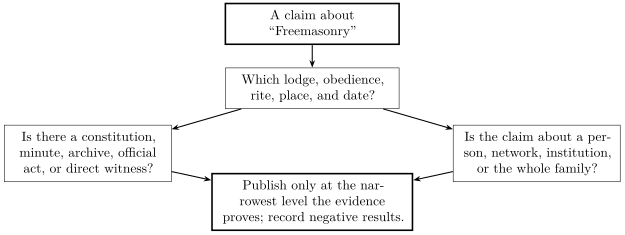
This procedure is not timidity. It is how a serious accusation becomes morally and historically credible.
Scope, Corpus, and Qualifications
Reader, genre, scope, and limitations
This is a discursive faith and theology article with substantial historical and Latin-canonical modules. Its primary profile is the repository’s article profile. Historical claims follow documentary and professional historiographical evidence. Theological claims distinguish Scripture, dogma, authoritative magisterial judgment, Thomistic analysis, and this article’s synthesis. The legal module applies the 1983 Code of Canon Law for the Latin Church, including Book VI as revised by Pascite gregem Dei and effective 8 December 2021, checked with later Roman acts through 13 July 2026. It is not a case-specific canonical opinion and does not apply the Latin Code automatically to Eastern Catholics.
The intended reader is a Catholic seeking an exact account, including a Catholic already enrolled in a lodge, a relative or descendant of a Mason, a pastor preparing catechesis, or a researcher trying to separate doctrine from folklore. The article does not disclose complete ritual scripts, reproduce restricted or copyrighted prayer books, adjudicate the legal status of a named lodge, diagnose possession, determine any person’s subjective guilt, or inventory every local association that has ever called itself Masonic. It does give a reproducibly bounded inventory of the papal and Roman-dicasterial corpus materially governing the Catholic question and a provenance audit of the principal exorcism and deliverance texts invoked in this controversy.
| Source class | What it can establish | How it is used |
|---|---|---|
| Masonic constitutions and official self-descriptions | A body’s rules, claims, vocabulary, recognition standards, and stated purposes; not an independent verdict on effects. | UGLE, Grand Orient de France, and selected Grand Lodge sources establish diversity and common structures. |
| Papal and Roman-dicasterial acts | The Church’s doctrine, discipline, pastoral judgment, and their historical development, calibrated by genre and date. | From In eminenti (1738) through the DDF response of 13 November 2023. |
| Codes and promulgating acts | The text, persons, territorial scope, effective dates, and juridical consequences of Latin canon law. | The 1917 and 1983 Codes are kept distinct; moral prohibition is not confused with a codal penalty. |
| Promulgated rites and prayer publications | The Church’s official exorcism discipline, or the narrower fact that a particular private edition was permitted for publication. | The Roman Ritual, CDF discipline, publication canons, and edition-specific prayer witnesses are ranked rather than conflated. |
| Professional history | Documentary origin, diffusion, networks, political context, and causal limits. | Stevenson, Jacob, Harland-Jacobs, Racine, Aguilar, Sommer, and primary archives test institutional legends and totalizing narratives. |
| Scripture, Fathers, and Aquinas | The revealed and theological grammar of faith, worship, oaths, conscience, grace, and moral action. | Used to explain rather than replace the Church’s authoritative judgment. |
| Editorial synthesis | Connections demonstrably supported by the sources but not attributed to one authority. | The structural comparison, causal distinctions, myth audit, and pastoral decision map. |
A complete corpus requires an inclusion rule
“All papal proclamations” could mean every papal sentence that ever mentions secret societies, liberalism, Carbonari, anti-clerical politics, or Freemasonry. That set has no stable boundary: documents quote predecessors, adjacent errors overlap, titles and genres differ, and incidental allusions can be multiplied indefinitely. This article therefore uses a reviewable rule. Its documentary appendix includes every located papal constitution, bull, encyclical, allocution, or letter whose principal object is Freemasonry or a named association treated by the act as materially continuous with the Masonic problem; every historical canon that directly governed Masonic enrollment; and every Roman-dicasterial act that authoritatively interprets the present prohibition. Adjacent papal texts are listed separately when they materially illuminate naturalism, indifferentism, secret societies, or the political context but are not represented as Masonry-only acts.
The result is a complete controlling and materially direct corpus under a stated rule, not a pretense to have found every incidental word in every language and local archive. Full official texts are linked. Their operative content, argument, scope, and development are expounded rather than reproduced wholesale. That choice respects both exactness and copyright while making every conclusion inspectable.
Five distinctions that govern every page
| Distinction | Do not collapse | Why it matters | Governing question |
|---|---|---|---|
| Body and person | An institutional principle or historical act is not every member’s conscious intention. | Leo XIII himself distinguishes generic judgment from awareness and participation of individuals (Humanum genus 11). | What belongs to the system, and what did this person know and choose? |
| Doctrine and penalty | Objective grave incompatibility is not identical to an automatic canonical censure. | The 1983 CDF declaration remains controlling although the current Code does not name Masonry in the manner of 1917 canon 2335. | What is forbidden, what is sinful, and what penalty is actually attached? |
| Network and cause | A Mason’s action, a lodge’s action, and “Freemasonry caused this event” are different propositions. | Political membership is often fluid and archival survival uneven. | Which organized mechanism connects the lodge to the effect? |
| Tolerance and equivalence | Civil immunity from coercion does not mean all religious claims are equally true or ritually interchangeable. | Catholic religious liberty and Masonic religious pluralization answer different questions. | Is the forum protecting persons, or redefining revealed truth? |
| Spiritual reality and ritual diagnosis | Objective service of an order opposed to Christ is not proof of conscious Satanism, possession, or hereditary affliction. | Revelation establishes spiritual conflict; extraordinary cases and reserved rites require ecclesiastical discernment. | What is doctrinally certain, what is alleged in this case, and who has authority to judge it? |
This publication is a source-audited working article. Its legal conclusions are educational and date-bounded. Independent historical, theological, and canonical review, and any ecclesiastical approval, remain outstanding.
References
Sacred Scripture and Catholic theological sources
-
Gen 3:1–15; Ex 20:7; Deut 6:13; Pss 115 and 127; Ezek 18:1–32; Matt 4:1–11, 5:33–37, 7:15–20, 22:34–40; Mark 1:21–28; Luke 10:17–20; John 1:1–18, 2:13–22, 8:12, 9:1–3, 14:6, 17:17–23; Acts 4:12; Rom 1:18–25, 6:1–14, 12:1–21; 1 Cor 8–10, especially 10:14–22; 2 Cor 6:14–18; Eph 2:11–22, 4:1–6, 6:10–18; Col 1:12–20; Heb 1:1–3, 2:14–18, 3:1–6, 11:10; Jas 5:12; 1 Pet 2:4–10, 5:8–9. Brief scriptural wording is a working rendering; no modern translation is reproduced at length.
-
Second Vatican Council, dogmatic constitution Dei Verbum (1965), nos. 2–6, on God’s self-Revelation and the obedience of faith, official English text; declaration Dignitatis humanae (1965), nos. 1–3, on civil immunity, the duty to seek truth, and the unchanged doctrine of the true religion, official English text.
-
First Vatican Council, dogmatic constitution Dei Filius (1870), chs. 2–3, on natural knowledge of God, supernatural Revelation, and faith; official Latin text.
-
Catechism of the Catholic Church, nos. 391–395 (Satan and fallen angels as creatures under Providence), 405 (original sin without personal fault in descendants), 813–822 (unity), 1237 and 1262–1274 (baptismal exorcism, forgiveness, and incorporation), 1673 (major exorcism and medical discernment), 1735 and 1857–1861 (imputability and mortal sin), 2104–2109 (religious truth and civil freedom), 2110–2117 (superstition and occult practice), 2150–2155 (oaths), 2477–2479 (rash judgment, detraction, and calumny).
-
St. Augustine, City of God XIV.28, on the two loves and cities; the encyclical’s use is governed by its own paragraph 11 and by Augustine’s eschatological account of intermingled societies.
-
St. Thomas Aquinas, Summa theologiae I, qq. 63–64 (the fall, limits, and action of demons); I–II, qq. 18–21 (object, end, circumstances, and moral specification), q. 87, a. 8 (personal guilt and effects reaching children); II–II, qq. 1–5 (faith), q. 23 (charity), q. 81 (religion), q. 89 (oaths), qq. 92–96 (superstition and illicit religious practices), q. 104 (obedience). Corpus Thomisticum; working English index.
Papal and Roman-dicasterial sources
-
Clement XII, In eminenti apostolatus specula (28 April 1738); Benedict XIV, Providas Romanorum Pontificum (18 May 1751); Pius VII, Ecclesiam a Jesu Christo (13 September 1821). All three are reproduced in Leo XII, Quo graviora (13 March 1825), official Holy See Italian witness. Pius VII’s Carbonari act is also available as a separate official text.
-
Pius VIII, Traditi humilitati (24 May 1829), official Italian text; Gregory XVI, Mirari vos (15 August 1832); Pius IX, Qui pluribus (9 November 1846) and Quanta cura (8 December 1864), used as broader context rather than Masonry-only acts.
-
Pius IX, Multiplices inter (25 September 1865), official Latin text; Apostolicae Sedis moderationi (12 October 1869), reserved excommunications no. IV, Acta Sanctae Sedis 5 (1869–70), 305–331, especially 311, official archive scan.
-
Leo XIII, Humanum genus (20 April 1884), especially nos. 4–6, 9–12, 16–20, and 30–38, official English text; Officio sanctissimo (22 December 1887), no. 12, official English text.
-
Leo XIII, Dall’alto dell’Apostolico Seggio (15 October 1890), official English text; Inimica vis (8 December 1892), official English text; Custodi di quella fede (8 December 1892), official English text.
-
CDF, declaration concerning Masonic associations (17 February 1981), AAS 73 (1981), 240–241, including the text of the 19 July 1974 restricted letter in the note, official AAS scan; official Spanish web text.
-
CDF, Declaration on Masonic Associations (26 November 1983), AAS 76 (1984), 300, official English text; CDF, Reflections on the Declaration concerning Masonic Associations (23 February 1985 / published in L’Osservatore Romano), official Spanish text.
-
CDF, Christian Faith and Demonology (26 June 1975), especially its treatment of Satan as a creature, human responsibility, liturgical reserve, and critical prudence, official English text.
-
Leo XIII, Exorcismus in Satanam et angelos apostaticos, with rescript Ex audientia Sanctissimi of 18 May 1890, Acta Sanctae Sedis 23 (1890–91), 743–746, official archive scan. The formula contains omnis congregatio et secta diabolica but no Masonic proper name.
-
CDF, letter to ordinaries recalling the norms governing exorcism (29 September 1985), official English text; CDF, instruction on prayers for healing (14 September 2000), arts. 5–10, official English text.
-
Holy See, presentation of the revised rite De Exorcismis et Supplicationibus Quibusdam (26 January 1999), official presentation; USCCB, “Exorcism”, official explanation of the current rite, appendices, authorization, discernment, and U.S. English edition.
-
Spanish Episcopal Conference, “Su misericordia se extiende de generación en generación”: Nota doctrinal sobre la práctica de la sanación intergeneracional (1 November 2024), approved by its Permanent Commission 26–27 September 2024, official text. Used as a particular episcopal application of universal baptismal and personal-culpability doctrine, not as a universal Roman act.
-
DDF, response to Bishop Julito Cortes concerning the best pastoral approach to Masonic membership (13 November 2023), approved by Francis ex Audientia, official English text. The DDF document index was checked for later universal acts through 13 July 2026.
Canon law
-
Benedict XV, 1917 Codex iuris canonici, canon 2335, official Vatican Polyglot Press edition, promulgated 27 May 1917 and effective 19 May 1918; bibliographic scan record. Used only as historical law.
-
1983 CIC cann. 1 and 6 (persons governed and abrogation), Holy See English; cann. 1311–1353 (penal principles, imputability, kinds and application of penalties), Book VI, part I; can. 1374, Book VI, part II; cann. 915–916, Eucharistic discipline; cann. 959 and 987–989, Penance; can. 1172, sacramentals and exorcism; cann. 824–830, publication and prayer-book approval.
-
Francis, apostolic constitution Pascite gregem Dei (23 May 2021), promulgating revised Book VI effective 8 December 2021, official English text.
Modern Masonry-specific prayer witnesses
-
Selwyn R. Stevens, Prayer of Release for Freemasons & Their Descendants, public PDF carrying copyright and revision dates 1994, 1996, 1999, 2004, 2007, 2015, and 2017, textual witness; National Library of New Zealand, bibliographic record for the 2017 expanded seventh edition. Used to establish the Protestant textual ancestor and its changing editions, not Catholic doctrine.
-
Chad A. Ripperger, Deliverance Prayers: For Use by the Laity, first bibliographic edition (CreateSpace, 10 December 2016), ISBN 978-1541056718, bibliographic record; Sensus Traditionis Press, current publisher page, reporting a Denver imprimatur. Approval is described at edition level.
-
Fr. Chad Ripperger, “Guide to the Deliverance Prayers for the Laity” (29 March 2021), interview transcript in which the compiler identifies a Protestant draft and explains his Catholic adaptation. His further efficacy, lineage, disease, and degree claims are recorded as pastoral testimony, not promoted to magisterial or independent historical evidence.
-
St. Michael Center for Spiritual Renewal, long “Prayer to Break the Freemasonic Curse”, short form, and “Ratification Prayer for Freemasonry and Other Curses”; ministry identity and leadership. Used to document current titles, wording families, audience labels, and anonymous attribution, not universal liturgical promulgation.
-
Archdiocese of Manila Office of Exorcism, ministry website; Roman Catholic Archdiocese of Manila, official ministry roster. The St. Michael short form points to this office; that link does not establish that the office authored every circulating version.
Masonic primary and institutional sources
-
United Grand Lodge of England, “What is Freemasonry?”, public account of building symbolism, lodges, charity, and three degrees; FAQ, public self-description; 1723 Constitutions project; history of the Book of Constitutions.
-
UGLE, Book of Constitutions (June 2026), including “Aims and Relationships of the Craft” and basic principles for Grand Lodge recognition, official PDF; UGLE, foreign Grand Lodges, on sovereign jurisdictions and recognition.
-
Grand Orient de France, “Nos valeurs”, on absolute freedom of conscience and laïcité; membership account, on belief, unbelief, Great Architect, and rites; Liberté de conscience: sécularisation ou laïcité?, official historical PDF, on the 1877 change.
-
Masons of California, FAQ, on lodges, sovereign Grand Lodges, and Masonic “temple” usage; Grand Lodge of Pennsylvania, “Masonic Centers, Halls, Temples, Shrines and Cathedrals”, an institutional explanation of building names. These sources establish self-description, not Catholic theological approval.
Professional histories and focused studies
-
David Stevenson, The Origins of Freemasonry: Scotland’s Century, 1590–1710 (Cambridge University Press, 1988), publisher record; Margaret C. Jacob, The Origins of Freemasonry: Facts and Fictions (University of Pennsylvania Press, 2006), publisher record; Andreas Önnerfors, Freemasonry: A Very Short Introduction (Oxford University Press, 2017), publisher record.
-
Margaret C. Jacob, Living the Enlightenment: Freemasonry and Politics in Eighteenth-Century Europe (Oxford University Press, 1991), bibliographic record; Jessica L. Harland-Jacobs, Builders of Empire: Freemasons and British Imperialism, 1717–1927 (University of North Carolina Press, 2007), publisher record.
-
Karen Racine, “Brothers in Arms: Freemasonry and Latin American Independence,” in The Cambridge Companion to Latin American Independence (2023), publisher record; Filomeno V. Aguilar Jr., “Masonic Myths and Revolutionary Feats in Negros Occidental,” Journal of Southeast Asian Studies, journal record.
-
Dorothe Sommer, Freemasonry in the Ottoman Empire: A History of the Fraternity and Its Influence in Syria and the Levant (I.B. Tauris/Bloomsbury, 2015), publisher record.
-
Library of Congress, Prince Hall Freemasonry resource guide; William Preston Vaughn, The Anti-Masonic Party in the United States, 1826–1843 (University Press of Kentucky), institutional record.
-
Italian Chamber of Deputies, Parliamentary Commission on the P2 lodge archive, including the Anselmi majority report approved 10 July 1984 and supporting volumes. Used as a documented particular case, not as a model of every lodge.
-
United States Holocaust Memorial Museum, “Freemasonry under the Nazi Regime” and “Freemasonry”, on suppression and Jewish-Masonic conspiracy propaganda.
-
Ruben van Luijk, “Unmasking the Synagogue of Satan,” in Children of Lucifer: The Origins of Modern Religious Satanism (Oxford University Press, 2016), publisher record, on the Taxil fabrication and its reception; Bibliothèque nationale de France, historical note on nineteenth-century symbol and anti-Masonic myth.
Last revised (UTC): 2026-09-24T16:45:12Z
Reuse and rights. To the extent Triptych holds the rights, project-created content and design are licensed under CC BY 4.0. Scripture, liturgical or official texts, received prayers or hymns, quotations, fonts, and other third-party material retain their own status; public-domain material remains public domain. Identify changes. Attribution implies neither Triptych nor ecclesiastical approval. See LICENSE and THIRD_PARTY.md in the source.