Claude · Full Text
Contents
The Ark of the Covenant: From Sinai to the Woman Clothed with the Sun
A source-audited study of the ark of the covenant: its canonical journey from Sinai to its disappearance, the theology of presence and holiness it teaches, and the Church's reading of the Virgin Mary as the ark of the new covenant, with every parallel graded by attestation and reception
Overture: The Question of the Ark
The ark of the covenant is the most famous lost object in the world, and the modern instinct, on hearing its name, is to ask where it is. The instinct is not foolish. The ark was a real chest of real wood, carried by real poles on real shoulders through a landscape whose towns can still be walked. So concrete a thing invites a concrete question, and the guesses have been concrete accordingly: a cave on Mount Nebo, a chamber under the temple pavement, a chapel in Aksum. This study reports those answers, with their dates and their witnesses, and hides none of them.
But the Bible, which watches the ark more closely than any other source, declines to end the story that way. The historical books let the ark vanish without an obituary. At some point no writer marks, it is simply no longer there, and the traditions that later arose to fill the silence disagree with one another. The New Testament names the ark of the covenant only twice: once in the Epistle to the Hebrews, to describe its furniture and decline to expound it; and once in the canon’s final book, to show it—not found, but seen, in the opened temple in heaven, one verse before the great sign of the woman clothed with the sun.1
The canon’s answer to “where did the ark go?” is an answer of a different kind, because the question was of a different kind than it looked. When a king moves his court, the antiquarian hunts for the old throne; the courtier follows the king. The ark was never important as furniture. It was important as the appointed meeting place of God and Israel, and to trace it honestly is to trace not a relic but a Presence.
The ark’s story is complete only when it is read forward. The chest built at Sinai carries the Presence of God through Israel’s history, vanishes without an obituary, and is seen again in heaven at Apocalypse 11:19, immediately before the sign of the woman clothed with the sun. The Church—in her philology, her Fathers, her liturgy, and her magisterium—reads the Virgin Mary as the ark of the new covenant. This study tells the whole journey, presents that reading at its evidence’s true weight, preserves its disputes, and keeps its devotional application under the primacy of Christ.
Two warnings, and the road can begin. The first concerns fact. Questions of fact—who wrote a homily, what a verse says, where a word occurs—are settled in these pages by evidence and by nothing else: a pseudonymous sermon is called pseudonymous even when its sentence is beautiful, and a wrong reference is corrected even when it is venerable. The second concerns interpretation. The critical minimalism that reads every unfulfilled expectation as an error is a school with premises, not a referee; and the Church reading her own Scripture in her own worship is not a bystander to the question of what that Scripture means. So two things will be measured throughout, and measured separately: how anciently a reading is attested, and how the Church has received it. A reading may be old and never received, or received and articulated late—and late articulation is what development looks like, not what error looks like. That is the whole method. It will do its work from here on without being talked about.
The journey is long, and it starts where every covenant thing starts, on the mountain where God told a freed people, in cubits and gold, exactly how He wished to be met. Begin at Sinai.
Sinai: The Ark Commanded
The ark of the covenant enters Scripture as a working drawing. Israel is encamped at the foot of Sinai. The mountain has been smoke and trumpet and a voice so terrible that the people begged not to hear it again. Yet when Moses goes up into the cloud to receive the pattern of God’s dwelling, the first thing dictated to him is a piece of joinery. “Frame an ark of setim wood,” he is told, “the length whereof shall be of two cubits and a half.”2 Setim is the acacia of the desert. The thing specified is a wooden chest with a lid, overlaid with gold, small enough to be carried on two poles. The reader who came for thunder may fairly feel the anticlimax, and had better feel it honestly. Nothing in the specification is beyond a competent carpenter, and the text does not pretend otherwise. But the order of the blueprint is itself the first lesson. A palace is designed outward from its throne room, and the tabernacle is designed outward from this box. The ark stands at the head of the pattern; everything else in the sanctuary, as readers have long observed, is arranged around it.
The specification continues. Rings of gold, and staves to run through them: “And they shall be always in the rings, neither shall they at any time be drawn out of them” (25:15) — built, from the first day, to move. Above the chest, “Thou shalt make also a propitiatory of the purest gold” (25:17), and two cherubims of gold “on the two sides of the oracle… covering the oracle… their faces being turned towards the propitiatory wherewith the ark is to be covered” (25:18, 20). Within it, “the testimony which I will give thee” (25:16) — the tables of the law. Then the sentence for which the whole chapter exists: “Thence will I give orders, and will speak to thee over the propitiatory, and from the midst of the two cherubims, which shall be upon the ark of the testimony” (25:22). Modern versions have God promise to meet Israel there. The Douay’s blunter idiom keeps the function on the surface: orders will be given, speech will happen, and the box is the appointed place of it. The ark is not a reliquary, not an idol, not an instrument to be worked. It is furniture built for a voice.
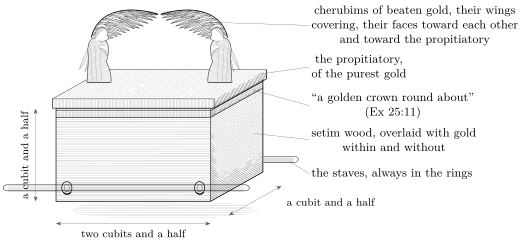
Drawing 1. The ark as commanded. The measures are Scripture’s (Exodus 25:10–22, Douay wording in the labels); the forms are not — Scripture nowhere describes the cherubims’ shape, and this reconstruction is editorial conjecture, drawn to fix the parts and their names, not the look.
The words of the thing
This study keeps one English Bible beneath it, the Douay-Rheims of Challoner, and the Douay’s words for the ark’s parts are not the words most readers know. Three of them need fixing now, once, so that every later section can use them without apology.
Propitiatory. Where modern versions print “mercy seat,” the Douay prints propitiatory: the lid of “the purest gold” laid upon the ark. The Hebrew is kapporet, from a root that means at once to cover and to atone. The Greek translators rendered it hilastērion — at its first occurrence with a doubled expression, hilastērion epithema, “a propitiatory, a cover” — and Jerome’s Latin is propitiatorium, whence the Douay’s word.3 The word has a long future; for the present it is the golden lid, nothing more.
Oracle. The Douay uses this one word for two different things, and the reader must watch it. In Exodus and Leviticus “the oracle” is the zone of the propitiatory itself: the cherubims stand “on the two sides of the oracle”; God will appear “in a cloud over the oracle” (Leviticus 16:2). In the books of Kings the same word names the temple’s whole inner chamber, the debir, the windowless room where the ark will one day rest — the Vulgate’s oraculum, the place of speaking.4 Both senses are named from the same fact, the promise of Exodus 25:22: God speaks there. The context will always show which is meant.
Covenant, testament, testimony. In Exodus the chest is “the ark of the testimony,” the testimony being the tables. Elsewhere its running name is “the ark of the covenant of the Lord”; but the Douay also prints, in three places, “the ark of the testament”: “But the ark of the testament of the Lord and Moses departed not from the camp” (Numbers 14:44); the “ark of the testament” of Hebrews 9:4; and — the last time the ark is named in the Bible — “the ark of his testament” seen in the opened temple of heaven (Apocalypse 11:19).5 That last name is worth remembering: the Bible’s final sight of the ark stands under it. Covenant and testament translate one and the same phrase. These pages say “ark of the covenant” throughout; the reader should hear the other two as the same name.
The nouns themselves are plain ones. The Hebrew aron is an ordinary word for a chest; the Greek Bible’s kibōtos is the very noun it uses for Noah’s vessel — “until the day that Noe entered into the ark” (Luke 17:27).6 What hallows the box is not its noun but its construct: of the covenant, of the testimony, of God. Finally, the Douay’s book names are used throughout. The books modern Bibles call 1–2 Samuel and 1–2 Kings are here four books of Kings, so that the temple chapters stand in 3 Kings; Paralipomenon is Chronicles; and the psalms carry Vulgate numbers.
Two makers, two arks?
Exodus assigns the making. God names Bezalel the son of Uri, of the tribe of Juda, fills him with the spirit of God for the work, and sets the ark first in his commission. In the execution account the blueprint is repeated nearly word for word — epoiēse Beseleēl tēn kibōton, “Beseleel made the ark,” as the Greek Bible puts it. He is the only named craftsman of the ark in the Hebrew text.7
Deuteronomy remembers differently. There Moses himself recounts: “thou shalt make an ark of wood”; “And I made an ark of setim wood”; and, of the tables, “…put the tables into the ark, that I had made, and they are there till this present, as the Lord commanded me” (Deuteronomy 10:1, 3, 5).8 In Deuteronomy the maker is Moses, and the making comes before he ascends again with the blank tables. The account knows no propitiatory, no cherubims, no gold — a box for the tables and nothing else.
Two kinds of explanation hold the field. Harmonists, ancient and modern, have posited a provisional chest later replaced by Bezalel’s finished work, a solution transmitted in rabbinic tradition. Critical scholarship instead assigns the plain chest and the golden ark to different literary strata with different theologies of the divine presence; von Rad influentially read Deuteronomy as deliberately demoting the throne of God to a container for documents.9 Both accounts are canonical, neither is embarrassed, and no verse resolves them; the tension can simply stand.
What lay within, and what lay before
The Pentateuch keeps its prepositions exact, and it pays to notice them now. In the ark goes the testimony: “And thou shalt put in the ark the testimony which I will give thee” (Exodus 25:16). But the omer of manna that Aaron lays up as a memorial is placed before the testimony (Exodus 16:33–34), and Aaron’s rod that blossomed is laid up, in the same phrase, before the testimony, as a token against the rebellious (Numbers 17:10).10 Before, not in.
The precision will matter. The Epistle to the Hebrews will one day list within the ark “a golden pot that had manna, and the rod of Aaron, that had blossomed, and the tables of the testament” (Hebrews 9:4), where the books of Kings, at the ark’s installation in the temple, will find nothing in it but the tables. The knot is real, and no verse unties it. It will be waiting for us at the temple door.
One more distinction of the same kind. The book of the law that Moses writes at the end of his life is placed at the ark’s side, as a witness against Israel — the tables in the ark, the book beside it.11 A people who kept even their furniture’s prepositions straight were not casual about this chest.
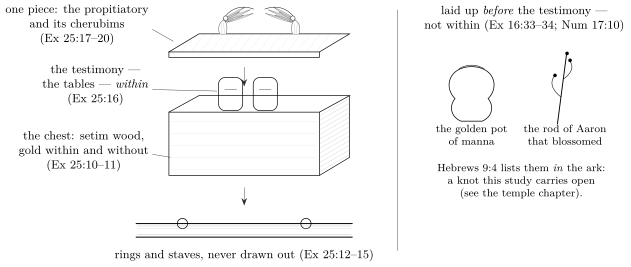
Drawing 2. The ark taken apart, and its neighbors. Chest, lid, and carriage are the three commanded makings; the tables go within. The jar and the rod stand drawn apart on purpose: the Pentateuch lays them up before the testimony, and the drawing keeps the preposition.
The law of approach
When the tabernacle is at last reared, Moses puts the testimony into the ark, sets the propitiatory above it, carries it within, and hangs the veil. The sign that the work is accepted follows at once. “The cloud covered the tabernacle of the testimony, and the glory of the Lord filled it. Neither could Moses go into the tabernacle of the covenant, the cloud covering all things and the majesty of the Lord shining, for the cloud had covered all” (Exodus 40:32–33).12 Even Moses cannot enter while the glory is there. Yet the promise of Sinai is kept: when he does go in to speak with the Lord, the voice comes to him from above the propitiatory, from between the two cherubims (Numbers 7:89).13
Around this presence Israel’s law builds a whole grammar of handling. The staves stay “always in the rings”: the ark is never to be gripped directly, and never unready to move. On the march it is carried by the sons of Caath — but only after Aaron and his sons have gone in and wrapped it, veil and covering and cloth: “then shall the sons of Caath enter in to carry the things wrapped up: and they shall not touch the vessels of the sanctuary, lest they die” (Numbers 4:15); and again, “Let not others by any curiosity see the things that are in the sanctuary before they be wrapped up, otherwise they shall die” (4:20).14 “By any curiosity” is the Douay’s phrase, worth remembering; it will return at Bethsames. And the porterage is not menial work but a consecration: “At that time he separated the tribe of Levi, to carry the ark of the covenant of the Lord, and to stand before him in the ministry, and to bless in his name until this present day” (Deuteronomy 10:8).
Then there is the approach of the one man on the one day. Leviticus 16 warns Aaron “that he enter not at all into the sanctuary, which is within the veil before the propitiatory, with which the ark is covered, lest he die,” for God says, “I will appear in a cloud over the oracle.” Once in the year the high priest comes within, and comes furnished: with incense, so that its cloud “may cover the oracle, which is over the testimony” (16:13), and with the blood of the bullock and of the goat, sprinkled “towards the propitiatory to the east” (16:14–15).15 Blood and cloud, one man, one day: the propitiatory is the one place on earth where atonement and presence are appointed to meet. Everything this history will have to teach hangs from that chapter. The Presence is not forbidden to Israel; it is appointed — a way in, a time, a wrapping, a tribe, a day. Holiness here is not a wall but a manner of approach, and the narrative to come will show, more than once, what its breach costs.
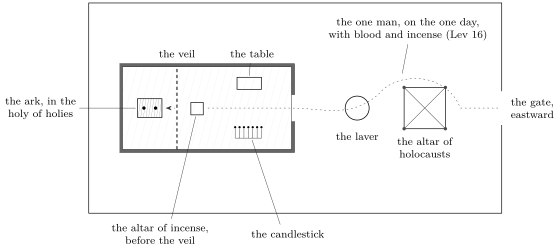
Drawing 3. Plan of the tabernacle in its court, the way in running from the east. Proportions are schematic, after Exodus 26–27 and 40. Everything in the arrangement points one direction: past altar and laver, through the holy place, to the veil — and once a year through it, to the ark.
Throne, footstool, container
What was it, then, this gilded chest with its golden lid and its attendant cherubims? The learned literature has returned three answers. Some read the ark as a throne: the older German scholarship’s “empty throne,” the seat of the invisibly enthroned Lord. Others, with de Vaux — the Dominican whose Ancient Israel long served Catholic readers as the standard account — read it as a footstool: the cherubims’ wings form the throne, and the chest lies beneath the feet of the enthroned God. And Deuteronomy itself calls it a container, “an ark of wood” made to hold the tables and nothing else. Seow’s survey observes that the ancient Near East knew a custom joining the last two readings: treaty documents were laid up at the feet of the god, so that a box for covenant tablets and a footstool for the covenant Lord are not two objects but one. The newest full-length study, Eichler’s, rejects throne and footstool alike. It argues that ark and cherubim formed a deliberately empty focus, an aniconic guard against picturing God at all.16
The canon will not settle this dispute, because the canon pulls all three ways. Deuteronomy’s box holds the tables. David couples “the ark of the Lord, and the footstool of our God” (1 Paralipomenon 28:2). The one psalm that names the ark bids Israel “adore in the place where his feet stood” (Psalm 131:7 = Hebrew 132:7). And the histories name God as sitting upon the cherubims precisely when they name the ark.17 The scholarly quarrel is really over which function is original and which is reinterpretation, and that question each scholar decides by his prior dating of the sources, not by any datum about the object itself. Every school concedes three things: no physical trace of the ark exists or is expected; a portable shrine of the Lord stands in the earliest strata anyone accepts; and the ark was gone before the Second Temple stood.
Was the chest that Solomon’s priests carried into the oracle the chest that Bezalel made? The object has been gone these five-and-twenty centuries, so every party argues from the same documents. Scholars who date the narratives late conclude that the object is late too — an inference exactly as strong as its premise, that nothing in Israel’s memory outran her archives; development of doctrine about a thing is not evidence against the thing. The comparatists answer that a gilded, pole-borne chest is at home among the barque shrines of the Late Bronze age, in the very centuries the Bible claims for it, and in no later ones.18
The Church, for her part, has never defined the carpentry. She receives the ark as Scripture presents it, a real thing really commanded, and reads its whole career — made, carried, lost — as ordered to the One it prefigured. So will we, on the received history, which no discovered fact contradicts.
The ark sets out
In the second year the camp breaks up from the mountain. The cloud is “over them by day,” and the ark does not travel in the baggage: it goes first, and Israel’s oldest war-song goes with it.19
Witness — Numbers 10:33, 35–36, Douay-Rheims
…the ark of the covenant of the Lord went before them, for three days providing a place for the camp.
And when the ark was lifted up, Moses said: Arise, O Lord, and let thy enemies be scattered, and let them that hate thee, flee from before thy face.
And when it was set down, he said: Return, O Lord, to the multitude of the host of Israel.
Three days ahead of the people, seeking out their resting place: the rest of this history is that verse enacted. The ark is on the road, and the next thing in its path is a river.
Into the land: Jordan, Jericho, Ebal, Silo
The chapters that carry the ark into the land are the ones in which it looks most like the thing the rest of its story will deny it is. A river halts because a box is carried into it. A walled city falls because a box is carried round it. A reader who concludes that Israel possessed a weapon has concluded nothing worse than what Israel’s own elders will one day conclude, with results this story will not spare him. The misreading is not a modern impiety; it is the oldest mistake in the story. The book of Josue (the Douay’s name for Joshua) never rebukes the impression directly. It does something quieter. It hedges its wonders about with distance, title, and order, so that the careful reader comes away having watched not a weapon at work but a King arriving.
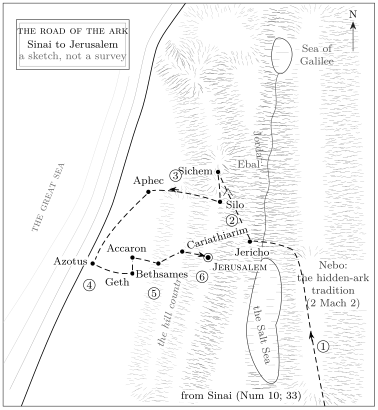
Drawing 4. The road of the ark: (1) up from Sinai east of the Salt Sea to the plains of Moab, in by Jordan and Jericho (Num 33; Josue 3–6); (2) to Sichem under Ebal, then the long residence at Silo — the tent marks it; (3) out to battle and taken at Aphec (1 Kings 4); (4) seven months among the Philistine cities, then home by Bethsames (1 Kings 5–6); (5) the parked decades at Cariathiarim (1 Kings 7); (6) David’s two processions to Jerusalem (2 Kings 6). Sites stand at their traditional identifications under the Douay’s names, projected true to position but not to scale; where an identification or an event’s archaeology is disputed, the text says so at the place. Nebo carries a tradition, not a finding.
The river and the stones
Israel crosses at the worst possible moment, in the season of harvest when the Jordan runs over his banks — the narrator troubles to say so. The people are commanded to follow the ark at an interval of some two thousand cubits, something over half a mile, because they had never passed that way before.20 The distance is already doing theology. A crowd keeps that kind of interval not around what is useful but before what is sovereign: it is the space cleared for a king, not the radius marked round a hazard. Then comes the title. “Behold the ark of the covenant of the Lord of all the earth shall go before you into the Jordan.”21 Nowhere else in the ark’s whole story is it given this name, and it receives it twice, both times at the river (3:11, 13). The God who is about to give one small people one small land is announced at its border as owner of every land. The conquest opens with a claim that relativizes it. The crossing itself is told as liturgy rather than stratagem: the priests bear the ark down into the flood, the waters stand and are heaped upstream, “swelling up like a mountain,” while the bearers “stood girded upon the dry ground in the midst of the Jordan” and the nation passed over.22
What Israel is given to keep from the marvel is not a relic but a catechism. Twelve stones are taken from the riverbed where the priests’ feet had stood and set up at Gilgal. Josue sets up twelve more in the midst of the Jordan itself, and the narrator adds that they were there still in his own day. The stones exist to provoke a question from children and to oblige an answer from fathers: when your sons ask what these stones mean, you shall tell them what the Lord did at this river. When the priests come up out of the channel, the waters return to their place.23 The first thing the ark does in the land, after the wonder, is to leave behind a discipline of memory. The wonder serves the telling, not the telling the wonder.
The wall and the mountain of the curse
At Jericho the text is exact about the order of march, and the order is the argument. Armed men go first; then seven priests with seven trumpets — trumpets the Douay names by their festal office, those “used in the jubilee”; then the ark; and “the rest of the common people followed the ark.” So arranged, “the ark of the Lord went about the city once a day” for six days, and seven times on the seventh. The narrative gives the wall’s fall no mechanism beyond the circuits, the trumpets, and the shout.24 The army is present, but as escort. The procession is shaped from its center outward, and the center is the ark. Jericho is not besieged. It is circled, as if in pilgrimage, until it is not there. The walls fell to a liturgy.
The mound itself is not in doubt: Jericho is Tell es-Sultan, fixed by its name, its spring, and a century of excavation. The archaeology of the fall is disputed — the fortified Bronze Age city was found destroyed well before any plausible date for Josue — and the dispute must simply be reported.25 And when Israel is beaten at Ai, the ark shows its other face: Josue rends his garments and lies on his face before the ark of the Lord until evening.26 The object at whose passage walls fell is also the place where defeat is carried and asked about. In both fortunes, the ark is where Israel goes to be before God.
Then, with the conquest scarcely begun, the campaign stops for a covenant. At Shechem, between the two mountains, all Israel stands in two halves — the stranger as well as the homeborn. One half faces Gerizim for the blessing, the other faces Ebal for the curse. Between them, facing both, the Levitical priests carry the ark, and the words of the law, blessing and curse together, are read over the whole assembly: the liturgy Moses had commanded in Deuteronomy 27, performed around the box that holds the tables.27 The scene is the plainest exposition of the ark in the whole conquest. Jericho showed what the ark’s presence can do; Ebal shows what the ark is for. The nation arranged around it is not an army but a congregation, and what issues from the center is not power but the reading of the law. Covenant, not conquest, is the content of the box.
Silo
When the land is divided, the tent of meeting is pitched at Silo — Shiloh, in the familiar spelling — in the hill country of Ephraim (Josue 18:1). There the ark stops for the longest residence of its story, from the days of Josue to the childhood of Samuel. Through the whole age of the Judges it is glimpsed exactly once: at Bethel, during the civil war against Benjamin, with Phinees the son of Eleazar ministering before it. That chronological notice is commonly read as setting the book’s grim epilogue early in the period.28 Otherwise, silence; and here silence means residence. By the time the story resumes, Silo is a settled sanctuary: a yearly feast, a hereditary priesthood, pilgrim families going up to sacrifice, a lamp burning through the night — and a narrative that has quietly begun to call the tent a temple.
Witness — 1 Kings 3:3 (= 1 Samuel 3:3), Douay-Rheims
Before the lamp of God went out, Samuel slept in the temple of the Lord, where the ark of God was.
The verse earns its frame by what happens next in the chapter: in that room, in the dark, the Lord calls a child by name, and the child learns to answer. This is the promise of Exodus 25:22 being kept. The God who said he would speak from above the propitiatory does speak, in the house where the ark is, to a boy lying near it.29 After a river stopped and a wall thrown down, the ark’s deepest work in the land is the quietest: it marks the place where God speaks. That is what it was built for, and at Silo, for once, it is allowed simply to do it.
What became of Silo the Scripture never narrates. It remembers it, twice, from a distance of centuries. The psalmist, recounting Israel’s rebellions, says that God “put away the tabernacle of Silo”30 — a verse that must be heard in full when the time comes to weigh what departed from Israel with the ark. And Jeremias, preaching against a temple grown complacent: “Go ye to my place in Silo, where my name dwelt from the beginning: and see what I did to it for the wickedness of my people Israel.”31 And here, for once in this story, the dirt has something to lay beside the text. Shiloh is Khirbet Seilun, an identification as secure as any in the archaeology of Israel. The excavated early Iron Age settlement there ends in a heavy burn layer: ash, collapsed brick, scorched store-jars, and a great deposit of burned animal bones that bespeaks a place of sacrifice. The layer is conventionally dated near the middle of the eleventh century before Christ — the right horizon for the catastrophe the next section will reach.32 The convergence should be stated exactly, because it is one of the few places in this whole history where text and stratum genuinely meet. No inscription names the destroyer. The attribution to the Philistines is an inference from the narrative, not a find, and the date is conventional. What may honestly be said is this: the one sanctuary Scripture remembers as destroyed is the one whose soil shows a destruction, at about the remembered time. The two witnesses do not prove each other. They face each other, and neither blinks.
But burn layer and psalm alike lie far downstream of the point the story has reached. In narrative time Silo is at peace, and the peace is real: the lamp burns, the feast comes round each year, a family climbs the hill country with its offering, a child sleeps beside the ark and is learning to answer when he is called. Only, the same chapters that show us the sleeping child show us the waking priests: the sons of Heli, who treat the Lord’s sacrifice as their own larder, and against whose father’s house a man of God has already pronounced sentence (1 Kings 2).33 The reader is not asked to guess; the text has told him. The ark has rested at Silo through the longest age of its history. The next time it goes out, Ophni and Phinees will go with it; and it will not come back.
The catastrophe: from Aphec to Cariathiarim
Begin by giving the elders of Israel their due. Their army has just been beaten at Aphec, and they ask the right question: why has the Lord struck us today before the Philistines? (1 Kings 4:3; in the Douay-Rheims numbering this study uses, 1 Kings 4 = 1 Samuel 4). Their answer is not vulgar superstition; it is memory. Let the ark be fetched from Silo, they reason, that it may save us out of the hand of our enemies. And the memory is accurate. The ark went first into the Jordan, and the river stood; it circled Jericho, and the wall came down. If the throne of the Lord goes before the army, how can the army fall? The reader who has come this far could sign that argument himself. It is exactly wrong. No prophet steps forward to say so; the event itself will explain why. The precedents the elders remember were never demonstrations of a lever that works when pulled. They were acts of a free Lord. At Hormah, on another day, that same Lord stayed in the camp while a presumptuous Israel marched without him and was cut to pieces (Numbers 14:44). The elders have remembered the wonders and forgotten the freedom. What they fetch from Silo, they think, is a weapon. What arrives is a judge.
Aphec: the glory departs
So the people send to Silo, and there comes into the camp “the ark of the covenant of the Lord of hosts sitting upon the cherubims: and the two sons of Heli, Ophni and Phinees, were with the ark of the covenant of God”34 (1 Kings 4:4). Pause on the English. The participle attaches oddly, so that on the surface it is the ark that sits upon the cherubims. The phrase in fact renders the great divine title — the Lord enthroned upon the cherubim, the title that binds the throne to the box — and so it must be read. The verse’s second clause is as ominous as its first is majestic. Ophni and Phinees are the two priests the reader left at Silo: the sons of Heli whose contempt for the offerings of the Lord has already been narrated and sentenced (1 Kings 2). The ark comes up to Aphec carried, so to speak, by its own indictment.
The camp of Israel shouts until the earth rings. The Philistines, learning what has arrived, are afraid, remembering what these gods did to Egypt (4:5–8). Israel remembers Jordan, Philistia the plagues: both armies hold the elders’ theology. Then the battle: “And the ark of God was taken: and the two sons of Heli, Ophni and Phinees, were slain”35 (4:11). A man of Benjamin runs all day to Silo with his clothes rent. Heli, ninety-eight years old, sits waiting by the gate, and the messenger’s report climbs from bad to worse: Israel fled; a great slaughter; your two sons dead; and the ark of God is taken. It is at the ark, not at his sons, that the old priest falls backward and dies (4:17–18). The narrator has graded the losses, and a father’s grief comes second.
The last word of the chapter belongs to a dying woman. The wife of Phinees, hearing that the ark is taken and her husband dead, is brought to labor before her time, and with her last strength she names the child:
Witness — 1 Kings 4:21–22, Douay-Rheims
And she called the child Ichabod, saying: The glory is gone from Israel, because the ark of God was taken… The glory is departed from Israel, because the ark of God was taken.
The name is a theology compressed to three syllables.36 It carries the Hebrew word kabod, glory — the glory of the visible Presence. And the text itself, twice over, makes the equation on which everything that follows will turn: the ark taken is the glory departed. Israel’s own Scripture never treats the loss at Aphec as the loss of a treasured object. It treats it as an eclipse. And the equation is no later devotion: it is the narrative’s own first-generation verdict, put in the mouth of a woman with nothing left to lose. The glory is departed. That is what the box meant.
Dagon on his face
“Now the ark of God was in the land of the Philistines seven months”37 (1 Kings 6:1). Those seven months are among the strangest campaigns in the Old Testament, because Israel takes no part in them. The Philistines do what any ancient victor did with a captured god: they carry the trophy into the house of their own god, to declare whose deity won. The trophy declines the role. In the morning at Azotus — Douay’s name for Ashdod — “behold Dagon lay upon his face on the ground before the ark of the Lord” (5:3). They set him up again, and the second morning “the head of Dagon, and both the palms of his hands were cut off upon the threshold”38 (5:4). The idol lies prostrate like a courtier, then dismembered like a defeated king — head and hands, before the thing he was supposed to have conquered.
Then the plagues. The Douay prints at 5:6 a double affliction: the Lord “afflicted Azotus… with emerods. And in the villages and fields… there came forth a multitude of mice, and there was the confusion of a great mortality in the city”39 (5:6). The mice are a genuine version divergence — Vulgate and Septuagint against a Hebrew that keeps only the emerods — but either way the shape of the episode is the same. The ark is passed like a hot coal from Azotus to Gath to Ekron, plague breaking out at each remove (5:8–12), until the lords of the Philistines are begged by their own people to send it home. No Israelite raid, no ransom, no negotiation: the ark’s captivity is conducted, from first to last, as the Lord’s solo campaign.
Even the sending home is made into evidence. The priests and diviners of Philistia prescribe a guilt offering — golden emerods and golden mice, images of the plagues, five for the five lords (6:3–5). Then they design what can only be called an experiment: a new cart, two milch kine that have never borne the yoke, their calves shut up at home; “if it go up by the way of his own coasts towards Bethsames… but if not, we shall know that it is not his hand hath touched us, but it hath happened by chance”40 (6:7–9). Untrained cattle, against every instinct, leaving their calves, taking the straight road up to Israelite territory. The diviners have honestly left the door open for coincidence, and the narrative lets pagan divination be good science. The kine go straight up the highway to Bethsames, lowing as they go, turning neither right nor left (6:12). The test convicts.
Bethsames: the number as printed
At Bethsames it is wheat harvest, and the reapers lift up their eyes and rejoice; the cart is broken up for altar wood and the kine offered upon it (6:13–14). The ark is home. Then, with no warning the narrative cares to give, the day of joy becomes the section’s hardest verse — hardest in what it reports, and hardest in how its text has come down. The number must be quoted before it can be discussed:
Witness — 1 Kings 6:19, Douay-Rheims
But he slew of the men of Bethsames, because they had seen the ark of the Lord: and he slew of the people seventy men, and fifty thousand of the common people. And the people lamented, because the Lord had smitten the people with a great slaughter.
Fifty thousand and seventy dead in a harvest village.41 The number has troubled readers for as long as the text has had readers. The Hebrew is itself the first problem: the Masoretic text reads, word for word, “of the people seventy men, fifty thousand men” — two numbers set side by side with no connective, a syntax anomalous in Hebrew counting and wildly out of scale for the place. The Douay’s “seventy men, and fifty thousand of the common people” follows the Vulgate’s attempt to construe that anomaly. The Septuagint keeps both figures and adds an offense of its own: the sons of Jechonias, it says, did not rejoice when they saw the ark — as though refusal of joy were the crime.42 Josephus, retelling the scene in the first century, gives seventy only, and his translator Whiston confessed he could not account for the fifty thousand of the other copies.43 Modern critical Bibles largely follow that instinct: the Revised Standard Version prints “seventy men” and flags it, with its own honest siglum, as a correction of the Hebrew. And one negative must be printed, because the contrary claim circulates. The great Samuel scroll from Qumran, 4QSam-a, preserves verses on either side of 6:19 but not the verse itself, and no other scroll has it. No Dead Sea manuscript reads “seventy”; none reads anything there at all.44 The case for seventy rests on Josephus, on the shape of the Hebrew anomaly, and on plausibility. That is a strong case; but it is a reconstruction, and a text quoted as printed must not be emended under the reader’s feet.
The Douay tradition has its own reading of the verse, and it deserves to be heard as reception rather than dismissed as apologetics. Challoner’s note on 6:19 glosses “seen”: “And curiously looked into. It is likely this plague reached to all the neighbouring country, as well as the city of Bethsames.”45 The second sentence stretches the geography to carry the number. The first is the interesting one, because it is not invented for the occasion. It wires Bethsames back to the transport law of the wilderness and its ban on seeing the holy things unwrapped: “Let not others by any curiosity see the things that are in the sanctuary before they be wrapped up, otherwise they shall die”46 (Numbers 4:20). On the Douay’s own terms the men of Bethsames died of the statute the porters of the ark had lived under since Sinai: not for malice, but for treating the holy as a curiosity. Whether that is what the Hebrew’s bare “because they had seen” means, the philology cannot settle. What the deaths mean — what kind of thing holiness is, that joy and irreverence can stand this close together — is a question that must wait until the whole journey is told; it will not be rushed. The men of Bethsames themselves ask it first, in almost those words: who shall be able to stand before this holy Lord? (6:20). Their answer is the practical one. They send messengers up the hill country, to ask someone else to take the ark.
Cariathiarim: the long parking
The men of Cariathiarim — Kiriath-jearim, the wooded height above the Jerusalem road — come down and take it to “the house of Abinadab in Gabaa: and they sanctified Eleazar his son, to keep the ark of the Lord”47 (1 Kings 7:1). Then the narrator closes the whole catastrophe with a sentence of studied quiet: “from the day the ark of the Lord abode in Cariathiarim days were multiplied, (for it was now the twentieth year,) and all the house of Israel rested following the Lord”48 (7:2). Two honest difficulties sit in that sentence. The first is arithmetic: the twenty years cannot span the interval the story requires. The ark stays in Abinadab’s house through Samuel’s judgeship and the whole reign of Saul, until David’s men come for it — decades on any chronology. The old solutions are two, and both are still on the table. Either the twenty years counts only from the ark’s arrival to the national repentance narrated immediately after it (7:3–14), or the verse is the seam where an older ark story was closed and the Saul narratives joined on, the arithmetic never reconciled. Report, not resolution.
The second difficulty is mood, and it divides the witnesses. The Douay’s Israel “rested following the Lord,” while the Hebrew as the moderns read it has Israel lamenting after him — a nation either at peace under the parked Presence or homesick for it. Both moods can stand; the note says which witness carries which.
One frame from the scholarship earns its two sentences here. Miller and Roberts read these chapters against the ancient Near Eastern literature of captured gods, in which carrying off a god’s image was never conceded to be the god’s defeat. The Aphec-to-Bethsames narrative, they argue, is Israel’s masterwork in that genre: the ark taken, and its God thereupon needing no rescue, wrecking Dagon, scourging five cities, and coming home unescorted and undefeated.49 On that reading the seven months in Philistia are not the interruption of the story but its thesis. Israel lost a battle; the Lord lost nothing.
So the catastrophe ends not with a restoration but with a parking. The ark does not go back to Silo; the reader will learn in time that there is no Silo to go back to. Nor does it come to rest in any sanctuary. The old tabernacle drifts separately through the story from now on, surfacing at Nob and later at Gibeon, a tent without its throne (1 Kings 21; 3 Kings 3:4; 2 Paralipomenon 1:3). The ark simply waits, in a hill-town house, one consecrated man keeping it, while the narrative turns its face away: to Samuel’s circuit, to the demand for a king, to Saul’s rise and long ruin. Days were multiplied. Twenty years and more the glory of Israel stands in Abinadab’s house at Gabaa, and a kingdom grows up below it. The next hand laid on the ark will be a king’s.
The Two Processions
On the road to Jerusalem a man put out his hand to steady the ark of God, and God struck him dead. Every honest reader stumbles at that sentence, and ought to. Oza’s motive, so far as the text lets us see one at all, was to help: the oxen kicked, the ark leaned, and he took hold of it. The instinct that protests on his behalf is not irreligion. It is a sense of justice, and it deserves stating at full strength before anything else in this chapter is said. A God who strikes dead the man who steadies the leaning sacred object looks, on a first reading, like caprice.
But the chapter in which Oza dies does not contain one procession. It contains two. Three months apart, over the same last miles, with the same ark and the same king, Israel makes the same journey twice — and the first ends in death and the second in dancing. Whatever changed between them is the thing the narrative wants found. Finding it takes some care, because the story has come down in two tellings: the historian’s, in 2 Kings 6 (= 2 Samuel 6, in the Hebrew naming), and the liturgist’s, in 1 Paralipomenon 13 and 15–16 (= 1 Chronicles). Both are printed here, and harmonized nowhere: where they differ, the differences are themselves evidence.
The first procession: the new cart
Samuel gives no motive. After the long years at Cariathiarim, with “all the chosen men of Israel, thirty thousand,” David simply acts:
Witness — 2 Kings 6:2, Douay-Rheims
And David arose and went, with all the people that were with him of the men of Juda to fetch the ark of God, upon which the name of the Lord of hosts is invoked, who sitteth over it upon the cherubims.
It is as full a title as the ark bears anywhere in the histories: the Name invoked over it, the throne above it. The narrator states what is being moved in the same breath as the moving of it, and the reader who has come through Sinai and Bethsames knows what those titles cost.50 The Chronicler, writing later and for the temple’s people, supplies the motive Samuel withheld — “let us bring again the ark of our God to us: for we sought it not in the days of Saul” — and widens the muster from an army to a nation, “from Sihor of Egypt, even to the entering into Emath.”51
Then the method. They set the ark of God upon a new cart and brought it “out of the house of Abinadab, who was in Gabaa,” with Oza and Ahio to drive it. A new cart drawn by oxen is exactly how the ark had last travelled. It is the transport the Philistine diviners devised at the end of the seven months — a contrivance for a god whose people were not there to carry him. Israel had another law. The sons of Caath were to bear the covered ark on shoulders, and “they shall not touch the vessels of the sanctuary, lest they die.”52 The cart was not a sin of malice. It was a convenience. But a cart is how one moves furniture. Even we do not wheel our dead to the grave while there are shoulders to bear them; some things are carried because carrying is itself the confession of what they are. The narrative does not say any of this at the outset. It lets the wheels turn.
At “the floor of Nachon” the oxen kicked, the ark leaned, and “Oza put forth his hand to the ark of God, and took hold of it.” (Paralipomenon calls the floor Chidon; no two witnesses quite agree on the name.53) Then the sentence on which the whole difficulty hangs: “and he struck him for his rashness: and he died there before the ark of God” (2 Kings 6:6–7).
The word that killed him
“For his rashness” reads like an explanation. It is not one — or rather, it is the Douay’s inheritance of an ancient guess. The received Hebrew has here a phrase of famous obscurity, al-hashshal, whose sense no one knows; English versions made on the Hebrew have ventured “for his error.” The Vulgate rendered it super temeritate, “for the rashness,” and the Douay follows. So the base text prints an interpretation of an obscure word.
The ancient witnesses divide in an instructive way. The Old Greek of Samuel had nothing at all where the phrase stands; the explanatory phrase entered the Greek tradition only later, as an addition under Origen’s asterisk.54 But the oldest Hebrew manuscript of Samuel that survives, the Qumran scroll 4QSam-a, is extant precisely across these verses. Where the received text has the opaque word, the scroll reads a full clause: God struck him for putting out his hand to the ark, and he died there before God. That is, in substance, the very text of Paralipomenon: “struck him, because he had touched the ark; and he died there before the Lord” (1 Par 13:10). The common critical judgment is that the received Hebrew of Samuel is the damaged remnant of that longer clause. The honest counterweight is that this scroll often agrees with Paralipomenon, so a harmonizing copyist cannot be excluded. Either way, the evidence that the offense was the touch — the hand on the holy thing — is ancient, Hebrew, and older than Christianity. It is not merely the Chronicler’s moral drawn after the fact.55
And the touch had a law. Here the two tellings play their parts. Samuel narrates and refuses to explain: the blow falls, David is angry, then afraid, and the story moves on — the older account tolerates the inexplicable. The Chronicler, a century and more of reflection later, gives the diagnosis: “No one ought to carry the ark of God, but the Levites, whom the Lord hath chosen to carry it, and to minister unto himself for ever” (1 Par 15:2). And when the procession is finally done rightly, “the sons of Levi took the ark of God as Moses had commanded, according to the word of the Lord, upon their shoulders, with the staves” (1 Par 15:15).56 The fault was not a hand; it was a method. The cart put the ark where a stumble of oxen could endanger it and a layman’s reflex could touch it. Obedience would have made the reflex impossible. What that severity means — why the Presence is not managed, and what kind of love the fear of the holy is — must wait until the whole road has been walked. Here it is enough to see what the texts insist on: the second procession will change exactly one thing, and it is the thing the law had commanded all along.
David’s response ends where the men of Bethsames ended: in dread, and then in distance — though in the king an anger comes first, which the narrative records without explaining. “How shall the ark of the Lord come to me?” (2 Kings 6:9). It is a question, not a refusal — the one sentence in the chapter still waiting for its full answer. It will be asked again, on other lips, before the end.
Three months in a borrowed house
Unwilling to bring the ark home, David turns it aside: “the ark of the Lord abode in the house of Obededom the Gethite three months: and the Lord blessed Obededom, and all his household” (2 Kings 6:11). The detail is quietly astonishing. The surname is, on its face, the name of Philistine country. The ark that had lately scourged the cities of its captors sits three months under the roof of a man called after Geth, and nothing burns. The same Presence that struck the floor of Nachon fills a private house with blessing. The narrative offers no theory — only the pairing, death on the road and blessing in the house, set side by side and left there. The blessing ends the suspension: David goes down to bring the ark up to his own city, and this time everything is done differently.
The second procession: shoulders and a dance
This time the change of method arrives in a subordinate clause, as though it were the most natural thing in the world: “when they that carried the ark of the Lord had gone six paces, he sacrificed an ox and a ram” (2 Kings 6:13). Carried — the verse’s plainest word is its most important one. No cart appears in the second procession; the ark goes up on men. The six paces can be construed two ways: a single sacrifice after the first six steps, or a sacrifice repeated at every sixth step, a road paved with offerings. The ancient Greek versions render the verb in a tense that leaves the repeated reading grammatically alive. Paralipomenon describes the day independently: “they offered in sacrifice seven oxen, and seven rams” (1 Par 15:26). The two descriptions should not be merged. And there is a manuscript to keep the editor humble: the same Qumran scroll of Samuel reads seven bulls and seven rams in the Samuel verse itself.57
Then the verse the whole tradition remembers: “And David danced with all his might before the Lord: and David was girded with a linen ephod” (2 Kings 6:14). The king whirls before the ark in a priest’s plain linen. Paralipomenon, characteristically, robes the dancer: “David was clothed with a robe of fine linen,” like the Levites around him, with the linen ephod over it (1 Par 15:27). And at the window of the palace the procession acquires its one cold spectator: “Michol the daughter of Saul, looking out through a window, saw king David leaping and dancing before the Lord: and she despised him in her heart” (2 Kings 6:16).58 Samuel alone preserves what follows: her derision of the king’s self-abasement, his answer, and the terse notice that closes her story — “Therefore Michol the daughter of Saul had no child to the day of her death” (6:23). Paralipomenon keeps the window and the scorn and drops everything after.
The day ends with the ark at rest: they “set it in the midst of the tent, which David had pitched for it,” with holocausts and peace offerings. The Chronicler adds what for him is the whole point — a ministry that does not disband when the procession does. Asaph and his brethren are left “before the ark of the covenant of the Lord … to minister in the presence of the ark continually” (1 Par 16:1, 37).59 In Samuel a king brings a throne to his capital; in Paralipomenon a liturgy is born.
The two accounts, side by side
The differences between the tellings are not blemishes to be sanded away. They are two vantage points on one event, and both are printed as they stand.60
| Point | 2 Kings 6 | 1 Paralipomenon | Note |
|---|---|---|---|
| Motive | None stated; David simply acts (6:1–2). | “For we sought it not in the days of Saul” (13:3). | The Chronicler passes the verdict on Saul that Samuel withholds. |
| Assembly | “The chosen men of Israel, thirty thousand” (6:1). | All Israel, “from Sihor of Egypt, even to the entering into Emath” (13:5). | A picked army in Samuel; a whole nation at liturgy in Paralipomenon. |
| Threshing floor | Nachon (6:6). | Chidon (13:9). | An unfamiliar name, copied differently in nearly every ancient witness; no reading deserves the crown. |
| Why Oza died | “For his rashness” (6:7) — the version’s rendering of an obscure Hebrew word. | “Because he had touched the ark” (13:10). | The oldest Hebrew manuscript of Samuel reads with Paralipomenon here. |
| Sacrifice | “An ox and a ram” after six paces (6:13). | “Seven oxen, and seven rams” (15:26). | Independent descriptions, not to be merged; a Qumran Samuel scroll carries the Paralipomenon numbers. |
| David’s dress | “Girded with a linen ephod” (6:14). | “A robe of fine linen,” and the linen ephod (15:27). | The Chronicler robes the dancer. |
| Michol | Window scene, the exchange, the childlessness (6:16, 20–23). | Window scene only (15:29). | Paralipomenon keeps her scorn and drops the sequel. |
| Aftermath | Sacrifice, blessing, bread to all the people (6:17–19). | Asaph and his brethren “to minister in the presence of the ark continually” (16:37). | For the Chronicler the procession founds a permanent liturgy. |
So the ark stands on Sion at last — but in a tent. David himself is the first to feel the unfinished edge of it: “Dost thou see that I dwell in a house of cedar, and the ark of God is lodged within skins?”61 The answer he receives is one of the strangest courtesies in Scripture. God declines the house, recalls that he has walked in a tabernacle and a tent since Egypt, and promises that a son will build it. The king who danced must leave the ark under canvas. A tent on Sion is not a resting place; it is a pause. The house waits for the son.
Temple and silence
The house is built at last, and the promised son carries the ark into it. Nothing in the ark’s story is stranger than what follows, because what follows is not an ending. The most famous lost object in the world has no loss narrative. A reader of the books of Kings expects either the story of how the ark perished or some claim about where it survives. Scripture gives neither. It gives an arrival told in glory. Then a silence of nearly four centuries, broken three times, each time more strangely. Then an inventory that does not mention it, and, from the prophet who watched the catastrophe come, an obituary written before the death. That silence must now be walked to its edge — to the one place where the canon itself breaks it.
The house at last
The entry is told in 3 Kings 8 (in modern Bibles, 1 Kings 8). Solomon assembles “the ancients of Israel”. The ark is carried up “out of the city of David, that is, out of Sion”—out of the tent David pitched for it—and set “into the oracle of the temple, into the holy of holies under the wings of the cherubims” (8:6), the inner room prepared for it from the first (3 Kings 6:19).62
Three details of the installation earn their keep. First, the staves: their ends “were seen without in the sanctuary before the oracle,” and “there they have been unto this day” (8:8). The poles are never to be drawn out (Ex 25:15). The ark stands in the house of its rest still rigged for the road, and “unto this day” means the narrator could still point to them—a clause the rabbis would later lean on. Second, the contents: “Now in the ark there was nothing else but the two tables of stone, which Moses put there at Horeb, when the Lord made a covenant with the children of Israel, when they came out of the land of Egypt” (8:9). The parallel at 2 Paralipomenon 5:10 repeats the exclusion in nearly the same words: nothing but the tables.63 And Solomon’s prayer presses the exclusion to an identity: “And I have set there a place for the ark, wherein is the covenant of the Lord, which he made with our fathers” (8:21). Not the tables of the covenant: the covenant. In Solomon’s mouth the ark’s whole content is a relation between God and Israel.
Third, the cloud.
Witness — 3 Kings 8:10–11, Douay-Rheims
…a cloud filled the house of the Lord, And the priests could not stand to minister because of the cloud: for the glory of the Lord had filled the house of the Lord.
The sign that took possession of the tabernacle at Sinai (Ex 40:32–33, Douay numbering) returns over the ark in the finished house: the cloud, the glory, the ministers driven out by the Presence they serve. The glory whose departure a dying woman had named at the ark’s capture (1 Kings 4:21–22) has come home. It is the ark’s highest moment. It is also its last.
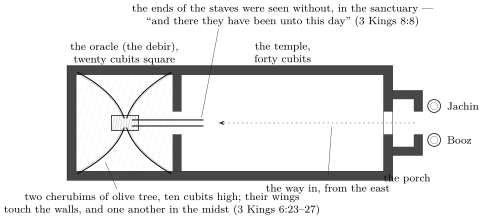
Drawing 5. Plan of Solomon’s house, after 3 Kings 6–8: porch, temple, and the windowless oracle where the ark came to rest under the wings of the great cherubim. The drawn staves make the text’s strangest clause visible: the ark at rest is still rigged for the road.
The long silence
After 3 Kings 8 the ark never again appears in the books of Kings. Not at the schism, not in the temple plunderings and repairs that Kings records across three centuries, not in the reform of Josias as Kings tells it. Kings never narrates the ark’s removal, destruction, or hiding. In the whole canon that silence is broken three times.
The first is a prayer. In 701 BC, with Sennacherib’s letter spread out before the Lord, Hezekiah prays in the temple: “O Lord God of Israel, who sitteth upon the cherubims, thou alone art the God of all the kings of the earth: thou madest heaven and earth” (4 Kings 19:15).64 The title is the ark’s own; Scripture attaches it to the ark verbally at 1 Kings 4:4 and 2 Kings 6:2. Prayed in the temple, it is the strongest canonical indication that the cherubim throne was a living cult reality two full centuries after Shishak of Egypt stripped the temple treasuries about 925 (3 Kings 14:25–26).
The old conjecture that the ark left with Shishak must therefore explain two silences. Kings, so ready to record Shishak taking everything, never hints the ark went too; and the throne-title is still prayed in 701. The conjecture is gratuitous. Honesty adds the calibration. The epithet also occurs in psalmody as a fixed divine title, so it could be formulaic; and the temple’s own ten-cubit cherubim of olive wood, which no raider could carry, would have stood over an empty floor. The prayer leaves the conjecture with nothing to stand on. It does not strictly refute it.65
The second is an order. In Josias’s reform, about 622, the king tells the Levites: “Put the ark in the sanctuary of the temple, which Solomon the son of David king of Israel built: for you shall carry it no more: but minister now to the Lord your God” (2 Paralipomenon 35:3).66 This is the ark’s last appearance in the historical books, and it is strange: it implies the ark was out of its place and being carried about. Three readings are on record. It had been removed under Manasseh—perhaps to make room for the graven image of 4 Kings 21:7—and Josias restored it. Or the Levites had been bearing it in processions. Or the notice is the Chronicler’s idealizing construction, telling us about the Chronicler’s liturgy rather than Josias’s temple—Kings’ own account of Josias has no ark in it—and this last is reported as the majority critical view. The text does not decide among them, and neither shall we. What no reading removes is the plain fact: chronologically, the trail of the ark as an object ends at this verse.
The third is the obituary. In the days of Israel’s increase, Jeremias prophesies, “they shall say no more: The ark of the covenant of the Lord: neither shall it come upon the heart, neither shall they remember it, neither shall it be visited, neither shall that be done any more. At that time Jerusalem shall be called the throne of the Lord: and all the nations shall be gathered together to it” (Jeremias 3:16–17).67 This is the only prophetic text that names the ark, and it names it in order to relativize it. The verse presumes an audience for whom the ark’s absence is, or is soon to be, a live wound. It answers the wound not with recovery but with enlargement: the whole city become “the throne of the Lord,” the nations gathered to it. The loss is absorbed, not mourned. The Bible’s own first theology of the disappearance is already a theology of supersession by something greater.
The year of the inventory
Then 587, and the lists. When the Chaldeans burned the house, the narrator of 4 Kings 25 itemized what they broke up and carried away: the two bronze pillars, the sea and its bases, the pots and shovels, the snuffers and dishes and firepans and bowls—an accounting that descends to the fire-irons of the altar service. The ark is not in the list. It is likewise absent from the fuller parallel list in Jeremias 52, and from the inventory of vessels Cyrus later restored.68 Call the argument what it is: an argument from silence. But a careful clerk has inventoried a looted house down to the fire-irons and never mentioned the one famous thing in it. The omission is itself a datum—though of what kind, the list alone cannot say. Either the ark was already gone before the Chaldeans came, or it perished unrecorded in the burning of the house. Both positions are held by serious scholars. The canon narrates neither.
The fate traditions
Into that silence tradition spoke, abundantly and not with one voice. The earliest witness is also the canonical one. Inside the second letter prefixed to 2 Machabees, the writer appeals to what “is found in the descriptions of Jeremias the prophet” (2 Machabees 2:1):
Witness — 2 Machabees 2:4–5, 7–8, Douay-Rheims
…the prophet, being warned by God, commanded that the tabernacle and the ark should accompany him, till he came forth to the mountain where Moses went up, and saw the inheritance of God. …Jeremias came thither he found a hollow cave: and he carried in thither the tabernacle, and the ark, and the altar of incense, and so stopped the door. …The place shall be unknown, till God gather together the congregation of the people, and receive them to mercy. And then the Lord will shew these things, and the majesty of the Lord shall appear, and there shall be a cloud as it was also shewed to Moses, and he shewed it when Solomon prayed that the place might be sanctified to the great God.
Some who followed came up afterward to mark the way, and could not find it; Jeremias blamed them for the attempt (2:6). The passage names its own source: Scripture is here canonizing a tradition and telling the reader that it is doing so. Its geography is Nebo, “the mountain where Moses went up.” And its horizon is not archaeological but eschatological. The place stays unknown till God gather the congregation of the people, and the appointed sign of disclosure is the cloud “as it was also shewed to Moses”—the very cloud of Exodus 40 and of 3 Kings 8:10–11, completing the inclusio in the text’s own words. This is consolation with a memory, not a map.69
And it has a family. The Lives of the Prophets is a Jewish treatise on the prophets’ deaths and burial places from the first century of our era, transmitted by Christian hands. Its Jeremias chapter tells how the prophet, before the destruction, made the ark be swallowed up in a cliff of rock. None shall bring it out but Aaron; none unfold its tables but Moses. In the resurrection the ark will rise first of all, come forth from the rock, and be set on Sinai, where the saints will gather to it. The rock lies in the wilderness between the two mountains where Moses and Aaron are buried, and a cloud of fire stands over it by night, for the glory of God will never cease from his law. Here the hiding tradition says aloud what 2 Machabees implies: the hidden ark is an object of resurrection hope.70
The expectation was not confined to Judea, nor even to the ark. Josephus records that in the year 36 a Samaritan—a man, he says, “who thought lying a thing of little consequence”—raised a multitude with exactly this hope: he “bid them to get together upon Mount Gerizzim, which is by them looked upon as the most holy of all mountains, and assured them, that when they were come thither, he would show them those sacred vessels which were laid under that place, because Moses put them there.” Pilate met the crowd with troops and executed the leaders; the massacre cost him his office. The precision matters: the depositor is Moses, the mountain is Gerizim, and Josephus says sacred vessels—not the ark. The words must not be sharpened. The episode proves that holy things hidden in a mountain, awaiting disclosure, were a live and politically explosive expectation in the first century.71
The apocalypses written after the year 70 read 587 through their own catastrophe and pushed the custody one step higher. In 2 Baruch, the night before the Chaldeans breach the walls, it is an angel who descends into the Holy of Holies, takes from it the veil, the holy ark, the mercy-seat, the two tables, and the rest of the holy things, and commands: “Earth, earth, earth, hear the word of the mighty God, and receive what I commit to you, and guard them until the last times, so that, when you are ordered, you may restore them, so that strangers may not get possession of them.”72 In 4 Baruch it is Jeremias again, but at God’s own command, who is told to “consign them to the earth,” the earth being charged: “Guard the vessels of the temple service until the gathering of the beloved.”73 Destruction becomes divine act, concealment divine custody, restoration a promise with a fixed though unknown date.
The rabbis preserved the debate rather than a verdict. The Mishnah records a temple tradition that the ark lay hidden under the wood-store of the temple court. It tells of a priest who noticed that one flagstone there was different from the others and died before he could finish telling it—whereby they knew the ark was hidden there. The Talmud makes Josias the hider, acting on our very verse, 2 Paralipomenon 35:3, and foreseeing the exile. With the ark, it says, went the jar of manna, the flask of anointing oil, and Aaron’s rod. But on the next folios stands the opposing baraita. Rabbi Eliezer and Rabbi Simeon ben Yohai held that the ark was carried to Babylon with the vessels; Rabbi Judah ben Lakish, that it was hidden in its place—his prooftext the staves seen “unto this day” of 3 Kings 8:8. Babylon and beneath-the-temple stand side by side in the same tractate, and neither is allowed to erase the other.74
And one ancient voice dissents from the whole hiding genre. In the mourning-woman vision of 4 Esdras—a book outside the Catholic canon, an appendix witness—the seer laments the sanctuary laid waste and the ark of the covenant plundered. Despoiled, not hidden.75
| Witness | Where, and by whom | Until |
|---|---|---|
| 2 Machabees 2:4–8 (2nd–1st c. BC letter) | Jeremias, “warned by God”: a hollow cave on the mountain of Moses (Nebo) | “till God gather together the congregation of the people” |
| Lives of the Prophets (1st c. AD, Christian transmission) | Jeremias: a rock in the wilderness between the graves of Moses and Aaron | the resurrection; the ark rises first, to Sinai |
| Josephus, Antiquities 18.85–87 (event AD 36) | Moses, in the Samaritan claim: sacred vessels, not the ark, under Mount Gerizim | a prophet’s disclosure |
| 2 Baruch 6 (ca. AD 100) | an angel; the earth receives the ark and vessels beneath the temple site | “the last times,” when the earth is ordered to restore them |
| 4 Baruch 3 (1st–2nd c. AD) | Jeremias, at God’s word: consigned to the earth | “the gathering of the beloved” |
| Mishnah and Talmud (Tannaitic–Amoraic) | Josias, under the wood-store of the temple court; or, in the rival view, carried to Babylon | the messianic future |
| 4 Esdras 10:22 (ca. AD 100) | no one: the ark was plundered | no horizon—the dissenting voice |
| Qur’an 2:248 with later tradition (7th c. AD and after) | looks back to Saul’s day; later tradition assigns the recovery to the Mahdi | the end of days |
The family resemblance is the real find. In nearly every witness the ark is not lost but kept, and its return is indexed not to excavation but to God’s regathering of his people. A family that has merely lost its father’s watch says so; this family tells you who is keeping it, and against what day. That is the shape the canon itself gave the question in 2 Machabees 2:7–8. The honest record keeps the minority report beside it: plundered, says 4 Esdras, and gone.
The empty room, and the wider world
Meanwhile there was a second temple, and its inmost room was empty. The rabbis say that in it stood only a stone from the days of the early prophets, called the foundation stone, three fingerbreadths above the floor, where the high priest set the censer on the Day of Atonement. Josephus describes the room: “In this there was nothing at all. It was inaccessible and inviolable, and not to be seen by any; and was called the Holy of Holies.” And the pagan witness agrees. Tacitus records that when Pompey entered the temple by right of victory in 63 BC, it became common knowledge that there was nulla intus deum effigie vacuam sedem et inania arcana—no image of a god within, the seat empty, the inner mysteries void.76 For six centuries the holiest room in Israel was, on the testimony of friend and enemy alike, empty—and was not therefore abandoned. Once a year the high priest still entered, to a bare stone where the ark had been. Israel’s worship had learned to face an absence without consenting to call it one.
The ark’s afterlife reached beyond Israel. The Qur’an enters the ark’s story at its biblical seam—the return in the days of Saul—and makes the ark the sign of Saul’s kingship: “there shall come unto you the ark wherein is peace of reassurance from your Lord, and a remnant of that which the house of Moses and the house of Aaron left behind, the angels bearing it” (Qur’an 2:248, Pickthall’s rendering). Pickthall’s “peace of reassurance” translates sakina, a word cognate with Shekinah: the Qur’an preserves in Arabic the ark’s theology of indwelt Presence. The classical commentators elaborate the “remnant” as the tablets or their fragments and the relics of Moses and Aaron. Later Islamic eschatology gives the ark a future of its own, in traditions that have the Mahdi bring it forth—from Lake Tiberias, or a cave near Antioch—before the end. Those last are reported leads, not verified texts. Even at one remove they show the same instinct: the ark’s reappearance belongs to the end of days.77
And there is Ethiopia. The claim that the ark rests at Aksum, in the chapel beside the church of Mary of Zion, guarded by one monk and seen by no one, is a present institutional fact of the Ethiopian Orthodox Church. Its charter text is the Kebra Nagast, in which Menelik, son of Solomon and the queen of Sheba, carries the ark from Jerusalem. That text must be dated honestly. It was produced in the early fourteenth century (1314–1322), compiled by Yeshaq of Aksum as the national epic of the Solomonic dynasty restored in 1270—some eighteen centuries after the event it narrates, with no ancient attestation of the Aksum claim behind it. No scholar regards it as history. But as reception it commands respect. Ethiopia did not merely claim the ark; it multiplied it into a living liturgy. The tabot, the consecrated ark-tablet without which no Ethiopian altar is an altar, means that every church in that communion houses an ark.78 The ark’s silence has also fed a modern treasure-hunt literature, from Templar romance to cellar excavation to fiction. This study declines the hunt, and keeps the older company of Jeremias 3:16.
Where, then, is the ark? History answers: unknown—the last sighting is Josias’s order, and after 587 the record is silence and inference. The traditions answer: kept, in a custody not ours, until God gathers his people. And the canon does not leave the question open: at the far end of the Bible, at the seventh trumpet, John saw it—“the ark of his testament was seen in his temple” (Apocalypse 11:19)—and it is there that this whole history will finish.79
The pattern: what the journey taught
The road is behind us: Sinai to Silo, Aphec to Sion, the temple, the silence. A reader who has walked it has not been following the fortunes of a treasure. He has been following a teaching, delivered not in propositions but in itineraries, plagues, processions, and one locked room entered once a year. It is time to step back and say what the road taught. One principle is the spine: the ark’s story is told as the itinerary of the glory of God among men. Three more hang from it. The ark’s holiness is the manners God requires of creatures in his presence. The ark’s golden cover is the place where blood and mercy met, and the New Testament gives that place’s own name to Christ. And the ark’s entrances were sung—by Israel at the gates of Sion, and still, of Christ, at the doors of churches.
The presence: the itinerary of the glory
The Bible narrates the ark’s end not as the loss of an object but as the departure and return of the glory of God. The canon’s own vocabulary makes the equation before any theologian does. When the ark was taken at Aphec, the wife of Phinees, dying in childbirth, named her son Ichabod. The narrator has her say it twice: “The glory is departed from Israel, because the ark of God was taken” (1 Kings 4:22; in the Hebrew naming, 1 Samuel 4:22).80 Ark and glory, kabod, are one loss. Israel’s psalmody remembered Aphec in the same terms:
Witness — Psalm 77:60–61 (Hebrew 78:60–61), Douay-Rheims
“And he put away the tabernacle of Silo, his tabernacle where he dwelt among men. And he delivered their strength into captivity: and their beauty into the hands of the enemy.”
On the surface of this English the ark is nowhere in sight. The Douay, following the Latin psalter’s Greek line, prints “their strength… their beauty,” as though Israel’s own force had gone captive. In the Hebrew the pronoun is God’s: he delivered his strength (oz) into captivity, his beauty or glory (tiferet) into the enemy’s hand. And what was carried to Azotus that day was the ark. Reading the psalm’s “strength” and “beauty” as the ark is therefore a synthesis. It stands on the Hebrew wording and on the Ichabod verses, not on the English surface.81 The glory departed; and the glory came back. At the dedication of Solomon’s temple the sign of Sinai returned: “a cloud filled the house of the Lord,” and the priests could not stand to minister, “for the glory of the Lord had filled the house” (3 Kings 8:10–11 = 1 Kings 8:10–11), the scene quoted in full in the temple section above.82
Then, at the end, the departure was shown to a prophet in slow motion. Ezechiel, a priest among the exiles, watched the glory leave the temple by stations, as if reluctant to go. It rose from the cherub to the threshold of the house, and the house filled with the cloud (Ezechiel 9:3; 10:4). It went out from the threshold and rested over the cherubim at the east gate (10:18–19). At last it went up from the midst of the city and stood upon the mountain east of the city (11:22–23)—the Mount of Olives, as readers ancient and modern have identified that mountain. Of the ark, in all this, not one word. The vision has already outgrown the furniture: the Presence departs, and what is left behind is left to the fire. But the same prophet was shown the return along the same road. The glory of the God of Israel came from the way of the east, entered by the east gate, and filled the house. The voice named the place his throne and the place of the soles of his feet, where he will dwell in the midst of the children of Israel for ever (43:1–7). And in Ezechiel’s visionary temple there is no ark at all. The throne is now the sanctuary itself.83 Jewish memory kept the same shape: a tradition in the Talmud counts ten stages of the Shekinah’s withdrawal from the temple, the last from the city to the Mount of Olives, where it tarried, calling Israel to return.84
This is the frame in which Jeremias’s word about the ark—the only prophetic text that names it—stops sounding like an obituary and starts sounding like theology. The days come, says the prophet, when they shall say no more “The ark of the covenant of the Lord”; it shall not come upon the heart, nor be remembered, nor missed. The Hebrew adds a precision the Douay’s “neither shall that be done any more” carries less sharply: it shall not be made again. Why not? Because “At that time Jerusalem shall be called the throne of the Lord” (Jeremias 3:16–17). The ark is not to be replaced, because what it was a vessel of will be present in a larger mode: not a chest in a city but the city itself become the throne. The ancients read the verse exactly this way, and joined it to the verse where this whole history will end. Tyconius, whose commentary shaped the whole Latin tradition on the Apocalypse, quotes Jeremias 3:16 at Apocalypse 11:19 to say that the ark seen in heaven is the Church—the old vessel surpassed, the figure filled.85 Whether that is the last word about the ark of Apocalypse 11:19 is a question whose hour has not yet come; what matters here is the shape. The arc even closes where the glory paused. From the Mount of Olives, where Ezechiel saw the glory stand as it left the city, the Glory in flesh wept over Jerusalem, and from that mountain he ascended (Luke 19:37–41; Acts 1:9–12). This arc—presence, departure, return—is a theological reading of the canon’s own architecture, not a report about where a gilded chest was carried. The honest range of historical opinion on that question was given already, and is not altered here. But the architecture is really there. The journey ended with John’s one sentence about where the ark was finally seen; this arc is the reason the canon could end the story nowhere else.
The holiness: the Presence is not managed
A glory that elects its own dwelling sets the terms of its company. That is the second lesson of the road: the presence of God is a gift that cannot be conscripted and a holiness that cannot be handled. The narrative taught it in two forms—presumption, which would use the Presence, and familiarity, which would handle it.
It cannot be conscripted. At Hormah the presumptuous attack went up without the sign of the covenant: “But the ark of the testament of the Lord and Moses departed not from the camp” (Numbers 14:44)—and Israel was cut to pieces.86 At Aphec the elders reversed the arrangement and fetched the ark to the battle, reasoning that its arrival would save them from their enemies (1 Kings 4:3). The narrative answered with the capture itself. God is not carried into service. The man who finally understood this was David, on the worst day of his life. Fleeing Absalom, with the priests standing ready to bring the ark into exile with him, he sent it back: “Carry back the ark of God into the city: if I shall find grace in the sight of the Lord, he will bring me again, and he will shew me it, and his tabernacle” (2 Kings 15:25).87 That sentence inverts the elders’ logic at Aphec. It is also the last the reader sees of the ark in the second book of Kings: the king who will not use God is the king God brings home.
It cannot be handled. The journey had two death-scenes: the men of Bethsames struck for looking into the ark, and Oza struck “for his rashness” when he put out his hand to steady it. Their textual difficulties were narrated above; they are real, and they were left standing. But the theology does not hang on the cruxes. In both scenes the offense is the same: a creature treating the throne of the Presence as an object among objects, to be inspected in the one case, managed in the other. The question the men of Bethsames asked afterward—who can stand before the Lord, this holy God? (1 Kings 6:20)—is the narrative’s own summary, and it is a question, not a complaint.88 The law had said all of this in advance, in the dry idiom of transport regulations. The sons of Caath were to carry the holy things already wrapped, “and they shall not touch the vessels of the sanctuary, lest they die,” nor look on them “by any curiosity” before the wrapping (Numbers 4:15, 20). What reads at first like ritual bookkeeping is reverence codified: the statute assumes that the danger is not malice but familiarity—the slow decay by which the holiest thing in the camp becomes, to its porters, luggage.89 The two lessons are symmetrical. Presumption treats God as a weapon; irreverence treats him as furniture. The ark’s whole discipline—poles never drawn out, veils, wrappings, shoulders, distance—exists to prevent both, and to train a people in the truth both errors deny: the Presence is a person, and the person is holy.
The propitiatory: mercy at the center
At the dead center of all this holiness, the law placed mercy. The one day a man entered the inner room, he came with blood, and the place he brought it was the ark’s golden cover—the kapporet, the Douay’s “propitiatory,” the “mercy seat” of the familiar modern rendering. Leviticus 16 built the room’s whole meaning around that surface. Aaron may not come at all times within the veil, “for I will appear in a cloud over the oracle,” and on the day he comes, the blood of the victims is sprinkled toward and before the propitiatory (Leviticus 16:2, 14–15).90 Atonement, in Israel’s central rite, is not transacted at the altar in the court. It is finished at the throne, on the gold between the cherubim, where God had promised to speak.
The word itself then makes a journey no student of the New Testament should be allowed to miss. The Greek translators rendered kapporet with hilasterion; at its first occurrence the phrase is doubled, hilasterion epithema, “a propitiatory, a cover” (Exodus 25:17, Septuagint). The Epistle to the Hebrews uses the same word in its inventory of the old sanctuary: “And over it were the cherubims of glory overshadowing the propitiatory: of which it is not needful to speak now particularly” (Hebrews 9:5). And Paul, writing to the Romans, sets Christ forth under this very word: God has put him forward as hilasterion, in his blood (Romans 3:25, cited here from the Greek). Whether Paul means the ark’s cover precisely or propitiation generally, the lexicons have argued for over a century, and the dispute belongs to them. What is not disputed is the word. The vocabulary of the ark’s lid is applied, in the New Testament, to the crucified Lord.91
The Fathers drew the consequence at the empty tomb. St. John alone records that Magdalen, stooping into the sepulchre, saw two angels in white sitting where the body of Jesus had lain, one at the head and one at the feet (John 20:12). St. Gregory the Great, preaching on the scene about the year 591, turned it toward the inner room of the tabernacle. In his reading the two angels are the two Testaments— “Possumus etiam per duos angelos duo Testamenta cognoscere”—and as the two cherubim that cover the propitiatory gaze at one another with their faces turned toward it, so the two Testaments face each other across one center. Then comes the question that carries the whole figure: “Quid vero per propitiatorium nisi incarnatus Dominus figuratur?”—what is figured by the propitiatory, if not the incarnate Lord? (an editorial paraphrase, not a translation).92 Gregory’s figure is an allegory of the Scriptures: two Testaments, one mercy seat, the Lord between them. The more sensory form of the same reading—the slab of the empty tomb itself as the kapporet, the two angels as its cherubim flanking the place of the vanished Presence—is early modern and modern. It runs from Lightfoot’s Hebraic commentary into current scholarship and preaching, a legitimate development of Gregory’s insight; but it should wear its date.93 Either way the third lesson holds. The ark’s center was a covering for sin and a meeting place with God; the gospel’s center is a person who is both.
The gates: the King of glory
The glory has a title in Israel’s songbook: the King of glory. Israel sang the ark’s entrances under that title, and the Church has never stopped singing them—of Christ. Psalm 23 (in the Hebrew numbering 24) stages an entrance as a dialogue at the doors. The gates are commanded to lift up their heads, that the King of glory may come in. A voice within asks who this King of glory is. The answer comes: the Lord strong and mighty, the Lord mighty in battle, the Lord of hosts. The ark is not named in the psalm. Hearing in it the liturgy of the ark’s entry into the sanctuary—the Lord entering his house as King, as at 2 Kings 6 and 3 Kings 8—is an interpretation, proposed in antiquity and argued in form-critical dress by the school of Gunkel and Mowinckel, whose reconstruction of a festival procession remains a hypothesis and is reported here as one.94
What is not hypothesis is what Christians did with the psalm, almost from the beginning. Justin Martyr, before the year 165, put the dialogue at the ascension. The rulers in heaven “are commanded to open the gates of heaven, that He who is King of glory may enter in,” and, failing to recognize the ascending Lord in his unglorious flesh, they ask, “Who is this King of glory?”—and the Holy Spirit answers, “The Lord of hosts.” Elsewhere he insists the psalm was spoken neither of Solomon nor of Ezechias but “to this our Christ alone.”95 Irenaeus, in the Demonstration of the Apostolic Preaching, has the angels who accompany the ascending Christ call the same summons up to the powers above, who ask their astonished question and receive the psalm’s own answer.96 And the old descensus tradition turned the same dialogue downward. In the Gospel of Nicodemus, a compilation of the fourth or fifth century on older material, the voice like thunder before the doors of Hades cries, “Lift up your gates, O ye rulers… and the King of glory shall come in,” Hades demands to know who this King of glory is, and is told: “The Lord strong and mighty, the Lord mighty in battle.”97 The gates of heaven, the gates of hell: antiquity aimed the psalm in both directions, and both readings are pure Christology. Neither names the ark. Both assume exactly what the ark’s processions had taught: when this King approaches a threshold, it is the threshold that must move.
And the entrance liturgy is not a museum piece. In the Byzantine rite, to this day, the bishop consecrating a church carries the relics in procession around the building, halts before its closed doors, and chants the psalm’s summons; the question comes back from within the empty building; the doors are opened, and the King of glory enters his new house. The older Roman pontifical staged the same dialogue at the church door, with the bishop’s staff, at the Tollite portas. And once a year the Roman lectionary appoints these very verses as the responsorial psalm of the feast of the Presentation of the Lord, their refrain asking the psalm’s question and answering it of the Lord—sung while the Gospel shows the Lord entering his temple carried in his mother’s arms.98 That scene is described here and left where the liturgy leaves it; its questions will be asked in order, when Luke is opened.
The pattern, then, can be named in one sentence: the ark is what the presence of God among men looks like before Christ—glory that elects a dwelling and cannot be detained; holiness that blesses the reverent house and breaks the presuming hand; mercy seated at the very center of danger; a King whose entrances make the gates themselves stand up. The whole of Israel’s experience of God-with-us was compressed into a box two cubits and a half long. Then the box was taken away, and the prophets said the Presence would come again in a larger mode. One question remains: what does the same pattern look like after Christ—and did anyone, in the event, look like it? Honesty requires one short pause before answering: a word about what kind of reasoning can answer such a question at all.
Reading Forward: The Rules of Typology
What does the presence of God among men look like after Christ? The Church’s answer, so far as it concerns the ark, is her long habit of reading the Virgin Mary as the ark of the new covenant. But before a single parallel is laid on the table, the reader is owed a confession. Resemblance is cheap. Set any two solemn processions side by side, in any two literatures, and they will share a vocabulary: a going up, a shouting, a carried holy thing, a crowd. Two texts written in the same Greek and steeped in the same Scriptures will echo each other whether or not anyone intended it. Whole libraries of nineteenth-century comparative religion were built on parallels no weaker than some that will appear in the next chapter, and those libraries are now cautionary tales. A reader who has watched parallel-hunting done badly is right to keep his hand on his wallet. Seeing a likeness is not yet knowing a meaning — so it must be said, once and briefly, what a likeness can prove.
What Typology Is
Typology is a claim about the authorship of history before it is a claim about the art of any writer. In a well-made novel, the thing set quietly on the mantel in the second chapter is aimed at the last chapter. No analysis of the second chapter alone will explain it; only the author’s one intention, holding both chapters at once, explains it. Typology claims that the two Testaments are such a book — and that its prose is not merely words but events, because its Author disposes events as freely as a novelist disposes sentences.
This is not a private theory of the devout imagination. It is the Church’s stated rule of reading. The Second Vatican Council’s constitution on divine revelation puts the rule in two halves.99 The interpreter must first search out what the human authors really intended, with every instrument that serves that search; nothing that follows is excused from that duty. But because Scripture is inspired, the same paragraph requires that it be read in the same Spirit in which it was written, and names three tests of such reading: the content and unity of the whole of Scripture; the living Tradition of the whole Church; and the analogy of faith. The Catechism receives the rule and gives the practice its name: from apostolic times the Church has discerned, in the works of God under the old covenant, prefigurations of what he accomplished in the fullness of time in his incarnate Son.100 Two words deserve their full weight. Typology discerns: the figure is found, not manufactured, and a discernment can be mistaken, which is why evidence will matter at every step. And it discerns in God’s works: deeds, persons, objects — a chest of wood as much as a word of prophecy — because the Author of this book writes with events.
It follows that typology presupposes the reality of what it reads; a figure built on nothing signifies nothing. That is why the box itself came first — construction, journeys, catastrophe, disappearance — and why its questions of fact were settled as fact is settled. The canon models the resulting reticence and the resulting confidence at once. The epistle to the Hebrews inventories the ark’s furniture — the golden pot, the rod, the tables — and then closes the veil: “of which it is not needful to speak now particularly” (Hebrews 9:5, Douay-Rheims).101 The New Testament’s own author signals that the furniture means more than the letter has yet said, and declines to say it hastily. There is no better warrant for speaking carefully.
Three confusions must be shut out at the gate. Typology is not literal exegesis: the human author of 2 Kings 6 wrote of David’s procession, and no reading offered here will overwrite his letter. It is not a claim about a writer’s psychology: whether Luke consciously wove the ark narrative into his first chapter is a real philological question, to be weighed with the philologists’ own tools; but the typological claim rests on the intention of Another, so a demonstrated Lucan design would strengthen the attestation, not create the meaning. And it is not decoration: a figure, if true, teaches, and if false, deceives; in neither case is it ornament.
The Two-Axis Rule
Every disputed reading in what follows is handled by one named distinction: attestation is not reception, and the absence of either is not falsity. Attestation is the historical trail of a reading — who read the figure this way, when, in what words, under whose name; a question of fact, settled by loci, dates, and manuscripts. Reception is the Church’s own adoption of a reading, in her liturgy, her catechisms, her solemn teaching; equally a question of fact, settled by dated public acts. The two run on separate axes. A reading may be anciently attested yet never received into worship, or received at the highest levels though no Father ever drew it; and a reading poor on both axes may still be true, for late articulation is how development of doctrine ordinarily looks from the outside. Accordingly, every reading printed below wears its state on its sleeve: philologically anchored; anciently attested, with its witnesses named and their names checked; liturgically or magisterially received, with the act and its date; or a labeled synthesis of this study’s own.
One more instrument, because the next chapter leans on it from its first page. The philological case there is cumulative: not one echo but a cluster, gathered in a few verses. Each strand must be weighed alone, and a strand that fails alone will be printed as failing; the negatives are findings, not embarrassments. But the bundle must also be weighed as a bundle, for the question a cluster raises is not whether any single echo compels but how likely it is that so many should meet by accident in so small a space. A rope is not refuted by showing that no one thread would hold the load; a heap of threads is not yet a rope.
Two ditches lie beside this road, and travelers are in both. Consider first the minimalist, and grant his conditional in full: if an allusion is real only when it can be demonstrated — shared words rare enough to signify, in matching order, beyond coincidence — then several of the echoes in the next chapter fail the test. The critical school that says so will be quoted there in its own words, at its own loci, with its premises stated fairly.102 That work is honest and this argument needs it. The ditch lies one step further on: the inference from “the allusion is unproven as the evangelist’s intention” to “the reading is false.” That step silently assumes that the only meaning in Scripture is the human author’s demonstrable meaning — the very question at issue. Philology can weigh words; it cannot weigh the intentions of God. The minimalist who thinks it can has not lost an argument; he has collapsed two axes into one.
Now the enthusiast, and grant his conditional too: if the Church’s reading is true, one would expect the ancients to have seen something — and, in substance, they did, earlier and more widely than the skeptic suspects, as the Fathers will show in their place. But the enthusiast is not content with the pedigree the record supplies; he improves it. Quotations migrate under greater names. A sermon by no one becomes a sermon by a Doctor of the Church. A translator’s loose clause becomes a third-century witness. An unchecked reading passes from book to book because it ought to be true.103 Notice what each embellishment concedes: that only an ancient pedigree could make the reading true — the minimalist’s own axiom, swallowed whole, with forgery added to make up the arrears. The Church does not need the forgery and is not honored by it. Both ditches are one error: both make attestation the sole measure of truth.
Why, finally, should reception count as evidence at all? Because the council names the living Tradition of the whole Church among the criteria of Spirit-led reading, and nowhere is that Tradition more public, more deliberate, or more precisely datable than in worship; the manuals count the liturgy among the loci theologici for exactly this reason. When the Church appoints a lesson and a psalm to a feast, she is not decorating a ceremony. She is performing an act of interpretation before her whole people, and signing it with a date. A lectionary is a commentary whose author is the reading Church, and its acts can be catalogued like any other witnesses — as, in their place, they will be.
That is all the method there is. The bar lifts, and the road beyond it climbs — as it happens, into the hill country of Juda.
Luke with the Septuagint: The Visitation and the Ark
The road climbs into the hill country of Juda, and a philological claim waits at the top. Philological claims can be tested. It is said that St. Luke composed the Visitation narrative on the pattern of the ark’s journey to Jerusalem: Mary goes up into the hill country as David went up; Elizabeth’s cry, her question, John’s leap, and the three months’ stay answer, point for point, the processions of 2 Kings 6. If that is true, it is true in Greek—in the vocabulary of the Septuagint, whose idiom the infancy narrative everywhere speaks, set against the Greek of Luke’s own sentences. The words can be counted, and they have been counted: every concordance claim below rests on a lemma-level search of the whole Rahlfs corpus, run and adversarially re-run, not on secondary lists.104 One naming note: the Greek Bible files the books that modern Bibles call 1–2 Samuel and 1–2 Kings as 1–4 Kingdoms; the Douay-Rheims calls the same sequence 1–4 Kings. Thus 2 Kingdoms 6 in the Septuagint and 2 Kings 6 in the Douay-Rheims are both modern 2 Samuel 6. Here are the two openings, side by side.
Witness — 2 Kings 6:2 (= 2 Samuel 6:2), Douay-Rheims
And David arose and went, with all the people that were with him of the men of Juda to fetch the ark of God, upon which the name of the Lord of hosts is invoked, who sitteth over it upon the cherubims.
Witness — Luke 1:39, Douay-Rheims
And Mary rising up in those days, went into the hill country with haste into a city of Juda.105
Set side by side, the two sentences already carry the shape of the claim: someone rises and goes, into the country of Juda, toward a house that will hold the holy for a season. But a shape is not a proof. What follows takes the alleged echoes one at a time, each with its Greek skeleton and its honest weight—the strong with their caveats, the weak named as weak, one outright negative printed as a negative. Then the scholarly debate is reported as a debate. What the Church has since done with this reading belongs to the next three sections; here the question is only what stands on the page.
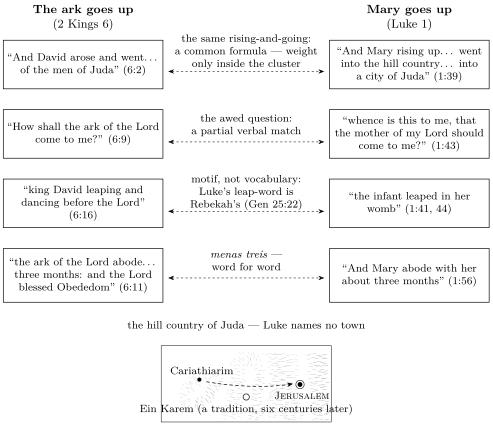
Drawing 6. The Visitation laid over the ark’s procession, at the honest weight of each contact; the wording on both sides is the Douay’s, quoted whole in the text. Below, the one patch of ground both stories cross. Luke names no town, and the drawing keeps Ein Karem an open circle: a venerable tradition, first attested by a pilgrim’s distance six centuries on.
The overshadowing
“The Holy Ghost shall come upon thee, and the power of the most High shall overshadow thee” (Lk 1:35). The verb beneath “overshadow” is episkiazein, and its Old Greek career is short: exactly four occurrences in the whole Septuagint. Twice it is the Psalter’s protective shadow, once wealth’s glory in Proverbs. The fourth—the one theologically laden use—is the cloud at the completion of the tabernacle: Moses could not enter the tent of meeting, because the cloud overshadowed it (epeskiazen ep’ autēn hē nephelē) and the tabernacle was filled with the glory of the Lord (Ex 40:35 LXX). The link lives only in the Greek. Douay Exodus reads “The cloud covered the tabernacle… the cloud covering all things” (Ex 40:32–33), while the English word “overshadow” surfaces at the New Testament end, at Lk 1:35 and again at Heb 9:5, “the cherubims of glory overshadowing the propitiatory.”106 And Luke himself tells us what the verb means to him. He uses it again at the transfiguration, where a cloud came and overshadowed the disciples (Lk 9:34, egeneto nephelē kai epeskiazen autous)—the theophanic glory-cloud, not mere shelter. That internal control is the strongest single piece of evidence that Lk 1:35 intends Shekinah imagery.
Now the precisions, both of them. First, the object of the overshadowing in Exodus is the tent of meeting, not the ark as such: the ark stands within the tent (Ex 40:20–21). Strictly taken, the figure Lk 1:35 supports is Mary as the overshadowed tabernacle, the place of the glory-cloud; the ark is one step further in. Second, that step is shorter than it once appeared. The adversarial re-run of the whole shadow-verb family found the simple verb skiazein sitting directly on the ark itself. At 1 Paralipomenon 28:18 LXX the cherubim spread their wings skiazontōn epi tēs kibōtou, overshadowing the ark of the covenant of the Lord—Douay: “spreading their wings, and covering the ark”—and at Ex 38:8 LXX the two cherubim stand skiazonta over the propitiatory, with the veil that shadows the ark for the march and the cloud that shall shadow Mount Sion in the same verb-family.107 The shadow-vocabulary of the Greek Bible, in short, is sanctuary furniture vocabulary—cherub wings over the ark, cloud over the tent—though Luke’s own compound episkiazein never rests on the ark anywhere in the Septuagint. Both facts belong in print.
The soberest critic of this parallel, Marie Isaacs, granted the verb and denied the inference: “it cannot be assumed that Luke is employing a typology whereby Mary represents the tabernacle in whom the Shekinah resides”. Her stated ground was that the Shekinah was not confined to the tabernacle or the ark, with the Psalter’s protective usage as her supporting observation.108 That is fairly said, and it does not touch Lk 9:34. A rare verb, an uncontested glory-cloud sense in Luke’s own usage, a tent rather than an ark at the Exodus end: that is the exact weight of the first echo.
The question at the door
When the ark set out for Jerusalem and Oza lay dead, David was afraid, and asked: “How shall the ark of the Lord come to me?” (2 Kings 6:9; LXX pōs eiseleusetai pros me hē kibōtos kyriou?). Elizabeth, filled with the Holy Ghost, asks: “And whence is this to me, that the mother of my Lord should come to me?” (Lk 1:43; pothen moi touto hina elthē hē mētēr tou kyriou mou pros eme?). Shared: a rhetorical question asked of oneself; a sacred bearer coming—pros me, “to me”—and “the Lord” in the genitive at the heart of both phrases. Not shared: the interrogative itself (pōs against pothen moi touto) and the register, David’s dread against Elizabeth’s joy.
The critics have a rival text, and it deserves the body of the page, not a footnote. Raymond Brown observed that when David comes to Araunah’s threshing floor—the future temple site—Araunah asks, in Brown’s rendering, “What is this, that my lord the king has come to his servant?” (2 Kings 24:21; LXX ti hoti ēlthen ho kyrios mou ho basileus pros ton doulon autou?). “This question also resembles Elizabeth’s question,” Brown concludes, “and it does not concern the Ark”; on his reading “the connecting link in the Lucan reminiscences may be David rather than the Ark.”109 The rejoinder, pressed by Jan Kozłowski, is about content rather than syntax. Araunah’s question is court courtesy to a superior. David’s question and Elizabeth’s are the only two shaped as numinous unworthiness—the creature asking how the bearer of the Lord’s presence can enter a private life.110 The honest verdict: a genuine motif-parallel with partial verbal support, an allusion at most, never a quotation—and at this single point the debate is genuinely open.
Elizabeth’s cry
The philologically strongest item in the cluster is a single word. Luke writes that Elizabeth anephōnēsen kraugē megalē—cried out with a loud cry—and blessed Mary among women and the fruit of her womb (Lk 1:42). The verb anaphōnein occurs nowhere else in the New Testament. In the whole Septuagint it occurs exactly five times, every one in Paralipomenon, every one a Levite’s liturgical acclamation, four of the five in ark ceremonies: the procession that brings the ark up to Jerusalem, the ministers appointed before the ark, the cultic music of Heman and Idithun (the one occurrence with no ark in the verse), and the ark’s installation in Solomon’s temple. That last acclamation ends with the house filled with the cloud of the glory of the Lord—the same Exodus 40 cluster that stands behind Lk 1:35.111 There is a further convergence: the ark goes up to Jerusalem meta kraugēs, with shouting (2 Kingdoms 6:15), and the critical text of Lk 1:42 gives Elizabeth precisely a kraugē. And Elizabeth is a daughter of Aaron (Lk 1:5), which gives the Levitical color of the verb somewhere to rest.
The caveats are printed with the claim. Five occurrences are a small base on which to declare a technical term. In Greek at large anaphōnein is an ordinary verb of crying out, so the Septuagintal distribution is a fact about a corpus, not a property of the word. And a hapax proves that Luke chose a rare word, not why he chose it. The statistic is suggestive, verified, and not a demonstration. That is its weight.
Three months and a blessed house
The record of the first procession says that “the ark of the Lord abode in the house of Obededom the Gethite three months: and the Lord blessed Obededom, and all his household” (2 Kings 6:11). “And Mary abode with her about three months; and she returned to her own house” (Lk 1:56). The Greek match is exact where it matters: mēnas treis, “three months,” verbatim on both sides, Luke adding only “about”. The Douay English adds a small bonus of its own, the same verb “abode” in both verses. The blessing motif stands beside the number: the Lord blessed (eulogēsen) all Obededom’s house because of the ark, and Elizabeth pronounces Mary blessed and the fruit of her womb blessed (eulogēmenē… eulogēmenos, Lk 1:42)—though Luke never says Zachary’s house was blessed, and honesty keeps that difference visible.
Two deflationary facts are also visible, and they belong in print. The three months are narratively motivated: Mary arrives in Elizabeth’s sixth month (Lk 1:36) and stays until John’s birth is due; no typology is needed to generate the number. And the Book of Judith stands nearby. Israel rejoiced for three months after Judith’s victory (Jdt 16:20), and Elizabeth’s actual sentence of blessing demonstrably tracks Judith’s blessing—blessed art thou, daughter, by the most high God above all women (Jdt 13:18: eulogētē sy, thygater, tō theō tō hypsistō para pasas tas gynaikas)—more closely than any ark text does.112
But the Judith echoes are polyphony, not rivals. Luke’s manner in these chapters is to layer scriptural voices—Hannah under the Magnificat, Daniel under Gabriel—and a Judith harmony does not silence an ark harmony. Indeed Kozłowski’s revival of the whole argument begins from the Judith verse, as we shall see. His judgment on this item is that 2 Kings 6:11 remains the closer parallel to Lk 1:56: in both, a God-bearing presence abides three months in a private Judean house, and blessing attends the stay.
The leap: an honest negative
Here an honest negative must be printed, because the popular form of this parallel claims more than the texts give. John “leaped” in Elizabeth’s womb—eskirtēsen (Lk 1:41, 44)—and David danced before the ark; the apologetic commonplace says they share a verb. They do not. In 2 Kingdoms 6 the Septuagint’s David plays (paizontes, v. 5), strikes up on instruments (anekroueto, v. 14—the Greek has actually softened the Hebrew’s whirling), and is seen dancing and playing (orchoumenon kai anakrouomenon, v. 16). The verb skirtan never occurs in the chapter. Its true Septuagintal partner is Gen 25:22: eskirtōn de ta paidia en autē—the twins leaping in Rebekah’s womb, in a verse whose question, hina ti moi touto?, is formally as close to Lk 1:43 as anything in Kingdoms. Luke may well be interlacing a second typology here—children leaping in the womb before the birth of Israel, and of the new Israel—and Isaacs made the point with relish: “Even the words for ‘dance’ and ‘leap’ are not the same in the greek.”113
Two precisions keep the negative honest in both directions. Laurentin never claimed the same verb. He glossed John’s leap from Malachias and the Psalter—leaping at the coming of the Lord—and listed the joyful bounds of David and of John together as a shared motif; the lexical equation is a popular overreach beyond what he wrote. And the motif equation itself has an ancient, if late, witness. In the second century after Christ the Jewish translator Symmachus rendered David’s whirling at 2 Kings 6:16 with precisely this verb: skirtōnta kai kanchazonta, leaping and laughing—the one ancient Greek Bible text in which David does skirtan before the ark.114 Symmachus is post-Lucan; he cannot be what Luke alluded to, and the verdict for Luke’s own composition stands: no verbal link. What Symmachus shows is smaller and still real: an ancient translator, independent of the Church, found “leaping” the natural Greek for what David did before the ark. The equation of the two scenes is not a modern contrivance. It is a hexaplaric footnote, not a proof.
The hill country
“Arose and went”: the formula anastasa… eporeuthē (Lk 1:39), matching anestē kai eporeuthē Dauid (2 Kingdoms 6:2), is Septuagintal boilerplate—Abraham rises and goes to Moriah in the same words (Gen 22:3), and dozens of journeys begin so. By itself it carries no allusive weight, and none is assigned to it. What carries weight is the cluster riding on it: arise, go, Juda, the ascent into hill country, a destination house, a sacred burden.
Here the Greek Bible offers one curious texture. The Septuagint of 2 Kingdoms 6:2 has lost the place-name. Where the Hebrew has David set out from Baale-Juda (that is, Kiriath-jearim), the Greek translator read the noun as a common one, producing apo tōn archontōn Iouda—from the rulers of Juda, on the ascent (en anabasei)—and the Vulgate, followed by the Douay’s “of the men of Juda,” lost the place-name the same way. A reader of the Greek or Latin Bible thus meets in 2 Kings 6:2 an unnamed Judahite starting point and an ascent—a texture oddly congenial to Luke’s unnamed “city of Juda” in the hill country, though Chronicles keeps the name (1 Par 13:5–6). The ark comes into the house of Obededom (eis oikon Abeddara, 6:10–11); Mary enters the house of Zachary (eisēlthen eis ton oikon Zachariou, Lk 1:40).
Luke names no town, and the tradition that names one must be dated as tradition. The identification of the Visitation with Ein Karem, west of Jerusalem, rests at its oldest on the pilgrim itinerary of Theodosius, composed between about 518 and 530. It gives a distance only: De Hierusalem usque ubi habitavit sancta Helisabeth mater domini Ioannis Baptistae milia V—from Jerusalem to where St. Elizabeth, the mother of John the Baptist, lived, five miles—and no name; one manuscript adds that holy Mary greeted Elizabeth there. The name itself appears in the later liturgical tradition of Byzantine Jerusalem, as reported.115 Both Ein Karem and Kiriath-jearim lie in the Judean hill country, and the popular claim that Mary “took the same road as the ark” has no textual basis whatever: Luke names neither town nor route. The tradition is venerable. It is not evidence, and this study does not spend it as evidence.
Daughter Zion, the companion typology
One more Old Testament pattern stands over Luke 1, and it must be kept distinct before it can be related. “Hail, full of grace, the Lord is with thee: blessed art thou among women” (Lk 1:28, the Douay printing the longer traditional text of the verse). The greeting chaire, followed by the announcement that the Lord is coming to dwell, is read by a whole line of scholarship as the Septuagint’s eschatological summons to the Daughter of Zion: chaire sphodra, thygater Siōn—rejoice greatly, daughter Sion (Soph 3:14)—with the King of Israel, the Lord, in the midst of thee (3:15) and the Lord thy God in thee (3:17); so too Zach 9:9. On this reading Gabriel greets Mary as the personified Zion whom the Lord enters, and kecharitōmenē—a rare verb—names the grace of that election.
The minimalist answer is verbal. The only word Lk 1:28 exactly shares with Sophonias is chaire itself, which is also the everyday Greek greeting; “the Lord is with thee” belongs to the call-formula spoken to Gedeon and by Booz (Judg 6:12; Ruth 2:4), not to the Zion oracles. Isaacs judged the verbal parallels “are, in fact, slight,” the womb-for-midst equation “wholly far-fetched”—while allowing that the Daughter-of-Zion personification “may have influenced Luke.”116
The point of printing this here is precision. Daughter Zion and the ark are two different figures: the first makes Mary the city and people whom the Lord indwells, the second the vessel that carries the Presence from place to place. The Church’s own prayer has fused them. The Catechism, in its commentary on the Ave Maria, calls Mary the daughter of Zion in person, the ark of the covenant, the place where the glory of the Lord dwells (CCC 2676); Ratzinger fuses them deliberately, handing the ark title finally to Christ with Mary as bearer. That fusion is an act of reception, and its story is told in section 32. Here it is enough to say what the texts show: two distinct patterns, each with its own verbal skeleton, laid over the same seventeen sentences.
The debate as a debate
The modern argument has a genealogy. Eric Burrows first developed the tabernacle-and-ark reading of Luke 1 in essays published in 1940; Stanislas Lyonnet argued the Daughter-Zion reading of the greeting in 1939. René Laurentin built both into the classic statement, Structure et théologie de Luc I–II (1957), where the Visitation’s chosen traits refer the reader “de façon convergente”—convergently—to the narrative of the ark’s transfer, and Mary is “le type de l’arche d’alliance.”117 The argument’s form is the cumulative one weighed a chapter ago: convergent, with no single echo claimed as proof. The claim is that so many independent contacts within the eighteen verses of one pericope (Lk 1:39–56) are unlikely to be accident.
The critics answer by dismantling the parallels one at a time and offering a rival frame. Brown’s Araunah text has been quoted above; his positive proposal is that the reminiscences are Davidic rather than arkological—Mary enters the story David entered, not the ark’s. Fitzmyer: “But this is subtle. If, indeed, the story may be compared with 2 Sam 24:21, then what connection does it have with the ark?” Schürmann held that the ark narrative aims at Jerusalem’s election, so that Mary shares with the ark only the direction of travel, never the destination, and that the fear-laden three months of the ark are “sehr unpassend”—very unfittingly—compared with Mary’s stay. Bovon was briefest: “Die Symbolik Maria = Lade ist zu weit hergeholt”—the symbolism is too far-fetched. Strauss found it “unlikely… that Luke would be drawing so subtle an allusion here”; Isaacs, that the case “rests upon the flimsiest of correspondences,” and that “it is to go beyond the evidence to suggest that she is a type of the ark of God.”118 This is a school with premises, and the study reports the premises with the verdicts: on strict verbal-echo criteria, an allusion must be lexically demonstrable—the same words, not the same shape—or it is not there; and liturgical reception is not admitted as evidence of what Luke meant.
The argument did not end in the commentaries. Kozłowski’s 2017–2018 intervention re-armed Laurentin from an unexpected side. Lk 1:42 blesses Mary and the fruit of her womb in the syntax Judith 13:18 uses to bless a woman and, in the phrase of Kozłowski’s own title, “The Lord God, Creator of Heaven and Earth”—so the child in the womb is acclaimed in Creator’s language, and if the burden is the Lord, the bearer is what the ark was. To this he added the corrected concordance facts for anaphōnein set out above. From the Reformed side, Jacobus de Koning argued the typology in 2020 from 2 Kings 6 with the Chronicles acclamation texts. He noted that it is “grootliks afwesig”—largely absent—from the mainstream commentaries, and proposed it as a challenge for Protestant rethinking of Mariology.119 And behind both stands an identifiable Catholic school with institutional addresses: Aristide Serra at the Marianum, whose Old Testament prefigurations of Mary include “the tent of the ark of the covenant”; André Feuillet at the Institut Catholique de Paris; Ignace de la Potterie at the Biblicum, for whom the Daughter-of-Zion promises are realized in a definite woman. This study cites their loci as reported, not as texts opened at first hand.120
Name the divide honestly and it names itself: methodological, not confessional. The thesis was born among Jesuits; its sharpest critics are Catholic priests in good standing; its newest defender is Reformed. What separates the parties is what counts as an allusion—strict lexical identity, or convergent pattern—and whether the reading Church’s use of a text is evidence about the text or only about the Church.
What the philology honestly yields
Count the inventory. One rare verb whose only laden Septuagintal use is the glory-cloud over the completed tabernacle, re-used by Luke himself for the transfiguration cloud—with the tent, not the ark, beneath it. One exact two-word match, “three months,” in the same structural position, with a narrative explanation available and a Judith harmony beside it. One New Testament hapax whose entire Old Greek career is Levitical acclamation, four-fifths of it around the ark—five occurrences in all. One question shaped like David’s question, with a rival Davidic text that lacks the ark. A journey texture congenial to the parallel but proving nothing alone. One honest negative, where the popular claim fails and only a post-Lucan translator supplies the missing verb. And one companion typology, Daughter Zion, distinct in figure, fused with the ark only downstream, in the Church’s prayer.
The verdict this study prints is the one the evidence will bear: the Visitation cluster is a convergent set of which no single strand compels. A reader who requires lexical demonstration, echo by echo, will judge with Brown and Bovon that the allusion is unproven—and on that criterion the judgment is correct. A reader who admits cumulative design in a writer as deliberate as Luke, and who weighs the improbability of five independent contacts in eighteen verses, will judge with Laurentin’s school that the evangelist knew what procession he was describing—and no verified fact above forbids it. Two verdicts, two premises; the two-axis rule holds the space between them: attestation is not reception, and the absence of either is not falsity. The philology is what it is. What the Church has made of the reading is a separate question with separate evidence, and it occupies the next two sections.
One thing more, and it changes the frame. The whole debate reported above was conducted, on both sides, as if the reading were born with Burrows in 1940. It was not. Around the year 500, a Syriac poet was already preaching the Visitation with the ark—Mary an ark full of mysteries, John’s leap answering David’s dance before it. His name was Jacob of Serugh, and the Fathers are the next section’s business. The philology can carry the reader no further; the Fathers take him up.
The Fathers: The Making of a Title
The Fathers gave the ark to Christ before they gave it to his Mother; and when at last they gave it to his Mother, they did not take it back from Christ. That is the whole story of this section, and it can be told with dates. The philology ended with a promise: the Church’s reading of the Visitation is older than the concordances that now defend it. The promise is kept here, but honestly — as development, not as antiquity flat. Explicit predication — “Mary is the ark” — cannot be documented before the fifth century in any language. What comes earlier is something else, and in some ways something greater: a third-century Christological ark typology in which the Virgin already stands at the ark’s making, and, in Syriac, a genuine fourth-century poetry that lets the figure rest on Mary a full generation before the Council of Ephesus. Every witness below is printed under its true name and its true date. Where a famous attribution fails, the failure is stated as a finding.
The Christological ark comes first
The oldest ark exegesis in the Church is about the body of Christ. Hippolytus of Rome (d. c. 235), commenting on Daniel, reads the ark of incorruptible wood as the Lord’s own incorrupt humanity. The reader who has met this Father in the apologetics collections has almost certainly met him saying something slightly — and consequentially — different:
Witness — Hippolytus, fragment on Daniel, ANF translation (1886)
“…the Saviour appeared and showed His own body to the world, (born) of the Virgin, who was the ark overlaid with pure gold, with the Word within and the Holy Spirit without.”
In that Victorian English the relative clause fastens to the Virgin: she is the ark. So read, Hippolytus becomes the earliest “Mary is the ark” witness in the language, endlessly reproduced as such. But the sentence is not a stray fragment. It belongs to the genuine, continuously preserved Commentary on Daniel, at IV.24.3, and in the modern translation of the full text the ambiguity disappears. There the Savior comes from the Virgin and then offers into the world “the Ark, his own body,” gilded in pure gold — within by the Word, without by the Spirit; two paragraphs later the commentary repeats the equation, the Savior arriving in the world bearing the incorruptible ark that is his own body. The celebrated Marian reading of Hippolytus is a translation artifact. What he actually witnesses is in its own way load-bearing: the ark’s incorruptible wood is Christ’s flesh, and the Virgin is where that flesh came from. A second fragment, on the Shepherd Psalm, says the same — the ark of imperishable wood is “the Saviour Himself,” sinless in his humanity, “of the virgin and the Holy Ghost inwardly, and outwardly of the word of God, like an ark overlaid with purest gold.”121
The same pattern recurs in fifth-century Alexandria and Constantinople. Among the works transmitted with Cyril of Alexandria is a catena-like compilation on Old Testament texts, of doubtful authenticity and labeled so here. It glosses the ark that went before Israel with the flat equation kibōtos ho Christos, “the ark is Christ”: as the ark of incorruptible wood and pure gold carried the law within it, so Christ’s humanity, incorrupt in respect of sin, held within it the Word of God.122 And Proclus of Constantinople, in a Theophany oration transmitted under his name, turns even Noah’s ark the same way: Noah framed an ark of incorruptible wood, but Christ, the spiritual Noah, built ek tēs aphthorou Marias tēn tou sōmatos kibōton — from the incorrupt Mary the ark of his own body.123 The grammar of all three texts carries the whole development: the ark is Christ’s body; Mary is the quarry of the incorruptible wood. She is inside the figure from the beginning — but as source, not yet as subject.
Ephrem: allusion before Ephesus
The first texts in which the figure comes to rest on Mary herself are not Greek or Latin but Syriac, and they are earlier than almost anyone expects. Ephrem the Syrian (d. 373), in the genuine Hymns on the Nativity, sings the Nativity in the language of the ark’s victory over Dagon (1 Kings 5 = 1 Samuel 5): “There rose from the Rib a hidden power, which cut off Satan as Dagon: for in that Ark a Book was hidden that cried and proclaimed concerning the Conqueror.” The ark before which Dagon fell is here the bearer of the proclaiming Book — and the bearer is she. In a second hymn the holy household itself becomes the sanctuary: “Joseph rose to minister before his Lord, Who was in Mary. The priest ministered before Thy ark by reason of Thy holiness. Moses carried the tables of stone…and Joseph bare about the pure Tablet in whom the Son of the Creator was dwelling.”124
This is not the later predication-formula; it is allusive typology, woven rather than asserted. But it is genuine Ephrem, it is Mary-referred on the judgment of the standard modern translator of these hymns, and its author died in 373 — fifty-eight years before the Council of Ephesus. The often-quoted “Greek Ephrem” prayers that address Mary as ark and urn of manna are another matter. They belong to a later pseudonymous corpus and prove nothing about the fourth century.125
The fifth century: Greek and Syriac together
Then comes Ephesus (431), the definition of the Theotokos, and within a generation the thing itself: explicit, public, liturgical predication, in Greek and in Syriac at once.
The Greek series can be dated man by man. (Through this subsection the English renderings of the Greek homilists are editorial, except where Livius’s are credited.) Proclus of Constantinople (d. 446/7), whose fifth oration is received as genuine in the modern critical study of his homilies, preaches Mary in a litany of titles: mother, handmaid, cloud, bridal chamber, and ark of the Master — kibōtos, ou ton nomon bastasasa, alla ton nomothetēn kyophorēsasa: an ark not carrying the law, but having borne in her womb the Lawgiver.126
Hesychius, the presbyter-exegete of Jerusalem (d. after 451), whose Marian homilies are dated to the 410s and 420s, preaches an ark wider, longer, and more glorious than Noah’s: that one an ark of animals, this one of life; that one carried Noah, this one Noah’s Maker; that one had second and third stories, this one the whole fullness of the Trinity. He is also, on present evidence, the first man in Greek to read the psalter’s ark verse of the Virgin by name: Arise, O Lord, into thy resting place: thou and the ark, which thou hast sanctified (Ps 131:8), a verse whose full career waits for the end of this history. In Livius’s Victorian rendering: “Arise, Lord, into Thy rest, Thou and the Ark of Thy sanctification, which is very evidently the Virgin.” If you are the pearl, Hesychius argues to his Lord, fittingly is she the ark.127
Chrysippus of Jerusalem (d. 479), preaching in all likelihood for the city’s fifteenth-of-August feast, takes up the same psalm verse and answers it: “ark truly royal…ark most precious” — an ark, he goes on, not of all the animal kinds as Noah’s was, nor of the stone tablets as Israel’s desert companion, but the ark whose architect and indweller, pilot and merchant, fellow-traveler and guide is the Maker of all creation.128
Around these named preachers stands the anonymous witness that outlived them all. The Akathist hymn, composed in the fifth or sixth century, salutes Mary in its twenty-third stanza as tabernacle of God the Word and kibōte chrysōtheisa tō Pneumati, ark gilded by the Spirit. Its popular ascription to Romanos the Melodist is late and unproven, and no ark epithet has been found in Romanos’s genuine corpus.129
Two texts often shelved beside these must be moved, with their labels showing. The Annunciation homilies transmitted under Gregory Thaumaturgus (d. c. 270) do contain the full predication — “For the holy Virgin is in truth an ark, wrought with gold both within and without, that has received the whole treasury of the sanctuary” — but they are pseudonymous products of the post-Ephesus homiletic boom, as the ANF’s own editors already flagged. They witness the fifth-century flowering, not the third.130
The same disposition governs the celebrated Coptic homily of the Turin papyrus, which apostrophizes the Virgin as ark of the new covenant, clothed with purity instead of gold, containing the golden vessel of the true manna — the flesh in which divinity resides. It circulates everywhere as “St. Athanasius says Mary is the Ark.” In fact it is a homily attributed to Athanasius in a Coptic papyrus; the attribution is disputed, and no scholarly defense of it has been located.131
And then the finding that changes the map. At the very moment the Greek preachers were coining their litanies, a Syriac poet-bishop had the whole Visitation typology — the one the philology section reconstructed echo by echo — explicit and complete. Jacob of Serugh (c. 451–521), in his metrical homilies on the Annunciation and the Visitation, presents Mary abiding in Zachary’s house like “an ark full of mysteries”; regarded by the household as an ark full of fire; carried on the road as an ark full of scriptures, in whom dwelt the interpretation of prophecy’s mysteries. And he does not leave the comparison decorative. The babe exults in Elizabeth’s womb so that Mary’s magnificence might exceed the ark’s — John’s leap answering David’s dance before the ark (2 Kings 6 = 2 Samuel 6). Mary’s three months in the priest’s house stand where the ark’s three months in Obededom’s house stood, a blessing on the roof that sheltered her.132 This is the full Lucan parallel — leap, dance, three months, blessed house — preached in West Syriac around the year 500, centuries before any concordance. The reading the modern critics call contrived was, to a poet with the Peshitta in his memory, simply visible.
The Latin negatives, printed as findings
The West is another country, and honesty requires saying so plainly: the two greatest Latin Fathers yield no genuine Mary-ark text. Augustine (d. 430), expounding the very psalm verse Hesychius was reading Marially in the same decades, turns it elsewhere: “He is our Head; His ark is His Church: He arose first, the Church will arise also”; and he registers, as other men’s view, that “The Body of Christ, that was born of Mary, has been understood by some to be the ark of sanctification.” Church or Christ’s body — not Mary.133
For Ambrose (d. 397) no Marian ark text could be found at all after a directed search: his genuine ark exegesis is Noachic-ecclesial or Christological. The finding is recorded as unfound-after-search rather than as proof of absence. What circulates everywhere under his name — and, in a second printing, under the name of Maximus of Turin — is one and the same anonymous sermon, printed twice in Migne: “saltavit propheta David ante arcam. Arcam autem quid nisi S. Mariam dixerimus? Siquidem arca intrinsecus portabat testamenti tabulas, Maria autem ipsius testamenti gestabat heredem” — David the prophet danced before the ark; and what shall we call the ark but holy Mary? — for the ark carried within it the tables of the testament, while Mary bore the testament’s own heir; the ark shone within and without with the gleam of gold, holy Mary within and without with the splendor of virginity (an editorial paraphrase, not a translation). The sermon is used here under its only honest label: a Latin sermon transmitted under both Ambrose’s and Maximus’s names, author unknown, probably of the fifth or sixth century or later.134
One more negative belongs beside these, because the lists assert the contrary. Cyril of Alexandria’s famous homily against Nestorius at Ephesus hails the Theotokos as revered treasure of the whole world, unquenchable lamp, crown of virginity, scepter of orthodoxy, temple that cannot be destroyed, place of him whom no place can hold — and it contains no ark. The word kibōtos occurs nowhere in it, nor in the great encomium transmitted under his name.135
The summit, and the medieval West
The Greek development has a summit, and everyone has always known where it is. John of Damascus (d. c. 749), preaching on the Dormition, opens his second homily with the sentence that would eventually be read at Rome itself. As it circulates in English: “Today the sacred and living ark of the living God, who conceived her Creator Himself, takes up her abode in the temple of God, not made by hands,” and the lesson continues that David her forefather exults. The third homily hails the true and living ark of the Lord; the first applies the ark verse of the psalm to her passage into rest.136 With the Damascene the title is no longer an epithet in a litany; it is the structural figure of a feast — the living ark carried into the temple not made with hands. And it is exactly this homily that the Roman Breviary would appoint as the Matins lessons of the Assumption from 1568 to 1950, a transmission that belongs to the next section.
And the medieval West? It carried the figure quietly, and mostly did not preach it — a double finding, and both halves matter. The quiet carrier came first. The hymn Quem terra, pontus, sidera, ascribed by long tradition to Venantius Fortunatus (d. c. 610) and sung in the office of Our Lady continuously thereafter, confesses in its third stanza: “Beata Mater munere, / Cujus, supernus Artifex, / Mundum pugillo continens, / Ventris sub arca clausus est” — blessed Mother, by whose gift the supernal Artificer, who holds the world in his palm, was enclosed beneath the ark of her womb (an editorial paraphrase, not a translation).137
Against that one singing stanza stand the silences, each verified in its sources. The treatise that governed the medieval West’s whole Assumption theology — Cogitis me, written c. 860 by Paschasius Radbertus and read for centuries at Matins under Jerome’s name — builds the feast entirely on the Song of Songs; the word arca does not occur in it. Bernard’s Assumption sermons contain one ark only, and it is Noah’s, in an ascetic digression. Thomas Aquinas, asking in the Summa what the ark signified, answers with the whole Hippolytan inheritance and no Marian clause at all: “He is also signified by the ark: because just as the ark was made of setim-wood, so was Christ’s body composed of most pure members”; the golden pot within is “His holy soul, having manna, i.e. ‘all the fulness of the Godhead.’ ” Across the eleven questions of the Summa on Our Lady and the infancy of Christ the word ark never appears.138
The chant repertory says the same thing with numbers. In the indexed corpus of the medieval office, the verse Surge Domine in requiem tuam… was sung at Paschaltide, of Christ’s rising, and in the rogation processions — never once at the Assumption. Of two hundred seventy indexed arca entries, not one belongs to the fifteenth of August. When the medieval Latin liturgy finally did sing Mary as ark, it was late and it was elsewhere. A responsory of the new Presentation feast, brought west in 1372, hides the sweet manna in the Virgin’s womb (Arca dei in qua reconditur). And a responsory of the Visitation feast instituted in 1389, Habitavit arca domini, is the one liturgical enactment of the Lucan parallel this study has found: its evident source is the ark’s sojourn in Obededom’s house, though the full text survives in the index truncated, in a single Munich manuscript, and the identification awaits the manuscript itself.139
What development looks like
Now the pattern can be stated as a principle: in the Fathers, substance precedes predication, and Christ precedes every other referent. The third century reads the ark of incorruptible wood as the incorrupt flesh of Christ, with the Virgin as its source. The fourth, in Syriac, lets the figure rest on her allusively. The fifth, in Greek and Syriac at once — Proclus before 446, Hesychius and Chrysippus in Jerusalem, Jacob of Serugh by about 500, the anonymous Akathist — says it outright, and says it without ever un-saying the Christological reading, since every one of these texts defines her as ark precisely by what she carried. The West keeps the Christological reading almost undiluted for a millennium, one hymn stanza excepted, until Greek lessons and late feasts carry the Marian figure in.
This is not the profile of a legend. A legend grows loudest where evidence is thinnest and backdates its credentials; the backdated credentials here — Ps.-Gregory, Ps.-Methodius, the Turin homily, the double-named Latin sermon — were removable, and have been removed, and the fifth-century flowering stands without their help. It is the profile of development: a figure whose substance was in the Church’s hands from the beginning, articulated explicitly when the Theotokos definition gave the articulation its grammar. What the Fathers achieved was attestation — ancient, datable, cross-lingual. Whether the Church made that attestation her own is a question about reception; and reception belongs to the liturgy, to which the Fathers, in the person of the Damascene read aloud at Roman Matins, now hand the title.
Reception: Liturgy, Devotion, Magisterium
The Fathers coined the title; it remained for the Church to pray it. This chapter dates that praying, act by act, and so gives the second axis — reception — its evidence. The kinds of act are kept apart as carefully as the dates. A hymn sung in Lent, a litany approved by a bull, a devotional classic, a Matins lesson, a dogmatic constitution, and a lectionary rubric are different sorts of ecclesial speech, and each is named below for what it is. The whole chain stands in one table at the end.
The Byzantine liturgy
The oldest continuous liturgical home of the title is Byzantine. The Akathist hymn, whose ark-line the previous section weighed among the fifth- and sixth-century witnesses, is not a text the liturgy quotes but a text it sings entire. The Triodion prescribes it for the Fridays of Great Lent, and on the fifth of them celebrates it in its own right. Its psi-stanza — the twenty-third of its twenty-four alphabetic stanzas — hymns Mary as the living temple, empsychon naon, and greets her: chaire, Kibōte chrysōtheisa tō Pneumati — “Hail, Ark gilded by the Spirit” (the English rendering is editorial). The gilding of Exodus 25 is transposed onto the overshadowing of Luke 1:35. It is the tightest one-line form the typology has ever taken, and the Byzantine rite prays it every Lent.140
At the Dormition (15 August) the ark enters not through the readings but through psalmody and hymnography. The three Old Testament lessons of Great Vespers are Genesis 28, Ezechiel 43–44, and Proverbs 9; 2 Kings 6 (= 2 Samuel 6) is read at no point in the feast. But the verses appointed with the aposticha at Great Vespers, and the Alleluia verses of the Divine Liturgy, come from Psalm 131 (the Hebrew counts it 132): verse 8, in which the Lord is called to arise into his resting place, he and the ark he has sanctified, with verse 11, the oath sworn to David.
The first canon of the feast, which the service books ascribe to Cosmas of Maiuma, calls Mary the animate ark. It also narrates, from the ancient Dormition traditions, the episode of Jephonias, the man who laid insolent hands on her funeral bier and lost them — the liturgy composing its own Oza antitype, the fear of 2 Kings 6:6–7 re-taught at Mary’s burial. In its sixth ode the same canon hands her the whole furniture of the sanctuary: candlestick of the immaterial Light, golden censer, the jar and the staff, the divinely inscribed tablet, the holy ark, the table of the Word of life. (These texts are described rather than quoted; the accessible English service books are derivative and their translations unidentified.) One troparion of this canon — God who kept her virgin in childbirth kept her body incorrupt in the tomb — is the very Byzantine text Munificentissimus Deus would quote in 1950 under the citation Menaei Totius Anni. The identification of the constitution’s citation with this ode is the study’s own, and it is textually exact in substance.141
At the Entrance of the Theotokos into the Temple (21 November) the Byzantine rite makes its most explicit lectionary use of the ark. Great Vespers, as the Greek Archdiocese’s published outline of the feast reports, reads Exodus 40 (the tabernacle erected, the ark installed, the glory filling it), 3 Kings 7:51–8:11 (the ark carried into the holy of holies, the glory filling the house), and Ezechiel 43:27–44:4 (the shut east gate). The child entering the temple is hymned as the true ark entering the true holy of holies. One disclosure is owed here, the same the Kebra Nagast received earlier: the feast’s story of Mary dwelling in the temple rests on the Protoevangelium of James, an apocryphon transmitted under an apostolic name, not on canonical history. The lectionary’s typological act is real reception; the narrative it adorns is not thereby historicized.142
Loreto, Liguori, and the devotional chain
In the West the title’s chief carrier was not a liturgical book but an approved devotion. The Litany of Loreto sets Foederis arca among its symbolic invocations, between the House of Gold and the Gate of Heaven. Its history, so far as it can be established, is short. The earliest known genuine Marian litany, in a twelfth-century Mainz codex, shows no ark invocation in the specimens its historian Angelo De Santi printed. The earliest surviving print of the Loreto form is a Dillingen booklet of about 1558, circulated by Peter Canisius. De Santi’s collations imply that Foederis arca stood already in the sixteenth-century core, and no source examined records it as a dated later addition, as Auxilium christianorum and the twentieth-century invocations are. Sixtus V approved the litany by the bull Reddituri (11 July 1587); a decree under Clement VIII (1601) suppressed all other Marian litanies for public use and so fixed the text. Who coined the invocation, and when, cannot be said. Its content simply compresses the Greek hymnographic commonplace into two Latin words.143
The litany did not pray alone. In the 1570s, preaching at Louvain, Robert Bellarmine argued the Assumption from the ark: “And who, I ask, could believe that the ark of holiness, the dwelling place of the Word of God, the temple of the Holy Spirit, could be reduced to ruin?” — words Munificentissimus Deus would quote four centuries later (MD 34).144 Yet within decades the greatest Catholic commentator of the age shows the other side of the ledger. Cornelius a Lapide’s commentary on Luke 1:39–56, searched in both the English translation and the Latin, contains no ark, no Obededom, no reference to 2 Kings 6; the three months of Luke 1:56 are explained from Ambrose and Origen as ministry to Elizabeth.145 The devotional title flourished in a Church whose exegesis of the Visitation knew nothing of the parallel. The two chains are distinct, and neither may be backdated into the other.
Alphonsus Liguori’s Glories of Mary (1750) deployed the title three ways. In the Visitation discourse, Obededom’s blessed house supplies the measure: “But with how much greater blessings are those persons enriched who receive some loving visit from this living ark of God, as was the divine mother!” In the second Assumption discourse the angels plead in the words of Psalm 131:8 that the Lord “bring with thee also the living ark of thy sanctification, namely, thy mother, who was the ark sanctified by thee when thou didst inhabit her womb”; and as David brought up the ark with shouting and trumpet, so “with far more splendid and glorious pomp he ordained that his mother should enter into heaven.” And in a novena of meditations on the litany itself he glosses the invocation Foederis arca: Mary “an ark more spacious than that of Noe” — Arca Noe largior — an attribution to Hesychius made at Liguori’s word. This is pious analogy, not a source-claim about Luke. But the fusion of Psalm 131:8 with the procession of 2 Kings 6 — the exact pairing that the philology of the Visitation section and the definition of 1950 would each make in its own register — stands assembled here, devotionally, two centuries before either.146
The nineteenth century carries the chain into magisterium and dogmatics. Ineffabilis Deus (1854) has the Fathers beholding Mary’s privilege “in that ark of Noah, which was built by divine command and escaped entirely safe and sound from the common shipwreck of the whole world,” and celebrating her as “the ark and house of holiness which Eternal Wisdom built” — ark language, echoing the Latin psalm’s arca sanctificationis, in the bull of the Immaculate Conception a century before the Assumption definition.147
Matthias Scheeben’s dogmatics (1882) treats the ark as “as much a prototype of Mary as of the humanity of Christ,” and reads Luke 1:35 as the power of the Most High descending “into Mary as into the true ark of the covenant,” dwelling in her more perfectly than it had dwelt in the cloud over the old ark. He also polices the boundary himself: the propitiatory he judges “rather a prototype of Christ.” The Christological priority on which the Fathers insisted is thus native to the modern dogmatic tradition too.148
One eloquent silence belongs in the record. Newman’s meditations on the litany for the month of May gloss thirty-one titles, and Foederis arca is not among them. The word ark never occurs in them, nor in his two Assumption discourses, nor in the Marian sections of the Letter to Pusey that were searched. His Marian architecture is the Second Eve. The chain does not need him; the record should show that its most eloquent nineteenth-century English witness chose other figures.149
The Roman office and the acts of 1950
The Roman rite’s own history is easily misstated, because its Mass and its office diverge. The Assumption Mass before 1950 contains no ark and no Psalm 131:8 anywhere in its propers. Its Gospel was Martha and Mary (Luke 10:38–42) — as it happens, the same Gospel the Byzantine Liturgy of the Dormition reads. But the office is another matter. At Matins the Church sang Fortunatus’s hymn Quem terra, pontus, sidera, with its sixth-century stanza on the Maker whom the world cannot contain: ventris sub arca clausus est, closed beneath the ark of her womb. And from the Pian breviary of 1568 down to 1950 — verified here in a 1942 printing — the second nocturn of 15 August read John Damascene’s second homily on the Dormition, beginning:
Witness — Breviarium Romanum, 1942 printing, 15 August, Matins, lectio iv
Hodie sacra et animata arca Dei viventis, quae suum in utero concepit Creatorem, requiescit in templo Domini, quod nullis est exstructum manibus. Et David exsultat ejus parens… — “Today the sacred and living ark of the living God, she who conceived her Creator in her womb, takes her rest in the temple of the Lord not built with hands; and David her forefather exsults” (an editorial paraphrase, not a translation).
The Greek summit-text of the Fathers’ chapter was thus the Roman Church’s own Matins lesson every 15 August for nearly four centuries. In 1950 the revised office kept the Damascene lessons and promoted the ark into the hymnody. The new Matins hymn carries the stanza Arca non putri fabricata ligno / Manna tu servas, fluit unde virtus, / Ipsa qua surgent animata rursus / Ossa sepulcris — an ark built of no rotting wood, you keep the manna from which flows the power by which ensouled bones will rise again from their tombs (an editorial paraphrase, not a translation). The new Mass formulary (Signum magnum, introduced 1951) set Apocalypse 12:1 at the entrance and the Visitation-Magnificat Gospel at the center — and still contained no explicit ark text, for Apocalypse 11:19 was not read. The ark reached the Roman office centuries before it reached the Roman Mass.150
Munificentissimus Deus (1 November 1950) is the chain’s magisterial summit, and precision about what it does is owed. In its paragraph 26, theologians and preachers “following in the footsteps of the holy Fathers” are described as applying to the Assumption the psalm and the type together:
Witness — Munificentissimus Deus 26 — AAS 42 (1950) 762–763, with the vatican.va English
sunt qui Psaltae sententiam inducant: “Surge, Domine, in requiem tuam, tu et Arca sanctificationis tuae”; atque Arcam foederis, incorruptibili ligno instructam atque in Dei templo positam, quasi imaginem cernant purissimi Mariae Virginis corporis… — some “have looked upon the Ark of the Covenant, built of incorruptible wood and placed in the Lord’s temple, as a type of the most pure body of the Virgin Mary, preserved and exempt from all the corruption of the tomb and raised up to such glory in heaven.”
The constitution’s own note at the words “the holy Fathers” identifies its exemplars. In the Latin of the Acta Apostolicae Sedis the note reads hom. II, 2, 11 — John Damascene’s second Dormition homily at numbers 2 and 11, number 2 being the sacra et animata arca passage itself — together with the Encomium “attributed to St. Modestus,” the attribution flagged by the constitution’s own wording. It is a Cf. citation: the constitution cites the Damascene ark texts in its apparatus and does not quote them in its body.
Beyond paragraph 26, paragraph 29 reports Anthony of Padua arguing from Isaias 60:13 that the ark of his sanctification “has risen up, since on this day the Virgin Mother has been taken up,” and paragraph 34 gives the Bellarmine sentence quoted above; the word ark occurs in exactly three paragraphs of the constitution — 26, 29, and 34. The dogmatic definition itself, paragraph 44, uses no ark language at all. The type stands in the argument, not in the defined formula — reception at the highest level, exercised with the tradition’s own restraint.151
Fourteen years later the most authoritative conciliar text on Mary passed the title over entirely. The word arca does not occur in Lumen Gentium, in Latin or in English. Chapter VIII prefers “temple of the Holy Spirit” (LG 53), and its list of invoked titles is Advocate, Auxiliatrix, Adjutrix, Mediatrix (LG 62). The finding is printed because popular literature often implies conciliar endorsement of the title; there is none to cite. By the two-axis rule the silence subtracts nothing — but it is a silence, and the record keeps it.152
From Marialis Cultus to the Catechism
Marialis Cultus (1974) restored the title to papal speech, twice. At MC 6, on the restored solemnity of the Annunciation, the liturgies celebrate the Virgin who, by receiving the one Mediator into her womb, “became the true Ark of the Covenant and true Temple of God” — in the Latin, vera Foederis Arca, the litany’s exact phrase, capitalized. At MC 26, reflecting on Luke 1:35, the Fathers are said to have seen in the Spirit’s intervention what transformed her into “the ‘Ark of the Covenant’ or ‘the Ark of Holiness’” (Foederis vel Sanctificationis Arcam). The note appended there is a papally curated patristic dossier in miniature — Severus of Antioch, Hesychius, Chrysippus, Andrew of Crete, John Damascene, with the Akathist’s psi-stanza cited in the companion note — the magisterium doing in an apparatus what the Fathers’ chapter of this study did at length.153
The postconciliar lectionary (1969) then did what no Roman Mass formulary had done. Its selections are described here by reference, as the rights of the liturgical translations require; the reception datum is in any case the Church’s choice and pairing of texts, not their modern English wording. At the Vigil of the Assumption (Lectionary 621) the first reading is 1 Paralipomenon 15:3–4, 15–16; 16:1–2 — David bringing the ark up to the tent he had pitched for it. The responsorial psalm is 131 (the lectionary counts it 132), with a refrain drawn from verse 8, the resting-place-and-ark verse; the Gospel is Luke 11:27–28. At the Mass of the day (Lectionary 622) the entrance antiphon keeps Signum magnum (Apocalypse 12:1). The first reading begins at Apocalypse 11:19a — the verse before the medieval chapter division, the ark seen in the opened temple — and runs into 12:1–6a and 10ab; the Gospel is Luke 1:39–56, the Visitation. For the first time the Roman Mass of the Assumption reads the ark narrative, prays the ark psalm, and joins the ark verse to the Woman and to the Visitation within a single formulary. What that splice means is the business of the last chapter; that it was made, and made in 1969 and not before, is the datum here. The current Liturgia Horarum matches it at Lauds, where the intercessions pray: Verbum aeternum, quod Mariam habitationis tuae arcam incorruptibilem elegisti — libera nos a corruptione peccati — Eternal Word, who chose Mary as the incorruptible ark of your dwelling: free us from the corruption of sin (an editorial paraphrase, not a translation).154
The Catechism gathers the whole into one clause. Commenting on the angel’s “the Lord is with thee,” CCC 2676 reads: Mary “is the daughter of Zion in person, the ark of the covenant, the place where the glory of the Lord dwells” — in the Latin, est ipsamet filia Sion, Foederis Arca, locus in quo Domini gloria commoratur, the litany’s capitalized phrase once more. Here two typologies that the Visitation chapter kept deliberately distinct are fused: Daughter Zion, the city and people whom the Lord indwells, and the ark, the vessel that carries him. The fusion is itself reception, not ancient exegesis. Elsewhere the Catechism receives the Daughter-Zion reading in so many words — “It was quite correct for the angel Gabriel to greet her as the ‘Daughter of Zion’: ‘Rejoice.’ ” (CCC 722; cf. 489) — and Joseph Ratzinger had made the fusion in his own voice, Marian devotion being “the praise of him…whom she bears, the true, incorruptible, indestructible Ark of the Covenant”: the ark predicated of Christ first, and of Mary as his bearer.
The ark clause of CCC 2676 stands under the Annunciation greeting, not under Elizabeth’s. It is the next article, 2677, that opens with Luke 1:43 — “whence is this to me, that the mother of my Lord should come to me” — the classic echo of 2 Kings 6:9, which the Catechism quotes without citing 2 Kings 6. The juxtaposition is the Catechism’s; the identification remains the exegetes’.155
John Paul II shows the same two-axis texture within a single pontificate. His Angelus address of 10 July 1983, in the series on the Loreto invocations, is a full ark catechesis. The title, he says, viene da molto lontano — comes from very far back — and from the Annunciation onward il suo grembo diviene l’arca della Nuova alleanza, her womb becomes the ark of the new covenant, the sanctuary where the incarnate Presence of God came to dwell (editorial paraphrases of the quoted Italian). Yet Redemptoris Mater (1987), his Marian encyclical, never uses the word, working instead with the daughter of Zion; and his Visitation catechesis of 1996 builds Elizabeth’s “mother of my Lord” on Psalm 109:1, not on 2 Kings 6. Reception is act by act; it was never a uniform policy.156
The chain, dated
Set out in order, the chain looks like this.
| Witness | Date | Ark content | Kind |
|---|---|---|---|
| Quem terra, pontus, sidera, st. 3 | 6th c.; attr. Fortunatus | ventris sub arca clausus est | Latin hymn; office of the BVM and of 15 Aug |
| Akathist, psi-stanza | anonymous; prescribed in the Triodion | “Ark gilded by the Spirit” | Byzantine liturgy |
| Dormition Menaion, 15 Aug | received text; canon ascribed to Cosmas | Ps 131:8, 11 as aposticha and Alleluia verses; the animate ark; Jephonias | Byzantine liturgy |
| Entrance feast Vespers, 21 Nov | as reported | Ex 40 and 3 Kings 8 read of Mary | Byzantine lectionary |
| Bellarmine, Louvain conferences | 1570s | the ark of holiness cannot be reduced to ruin | sermon, quoted at MD 34 |
| Litany of Loreto | core pre-1587; approved 1587; fixed 1601 | Foederis arca | approved devotion |
| Roman Breviary, Matins of 15 Aug | 1568–1950 | Damascene lesson: sacra et animata arca | Roman office |
| Liguori, Glories of Mary | 1750 | Visitation “living ark”; Ps 131:8 fused with the procession; litany gloss | devotion |
| Ineffabilis Deus | 1854 | “the ark and house of holiness” | papal magisterium |
| Scheeben, Mariology | 1882 | ark a prototype of Mary; Lk 1:35 as ark-cloud | dogmatics |
| Munificentissimus Deus 26, 29, 34; revised office | 1950 | incorruptible-wood type; Ps 131:8; Arca non putri fabricata ligno | papal magisterium; Roman office |
| Lumen Gentium ch. VIII | 1964 | none — arca absent | conciliar magisterium (verified negative) |
| Lectionary 621/622 | 1969 | 1 Par 15–16; Ps 131:8 refrain; Apoc 11:19a | Roman lectionary |
| Liturgia Horarum, Lauds of 15 Aug | 1971/1985 editions | arcam incorruptibilem intercession | Roman office (derivative witness) |
| Marialis Cultus 6, 26 | 1974 | vera Foederis Arca; curated patristic note | papal magisterium |
| John Paul II | 1983; 1987 | Angelus catechesis; Redemptoris Mater silent | ordinary papal teaching |
| CCC 2676 | 1992 | Foederis Arca, fused with Daughter Zion | catechism |
The table reads two ways, and both readings are true. The title is ancient: a sixth-century Latin hymn, an anonymous Byzantine masterpiece, a Greek homily read at Roman Matins from 1568 — no one invented the ark of the covenant as a name for Mary in modern times. The liturgy’s embrace of the texts is largely modern: 1 Paralipomenon 15–16, the Psalm 131:8 refrain, and Apocalypse 11:19 entered the Roman Mass only in 1969. And the exegetical case for reading Luke 1 through 2 Kings 6 found no commentator before the twentieth century in this study’s audit, though Liguori had assembled its devotional raw materials by 1750. The Church knew what she was doing both times: when she prayed the title for centuries without a philological warrant, and when, the philology in hand, she finally set the old texts into the feast itself. Development has exactly this shape. One text remains, the one the lectionary’s splice points at: the ark seen in the opened temple, and the Woman clothed with the sun. To that text the whole road has been climbing, and it is time.
The Assumption and the Woman Clothed with the Sun
Two promises were made earlier, and both fall due here. The story of the journey ended with one sentence held in reserve: at the far end of the Bible, John saw the ark. The story of the praying ended with a splice pointed at one text: since 1969 the Roman Church has read the ark verse and the Woman clothed with the sun as a single lesson on the day she celebrates Mary’s Assumption. The canon answers the question where is the ark? not with a place but with a vision of heaven. The Church answers the question where is Mary? from the same page. Whether those two answers are one answer is what must now be weighed, by the two-axis rule.
The psalm of the resting place
Begin with the verse that has followed the ark since Solomon’s dedication and now stands over Mary’s feast. Psalm 131 (the Hebrew counts it 132) prays the ark into its rest. By an accident of its textual inheritance, the Douay Bible shows the verse’s two ancient forms without leaving the base text: its psalter follows the Gallican and Septuagint line, while the Chronicler’s quotation of the same prayer follows the Hebrew:
Witness — Psalm 131:8 and 2 Paralipomenon 6:41, Douay-Rheims
Arise, O Lord, into thy resting place: thou and the ark, which thou hast sanctified. (Psalm 131:8)
Now therefore arise, O Lord God, into thy resting place, thou and the ark of thy strength: let thy priests, O Lord God, put on salvation, and thy saints rejoice in good things. (2 Paralipomenon 6:41)
The ark of thy strength; the ark, which thou hast sanctified. One Bible, both traditions. The Greek psalter reads hē kibōtos tou hagiasmatos sou, the ark of thy holiness or sanctification. The Latin of the Church’s use makes it a noun-phrase, arca sanctificationis tuae — the form the Assumption liturgy and the constitution of 1950 employ. The English relative clause (“which thou hast sanctified”) says the same thing more quietly.157
Before the verse was Mary’s it was Christ’s. Primasius, bishop of Hadrumetum in the mid-sixth century, quotes the psalm at the very verse of the Apocalypse this section will reach and applies it to the incarnate Lord. The ark seen in heaven is mysterium incarnationis Christi, the mystery of Christ’s Incarnation; Exsurge, domine, in requiem tuam, tu et arca sanctificationis tuae is the Lord arising into his rest with the ark of his own sanctified flesh.158 The medieval Latin office agrees with him. As the chant-database audit recorded, the one responsory verse built on Psalm 131:8 was sung in Paschaltide — the Lord risen with the ark of his body — and never, in the indexed manuscripts, at the Assumption.159 The oldest typological career of the Assumption proof-verse is paschal and Christological.
Its Marian career has been dated, act by act, in the two preceding chapters, and is only gathered here. Hesychius of Jerusalem, in the decades around 420, is the first man in this study’s evidence to read the verse of the Virgin by name. Anthony of Padua in 1231 is the earliest Western application to the Assumption the audit could find. Liguori in 1750 fused the psalm with the procession of 2 Kings 6 in a devotional classic. Munificentissimus Deus in 1950 quoted the verse twice on its way to the definition. The Roman Vigil Mass since 1969 sings verse 8 as its refrain while the ark procession is read.160 The verse’s history is this whole history’s lesson in miniature: a Christological antiquity, a Marian development, a modern liturgical embrace. By the two-axis rule, the lateness of the last two subtracts nothing from their reality as acts of the reading Church, provided no one backdates them. No one here will.
The ark and the Woman: Apocalypse 11:19–12:1
The text must be seen whole. The numbers that divide it are a thirteenth-century convenience, and the vision knows nothing of them. At the sounding of the seventh trumpet, heaven’s temple opens:
Witness — Apocalypse 11:19–12:1, Douay-Rheims
And the temple of God was opened in heaven: and the ark of his testament was seen in his temple, and there were lightnings, and voices, and an earthquake, and great hail. And a great sign appeared in heaven: A woman clothed with the sun, and the moon under her feet, and on her head a crown of twelve stars:
“ark of his testament” is Douay’s rendering of the same construct elsewhere printed “ark of the covenant”; the terminology note struck at Sinai owns it. One question matters now: did the ancients read these two sentences together?161
The answer has two halves, because a popular sentence and its popular refutation are each half wrong. The ancient commentators, Greek and Latin, were checked at this verse for this study. Victorinus of Pettau, the earliest Latin commentator (d. c. 304), reads the opened temple as “a manifestation of our Lord,” the ark’s appearance as “the preaching of the Gospel and the forgiveness of sins, and all the gifts whatever that came with Him,” and the woman as “the ancient Church of fathers, and prophets, and saints, and apostles.” Oecumenius wrote the earliest full Greek commentary, in the sixth century, and was the first to read the woman of 12:1 directly as Mary — “the mother of our Savior,” pure in soul and body, of the same substance as we are. Yet the ark of 11:19 he reads as something else entirely: the hidden good things of the age to come, the things eye has not seen (1 Corinthians 2:9), revealed to the saints. The one ancient commentator who held both pieces in his hands did not join them. Andrew of Caesarea (c. 611) makes the ark the good things concealed in Christ, “in whom all the fullness of divinity dwelt bodily” (Colossians 2:9). He reports that “some” had understood the woman to be the Theotokos, and sides with Methodius: she is the Church. Cassiodorus’s summary skips the ark of 11:19 altogether while touching the woman partly Marially; the anonymous Greek scholia pass over ark and woman in silence. So the first half of the finding, hardened by the audit: no ancient commentator reads the ark of Apocalypse 11:19 as Mary — not even the one who read the very next verse of her.162
The second half overturns what apologetic and anti-apologetic literature alike assume. An ancient commentator does join the ark and the woman — the most influential of them all. Tyconius, the Donatist whose commentary of about 380 shaped the whole Latin tradition, writes at 11:19 that “it is understood that the church is the Ark of the Covenant,” and quotes Jeremias 3:16 at the verse as his warrant — the prophecy, weighed when the long silence was walked, that the old ark would neither be remembered nor remade. At 12:1, by his rule of genus and species, he makes heaven, the temple in heaven, and the woman clothed with the sun “one and the same thing,” the Church. He even supplies the structural claim the modern lectionary needs: at 11:19, he says, the vision recapitulates from the nativity of the Lord, and chapter 12 restates the same content more extensively. Primasius repeats the genus-species chain for temple, heaven, and woman — “the church clothed with Christ” — though he lifts the ark out of it and gives it, as quoted above, to the Incarnation. Bede, in Marshall’s Victorian English, carries the incarnational ark to its most finished form: in the Church, “the ark of His Incarnation is laid open to the whole world,” the veil rent, and “like the heavenly manna in clean gold is the Divinity in a holy body.” Elsewhere Bede can say simply “the ark of the Lord’s body.”163 So the corrected finding, in full. The structural continuity of 11:19 with 12:1 — one movement, ark and woman a single referent — is anciently attested. What has no ancient witness is the Marian identification of either term at this verse. The ancient ark of the Apocalypse, where it is not the Church, is Christ’s flesh — the flesh, Primasius adds in the same breath, of one begotten of the inviolate Virgin in a new birth. The ancient reading stands one explicit step short of Mary, and no ancient took the step.
Two more facts frame the verse, and both are conceded in full. First, within the Apocalypse the ark belongs to a furnished heavenly sanctuary that the book keeps steadily in view: the altar of 6:9 and 8:3–5, the ark of 11:19, the temple opening again at 15:5 under its wilderness name, the tent of the testimony. Oecumenius and Andrew both read this architecture as the archetype of Bezalel’s tent — the pattern shown to Moses, of which the tabernacle was the copy — and Bede expressly ties 15:5 back to 11:19. Second, the modern critical account of the verse’s function. The storm formula that closes each septet of the book grows by one member at each recurrence — 4:5, 8:5, 11:19, 16:18–21. As Bauckham’s analysis has it, the theophany of 11:19 therefore marks the climactic close of the trumpets and encompasses what follows. The ark’s appearance is covenant theophany in the manner of Sinai, and the woman of 12:1, for the critical mainstream as for the patristic majority, is the people of God, with the Marian sense as reception history. This is a school’s verdict resting on that school’s premises — but here, for once, the school and the Fathers substantially coincide, and honesty says so plainly.164
Nothing in what the Church now does with the verse requires denying any of that. It requires only seeing what she did. The Assumption constitution itself used the Woman of chapter 12 guardedly and never cited 11:19; the 1950 Mass put Apocalypse 12:1 at the entrance and still read no ark text. It was the postconciliar lectionary, in 1969, that began the day’s first reading at 11:19a and ran it into the vision of the Woman, then closed the formulary with the Visitation Gospel. In one Mass the Church now reads the ark seen in the opened temple, the Woman crowned with stars, and Elizabeth’s question at the door, the question this study traced to 2 Kings 6:9. The splice is deliberate, datable, and hers. On the principle adopted at the outset — the liturgy as a privileged act of the reading Church — that selection is not decoration. It is the Church saying, in the idiom proper to her, where she finds Mary in the canon’s last vision. The reading is received; it is not, and should never be printed as, an exegesis the Fathers drew.165 One adjacent thread deserves its footnote and no more: the “hidden manna” promised to the conqueror at Apocalypse 2:17. Modern exegesis hears it against the hidden ark-and-urn of the Maccabean and apocalyptic tradition; the ancient commentators heard the Bread come down from heaven — Victorinus glossing immortality, Andrew the Bread of Life — and only the modern instruments connect the urn. The two readings converge on the same Christ; only the second is ancient.166
What remains is the study’s own act, and it is labeled as such.167
Source-grounded synthesis — the project’s reading
The second letter of 2 Machabees left the hidden ark under a promise with a horizon: the place unknown “till God gather together the congregation of the people, and receive them to mercy,” and then disclosure — “the Lord will shew these things, and the majesty of the Lord shall appear, and there shall be a cloud,” the cloud of Moses and of Solomon. The Apocalypse’s seventh trumpet sounds precisely such a horizon: the moment the loud voices in heaven proclaim that the kingdom of this world has passed to the Lord and to his Christ (Apocalypse 11:15), the temple opens and the ark is seen. The project reads the one text as answering the other: the disclosure promised for the ingathering, granted at the ingathering — not a relic produced from a cave, but the reality the relic guarded, shown at last where it always belonged. At this same verse the ancients stood at a crossroads. Tyconius turned toward the Church: the ark superseded, Jerusalem become the throne (Jeremias 3:16 quoted at the verse). The lectionary of 1969, and this study following it, turn the other way: toward the Mother of God, the living ark whom the next sentence of the vision shows crowned in heaven — the ark of the Assumption. And the two turns are not rivals. The Church and the Mother of God are not competitors for the figure; the Fathers who read the Woman as the Church and the liturgy that reads her as Mary are reading one mystery at two distances. For Mary is what the Church will be, and the ark that went up is the first of the vessels of the Presence to reach its resting place. This reading is the project’s own synthesis: its verbal skeleton is verified above, its structural continuity is anciently attested in Tyconius, its Marian form is attested by no ancient commentator and received in the Church’s lectionary.
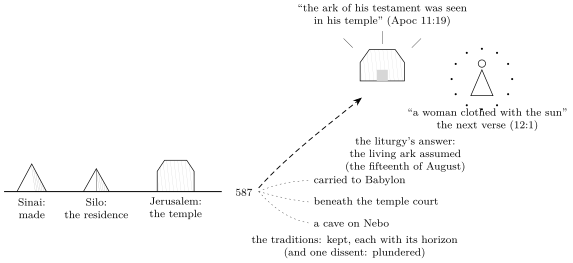
Drawing 7. The whole arc, drawn once: made at Sinai, resident at Silo, at rest in the temple, unaccounted for after Josias — then seen, at the last trumpet, in the opened temple in heaven, one verse before the sign of the woman. That the two verses are one movement is an ancient reading; that the movement is Mary’s is the lectionary’s, and the master table nearby holds both judgments apart and together.
The master table
The parallels this study has examined are summarized once, here, and nowhere else. Every row abbreviates a discussion given above, where its texts and endnotes stand. The grades are prose, on the two axes: what the words are, who anciently read them so, and what the Church has made of them.
| Parallel | Textual basis | Attestation | Reception |
|---|---|---|---|
| The journey: “Mary rising up… went” into the hill country of Juda | Lk 1:39 / 2 Kings 6:2; arose-and-went a stock LXX formula; weight only inside the cluster | none ancient; a modern philological reading (Laurentin’s school) | indirect: the Visitation Gospel set beside the ark procession across Lectionary 621/622 |
| The awed question at the door | Lk 1:43 / 2 Kings 6:9; partial verbal match; rival antecedent 2 Kings 24:21 | Jacob of Serugh, c. 500 | CCC 2676–2677 juxtapose title and verse without citing 2 Kings 6 |
| Elizabeth’s cry, anephōnēsen | NT hapax; five LXX uses, four in ark ceremonies; kraugē doubling 2 Kingdoms 6:15 | none ancient; modern concordance argument | none specific |
| Three months and the blessed house | mēnas treis verbatim; Douay “abode” both sides; the blessing explicit only in Kings | Jacob of Serugh; a late-medieval Visitation responsory (manuscript pending) | devotional (Liguori); no modern liturgical use of 2 Kings 6:11 |
| The leap and the dance | verbal negative: skirtan absent from 2 Kingdoms 6; Gen 25:22 the true verbal kin; Symmachus’ skirtōnta post-Lucan | Jacob of Serugh (motif, not lexicon) | none liturgical |
| The overshadowing | Lk 1:35 / Ex 40:35 LXX episkiazein; strictly the tent, not the ark; cherubim shadow-texts adjacent | ancient exegesis of the verse Christological; no ancient Visitation use | Marialis Cultus 26 with its patristic note; the Akathist’s gilding; Scheeben |
| Contents: manna, rod, tablets | Heb 9:4 fixes the contents; no NT Marian mapping | the title with the manna in late, partly pseudonymous homilies; the triple set modern catechesis | Dormition canon, Ode 6 furniture catalogue |
| Incorrupt wood, gold within and without | Ex 25:10–11; Hippolytus’s gilded ark is Christ’s body, “from the Virgin” | Christological in the 3rd c.; Marian transfer 5th c. | MD 26 (incorruptible-wood type); the 1950 office hymn |
| The propitiatory | kapporet / LXX hilastērion / Rom 3:25 of Christ | ancient and Christological (Gregory the Great at the tomb); the Marian extension unattested | none for the Marian extension |
| Ps 131:8 and the Assumption | Douay “the ark, which thou hast sanctified”; Latin arca sanctificationis tuae; in-Bible contrast at 2 Par 6:41 | Hesychius (Marian, 5th c.); Primasius (of Christ); the medieval office Paschal, not at the Assumption | MD 26 and 29; the Byzantine Dormition psalmody; Vigil refrain (1969) |
| Apoc 11:19–12:1: the ark and the Woman | one continuous vision; the chapter break thirteenth-century | continuity ancient (Tyconius: ark and woman one Church); the Marian join in no ancient commentator | Lectionary 622 splice (1969); MD 27 uses the Woman, never 11:19 |
| Jer 3:16 / 2 Mach 2: the unremade, hidden ark | texts verified; horizon eschatological, disclosure with cloud and glory | none Marian; the ancients joined Jer 3:16 to Apoc 11:19 for supersession | none; the project’s labeled synthesis, this section |
| Dagon falls / the idols of Egypt | 1 Kings 5:3–4; Is 19:1 with the apocryphal Flight narrative | the halves ancient, the splice modern; the patristic figure is the cloud, not the ark | Coptic Flight commemorations (reported) |
| Bethsames: fear before the holy | 1 Kings 6:19–20; no Lucan echo | none | none; homiletic use only |
| Obededom’s blessed house | 2 Kings 6:11 (the kernel graded with the three months above) | none beyond the three-months row | Liguori’s Visitation discourse |
| Oza and Joseph’s continence | no textual link; the tradition’s anchor is the closed gate of Ezechiel 44 | none — a modern devotional analogy; the closed gate itself patristic (Ambrose) | none; treated as devotional development in the coda |
The table should be read the way the study was written. The attestation column is honest to the point of severity: most rows show no ancient witness for the Marian reading. Where antiquity speaks at all it speaks of Christ first — his body the gilded ark, his flesh the ark of the Incarnation, his resurrection the psalm’s arising. The reception column is equally real: a catechism, a dogmatic constitution’s argument, two rites’ liturgies. The named distinction holds the two columns apart and holds them both: attestation is not reception, and the absence of either is not falsity. A tradition that put Christ first and let his Mother’s title grow from his — ark as bearer, figure from figure — is not a tradition caught inventing. It is a tradition developing in the only order sound doctrine allows.168
Where, then, is the ark? The question opened this study, and it can now be answered three times over. History answers: unknown — a last sighting under Josias, then silence. The canon answers: seen — in the opened temple of heaven, at the last trumpet, when the kingdom is the Lord’s. The liturgy answers: assumed — the living ark carried into the temple not made with hands, while the Church sings the psalm of the resting place. And the three answers end in one sentence, which is the whole of this study’s finding and the only map it offers: the ark is with God, carried into his rest by the One it carried.
Coda: Carrying the Presence
What the ark teaches is not, in the end, information about a box. It is the manners of creatures before the Presence. A journey, a pattern, and a reading have gone before this page, and this coda adds nothing to them. It asks the question the sources keep forcing on anyone who reads them slowly: granted all of that, how am I to behave? For the doctrine all of it rested on is not antiquarian. The God who spoke from between the cherubims has not withdrawn from the earth. He makes his abode with the man who loves him (John 14:23). Paul has to remind the Corinthians that their bodies are temples of the Holy Ghost (1 Corinthians 6:19). And every communicant walking back from the altar is, for those minutes, a bearer of Christ in a sense more literal than any figure in these pages. The modes of presence differ, and theology keeps them carefully distinct; the manners they ask of us are of one family. The first grammar of those manners is Israel’s long schooling before the ark.
The Visitation as the pattern of apostolate
Works are the overflow of a presence carried, or they are noise. The old masters of the interior life put this in a figure, restated here in the study’s own words: a cistern serves the valley below it only because it is first full, while a bare channel passes water all day, keeps none, and runs dry the hour its source is cut. The apostle is meant to be a cistern, not a channel.169
The first apostolic journey of the new covenant shows what that means. It was made by a woman newly with child. Mary, overshadowed by the power of the most High (Luke 1:35), “rising up” went “into the hill country with haste” (Luke 1:39). She brought Elizabeth no gift and no program; she brought only what she carried. At her plain greeting the house filled with the Holy Ghost — Elizabeth cried out, and “the infant in my womb leaped for joy” (Luke 1:44). Then the visit of the Presence became service. She “abode with her about three months” (Luke 1:56), the last months of an old woman’s difficult waiting, and her one recorded utterance in that house is praise, the Magnificat (Luke 1:46–55).170
The order of the narrative is itself the doctrine. Luke sets the overshadowing before the journey: she is filled before she is sent, and she does not go until she carries. Even her haste, the one detail a busy man reads with relief, will not serve as his alibi. It is not the haste of someone escaping an empty house but the overflow of a fullness that cannot wait to become service. And Luke, who records Elizabeth’s cry to the syllable, records not one word of the greeting that provoked it (Luke 1:40–41). What entered that house with Mary was not eloquence.171 Preachers extend the scene: the house that receives the bearer of Christ is blessed, as Obededom’s house was blessed in the ark’s three months there (2 Kings 6:11 = 2 Samuel 6:11). That is homiletics rather than demonstrated typology, and the project’s records say so plainly. But a coda is the lawful place for homiletics, and this homily claims only the principle already stated: where Christ is carried in, blessing follows him.
Then the examination writes itself, and it must be made in the first person or not at all. I have reason to fear that in me the channel has outrun the cistern: if I speak about God more fluently than I speak to him; if my works have multiplied in the same years in which my prayer has shortened; if I go everywhere with haste and could not say, on arriving, that I carry anything; if the last soul who left my company went away impressed by me and unchanged toward my Master. The figures this study has watched — Levites under the poles, David counting six paces, a young woman on the hill road into Juda — never confused the carrying with the thing carried. Let the whole long road condense to one question, small enough to take through any doorway on any errand: whom do I carry when I go?
Reverence, and the fear of the holy
The fear of the holy is not the opposite of love. It is love’s grammar. This study did not soften Oza or Bethsames, and it declines now to turn them into threats. The narratives are not blackmail; their lesson was drawn long since, and it stands: the Presence is not managed. The law had said it before either incident, and said it to the very men whose office was carrying: the sons of Caath were to bear the holy things only after the veiling, forbidden to look on them “by any curiosity… otherwise they shall die” (Numbers 4:20).172 The severity is Scripture’s own; the study’s part is only to refuse to explain it away. What God has taken for his own use is not afterward common. That is the whole grammar, and love speaks it or speaks something else.
But the same law that forbade the look prescribed the veiling, and the sentence that threatened the Caathites appointed them their poles and their shoulders. The severity and the tenderness are one provision. God did not leave Israel to guess how to come near; he taught them, in cubits and coverings and an appointed manner of carrying, how the unbearable could dwell in the middle of the camp and no one be destroyed. Reverence, in the canon, is not the distance love keeps from God. It is the nearness God makes possible for love. The survivors of Bethsames asked who could stand before so holy a God (1 Kings 6:20 = 1 Samuel 6:20), and the question was better than they knew. The rest of this study has been the long answer, and it ends with the Presence carried in a girl’s body and laid in a manger. The holiness never lessened. The provision widened.
The Church never outgrew that grammar; she set it to music. The Byzantine office of the Dormition, which hymns Mary as the living ark, carries in its canon the old Transitus episode of Jephonias, the insolent man who laid hands on the Virgin’s funeral bier and lost them — the liturgy’s own Oza, sung each fifteenth of August. On the eve of the same feast the Church reads Ezechiel’s vision of the east gate kept shut because the Lord had entered by it (Ezechiel 44:1–2).173 That shut gate is the Fathers’ figure for consecrated things. Ambrose asks, in his work on the instruction of a virgin, what that gate is if not Mary, shut because virgin. There — at the gate, not at Oza’s cart — the old tradition anchors what it says of St. Joseph’s continence.174
The modern devotional argument — that Joseph held back from his wife because he knew what befell those who touched the ark — must be labeled honestly: no ancient witness for it could be found. Pressed as an argument it proves too much. Elizabeth embraced Mary unharmed, and touch as such was never the ark’s offense; the Caathites were commanded to carry it, and the Chronicler locates Oza’s fault in transport against the law (1 Paralipomenon 15:13–15).175 It is a modern devotional development, consonant with the attested grammar of reverence but resting on none of the ancient texts. The ancient anchor is the shut gate, and it is enough.
And then the grammar turns on us, who assault no biers and are in little danger of Oza’s zeal, being rarely zealous enough to steady anything. The examination, again, in the first person. My genuflection — has it worn down to the bob of a man glancing at his watch, or is it still the body’s confession of what the lamp means? My communions — do I prepare for, and give thanks after, the reception of him whom the propitiatory only prefigured, with as much recollection as Israel spent on a gilded chest it was forbidden to see? My speech about holy things — has familiarity made it glib, the insider’s patter of a man handling sacred vessels like stock? My silence in church — do I keep any? These are not scruples. They are manners, and no one who has followed the ark from Sinai will mistake the manners of creatures before the Presence for etiquette.
Mary, bearer
Mary is in this study for one reason, and it is the reason she is in the Gospel: she carried Christ. The oldest ark typology the project verified is Christological. Hippolytus’s ark of imperishable wood is the Lord’s own body, its incorrupt timber from the Virgin; when the explicitly Marian title flowers in the fifth century, it flowers as a way of saying that same thing about her Son. John Damascene, on the day of her passing, called her the sacred and living ark of the living God, the ark that had conceived its own Maker.176 A modern abbot, writing for apostles, closed his book before a Byzantine icon of the Mother of God and read the whole interior life off its geometry: Jesus her center, her breath, her life; she carrying him, magnifying his voice, holding him out to be seen. His word for her was the monstrance.177 A monstrance is precious metal shaped entirely around what it holds. Empty, it is a curiosity in a case, and no one who kneels before it kneels to the gold.
Everything the Church says of Mary under the ark’s figure has exactly that shape, and the Church says so in her own voice: Mary’s maternal office adds nothing to the one mediation of Christ and takes nothing from it, but shows its power. Whatever she carries, and whatever grace her carrying brings near, is his.178 Israel’s reverence ran through the ark to the Presence between the cherubims; the Church’s runs through Mary to her Son. A devotion to her that stopped at her would be the figure emptied — the gold without the manna.
One practice, then, and this book has done its work if the reader takes nothing else from it. The next time I enter a church I will look first for the small flame beside the tabernacle. Israel had a cloud over the tent by day and “a fire by night” — and that “throughout all their mansions,” the Douay’s old word for every stopping-place of the pilgrimage. When the camp moved, the ark went before it, “for three days providing a place for the camp” (Exodus 40:36 Douay = 40:38; Numbers 10:33).179 The lamp keeps that watch still, two steps from the door of any parish church, at the end of the long road this study has walked from Sinai. I will genuflect like a man who has read the journey; keep a moment of silence like a man who has weighed the pattern; and go out carrying what I have received, as she went into the hill country. The ark still goes before the camp.
Scope, Status, and Qualifications
Question and coverage. This study answers: where the ark of the covenant went, so far as Scripture, tradition, and scholarship can say; what its journey teaches about presence, holiness, and the propitiatory; and how the Church came to read the Virgin Mary as the ark of the new covenant — in philology, Fathers, liturgy, and magisterium — with every parallel graded separately for attestation and reception, ending at Apocalypse 11:19–12:1 and the Assumption. It is a source-audited study under the repository’s Mariology profile: the narrative chapters follow the repository’s evidence discipline for historical accounts, and the philological chapters read each witness at its own locus and preserve disagreement. It is not a general Mariology, a liturgical book, an apparition study, or a guide to recovering the object. Excluded or bounded: contested archaeology is reported at its scholarly confidence and not adjudicated (Jericho’s event archaeology; the Mount Ebal structure); the Kebra Nagast and the Aksum claim are treated as fourteenth-century reception history; modern pseudo-archaeology is declined in a sentence; Islamic reception is bounded to one paragraph on Qur’an 2:248; source hypotheses about the ark narratives (Rost and successors) are noted without adjudication, the narrative standing on the canonical text; and no mediation title beyond the sense of Lumen Gentium 60–62 is advanced.
Authority classes, kept distinct. (1) Scripture supplies the whole substance: every canonical ark pericope from Exodus 25 to Apocalypse 11:19 is treated, quoted from the Douay-Rheims base text; the study adds nothing to public Revelation, and reads the unity of the two Testaments under Dei Verbum 12 and CCC 128–130, the rule stated in the chapter on the rules of typology. (2) Defined dogma touched here: the divine motherhood (Ephesus, 431) and the Assumption (1950). The Mary-ark typology itself belongs to no defined formula: Munificentissimus Deus deploys the type in its argument (nn. 26, 29, 34) and defines without ark language (n. 44), and the study claims nothing more. (3) Conciliar and papal magisterium, cited act by act: Ineffabilis Deus (1854); Munificentissimus Deus with its Acta text and notes; Marialis Cultus 6 and 26; CCC 489, 722, 2676–2677; Lumen Gentium 60–62 governing everything said of Mary, with the verified negative that the constitution never uses the title; John Paul II’s 1983 Angelus catechesis beside the silence of Redemptoris Mater. (4) Liturgical reception, treated as real evidence on the warrant stated in the chapter on the rules of typology: dated acts of two rites, from the Akathist and the Dormition Menaion through the Litany of Loreto (approved 1587, fixed 1601), the Damascene Matins lesson of the Roman office (1568–1950, verified here in a 1942 printing), the revised office of 1950, and the postconciliar Lectionary 621/622 with the Liturgia Horarum. (5) Patristic witness, carried with per-text authenticity classes: genuine and dated witnesses (Hippolytus, Ephrem, Proclus’s fifth oration, Hesychius, Chrysippus, Jacob of Serugh, John Damascene, and Augustine’s contrary exegesis); pseudonymous or disputed texts used only under honest labels (Ps.-Gregory Thaumaturgus, Ps.-Methodius, the Turin homily attributed to Athanasius, the sermon transmitted under both Ambrose’s and Maximus’s names, author unknown); and verified negatives printed as findings (no genuine Augustine or Ambrose Marian ark text; no ark in Cyril’s Ephesus homily; the silences of Cogitis me, Bernard, and Aquinas; the chant-index negative for the Assumption). (6) Historical scholarship: the ark-origins literature (de Vaux, Haran, Mettinger, Seow, Eichler, Noegel, and the compositional school), the excavation records of Shiloh and Jericho, Miller and Roberts, and the modern Apocalypse commentators (Bauckham, Aune, Beale) are reported as schools with premises; where a work was consulted at one remove, the note says so. (7) The Luke debate is presented as genuinely open and methodological: Burrows, Lyonnet, and Laurentin against Brown, Fitzmyer, Schürmann, Bovon, and Isaacs, with the Kozłowski and de Koning revival — both sides quoted at their strongest, no verdict imposed beyond what the Visitation section prints. (8) Editorial synthesis, labeled where it occurs: the study’s one framed synthesis box, in the Assumption section, joins 2 Machabees 2:7–8 to the seventh trumpet; the identification of Psalm 77:60–61’s “strength” and “beauty” with the ark is labeled source-grounded synthesis in the prose of the pattern section; and the master table’s prose grades, the fate-traditions table, and the coda’s homiletic extensions are project constructions grounded in the cited sources and labeled at their places.
The two axes. One promise of method governs the study, made in the overture and stated formally in the chapter on the rules of typology: facts exact, framework Catholic, labels honest. Questions of fact are settled by evidence; questions of interpretation are not settled by any school’s minimalism; liturgical and magisterial reception counts as evidence; and every disputed reading is declared in one or more of four states — philologically anchored, anciently attested, liturgically or magisterially received, or the project’s own labeled synthesis — under the named distinction that attestation is not reception, and the absence of either is not falsity.
Edition and as-of bounds. English Scripture is quoted throughout from the public-domain Douay-Rheims (Challoner) text as printed at drbo.org, with its book names (1–4 Kings, 1–2 Paralipomenon, Josue, Jeremias, 2 Machabees, Apocalypse) and Vulgate psalm numbers, dual citations given where confusion threatens. Septuagint claims follow Rahlfs numbering and were verified in a machine-readable derivative of Rahlfs 1935, independently re-run in an adversarial pass; a spot-check against the printed Rahlfs–Hanhart remains open below. New Testament Greek counts use the SBL Greek New Testament. The print contains no Greek or Hebrew script: Greek is transliterated in italics with macrons, Hebrew in plain unpointed transliteration; the exact scripts stand in the research records. All web witnesses were read 2026-08-15 unless a note states another date (the chant-index data were retrieved in August 2026). Mutable claims — the current lectionary selections, the Liturgia Horarum text served by derivative electronic witnesses, the Triodion rubric reported from modern liturgical resources — are stated as of those witnesses and dates and must be rechecked before reliance.
Translation status. Scripture in English is Douay-Rheims only. Patristic and ancient English quotations use identified public-domain translations, named at each locus: the Ante-Nicene and Nicene/Post-Nicene series translators, Morris (1847) for Ephrem, Livius (1893), Allies (1898) for the Damascene (an identification noted as not confirmed line by line), Marshall (1878) for Bede, Whiston for Josephus, Charles for 2 Baruch, Kraft and Purintun for 4 Baruch, Pickthall for the Qur’an. Quotations from in-copyright scholarly translations (the modern Apocalypse-commentary volumes; Scheeben’s translator) are kept to brief attributed scale. Texts with no public-domain English — the Turin homily, Jacob of Serugh, Gregory the Great’s homily, the Latin hymns and the Breviary lesson, Primasius, the Greek homilists where no public-domain rendering is credited — are given in labeled editorial paraphrase, each marked as a paraphrase and not a translation, or are described with their loci. Rabbinic, Menaion, and current lectionary texts are described or paraphrased with exact references; their modern English translations are not quoted. No prayer or liturgical text is offered for recitation, and the leaf therefore keeps no prayer-text audit.
Textual cruxes carried. The base text is quoted as printed and never silently emended; where the witnesses divide, the division is printed. The cruxes, each at its section: the Bethsames number, 1 Kings 6:19 (fifty thousand and seventy quoted as printed; the Masoretic anomaly, Josephus’s seventy, the Revised Standard Version’s flagged emendation, and the negative that 4QSam-a does not preserve the verse — the catastrophe section); the mice of 1 Kings 5:6 (Vulgate and Septuagint against the Hebrew — the same section); the mood and arithmetic of 1 Kings 7:2 (“rested” against the Hebrew’s lamenting; the twenty years — the same section); the word that killed Oza (Douay “for his rashness” as the Vulgate’s construal of the obscure shal, with 4QSam-a and 1 Paralipomenon 13:10 reading the touch — the processions section); Nachon against Chidon, and the sacrifices of the six paces (an ox and a ram against seven bulls, the scroll siding with Paralipomenon — the same section, tabled, not harmonized); the ark’s contents (nothing but the tables at 3 Kings 8:9 against the fuller inventory of Hebrews 9:4 — stated at Sinai, restated at the temple, untied nowhere); and the pronouns of Psalm 77:60–61 (the Douay’s “their” against the Hebrew’s “his” — the pattern section, with the ark identification labeled as synthesis).
Unresolved and outstanding. The open verification queue, disclosed note by note in the body and gathered here: the standing of Hesychius’s Homily V in Aubineau’s critical edition of the festal homilies was not consulted, and the attribution is carried under that caution; Mutzenbecher’s disposition of the doublet sermon remains unchecked; the Clementine Vulgate’s Psalm 131:8 was not collated against the registered Clementine edition (the same Latin stands verified in the Acta Apostolicae Sedis and in Migne’s Hesychius column); the machine-readable Septuagint corpus awaits its spot-check against the printed Rahlfs–Hanhart; the Visitation responsory Habitavit arca domini survives truncated in the chant index, and its Munich manuscript has not been read; whether the Damascene arca sentence stood in the 1568 editio princeps of the breviary lesson was not established; the a Lapide negative awaits a page-image check of an Antwerp edition; Jacob of Serugh is cited through Puthuparampil, the wording to be re-verified against Hansbury before any longer quotation; and the 1558 Dillingen print of the litany was not inspected. Several modern monographs are reported at one remove and flagged as such in their notes, including Laurentin’s and Brown’s pages as transmitted in Kozłowski, the ark-origins monographs, Miller and Roberts, and the modern Apocalypse commentaries. The ark-or-ephod variant at 1 Kings 14:18, noted in the research scope as a crux to preserve, was in the event not treated in the body and is recorded here as untreated. Outstanding review: independent Mariological, patristic, liturgical, historical, and rights review; collation against print editions; ecclesiastical review or approval (none claimed). Publication language for this artifact is “source-audited working reference.”
Drawings. The seven drawings are schematic readings of the texts they cite, not archaeological reconstructions; the map is not to scale and takes the traditional site identifications, as its caption states. Because the drawings cannot yet be carried into the web rendering path, this study is published in print form only, and its web edition is withdrawn until that path exists.
Records. Research records for this leaf, under research/: scope.md; source-audit.md; evidence-map.md (the narrative chapters’ evidence map); and source-bindings.toml (bindings into the repository source library).
References
Witnesses are listed with role and rights notes; the access date for all web loci is 2026-08-15 unless another date is stated in the endnote where the witness is used. Stable source identities are registered, or to be registered, in the repository source library; this publication’s bindings are in research/source-bindings.toml. The list contains only works cited in the study’s endnotes or named in its prose. Entries give the principal witnesses; subsidiary transcriptions and discussion pages used for single points stand in the endnotes at their loci, with exact URLs. Works consulted at one remove — known through reviews, through quotations transmitted verbatim in other works read for this study, or through search-level reporting — are listed as such; the body claims nothing from them beyond what the endnotes attribute.
Scripture and versions
-
Douay-Rheims Bible (Challoner revision; public domain), drbo.org chapter pages (e.g. https://drbo.org/chapter/10006.htm for 2 Kings 6). Role: every English Scripture quotation, with the Douay book names (Josue, 1–4 Kings, 1–2 Paralipomenon, Jeremias, 2 Machabees, Apocalypse) and Vulgate psalm numbers (77 = Hebrew 78; 131 = 132). Challoner’s note at 1 Kings 6:19 was read on the same chapter page.
-
Clementine Vulgate, as printed at drbo.org beside the English. Role: the Latin of Exodus 25:17, 22 and 3 Kings 6:19. Limit: the Latin of Ps 131:8 was not collated there; arca sanctificationis tuae rests on the AAS and Migne witnesses below.
-
Septuagint research instruments, described, never base text: the Elpenor edition (ellopos.net; versification offsets noted where cited); the machine-readable Rahlfs 1935 corpus of E. Wong, https://github.com/eliranwong/LXX-Rahlfs-1935, on which the lemma-level concordance searches were run and adversarially re-run; the Blue Letter Bible LXX pages (blueletterbible.org) confirming the decisive loci. A spot-check against the printed Rahlfs–Hanhart remains open (section 90).
-
SBL Greek New Testament, https://github.com/LogosBible/SBLGNT. Role: NT concordance counts and the critical text of Lk 1:42; Nestle 1904, Westcott–Hort, and the Byzantine tradition cited comparatively there.
-
Revised Standard Version, read at biblegateway.com. Role: comparative modern witness only — its translators’ note at 1 Samuel 6:19, its renderings where the Douay diverges, the description of 4 Esdras 10:21–22. In copyright; brief attributed use only.
-
Abegg, Flint, and Ulrich, The Dead Sea Scrolls Bible (1999), read in an archive.org lending copy. Role: the 4QSam-a evidence (coverage at 1 Kings 6; readings at 2 Kings 6:2, 6–7, 13). In copyright; reported and paraphrased. DJD XVII (2005) not consulted.
Magisterial and liturgical
-
Pius XII, Munificentissimus Deus (1 November 1950), Vatican English web text, https://www.vatican.va/content/pius-xii/en/apost_constitutions/documents/hf_p-xii_apc_19501101_munificentissimus-deus.html; Latin at AAS 42 (1950) 753–773, read in the scan https://www.vatican.va/archive/aas/documents/AAS-42-1950-ocr.pdf. Role: the Assumption definition; the ark at §§26, 29, 34 and there only; the footnote-20 finding; also the witness for Anthony of Padua (§29) and Bellarmine (§34), quoted only as transmitted there. Two defects of the vatican.va English are recorded in the notes.
-
Pius IX, Ineffabilis Deus (1854), English at papalencyclicals.net, translator unnamed; the Latin not checked against the Acta. Role: “the ark and house of holiness.”
-
Second Vatican Council: Dei Verbum (1965) §12, paraphrased throughout, no edition quoted; Lumen Gentium (1964), English and Latin from vatican.va, searched in full — doctrinal frame of the coda (LG 53, 60–62, paraphrased) and the verified negative for arca.
-
Paul VI, Marialis Cultus (1974), English and Latin at vatican.va. Role: vera Foederis Arca at MC 6; the ark clause and curated patristic note at MC 26 (Severus of Antioch, Hesychius, Chrysippus, Andrew of Crete, John Damascene; the Akathist in the companion note); the negatives recorded with them.
-
Catechism of the Catholic Church: Latin editio typica at https://www.vatican.va/archive/catechism_lt/p4s1c2a2_lt.htm; English second edition at the St. Charles Borromeo mirror (scborromeo.org). Role: §§112–114, 128–130 (typology, paraphrased); §§489, 722, 2676–2677 (the Daughter-Zion and ark fusion).
-
John Paul II: Angelus of 10 July 1983, Italian at vatican.va (document hf_jp-ii_ang_19830710), quoted briefly with editorial paraphrase; Redemptoris Mater (1987), searched — verified negative for “ark”; general audience of 2 October 1996, Italian (hf_jp-ii_aud_19961002), searched — no arca.
-
Breviarium Romanum, Pars Aestiva, 1942 printing, https://archive.org/details/breviarium-romanum-1942. Public domain. Role: the pre-1950 Matins of 15 August (the Damascene lesson Hodie sacra et animata arca…, quoted as printed; the Fortunatus hymn Quem terra, pontus, sidera in the Urban VIII revision) and the bound-in 1950 supplement (Arca non putri fabricata ligno). Latin quoted with labeled editorial paraphrases.
-
Roman Lectionary (1969) and current order of readings, verified at the USCCB readings pages, https://bible.usccb.org (Lectionary nn. 621–622; the Presentation responsorial at the daily-readings page for 2 February 2026). Role: the facts of selection, which are the reception data. Rights: Lectionary text copyright CCD, refrains copyright ICEL — described by reference, never quoted.
-
Liturgia Horarum, Lauds of 15 August, Latin served at societaslaudis.org, cross-checked at universalis.com (exact URLs in the reception notes). Both derivative witnesses; the editio typica altera not opened. Role: the arcam incorruptibilem intercession, Latin with editorial paraphrase.
-
Byzantine service texts, described rather than quoted because the accessible English translations are unidentified and presumptively copyrighted: the Reader Menaion for 15 August at st-sergius.org (Emenaion 08-15.pdf); the Antiochian Archdiocese Great Vespers text for 14 August; the Greek Orthodox Archdiocese feast and service descriptions at goarch.org (the Entrance readings; the consecration dialogue). Role: the Dormition psalmody and canon (Ps 131:8, 11; the animate ark; Jephonias; the Ode 6 catalogue), the Entrance lections (with their Protoevangelium substrate disclosed), the entrance liturgy.
-
Akathist hymn, ecclesiastical Greek read at Greek Wikisource (the Akathistos hymnos page; exact URL in the leaf’s source audit) and in the transcription at lyricstranslate.com. Role: stanza 23, kibōte chrysōtheisa tō Pneumati; anonymous, fifth–sixth century; the Romanos ascription unproven. Original PD; renderings editorial.
-
CANTUS indices: Cantus Index (https://cantusindex.org/id/006069a and correspondingly numbered pages) and the CANTUS Database full-text search (cantusdatabase.org), retrieved August 2026. Role: the medieval-office negatives and the late positives (Arca dei in qua reconditur; Habitavit arca domini, text truncated, manuscript pending).
Patristic and medieval witnesses
Identified public-domain translations are named at every quotation; texts with no public-domain English are given in the original language with labeled editorial paraphrases, per the rights rules.
-
Ante-Nicene Fathers (Roberts–Donaldson American edition; public domain), New Advent, CCEL, and Early Christian Writings transcriptions used as delivered: Justin, Dialogue with Trypho 36, 85 (vol. 1); Hippolytus, exegetical fragments (vol. 5, https://www.newadvent.org/fathers/0502.htm), the Daniel fragment quoted with its translation artifact corrected; Ps.-Gregory Thaumaturgus, Annunciation homilies (vol. 6, ccel.org), with the editors’ own spuria note; Ps.-Methodius, De Simeone et Anna (vol. 6), pseudonymous, fifth–sixth century or later; Victorinus, Commentary on the Apocalypse, Jerome’s recension (vol. 7, https://www.newadvent.org/fathers/0712.htm); Gospel of Nicodemus (vol. 8, earlychristianwritings.com).
-
Nicene and Post-Nicene Fathers (public domain), New Advent transcriptions: Augustine, Enarrationes in Psalmos 131, trans. Tweed, NPNF I/8, https://www.newadvent.org/fathers/1801132.htm — the Latin negative; Ephrem, Nativity hymns, NPNF II/13.
-
Ephrem, Hymns on the Nativity (Nat. 4; 16.16–17), quoted in the wording of J. B. Morris, Select Works of S. Ephrem the Syrian (Oxford, 1847; public domain), https://archive.org/details/selectworksofsep41ephr. McVey’s 1989 translation (in copyright) was read at archive.org for her editorial judgment that the ark of Nat. 4.113 is Mary; Brock’s guide (https://syri.ac/brock/ephrem) is the genuineness control; the Ephraem Graecus prayers are excluded as pseudonymous.
-
Hippolytus, Commentary on Daniel IV.24, trans. T. C. Schmidt (2010), witness PDF cited in the notes (pergrazia.com). In copyright; brief attributed use. Role: the content-match giving the ark to Christ’s own body.
-
Patrologia Graeca (Migne; public domain), archive.org scans (https://archive.org/details/PatrologiaGraeca): Proclus, Or. V, PG 65:719–720 (genuine per Constas, reported) and Or. VII, PG 65:759–760 (authenticity unsorted); Hesychius, Homily V De S. Maria Deipara, PG 93:1461–1464 (corrected columns; Aubineau’s disposition pending); the Collectio dictorum among Cyril of Alexandria’s works, PG 77:1221–1224, doubtful and so labeled; Cyril, Ephesus Homily 4, PG 77:991–996, and Homily 11, PG 77:1029–1040 — verified negatives for kibōtos. Greek and Latin quoted with labeled paraphrases; short English phrases credited to Livius.
-
John of Damascus, Dormition homilies, PG 96:700–761 (Hom. II at 722–754, reported columns). English: the circulating text of Hom. II §2, read at malankaraworld.com, appears to be Mary H. Allies (1898; public domain), the identification not confirmed line by line and so flagged; the Latin verified in the 1942 Breviarium. Role: the summit text and Roman Matins lesson 1568–1950.
-
Chrysippus of Jerusalem, Oratio in sanctam Mariam Deiparam, ed. Jugie, Patrologia Orientalis 19.3 (1926) 336–343, scan at https://archive.org/details/patrologiaorient19pariuoft; PO 19 is US-public-domain; English snippets Livius’s. Setting per the Oxford Cult of Saints record E04681 (URL in the notes; the Hesychius record E05888 reported).
-
The doublet sermon, under its own honest label: an anonymous Latin sermon on David’s dance and the ark, transmitted under both Ambrose’s name (PL 17:689, among the spuria) and Maximus of Turin’s (PL 57:737–740), probably fifth–sixth century or later; Latin read in the PL 57 scan cited in the notes, with Bruni’s admonitio; English excerpts Livius p. 77; Mutzenbecher’s disposition pending.
-
Jacob of Serugh, homilies on the Annunciation and Visitation, ed. Bedjan (Paris, 1902), pp. 614–774; English in M. Hansbury, On the Mother of God (1998; in copyright), reported with loci via J. Puthuparampil, Mariological Thought of Mar Jacob of Serugh, read in full at https://archive.org/details/mariologicalthou0000jame. Paraphrased; no long quotation pending re-verification against Hansbury.
-
The Turin homily attributed to Athanasius: ed. Lefort, Le Muséon 71 (1958). No PD English; described, not quoted; attribution disputed, no located scholarly defense.
-
Gregory the Great, Homiliae in Evangelia 25.3 (PL 76:1189–1196), Latin read at la.wikisource.org; labeled paraphrase.
-
Patrologia Latina scans for the Latin negatives: Cogitis me (Ps.-Jerome; Paschasius Radbertus), PL 30:121–147 — verified negative for arca, OCR-grade caveat; Bernard, Assumption sermons, PL 183 — the sole arca Noah’s (archive.org items in the notes). Ambrose, De institutione virginis 8.52 (PL 16), reported for the porta clausa figure, the column not independently verified; Jerome’s parallel (Comm. in Hiezechielem XIII) likewise reported.
-
Irenaeus, Demonstration of the Apostolic Preaching 84, read at tertullian.org; paraphrase only.
-
The ancient Apocalypse commentators, in the Fathers of the Church series, read in the archive.org collection cited in the notes: Oecumenius, trans. Suggit, FOTC 112 (2006); Andrew of Caesarea, trans. Constantinou, FOTC 123 (2011); Tyconius, Expositio Apocalypseos (CCSL 107A, ed. Gryson), trans. Gumerlock, FOTC 134 (2017); Cassiodorus and the anonymous Greek scholia, FOTC 144 (2022). In copyright; quotations at brief attributed scale, the rest paraphrase. Role: the commentary audit at Apoc 11:19–12:1.
-
Primasius, Commentarius in Apocalypsin (CCSL 92, ed. Adams), Latin verified against the full transcription at turretinfan.blogspot.com (August 2023 post), carried at transcription level with that caution; paraphrases editorial.
-
Bede, The Explanation of the Apocalypse, trans. E. Marshall (Oxford, 1878; public domain), https://archive.org/details/explanationapoc00bedegoog; quoted verbatim.
-
Thomas Aquinas, Summa theologiae I-II q. 102 a. 4 ad 6, English Dominican translation (public domain), https://www.newadvent.org/summa/2102.htm; the negative across ST III qq. 27–37 checked on the same site.
Historical scholarship
-
Frederick Field, Origenis Hexaplorum quae supersunt (Oxford, 1875), vol. I, page images at https://archive.org/details/origenhexapla01unknuoft. Public domain. Role: Symmachus’s skirtōnta (p. 555 n. 28); the Old Greek vacat at 2 Kings 6:7; the threshing-floor variants.
-
J. Gildemeister, ed., Theodosius, De situ terrae sanctae (1882), https://archive.org/details/theodosiusdesit00theogoog. Public domain. Role: the oldest Ein Karem witness (§35, a distance only); renderings editorial.
-
Thomas Livius, The Blessed Virgin in the Fathers of the First Six Centuries (London: Burns & Oates, 1893). Public domain. Role: the identified PD English for the Hesychius and Chrysippus snippets and the doublet-sermon excerpts. Limit: he cites Migne appendices without flagging spuria; two propagated citation errors are corrected in the notes.
-
A. De Santi, “Litany of Loreto,” The Catholic Encyclopedia, vol. 9 (1913), read at Wikisource. Public domain. Role: the litany’s history — the 1558 print, the 1587 approbation, the 1601 fixing.
-
Alphonsus Liguori, The Glories of Mary (1750), first complete English translation (New York, 1862; 1888 printing), searched in full at https://archive.org/details/thegloriesofmary00liguuoft. Public domain. Role: the devotional assembly of the Visitation “living ark” and the Ps 131:8–2 Kings 6 fusion.
-
Cornelius a Lapide, The Great Commentary, trans. Mossman, and the Latin Commentaria, searched at the witnesses in the notes (catholicapologetics.info; archive.org). Role: the verified negative at Luke 1:39–56. Limits: Mossman abridges; the Latin OCR is poor; an Antwerp page-image check remains open.
-
John Henry Newman, Meditations and Devotions, Discourses to Mixed Congregations 17–18, the searched sections of the Letter to Pusey, from newmanreader.org. Public domain. Role: the eloquent negative — zero occurrences of “ark.”
-
Matthias Scheeben, Mariology I, trans. Geukers (1946; German 1882), archive.org scan in the notes. Translation in copyright; brief attributed quotations. Role: the ark in modern dogmatics, with Scheeben’s own Christological policing.
-
Jean-Baptiste Chautard, The Soul of the Apostolate (Gethsemani translation, 1946), read at the mountsaintbernard.org PDF. Copyright unresolved; paraphrased, never quoted. Role: the cistern-and-channel and monstrance figures, restated; register model for the coda.
-
Joseph Ratzinger, Daughter Zion (Ignatius, 1983; German 1977), quoted from the Ignatius Press excerpt in Catholic World Report (25 March 2025; URL in the notes); page numbers not established. In copyright; brief attributed quotations.
-
Marie E. Isaacs, “Mary in the Lucan Infancy Narrative,” The Way Supplement 25 (1975), https://www.theway.org.uk/back/s025Isaacs.pdf, read in full. Role: the critical school’s soberest statement, quoted at her own grounds. In copyright; brief attributed quotations.
-
Jan M. Kozłowski, “Mary as the Ark of the Covenant in the Scene of the Visitation (Luke 1:39–56) Reconsidered,” Warszawskie Studia Teologiczne 31/1 (2018) 108–116, https://czasopismowst.pl/index.php/wst/article/view/159, read in full. Role: the modern revival; also the transmitting witness for the verbatim quotations of Laurentin, Brown, Fitzmyer, Schürmann, Bovon, Strauss, and Rice (his notes 8–10, checked in full). His 2017 ETL article and 2022 Antigone essay are reported.
-
Jacobus d. W. de Koning, “Maria as anti-tipe van die verbondsark in Lukas 1:39–56,” In die Skriflig 54(1), a2561 (2020), https://indieskriflig.org.za/index.php/skriflig/article/view/2561, read in full. Role: the Reformed statement of the typology.
-
The Lucan debate, consulted at one remove (loci as transmitted in Kozłowski 2018 and Isaacs, or from publishers’ records; none opened at its own pages): Burrows, The Gospel of the Infancy (1940); Lyonnet, Biblica 20 (1939); Laurentin, Structure et théologie de Luc I–II (1957) and A Short Treatise on the Virgin Mary (ET 1991); Brown, The Birth of the Messiah (1993); Fitzmyer (AB 28, 1981); Schürmann (1969); Bovon (1989; Hermeneia 2002; Luke the Theologian); Strauss (1995); Rice (2016); Goulder and Sanderson, JTS 8 (1957); Serra, La Donna dell’Alleanza (2006); Feuillet, Jésus et sa mère (1974) and RB 66 (1959); de la Potterie, Mary in the Mystery of the Covenant (1992).
-
Ark-and-cherubim scholarship, consulted at one remove (reviews, surveys, publishers’ listings): de Vaux, Ancient Israel (ET 1961); Haran (1978); Mettinger (1982); Seow (ABD 1, 1992); von Rad (ET 1966); Eichler, The Ark and the Cherubim (2021); Ahlström (JNES 43, 1984); van der Toorn and Houtman (JBL 113, 1994); Kitchen (2003); Noegel (2015); Miller and Roberts, The Hand of the Lord (1977); Rost (1926); McCarter (AB 9, as reported); with Gunkel and Mowinckel for the entrance-liturgy hypothesis, and Lightfoot’s Horae Hebraicae as transmitted by Adam Clarke.
-
Site archaeology: the Shiloh sequence and burn layer, read at the Emek Shaveh and Associates for Biblical Research pages cited in the notes, the excavators’ claims reported at one remove; the Jericho literature (Sellin–Watzinger, Garstang, Kenyon) and Zertal’s Ebal claims, reported, not re-examined.
-
Patristic scholarship, reported: Constas, Proclus of Constantinople and the Cult of the Virgin in Late Antiquity; Aubineau, Les homélies festales d’Hésychius de Jérusalem (not yet consulted — open item, section 90); Mutzenbecher’s CCSL 23 (pending); the Oxford Cult of Saints records named above; DiPippo’s compendium of breviary reforms at newliturgicalmovement.org.
-
Apocalypse scholarship, reported at one remove: Bauckham, The Climax of Prophecy (1993), via a transcription at exegesisandtheology.com; Aune (WBC 52B, 1998) and Beale (NIGTC, 1999) as reported at readingacts.com. None consulted in the editions named.
Jewish, Samaritan, Islamic, and other ancient sources
-
Josephus, Antiquities and Jewish War, in William Whiston’s translation (public domain), Project Gutenberg ebooks 2848 and 2850 (https://www.gutenberg.org/ebooks/2848; https://www.gutenberg.org/ebooks/2850), with Ant. 18.85–89 verified at lexundria.com and the Greek at the Scaife Viewer (URNs in the notes). Role: the seventy of Bethsames with Whiston’s note; the Samaritan sacred-vessels episode of AD 36; the empty Second-Temple sanctuary.
-
Vitae Prophetarum, Jeremias chapter, ed. and trans. C. C. Torrey (SBL Monograph 1, 1946), read at http://lotp.thebookofenoch.info/ with the edition scan at https://archive.org/details/SBLMS1; Hare’s OTP rendering reported. The 1946 renewal status was not established, so the chapter is paraphrased; the possibly Christian sign-clause is flagged in use.
-
2 Baruch 6, trans. R. H. Charles (1896; public domain), verified at https://www.pseudepigrapha.com/pseudepigrapha/2Baruch.html, cross-checked at the Wesley Center Online; the “holy ark”/“ephod” caution printed with the quotation.
-
4 Baruch 3, in the public-domain translation of Kraft and Purintun, verified at http://ccat.sas.upenn.edu/rak//publics/pseudepig/ParJer-Eng.html.
-
4 Esdras 10:21–22, described from the RSV at Bible Gateway per the rights rules; an appendix witness, the dissenting “plundered” voice.
-
Mishnah and Babylonian Talmud: m. Sheqalim 6:1–2; b. Yoma 52b, 53b–54a, read via the Sefaria API (https://www.sefaria.org/Yoma.52b and correspondingly named pages); b. Rosh Hashanah 31a with Lamentations Rabbah, proem 25, reported. Rights: the William Davidson (Steinsaltz) English is CC BY-NC and is not quoted; all rabbinica paraphrased with exact loci.
-
Tacitus, Historiae 5.9, Latin verified at https://www.thelatinlibrary.com/tacitus/tac.hist5.shtml; English editorial. Role: the pagan witness to the empty sanctuary.
-
Qur’an 2:248, in Pickthall, The Meaning of the Glorious Koran (1930; US public domain since 2026), verified via the quran.com API (https://quran.com/2/248); the tafsir elaborations and Mahdi traditions are reported leads, loci unverified.
-
Kebra Nagast (early fourteenth century; Yeshaq of Aksum), dated on the colophon as fixed by Conti Rossini, Littmann, and Cerulli (reported); verified at the level of the sourced survey at https://en.wikipedia.org/wiki/Kebra_Nagast and Budge’s 1922 introduction at sacred-texts.com; Ullendorff’s 1941 examination reported via Munro-Hay. Role: reception history of the Aksum claim and the tabot practice.
Last revised (UTC): 2026-09-24T15:27:14Z
Reuse and rights. To the extent Triptych holds the rights, project-created content and design are licensed under CC BY 4.0. Scripture, liturgical or official texts, received prayers or hymns, quotations, fonts, and other third-party material retain their own status; public-domain material remains public domain. Identify changes. Attribution implies neither Triptych nor ecclesiastical approval. See LICENSE and THIRD_PARTY.md in the source.
-
Hebrews 9:4–5; Apocalypse 11:19 and 12:1; Douay-Rheims (Challoner) numbering and naming, read at https://drbo.org/chapter/65009.htm, https://drbo.org/chapter/73011.htm, and https://drbo.org/chapter/73012.htm. All web loci cited in these notes were read on 2026-08-15 unless another date is stated; full bibliographic detail and witness identifications are in the References. ↩
-
Exodus 25:10, 15–18, 20–22, Douay-Rheims (Challoner), read at https://drbo.org/chapter/02025.htm. All Scripture quotations in this section are Douay-Rheims wording as printed at the drbo.org chapter pages cited in these notes. Modern versions render setim as “acacia” (so the RSV at Ex 25:10, cited here as a comparative modern witness, not as base text). ↩
-
Septuagint wording from the Elpenor edition (the Greek text of the Church of Greece, with the ark command at LXX Ex 25:9 and the propitiatory at LXX 25:16; the Elpenor versification runs one verse behind the Hebrew in this stretch), read at ellopos.net. Clementine Vulgate as printed at drbo.org: Ex 25:17 “Facies et propitiatorium de auro mundissimo”; Ex 25:22 “Inde praecipiam, et loquar ad te supra propitiatorium, ac de medio duorum cherubim.” ↩
-
Douay “oracle” for the propitiatory zone: Ex 25:18, 20 (https://drbo.org/chapter/02025.htm); Lev 16:2, 13 (https://drbo.org/chapter/03016.htm). For the inner chamber: 3 Kings 8:6 (https://drbo.org/chapter/11008.htm); and the Latin of 3 Kings 6:19 (= 1 Kings 6:19), Clementine Vulgate as printed at drbo.org: “Oraculum autem in medio domus, in interiori parte fecerat, ut poneret ibi arcam foederis Domini”. ↩
-
Num 14:44 at https://drbo.org/chapter/04014.htm; Heb 9:4 at https://drbo.org/chapter/65009.htm; Apoc 11:19 at https://drbo.org/chapter/73011.htm. The Douay renders the covenant construct now “covenant,” now “testament”; “ark of the testimony” translates a second Hebrew construct, aron ha-edut, but the referent is the same chest. ↩
-
Luke 17:26–27 at https://drbo.org/chapter/49017.htm; the Greek kibōtos is verified in the project’s records at LXX Ex 25:9, Heb 9:4, and Apoc 11:19. ↩
-
Exodus 31:1–11 and 37:1–9, cited in paraphrase; the loci are verified in the project’s Scripture corpus, but the Douay wording of these verses was not separately re-anchored, so no English quotation is printed. The Greek sentence is LXX Ex 38:1 (Elpenor edition, ellopos.net), where the differently ordered Greek construction account places the making of the ark. ↩
-
Deuteronomy 10:1–8, Douay-Rheims, https://drbo.org/chapter/05010.htm. ↩
-
Both the harmonistic two-ark proposal (transmitted in rabbinic tradition) and the source-critical assignment (a plain Deuteronomic chest; a golden Priestly ark) are reported literature, summarized at one remove in the project’s research records and not verified at their loci for this study. ↩
-
Exodus 16:33–34 and Numbers 17:10, cited in paraphrase with loci; the before-the-testimony placement is explicit at both. Douay wording for these verses was not re-anchored in the project’s records, so no quotation is printed. ↩
-
Deuteronomy 31:9, 24–26, cited in paraphrase; loci verified in the project’s Scripture corpus. ↩
-
Exodus 40, Douay-Rheims, https://drbo.org/chapter/02040.htm. Douay Exodus 40 has thirty-six verses; the cloud-and-glory pericope stands at Douay 40:32–36 = Hebrew and RSV 40:34–38. Dual citation is given once here; Douay numbers are used hereafter. ↩
-
Numbers 7:89, cited in paraphrase; locus verified in the project’s Scripture corpus. ↩
-
Numbers 4:5–6, 15, 20, Douay-Rheims, https://drbo.org/chapter/04004.htm. ↩
-
Leviticus 16:2, 12–15, Douay-Rheims, https://drbo.org/chapter/03016.htm. ↩
-
Reported literature, consulted at one remove (reviews, survey articles, and publisher listings; each position remains to be spot-checked at its own pages before further weight is placed on it): Roland de Vaux, O.P., Ancient Israel: Its Life and Institutions, trans. John McHugh (1961); Menahem Haran, Temples and Temple-Service in Ancient Israel (Oxford: Clarendon, 1978), who refines the throne reading into a single composite structure of chest, propitiatory, and cherubim; Tryggve N. D. Mettinger, The Dethronement of Sabaoth: Studies in the Shem and Kabod Theologies (Lund: Gleerup, 1982), who sets that throne within a whole pre-exilic theology of Sion, the King unseen upon the cherubims; C. L. Seow, “Ark of the Covenant,” in The Anchor Bible Dictionary, vol. 1 (New York: Doubleday, 1992); Gerhard von Rad, “The Tent and the Ark,” in The Problem of the Hexateuch and Other Essays, trans. E. W. Trueman Dicken (1966); Raanan Eichler, The Ark and the Cherubim, FAT 146 (Tübingen: Mohr Siebeck, 2021), whose bibliographic details are verified at the publisher’s listing and whose argument is reported from reviews. ↩
-
1 Paralipomenon 28:2, Douay-Rheims, https://drbo.org/chapter/13028.htm; Psalm 131:7, https://drbo.org/chapter/21131.htm; the enthronement title beside the ark at 1 Kings 4:4 and 2 Kings 6:2 (= 1 Samuel 4:4; 2 Samuel 6:2). The Douay coordinates “the ark of the Lord, and the footstool of our God” as two items; the reading of the ark as itself the footstool is an interpretation of the verse, not its surface. ↩
-
The compositional case: G. W. Ahlström, “The Travels of the Ark: A Religio-Political Composition,” Journal of Near Eastern Studies 43 (1984); Karel van der Toorn and Cees Houtman, “David and the Ark,” Journal of Biblical Literature 113 (1994). The Late Bronze comparative case: Kenneth A. Kitchen, On the Reliability of the Old Testament (Grand Rapids: Eerdmans, 2003); Scott B. Noegel, “The Egyptian Origin of the Ark of the Covenant,” in Israel’s Exodus in Transdisciplinary Perspective, ed. T. E. Levy, T. Schneider, and W. H. C. Propp (Cham: Springer, 2015); Eichler as in the previous note. All are reported literature, consulted at one remove; none was opened at the page for this study. ↩
-
Numbers 10:33–36, Douay-Rheims, https://drbo.org/chapter/04010.htm. Verse 34, the cloud “over them by day,” is quoted only in the fragment captured in the project’s records and is otherwise paraphrased; the witness block below accordingly prints verses 33 and 35–36. ↩
-
Josue 3:3–4, 15, Douay-Rheims (Challoner), read at https://drbo.org/chapter/06003.htm; the flood-stage notice and the two-thousand-cubit interval are paraphrased from the chapter as printed. ↩
-
Josue 3:11, Douay-Rheims (Challoner), read at https://drbo.org/chapter/06003.htm, as quoted; repeated in substance at 3:13, “the ark of the Lord the God of the whole earth.” ↩
-
Josue 3:13, 15–17, Douay-Rheims (Challoner), read at https://drbo.org/chapter/06003.htm; quoted phrases as printed there: the waters “shall stand together upon a heap” (3:13), “swelling up like a mountain,” “stood girded upon the dry ground in the midst of the Jordan” (3:15–17). ↩
-
Josue 4:6–9, 18, 21–24, paraphrased at the locus (wording checked in a modern edition, not re-anchored in Douay for quotation). Gilgal itself has never been identified; candidate sites northeast of Jericho remain unconfirmed, and this study says only “near Jericho, site unknown.” ↩
-
Josue 6:4, 6–13, Douay-Rheims (Challoner), read at https://drbo.org/chapter/06006.htm; quoted phrases as printed: the trumpets “used in the jubilee” (in the opening instructions, 6:4–8), “the ark of the Lord went about the city once a day” (6:11), “the rest of the common people followed the ark” (6:13). ↩
-
Site identification and the state of the question are reported from the standard excavation literature (Sellin and Watzinger, Garstang, Kenyon): the identification of Tell es-Sultan is secure; Kathleen Kenyon’s finding that the fortified Bronze Age city was destroyed long before any plausible conquest horizon is the crux of the event-archaeology dispute. Reported at one remove; not re-examined for this study. ↩
-
Josue 7:6, paraphrased at the locus. ↩
-
Josue 8:30–35, paraphrased at the locus (8:33 checked in a modern edition this study’s research records identify; not re-anchored in Douay for quotation); the commanded rite is Deuteronomy 27. The site of Shechem is securely Tell Balata; the structure on Mount Ebal excavated by Adam Zertal and read by him as Josue’s altar remains sharply contested, and the associated “curse tablet” claim of 2019–2022 has not won peer acceptance — both reported, neither relied on. ↩
-
Judges 20:27–28, paraphrased at the locus (the Douay’s temporal marker there is “At that time”); the inference from the chronological notice to an early setting for the book’s closing episodes is an interpretive commonplace, reported as such. The pitching of the tent at Silo is Josue 18:1; the yearly feast at Silo is Judges 21:19. ↩
-
1 Kings 3:3 (= 1 Samuel 3:3), Douay-Rheims (Challoner), read at https://drbo.org/chapter/09003.htm, as quoted; the call follows in 3:4–14. The meeting-promise is Exodus 25:22, treated in the Sinai section above. ↩
-
Psalm 77:60, Douay numbering (= Psalm 78:60), Douay-Rheims (Challoner), read at https://drbo.org/chapter/21077.htm; the fragment is quoted as printed there. Verses 60–61 are block-quoted, with their textual disclosure, where the pattern of the journey is drawn below. ↩
-
Jeremias 7:12, Douay-Rheims (Challoner), read at https://drbo.org/chapter/28007.htm, as quoted; the threat is turned on the temple itself at 7:14, and the sermon is reprised in Jeremias 26. ↩
-
The identification rests on the survival of the name, the precise directions of Judges 21:19, and a century of excavation. Excavation sequence: the Danish expedition under Hans Kjaer, 1926–1932 (with a season in 1963); Israel Finkelstein for Tel Aviv University, 1981–1984; renewed soundings from 1988; the Associates for Biblical Research under Scott Stripling since 2017. Sequence per the site reports read for this study, https://emekshaveh.org/en/wp-content/uploads/2013/07/13-Tel-Shiloh-Eng-03.pdf and https://biblearchaeology.org/50-the-shiloh-excavations/4345-research-on-shiloh; the burn-layer particulars, the mid-eleventh-century date, and the cultic reading of the bone deposit are the excavators’ published account, reported at one remove. ↩
-
The conduct of the sons of Heli and the oracle of the man of God against the house of Heli: 1 Kings 2 (= 1 Samuel 2), paraphrased at the chapter. ↩
-
Douay-Rheims (Challoner), 1 Kings 4:4, read at https://drbo.org/chapter/09004.htm. Douay’s 1–2 Kings are the books called 1–2 Samuel in Hebrew-numbered Bibles; its 3–4 Kings are 1–2 Kings. The section quotes the Douay text as printed throughout. ↩
-
Douay-Rheims, 1 Kings 4:11, at https://drbo.org/chapter/09004.htm. ↩
-
Douay-Rheims, 1 Kings 4:21–22, at https://drbo.org/chapter/09004.htm; verse 21 is elided in the witness block as shown (its remaining clauses, on her father in law and her husband, were not re-verified verbatim for this study’s records). ↩
-
Douay-Rheims, 1 Kings 6:1, at https://drbo.org/chapter/09006.htm. ↩
-
Douay-Rheims, 1 Kings 5:3–4, at https://drbo.org/chapter/09005.htm. ↩
-
Douay-Rheims, 1 Kings 5:6, at https://drbo.org/chapter/09005.htm. “Emerods” is the old English for tumors. The mice clause is a genuine version divergence: the Vulgate, with the Septuagint, reads a plague of mice already at 5:6, where the Masoretic Hebrew (so the Revised Standard Version and most moderns) has only the tumors, mice first appearing at 6:4–5 as the golden images of the guilt offering. The study prints its base text and reports the divergence; it does not harmonize. ↩
-
Douay-Rheims, 1 Kings 6:7–9, at https://drbo.org/chapter/09006.htm; “coasts” in the older English sense of borders. Bethsames is Douay’s form of Beth-shemesh. ↩
-
Douay-Rheims, 1 Kings 6:19, at https://drbo.org/chapter/09006.htm, quoted in the witness block as printed. ↩
-
Masoretic reading as printed in the Revised Standard Version’s translators’ note at 1 Samuel 6:19: “Cn: Heb of the people seventy men, fifty thousand men” (RSV, read at https://www.biblegateway.com); the RSV text prints “he slew seventy men of them” — a correction, so flagged by the translators themselves. Septuagint (Rahlfs) at 1 Kingdoms 6:19, read via Blue Letter Bible (blueletterbible.org): kai ouk ēsmenisan hoi huioi Iechoniou en tois andrasin Baithsamus, hoti eidan kibōton kyriou, kai epataxen en autois hebdomēkonta andras kai pentēkonta chiliadas andrōn — the sons of Jechonias did not rejoice among the men of Bethsames when they saw the ark of the Lord; the clause is absent from the Hebrew, and the Greek keeps both numbers. The standard apparatus further reports a few medieval Hebrew manuscripts lacking the fifty thousand. ↩
-
Josephus, Antiquities 6.1.4 (Niese §16), Greek text read via the Scaife Viewer (scaife.perseus.org),
-
Coverage per The Dead Sea Scrolls Bible (Abegg, Flint, and Ulrich, 1999), 1 Samuel apparatus, read in an archive.org ebook for this study’s research records: 4QSam-a preserves 1 Kings (1 Samuel) 6:1–7, 12–13, 16–18, 20–21 — not verse 19. The primary edition is DJD XVII (2005), not consulted directly. ↩
-
Challoner’s note at 1 Kings 6:19, read on the same drbo.org chapter page, quoted verbatim. ↩
-
Douay-Rheims, Numbers 4:20, at https://drbo.org/chapter/04004.htm; “by any curiosity” is the Vulgate’s interpretive gloss, matching Challoner’s “curiously looked into” at 1 Kings 6:19 — the version’s own internal cross-reference, quoted here as the Douay tradition’s reading, not as a rendering of the Hebrew. ↩
-
Douay-Rheims, 1 Kings 7:1, at https://drbo.org/chapter/09007.htm. “Gabaa” renders the Hebrew for “the hill” as a place name. ↩
-
Douay-Rheims, 1 Kings 7:2, at https://drbo.org/chapter/09007.htm, with the parenthesis as printed. The mood of the verse is itself a version divergence: the Vulgate’s requievit (“rested following the Lord”) stands against the Hebrew as modern versions render it — RSV “lamented after the Lord” — rest in one tradition, homesick mourning in the other. Quoted as printed; divergence disclosed. ↩
-
Patrick D. Miller, Jr., and J. J. M. Roberts, The Hand of the Lord (Johns Hopkins University Press, 1977) — reported here from the study’s research records at the level of the book’s thesis; the monograph was not itself opened for this study. It stands within a longer source-critical debate over these chapters, running since Leonhard Rost’s 1926 monograph, whose existence the study notes without adjudicating. ↩
-
2 Kings 6, Douay-Rheims (Challoner), https://drbo.org/chapter/10006.htm. Douay 6:2 reads “of the men of Juda” (Vulgate de viris Juda) where the received Hebrew has what modern versions print as the place-name Baale-judah; the oldest Samuel manuscript, 4QSam-a, reads a place-name here outright — Baalah, there identified with Cariathiarim (the identifying phrase partly restored in the scroll), as at 1 Paralipomenon 13:6 (The Dead Sea Scrolls Bible, ed. Abegg, Flint, and Ulrich, 1999, notes to 2 Samuel 6, read at archive.org). ↩
-
1 Paralipomenon 13:3, 5, Douay-Rheims, https://drbo.org/chapter/13013.htm. ↩
-
Numbers 4:15, Douay-Rheims, https://drbo.org/chapter/04004.htm: “then shall the sons of Caath enter in to carry the things wrapped up: and they shall not touch the vessels of the sanctuary, lest they die.” The transport law is set out in the Sinai chapter of this study; the Philistine cart, in the chapter on the ark’s captivity (1 Kings 6:7–9). ↩
-
The name of the threshing floor is garbled in every direction: Nachon (Douay 2 Kings 6:6, with the received Hebrew); Chidon (Douay 1 Paralipomenon 13:9); Nodab in the Vatican manuscript of the Greek (Rahlfs, 2 Kingdoms 6:6, heōs halō Nōdab, read at blueletterbible.org); Nachor, with Achor as a variant, in the hexaplaric witnesses; Aquila took it for no name at all but rendered “the prepared threshing floor” (halōnos hetoimēs), a reading Field’s note finds preserved also in Eusebius’s Onomasticon; the Samuel scroll 4QSam-a has yet another form, reported in the literature as Nodan; Josephus has Cheidon (Antiquities 7.81, as reported). Field, Origenis Hexaplorum quae supersunt (Oxford: Clarendon, 1875), vol. I, p. 555, https://archive.org/details/origenhexapla01unknuoft; The Dead Sea Scrolls Bible, notes to 2 Samuel 6. An unfamiliar name, variously copied; no witness deserves the crown. ↩
-
Field, Origenis Hexaplorum quae supersunt, vol. I, p. 555, at 2 Kings 6:7: the Old Greek is marked vacat; the asterisked addition supplies “for the rashness” (epi tē propeteia); Aquila rendered the Hebrew “for the folly” (epi tē eknoia). https://archive.org/details/origenhexapla01unknuoft. ↩
-
The Dead Sea Scrolls Bible, ed. Abegg, Flint, and Ulrich (1999), 2 Samuel 6 with its textual notes (the scroll’s readings at 6:6–7; the opening words of the 6:7 clause are printed there restored in brackets), read at archive.org; the scroll preserves 2 Samuel 6:2–9 and 6:12–18. The haplography judgment is McCarter’s (Anchor Bible 9, ad loc., as reported there); the letter-level edition is DJD XVII (2005), not consulted for this study. Douay 1 Paralipomenon 13:9–10, https://drbo.org/chapter/13013.htm. ↩
-
1 Paralipomenon 15, Douay-Rheims, https://drbo.org/chapter/13015.htm. The Douay’s 15:13 differs materially from versions made on the Hebrew: where modern translations have David say the breach came “because we did not carry it the first time,” the Vulgate and Douay read “because you were not present.” The Chronicler’s diagnosis therefore rests, in this study’s base text, on the verified wording of 15:2 and 15:15, not on 15:13. ↩
-
Douay 2 Kings 6:13 (“an ox and a ram”); 1 Paralipomenon 15:26. The iterative possibility: Aquila and Symmachus at 2 Kings 6:13 use the imperfect ethysiaze (Field, vol. I, p. 555). 4QSam-a at 6:13 reads seven bulls and seven rams, with Paralipomenon, against the received Hebrew and the Greek (The Dead Sea Scrolls Bible, notes to 2 Samuel 6). ↩
-
Symmachus, the second-century Jewish translator, rendered David’s whirling at this verse skirtōnta kai kanchazonta, “leaping and laughing” — skirtan being the verb Saint Luke uses of the infant John in Elizabeth’s womb. The reading is preserved in two manuscripts (Codex Regius and the Chigi catena manuscript, cod. 243): Field, Origenis Hexaplorum quae supersunt, vol. I, p. 555, note 28, https://archive.org/details/origenhexapla01unknuoft. It is the one ancient Greek Bible text in which David “leaps” before the ark — and the form is the participle skirtōnta, not the aorist sometimes quoted in devotional use. Symmachus worked after Luke; what this parallel can and cannot show is weighed in the chapter on Saint Luke. ↩
-
1 Paralipomenon 16, Douay-Rheims, https://drbo.org/chapter/13016.htm. In Paralipomenon the procession is the founding act of Israel’s ordered worship — Levites, singers, and gatekeepers organized around the ark (15:16–24), a psalm sung that day, and a permanent ministry before the tent. That liturgical framing is the Chronicler’s own emphasis, and it is itself part of the ark’s reception history. ↩
-
One caution about the table: in versions made from the received Hebrew, the phrase “in her heart” at the window scene stands only in Paralipomenon, and commentators have made much of the contrast; the Vulgate and Douay print the phrase in both verses, so that contrast is invisible in this study’s base text and is not tabled. ↩
-
2 Kings 7:2, Douay-Rheims, https://drbo.org/chapter/10007.htm (Vulgate in medio pellium, “amid the skins,” the tent-curtains); for “Sion,” 3 Kings 8:1, where the ark is carried “out of the city of David, that is, out of Sion” (https://drbo.org/chapter/11008.htm). ↩
-
3 Kings 8:1, 3, 6–11, 21, Douay-Rheims (Challoner), verified at https://drbo.org/chapter/11008.htm. The synoptic difference in the bearers is preserved, not harmonized: 3 Kings 8:3 “and the priests took up the ark”; 2 Paralipomenon 5:4 “the Levites took up the ark” (verified at https://drbo.org/chapter/14005.htm). On “oracle” as Douay’s word both for the inner sanctuary and for the propitiatory zone, see the terminology discussion in the Sinai section. ↩
-
2 Paralipomenon 5:10, Douay-Rheims: “And there was nothing else in the ark but the two tables which Moses put there at Horeb when the Lord gave the law to the children of Israel, at their coming out of Egypt”; verified at https://drbo.org/chapter/14005.htm. The two formulas are substantially identical but not verbatim in the Douay text; the tension between this exclusion and the fuller inventory of Hebrews 9:4 is carried as an open crux in the study’s apparatus. ↩
-
4 Kings 19:15, Douay-Rheims, verified at https://www.drbo.org/chapter/12019.htm. The parallel at Isaias 37:16 prints “sittest” where 4 Kings prints “sitteth”—an internal variation of the 1899 Douay edition, quoted here as each place stands. ↩
-
The calibration follows the project’s fate-chronology research record. The formulaic occurrences of the throne-title in psalmody: Ps 79:1; 98:1 (Vulgate numbering); the olive-wood cherubim: 3 Kings 6:23–28. Combined with the Josias notice below, the canonical data place the loss between Josias’s reform and 587 if the Chronicler’s notice is historical, and in any case give no positive footing earlier than Manasseh for a disappearance. ↩
-
2 Paralipomenon 35:3, Douay-Rheims, verified at https://drbo.org/chapter/14035.htm. The Babylonian Talmud reads this same verse as Josias hiding the ark (b. Yoma 52b; see the fate traditions below). ↩
-
Jeremias 3:16–17, Douay-Rheims, verified at https://drbo.org/chapter/28003.htm; the verse’s opening clause, on Israel’s multiplying in the land in those days, is paraphrased above. The Douay’s closing clause “neither shall that be done any more” renders Vulgate nec fiet ultra; the Hebrew is blunter—welo yeaseh od, it shall not be made again. ↩
-
4 Kings 25:13–17 was checked item by item in the study’s research records (the Douay wording of the list is described here, not quoted); the parallels at Jeremias 52:17–23 and 1 Esdras [Ezra] 1:7–11 are standard and are reported, not re-verified. ↩
-
2 Machabees 2:1–8, Douay-Rheims, verified at https://drbo.org/chapter/46002.htm; v. 6 is paraphrased above, and the block quotation elides it. The letter carrying the passage (2 Machabees 1:10–2:18) invites the Jews of Egypt to keep the new feast of the dedication; its authenticity and date are themselves debated in the literature, which does not touch its canonical standing as Scripture reporting a tradition. ↩
-
Vitae Prophetarum, Jeremias chapter (Torrey’s vv. 9–15; Hare’s 2:11–19 in OTP 2, reported). Paraphrased, not quoted: the accessible English is C. C. Torrey, The Lives of the Prophets (SBL Monograph 1, 1946), read at http://lotp.thebookofenoch.info/ with the edition at https://archive.org/details/SBLMS1, and the 1946 copyright-renewal status was not established, so the study paraphrases. The chapter’s sign-clause about the Gentiles worshipping a piece of wood reads as Christian; whether it is an interpolation in a Jewish work or evidence of Christian redaction of the chapter is debated, and the witness is used here with that caution. ↩
-
Josephus, Antiquities 18.85–87 (Whiston’s 18.4.1), Whiston’s translation, verified at https://lexundria.com/j_aj/18.85-18.89/wst. The sequel (§§88–89), Vitellius sending Pilate to Rome, dates the episode to AD 36. The expected discloser is usually identified with the Samaritan restorer-figure, the Taheb (reported). ↩
-
2 Baruch 6:4–10, R. H. Charles’s translation (1896, public domain), verified at https://www.pseudepigrapha.com/pseudepigrapha/2Baruch.html and cross-checked verbatim at the Wesley Center Online. Charles reads “holy ark” in the list at 6:7; other renderings of the Syriac are reported to read “ephod” there, so the argument leans on the list as a whole, not on the single noun. ↩
-
4 Baruch (Paraleipomena Jeremiou) 3:7–11 (OTP numbering; editions differ), in the public-domain translation of Robert A. Kraft and Ann Elizabeth Purintun, verified at http://ccat.sas.upenn.edu/rak//publics/pseudepig/ParJer-Eng.html. ↩
-
m. Sheqalim 6:1–2; b. Yoma 52b; b. Yoma 53b–54a, read via the Sefaria API (https://www.sefaria.org/Yoma.52b; https://www.sefaria.org/Yoma.53b; https://www.sefaria.org/Mishnah_Shekalim.6.1). Paraphrased throughout: the William Davidson (Steinsaltz) English is CC BY-NC and is not quoted, per the study’s rabbinica policy. ↩
-
4 Esdras (2 Esdras) 10:21–22, verified in the research records at the Revised Standard Version (Bible Gateway, https://www.biblegateway.com/); described here rather than quoted, per the study’s rights rules. Written about AD 100, reading 587 through the lens of 70. ↩
-
The foundation stone (even shetiyyah): b. Yoma 53b, read via Sefaria and paraphrased (the cognate Mishnah text is m. Yoma 5:2, reported). Josephus, Jewish War 5.219 (5.5.5), Whiston’s translation, verified at Project Gutenberg ebook 2850 (https://www.gutenberg.org/ebooks/2850); Greek verified at the Scaife Viewer,
-
Qur’an 2:248 in Muhammad Marmaduke Pickthall, The Meaning of the Glorious Koran (1930; public domain in the United States since 2026), verified via the quran.com API, translation resource M. Pickthall, verse key 2:248 (https://quran.com/2/248). The tafsir-level claims (al-Tabari, al-Qurtubi, Ibn Kathir) and the Mahdi traditions (Nuaym ibn Hammad, Kitab al-Fitan, cited by al-Suyuti) are reported from the study’s research records; exact loci unverified. ↩
-
Kebra Nagast: composition 1314–1321/22 by Yeshaq (Isaac), nebura’ed of Aksum, on the colophon’s testimony as fixed by Conti Rossini, Littmann, and Cerulli (reported); claims verified at the level of the sourced survey at https://en.wikipedia.org/wiki/Kebra_Nagast and Budge’s 1922 introduction at https://sacred-texts.com/afr/kn/kn004.htm. Edward Ullendorff is reported (via Munro-Hay) to have examined the Aksum object in 1941 and judged it an ordinary tabot; secondhand, not quoted. ↩
-
Apocalypse 11:19, Douay-Rheims, verified at https://drbo.org/chapter/73011.htm: “And the temple of God was opened in heaven: and the ark of his testament was seen in his temple, and there were lightnings, and voices, and an earthquake, and great hail.” The verse stands immediately before the woman clothed with the sun (Apocalypse 12:1); the chapter division between them is medieval. The study returns to the whole passage in its final chapter. ↩
-
1 Kings (1 Samuel) 4:21–22, Douay-Rheims (Challoner), read at https://drbo.org/chapter/09004.htm. The verses are quoted in full in the Aphec section above; the ark–glory equation (kabod) is theirs, not this study’s. ↩
-
Psalm 77:60–61 Douay-Rheims, read at https://drbo.org/chapter/21077.htm. The Douay follows the Gallican/Septuagint pronouns (“their”); the Masoretic text reads “his strength… his glory” (oz, tiferet), terms the commentators take as ark titles in this psalm’s retelling of 1 Kings 4. The ark identification is printed here as source-grounded synthesis resting on the Hebrew and on 1 Kings 4:21–22, not as the Douay text’s own statement. ↩
-
3 Kings (1 Kings) 8:10–11, Douay-Rheims, read at https://drbo.org/chapter/11008.htm; block-quoted in the temple section. ↩
-
Ezechiel 9:3; 10:4; 10:18–19; 11:22–23; 43:1–7, cited by locus and given here in paraphrase; the wording of each station was verified for the research record. The identification of the mountain on the east side of the city (Douay: “the mount that is on the east side of the city”) with the Mount of Olives is the common reading, ancient and modern. ↩
-
b. Rosh Hashanah 31a, with Lamentations Rabbah, proem 25; reported at one remove, the loci not read for this study. Cited as Jewish reception of the same canonical shape, not as an exegesis of Ezechiel. ↩
-
Jeremias 3:16–17, Douay-Rheims, read at https://drbo.org/chapter/28003.htm; the Hebrew of 3:16 ends welo yeaseh od, “neither shall it be made again.” Tyconius, Expositio Apocalypseos on Apoc 11:19 (ed. Gryson, CCSL 107A; English trans. Gumerlock, FOTC 134, read for the research record): the temple opened in heaven is the Church, “the church is the Ark of the Covenant,” with Jeremias 3:16 quoted at the verse as warrant. His reading, and the whole ancient commentary tradition on that verse, is treated in the Assumption section below. ↩
-
Numbers 14:44, Douay-Rheims, read at https://drbo.org/chapter/04014.htm. “Ark of the testament” is the Douay’s rendering here of the same construct printed “ark of the covenant” elsewhere; the terminology section above owns this note. ↩
-
2 Kings (2 Samuel) 15:24–29, Douay-Rheims, read at https://drbo.org/chapter/10015.htm; v. 25 quoted. The elders’ reasoning at Aphec is paraphrased from 1 Kings 4:3. ↩
-
1 Kings 6:19–20 (the Bethsames crux, with the number as the Douay prints it) and 2 Kings 6:6–7 (Oza, Douay “struck him for his rashness”) are quoted and discussed in their own sections above; 6:20 is paraphrased here. Loci at https://drbo.org/chapter/09006.htm and https://drbo.org/chapter/10006.htm. ↩
-
Numbers 4:4–20, Douay-Rheims, read at https://drbo.org/chapter/04004.htm; vv. 15 and 20 quoted. The Douay’s “by any curiosity” renders the Vulgate’s interpretive gloss; Challoner’s note at 1 Kings 6:19 wires that verse to this one, as the catastrophe section records. ↩
-
Leviticus 16:2, 12–15, Douay-Rheims, read at https://drbo.org/chapter/03016.htm. The Douay’s “oracle” here names the propitiatory zone, one of the two uses of that word disambiguated in the terminology section above. ↩
-
The chain: kapporet (root k-p-r, to cover, to atone); Septuagint Exodus 25:17 (Elpenor numbering 25:16) hilasterion epithema, verified in the research record; Vulgate propitiatorium; Hebrews 9:5, Douay-Rheims, read at https://drbo.org/chapter/65009.htm, with the Greek kataskiazonta to hilasterion verified; Romans 3:25 cited from the Greek, the Douay wording of that verse not being among this study’s re-anchored loci. The mercy-seat rendering of Romans 3:25 against the general sense “propitiation” has been contested since Deissmann (1903), in part because Paul’s noun lacks the article; the question is reported, not adjudicated, here. ↩
-
Gregory the Great, Homiliae in Evangelia 25.3, on John 20:11–18 (PL 76:1189–1196); Latin read at la.wikisource.org (Homiliarum in Evangelia, Homilia XXV): “Possumus etiam per duos angelos duo Testamenta cognoscere… Unde et duo cherubim quae propitiatorium tegunt sese invicem aspiciunt versis vultibus in propitiatorium… Quid vero per propitiatorium nisi incarnatus Dominus figuratur?” The English gloss above is an editorial paraphrase, not a translation. ↩
-
The direct tomb-as-propitiatory form is reported from John Lightfoot, Horae Hebraicae et Talmudicae on John 20:12, as transmitted by Adam Clarke’s commentary at the verse (“So were the cherubim placed at each end of the mercy-seat”); reported at one remove, the seventeenth-century text not opened for this study. ↩
-
Psalm 23:7–10, Vulgate numbering (Hebrew 24), given in paraphrase; the Douay wording of this psalm was not among the loci re-anchored for this study, and no English edition is quoted. The entrance-liturgy setting: Gunkel, Einleitung in die Psalmen; Mowinckel, Psalmenstudien II (1922); reported as the form-critical school’s hypothesis, the monographs not opened for this study. ↩
-
Justin Martyr, Dialogue with Trypho 36 and 85; English of the Ante-Nicene Fathers edition (Roberts–Donaldson American edition, vol. I), read at newadvent.org. ↩
-
Irenaeus, Demonstration of the Apostolic Preaching 84, read at tertullian.org; given in paraphrase. ↩
-
Gospel of Nicodemus, Descent into Hell, ch. 5 (21); Ante-Nicene Fathers text (vol. VIII), read at earlychristianwritings.com. The compilation’s date is reported. ↩
-
Byzantine consecration rite: reported from the Greek Orthodox Archdiocese’s published description of the service (goarch.org). Roman pontifical Tollite portas dialogue: standard liturgical history, reported. Roman lectionary, feast of the Presentation (2 February): responsorial Psalm 23(24):7–10, selection verified at the USCCB daily-readings page for 2 February 2026; per the rights policy of this study the lectionary’s copyrighted refrain is described, not quoted. The Presentation tableau is described here as the liturgy’s own scene, not claimed as a typology. ↩
-
Second Vatican Council, dogmatic constitution Dei Verbum (18 November 1965), §12, given here in paraphrase, not quotation: the interpreter must carefully search out the meaning the sacred writers really intended, attending to literary forms and to the conditions of their time and culture; and, since sacred Scripture must be read and interpreted in the same Spirit in which it was written, must attend no less carefully to the content and unity of the whole of Scripture, taking into account the living Tradition of the whole Church and the analogy of faith. ↩
-
Catechism of the Catholic Church, §§128–130, in paraphrase; with §§112–114, which restate Dei Verbum 12’s three criteria. §129 adds the two guards noted in the text: Christians read the Old Testament in the light of Christ crucified and risen, and such reading must not make the Old Testament’s own standing as revelation forgotten; the New Testament, equally, must be read in the light of the Old. ↩
-
Hebrews 9:1–5, Douay-Rheims (Challoner), read at https://drbo.org/chapter/65009.htm; v. 5 quoted. ↩
-
The school — Brown, Fitzmyer, Schürmann, Bovon, with Isaacs’s grounds — is quoted verbatim and cited at exact loci in the Visitation chapter below and in its notes; its shared premise, a strict verbal-echo criterion for allusion, is stated there in the body. ↩
-
Each habit is documented at its place below: a sermon joining David’s dance before the ark to the Virgin, transmitted under two great names, its one author unknown, and a celebrated “earliest Marian ark” text that proves an artifact of a nineteenth-century translation (the chapter on the Fathers); and an ancient variant long repeated in apologetic literature without an edition check — which, as it happens, survived the check when this study’s research finally made it (the Visitation chapter). ↩
-
The Septuagint concordance results in this section were obtained by lemma-level search of the complete Rahlfs 1935 corpus in the machine-readable edition of E. Wong, https://github.com/eliranwong/LXX-Rahlfs-1935, independently rebuilt and re-run in an adversarial verification pass, with the decisive loci confirmed against a second instrument (Blue Letter Bible LXX, e.g. https://www.blueletterbible.org/lxx/1ch/28/18/); New Testament counts against the SBL Greek New Testament, https://github.com/LogosBible/SBLGNT. The machine text is a derivative electronic edition; a spot-check against the printed Rahlfs–Hanhart remains on the study’s open queue (section 90). ↩
-
Douay-Rheims (Challoner) quotations in this section are from the drbo.org chapter pages: Luke 1 at https://drbo.org/chapter/49001.htm; 2 Kings 6 at https://drbo.org/chapter/10006.htm. The 2 Kings 6 verses quoted in full in section 13 appear here only in the fragments the philology requires. ↩
-
Douay Ex 40:32–33 read at https://drbo.org/chapter/02040.htm; the pericope stands at 40:34–35 in RSV and Hebrew-numbered editions, and at 40:28–29 in the Greek church text’s numbering (Rahlfs numbering is used in this study). LXX episkiazō occurrences: Ex 40:35; Ps 90:4; Ps 139:8; Prov 18:11. New Testament: Mt 17:5; Mk 9:7; Lk 1:35; Lk 9:34; Acts 5:15. Num 9:18–22, sometimes cited in popular treatments as further occurrences, in fact uses the simple skiazō (and once skepazō), not the compound. ↩
-
1 Par 28:18 LXX verified in the corpus and at https://www.blueletterbible.org/lxx/1ch/28/18/; Douay wording at https://drbo.org/chapter/13028.htm. Ex 38:8 LXX (cherubim skiazonta over the hilastērion; the Hebrew ordering of the chapter differs); Num 4:5 (the veil to syskiazon with which the ark is covered when camp breaks); Isa 4:5 (skiasei nephelē over Zion). ↩
-
Marie E. Isaacs, “Mary in the Lucan Infancy Narrative,” The Way Supplement 25 (1975), https://www.theway.org.uk/back/s025Isaacs.pdf, read in full for this study. The quoted sentence and her stated ground (“the Shekinah was not confined to the tabernacle or the ark”) are verbatim from the article; she observes that the verb occurs elsewhere “similarly to signify the divine presence” (Ps 90:4; 139:8 LXX). ↩
-
Raymond E. Brown, The Birth of the Messiah (updated ed.; New York: Doubleday, 1993), pp. 344–345, quoted here as transmitted verbatim in Kozłowski 2018, n. 9 (see below); Brown’s pages were not opened at first hand for this study. His dedicated subsection “The Ark of the Covenant in 1:35?” stands at p. 327 of the same work, as reported from its table of contents. ↩
-
Jan M. Kozłowski, “Mary as the Ark of the Covenant in the Scene of the Visitation (Luke 1:39–56) Reconsidered,” Warszawskie Studia Teologiczne 31/1 (2018) 108–116, https://czasopismowst.pl/index.php/wst/article/view/159, read in full for this study; his supporting argument on Lk 1:42 is “ ‘The Fruit of Your Womb’ (Luke 1,42) as ‘The Lord God, Creator of Heaven and Earth’ (Judith 13,18),” Ephemerides Theologicae Lovanienses 93 (2017) 339–342, cited here as reported. A popular restatement is his “Biblical Intertextuality: The Virgin Mary as the Ark of the Covenant,” Antigone Journal, June 2022. ↩
-
LXX anaphōneō: 1 Par 15:28; 16:4, 5, 42; 2 Par 5:13—the five occurrences confirmed by independent whole-corpus search; Kozłowski (2018, pp. 113–114) states the proportion as eighty percent. 2 Par 5:13 ends kai ho oikos eneplēsthē nephelēs doxēs kyriou. The critical text of Lk 1:42 reads kraugē megalē (so SBLGNT, Nestle 1904, Westcott-Hort); the Byzantine and Received texts read phōnē megalē—the verb itself is stable across all traditions. ↩
-
Jdt 16:20 LXX: the people rejoicing in Jerusalem epi mēnas treis, Judith remaining with them; Jdt 13:18 as transliterated in the text. Both loci verified in the corpus for this study; the English glosses of the Judith verses are editorial renderings of the Greek, not quotations of any version. ↩
-
LXX skirtaō: Gen 25:22; Ps 113:4, 6; Wis 17:18 (Rahlfs numbering); Joel 1:17; Mal 3:20; Jer 27:11 LXX (= MT 50:11)—seven occurrences, none in 2 Kingdoms 6; in the New Testament the verb is exclusively Lucan (Lk 1:41, 44; 6:23). Isaacs’s sentence is quoted as printed (lowercase “greek”), the Gen 25:22 observation credited by her to Goulder and Sanderson, JTS 8 (1957), p. 21. Laurentin himself glossed skirtan from Mal 3:20 and Ps 113:4–6 and a Wisdom locus transmitted as “17,9”—a phantom as printed, since the only Wisdom occurrence is 17:18 (17:19 in some numberings); and his fifth point lists the “bonds joyeux de David et de Jean-Baptiste” among the shared manifestations of joy (as quoted in Kozłowski 2018, n. 8). The motif-parallel is thus Laurentin’s own; the same-verb claim is not his. ↩
-
Field, Origenis Hexaplorum quae supersunt, vol. I (Oxford: Clarendon, 1875), p. 555, with n. 28 (the reading rests on Codex Regius and Cod. 243, with the orthographic variant kakchazonta and a misprint in Montfaucon); page image read at https://archive.org/details/origenhexapla01unknuoft. Field prints the present participle skirtōnta; the aorist sometimes quoted in apologetic use exists nowhere. Symmachus worked in the later second century A.D., after Luke. ↩
-
Theodosius, De situ terrae sanctae §35, in J. Gildemeister’s 1882 edition; the manuscript S addition salutavit sancta Maria Elisabeth stands in the apparatus; the English renderings in the text are editorial, not a translation. Read at https://archive.org/details/theodosiusdesit00theogoog; the paragraph-numbering is Gildemeister’s, and the CCSL 175 numbering has not been confirmed for this study. The later attestation of the name (Enqarim/Ain Karim) in the Byzantine Jerusalem liturgical tradition is reported at second hand. Ein Karem lies some eight kilometers west-southwest of Jerusalem’s Old City and Kiriath-jearim some thirteen kilometers west, as the standard atlases report. ↩
-
Soph 3:14–17; Zach 9:9; Joel 2:21; Judg 6:12 (Codex Vaticanus text; Alexandrinus varies in the epithet); Ruth 2:4—all verified in the corpus. Douay Lk 1:28 prints the “blessed art thou among women” clause with the Vulgate and Byzantine tradition; the critical text carries it only at Lk 1:42. Isaacs’s phrases as in her article (above); Fitzmyer’s treatment of chaire as an ordinary greeting is reported at second hand. The Daughter-Zion exegesis descends from S. Lyonnet, “Chaire kecharitōmenē,” Biblica 20 (1939) 131–141 (reported), through Laurentin to Joseph Ratzinger, Daughter Zion (San Francisco: Ignatius, 1983; German 1977), whose sentences—the salutation “modeled closely on Zephaniah 3:14-17”; Mary “in person the true Zion”; the praise of him whom she bears, “the true, incorruptible, indestructible Ark of the Covenant”—are quoted from the excerpt at https://www.catholicworldreport.com/2025/03/25/joseph-ratzinger-the-mystery-of-the-annunciation-is-the-mystery-of-grace/; page numbers not established. Note the shape of Ratzinger’s claim: the title “Ark” passes finally to Christ, Mary being ark as his bearer. ↩
-
E. Burrows, The Gospel of the Infancy and Other Biblical Essays, ed. E. F. Sutcliffe (London: Burns Oates, 1940), esp. pp. 47f., reported via Isaacs’s notes (Laurentin p. 191: “following Burrows, op. cit., pp 47f”); Lyonnet as in the preceding note; R. Laurentin, Structure et théologie de Luc I–II (Paris: Gabalda, 1957; repr. 1964)—Daughter Zion pp. 64–71, the overshadowing p. 73, the ark parallels pp. 79–81, “le type de l’arche d’alliance” p. 80; his summary sentence at p. 79, “Le récit — très stylisé — est composé de traits choisis qui nous renvoient de façon convergente au récit du transfert de l’arche à Jérusalem par David,” is quoted as transmitted in Kozłowski 2018 (whose numbering of Laurentin’s five points is Kozłowski’s own); the 1957/1964 pagination equivalence has not been confirmed at first hand. ↩
-
J. A. Fitzmyer, The Gospel According to Luke I–IX (Anchor Bible 28; New York: Doubleday, 1981), p. 364; H. Schürmann, Das Lukasevangelium I (HThKNT; Freiburg: Herder, 1969), pp. 64–65 n. 161 (“Das furchterfüllte dreimonatige Belassen der Lade… wird sehr unpassend… verglichen”; Mary has “nur ‘la direction’, keineswegs aber das Reiseziel”); F. Bovon, Das Evangelium nach Lukas I (EKK, 1989), p. 86 n. 43, = Luke 1 (Hermeneia, 2002), p. 59 n. 46, with his Luke the Theologian, pp. 183–184, against the identification of the child with YHWH that underlies the recent revival; M. L. Strauss, The Davidic Messiah in Luke-Acts (JSNTSup 110; Sheffield, 1995), p. 96; H. Rice, Behold, Your House Is Left to You (Pickwick, 2016), p. 63 (“Less persuasively, Laurentin connects…”). All of these are quoted as transmitted verbatim in Kozłowski 2018, nn. 9–10, whose quotations were checked in full for this study; the originals were not opened at first hand. Isaacs is quoted from her article directly. ↩
-
Jacobus d. W. de Koning, “Maria as anti-tipe van die verbondsark in Lukas 1:39–56: ’n Uitdaging tot Protestantse herbesinning van die Marialogie,” In die Skriflig/In Luce Verbi 54(1), a2561 (17 June 2020), https://indieskriflig.org.za/index.php/skriflig/article/view/2561, read in full for this study; the “grootliks afwesig” judgment on the commentary tradition (Bock, Fitzmyer, Green) stands at his p. 10. ↩
-
A. Serra, La Donna dell’Alleanza: Prefigurazioni di Maria nell’Antico Testamento (Padova: Messaggero, 2006), whose chapter plan includes “La tenda dell’Arca dell’alleanza” (publisher’s table); A. Feuillet, Jésus et sa mère (Paris: Gabalda, 1974; ET Jesus and His Mother, 1984), with his “Le Messie et sa Mère d’après le chapitre XII de l’Apocalypse,” Revue Biblique 66 (1959) 55–86; I. de la Potterie, Mary in the Mystery of the Covenant, trans. B. Buby (New York: Alba House, 1992). Laurentin’s compact late statement of the ark argument stands at his A Short Treatise on the Virgin Mary (ET 1991), pp. 27–30. All of these loci are reported from the survey literature and publishers’ records assembled in the study’s research files; none was read at first hand this session. ↩
-
Hippolytus, exegetical fragments, trans. Roberts–Donaldson, ANF vol. 5, https://www.newadvent.org/fathers/0502.htm (the Daniel fragment: “the Saviour appeared and showed His own body to the world, (born) of the Virgin, who was the ark overlaid with pure gold”; the Ps 22/23 fragment: “the ark made of imperishable wood was the Saviour Himself”). The Daniel passage = Commentarium in Danielem IV.24.3 (CPG 1873), confirmed by content-match against T. C. Schmidt’s translation of the complete commentary (1st ed. 2010, chronicon.net; https://www.pergrazia.com/wp-content/uploads/2019/12/0205_hippolytus_commentary-on-daniel_2010.pdf), where the Savior “offered the Ark, his own body, into the world,” and IV.24.5 repeats: the Savior arrived “bearing the incorruptible ark, that is his own body.” The translation-ambiguity analysis, with the Migne locus PG 10:647, at https://parochianus.blog/2016/09/09/the-ark-saint-hippolytus/ (reported). The Psalm fragment is transmitted separately, reportedly via Theodoret; fragment-level caution applies to it, not to the Daniel commentary. ↩
-
Collectio dictorum Veteris Testamenti transmitted among Cyril of Alexandria’s works, on Num 10:33, at approximately PG 77:1221–1224 (column markers 1215 and 1229 flank the passage); read in the Patrologia Graeca scans, https://archive.org/details/PatrologiaGraeca. Opening words verified in the scan: Kibōtos ho Christos. The compilation is catena-like and of doubtful authenticity; it is cited here only as a witness to the pattern, not as Cyril. ↩
-
Proclus (transmitted), Oratio VII, In sancta Theophania, PG 65:759–760, read in the Patrologia Graeca scan (https://archive.org/details/PatrologiaGraeca). This oration is not among the five homilies Constas edits as genuine; authenticity remains to be sorted, and the text is used here only for the shape of its typology. ↩
-
Ephrem, Hymns on the Nativity: the Dagon stanza at Nat. 4.112–114 (Beck/McVey numbering) = Rhythm III in J. B. Morris, Select Works of S. Ephrem the Syrian (Oxford, 1847), p. 20, whose wording is quoted (scan: https://archive.org/details/selectworksofsep41ephr); the Joseph stanzas at Nat. 16.16–17 = Morris, Rhythm XI, pp. 51–52. The same hymns in the public-domain NPNF II/13 as Nativity Hymns 3 and 11, https://www.newadvent.org/fathers/3703.htm. Kathleen McVey’s editorial note to her 1989 translation states the Marian reading for the genuine corpus — “Mary is the Ark; cf. Nat. 4.113” — read in the accessible text of her volume (https://archive.org/details/ephrem-the-syrian-hymns); her further cross-reference to Nat. 12.3 could not be confirmed by search and is not relied on. ↩
-
The Precationes ad Deiparam and Threni cited by Livius from Assemani’s Greek Ephrem (Opp. Gr. III, 522, 575 — reported loci) belong to the Ephraem Graecus corpus, whose Marian prayers are generally regarded as later and not Ephrem’s; Sebastian Brock’s guide to the editions (https://syri.ac/brock/ephrem) is the control for what counts as genuine. ↩
-
Proclus, Oratio V, Laudatio in S. Virginem ac Dei genitricem Mariam, §3, PG 65:719D–720, read in the Patrologia Graeca scan (https://archive.org/details/PatrologiaGraeca); Oratio V spans cols 716–721. Genuine: it is among the five homilies edited as authentic by Nicholas Constas, Proclus of Constantinople and the Cult of the Virgin in Late Antiquity (reported). Livius’s citation “PG 65:710,” copied through the apologetics lists, is a misprint for 720. A further “ark gilded within and without” litany stands in Oratio VI (PG 65:753–756), but that oration’s authenticity is not covered by Constas’s five and it is not relied on here. ↩
-
Hesychius of Jerusalem, Homily V De S. Maria Deipara: the Noah-surpassing litany at PG 93:1461–1462, the Ps 131:8 exegesis at PG 93:1463–1464, both read in the Patrologia Graeca scan (https://archive.org/details/PatrologiaGraeca); the Latin column runs “Surge, Domine, in requiem tuam, tu et arca sanctificationis tuae, quae est haud dubio Virgo Deipara,” and the Greek continues ei gar sy margaritēs, eikotōs ekeinē kibōtos. The English sentence in the body is Thomas Livius’s translation, The Blessed Virgin in the Fathers of the First Six Centuries (1893) — whose column citation “PG 93:460–464,” still propagated in the apologetics lists, is simply wrong (the homilies stand at PG 93:1453–1477). The homily’s standing in Michel Aubineau’s critical edition of the festal homilies (Subsidia Hagiographica 59) has not yet been consulted; the attribution is reported under that caution. Dating of the Marian homilies to the 410s–420s: the Oxford Cult of Saints record E05888 (reported). ↩
-
Chrysippus of Jerusalem, Oratio in sanctam Mariam Deiparam, ed. M. Jugie, Homélies mariales byzantines II, Patrologia Orientalis 19.3 (1926), 336–343; the ark passage at PO 19, pp. 338–339, read in the scan (https://archive.org/details/patrologiaorient19pariuoft): kibōtos gar ontōs basilikē, kibōtos lian polytimos hē aeiparthenos theotokos. The short English phrases quoted are Livius’s (1893). Setting and probable feast: the Oxford Cult of Saints record E04681, http://csla.history.ox.ac.uk/record.php?recid=E04681 (reported). ↩
-
Akathist hymn, stanza 23 (the stanza beginning Psallontes sou ton tokon; “Oikos 12” in the liturgical numbering); Greek text read at Greek Wikisource (the Akathistos hymnos page; exact URL in the leaf’s source audit) and in the transcription at lyricstranslate.com. Anonymous, fifth–sixth century (post-Ephesus, before the 626 siege to which the later prooimion is tied); the Romanos ascription is late and unproven, and searches of his 59 genuine kontakia turned up no ark epithet. ↩
-
Ps.-Gregory Thaumaturgus, First Homily on the Annunciation (CPG 1775; the set reported at PG 10:1145–1177), ANF 6, at https://ccel.org/ccel/schaff/anf06/anf06.iii.iv.v.i.html, which carries both the ark sentence quoted and the editors’ authenticity note (“even Pellicia objects that this is a spurious work”). Likewise the “living ark” oration De Simeone et Anna under the name of Methodius of Olympus (d. c. 311) is pseudonymous, fifth–sixth century or later (PG 18:347–381; dating discussion at https://www.roger-pearse.com/weblog/2023/07/25/the-date-and-authenticity-of-the-oration-concerning-simeon-and-anna-of-pseudo-methodius/; ANF 6 prints it with editorial doubt, https://www.newadvent.org/fathers/0627.htm). ↩
-
The Turin homily: ed. L.-Th. Lefort, “L’homélie de S. Athanase des papyrus de Turin,” Le Muséon 71 (1958), 5–50 and 209–239 (no public-domain English exists; the ark passage is described, not quoted, from the reported text). Lefort himself is reported not to have insisted on authenticity; David Frankfurter cites the piece as Ps.-Athanasius (reported); discussion at https://turretinfan.wordpress.com/2008/05/08/athanasius-homily-of-the-papyrus-of-turin-pseudographic/. A distinct Greek Annunciation homily among Athanasius’s spuria (PG 28) carries an “ark of sanctification” and is pseudonymous by long-standing consensus; the two get conflated in the lists. A reported “sacred tabernacle” in Theodotus of Ancyra (d. before 446), Hom. 4 — tabernacle and temple epithets, not the ark proper — is cited in the lists at “PG 74,” a propagated typo for PG 77 (Theodotus’s works stand at PG 77:1307–1432); the claim itself remains an unverified lead and is not used here. ↩
-
Jacob of Serugh, homilies On the Annunciation and On the Visitation, in the eight Marian homilies edited by P. Bedjan (Paris, 1902), pp. 614–774; English in M. Hansbury, On the Mother of God (SVS Popular Patristics 19, 1998; in copyright), the ark passages at Hansbury pp. 53, 74, and 80 (“ark full of mysteries,” Hansbury 53). Reported here via the full text of J. Puthuparampil, Mariological Thought of Mar Jacob of Serugh (451–521), https://archive.org/details/mariologicalthou0000jame, whose section on Mary as ark supplies the loci; the wording should be re-verified against Hansbury’s pages before any longer quotation, and none is offered. Note a conflation abroad in the popular lists: the “more beautiful than the Ark…David had danced” quote sometimes pinned on Maximus of Turin is this Jacob of Serugh passage. ↩
-
Augustine, Enarrationes in Psalmos 131, §8, trans. Tweed, NPNF I/8, at https://www.newadvent.org/fathers/1801132.htm (both sentences quoted verbatim from that page). The Assumption sermon among his works (Sermo 208 in the appendix numbering) is pseudonymous — no Assumption feast existed in Augustine’s Africa (reported). ↩
-
The doublet sermon: PL 17:689 (Sermo XLII among the Ambrosian spuria) = PL 57:737–740 (Sermo CIV among Maximus’s, Bruni’s numbering); the Latin quoted was read in the PL 57 scan, https://archive.org/details/bim_early-english-books-1641-1700_1847_57, cols 739–740. Bruni’s own admonitio, read there, reassigns it on four manuscripts’ evidence: the sermon “Maximi nomen praefert. Quamobrem ejus auctorem non fuisse Ambrosium, sed Maximum judicamus.” Modern citations split along the two printings without noticing (a 2021 survey cites it as Maximus, PL 57; a 2024 survey as Ps.-Ambrose, PL 17:689, https://www.mdpi.com/2077-1444/16/1/17) — which is how the apologetics lists came to count one sermon as two witnesses. No Marian ark sermon in the genuine Maximus corpus (CCSL 23) surfaced in any source consulted; Mutzenbecher’s disposition of this sermon remains to be checked. English excerpts: Livius (1893), p. 77. ↩
-
Cyril of Alexandria, Homily 4 at Ephesus, PG 77:991–996, read in the Patrologia Graeca scan (Greek and Latin; epithet litany at col. 992) and checked against two independent English renderings (https://www.crossroadsinitiative.com/media/articles/mary-mother-of-god-theotokos-cyril-of-alexandria/; https://erickybarra.wordpress.com/2018/01/21/5th-century-marian-devotee-st-cyril-of-alexandria-376-444/): verified negative for kibōtos. Same negative for Homily 11, Encomium in S. Mariam Deiparam, PG 77:1029–1040, and for an OCR sweep of the whole span of the lesser homilies (cols 981–1116, approximate span). ↩
-
John of Damascus, three homilies on the Dormition (CPG 8061–8063; PG 96:700–761; Homily II spans PG 96:722–754). The English sentence quoted is the circulating text of Hom. II §2, reported at PG 96:723 by converging secondary witnesses (full text at https://malankaraworld.com/library/shunoyo/shunoyo-Homily-st-John-Dmascus-2.htm); it appears to be Mary H. Allies’s public-domain translation, St. John Damascene on Holy Images, followed by Three Sermons on the Assumption (London, 1898), though that identification has not been confirmed line by line. The Latin of the same sentence — “Hodie sacra et animata arca Dei viventis…Et David exsultat ejus parens” — is verified in the 1942 Breviarium Romanum (https://archive.org/details/breviarium-romanum-1942) and quoted in the next section. Hom. III (“the true and living Ark”) and Hom. I’s use of Ps 131:8: reported. ↩
-
Quem terra, pontus, sidera (in its pre-Urbanite form Quem terra, pontus, aethera), stanza 3, verified as printed in the Breviarium Romanum, Pars Aestiva (1942 printing), Assumption Matins, https://archive.org/details/breviarium-romanum-1942; indexed for the medieval office as Cantus 008375:04. The Fortunatus ascription is the standard attribution, reported, not independently verified here. ↩
-
Cogitis me (Ps.-Jerome, Ep. 9; Paschasius Radbertus, c. 860), PL 30:121–147, read in the scan (https://archive.org/details/patrologiae_cursus_completus_lat_vol_030); verified negative for arca and for Ps 131:8, with an OCR-grade caveat. Bernard, In Assumptione B.V.M. sermons I–IV with the sermon within the octave, PL 183 (scan: https://archive.org/details/bim_early-english-books-1641-1700_1854_183); the sole arca is Noah’s, in Sermo III; the negative is asserted for the Assumption sermons, not the whole corpus. Aquinas, Summa theologiae I-II q. 102 a. 4 ad 6 (not ad 4, as sometimes cited), English Dominican translation, quoted verbatim from https://www.newadvent.org/summa/2102.htm; the full-text negative for “ark” across ST III qq. 27–37 was checked on the same site’s pages. ↩
-
CANTUS evidence, retrieved August 2026: the Ps 131:8 verse is Cantus 006069a (https://cantusindex.org/id/006069a), verse of the Paschaltide responsory Alleluia audivimus ea in Ephrata; a full-text search of the CANTUS Database (https://cantusdatabase.org/chant-search/) returned 54 rows for “in requiem tuam” and 270 for “arca,” with zero rows at Assumptio Mariae in either set. The late positives: R. Arca dei in qua reconditur (Cantus 600135, Praesentatio Mariae; the feast reached the West in 1372 with Philippe de Mézières — reported); R. Habitavit arca domini (Cantus 602664, Visitatio Mariae, feast instituted 1389; witness D-Mbs Clm 4305 f. 109r; text truncated in the index; the identification of 2 Kings 6:11 as its source is this study’s inference from the incipit, pending the manuscript). The earliest Western application of Ps 131:8 to the Assumption in this study’s evidence is homiletic, not liturgical: Anthony of Padua (d. 1231), whose sermon is treated with the modern reception in the next section. ↩
-
Akathist, psi-stanza, read in the received ecclesiastical Greek text (transcription at lyricstranslate.com); the stanza hails Mary as empsychon naon, greater than the Holy of Holies, and Kibōtos gilded by the Spirit. Renderings editorial. The Triodion rubric (four Friday sections in Lent, the whole on the fifth Friday and Saturday, the “Saturday of the Akathist”) is the standard modern rubric as published in Byzantine liturgical resources; it was not checked against a printed Triodion. ↩
-
Dormition texts read in two derivative English service books: the Reader Menaion posted at st-sergius.org (file Emenaion 08-15.pdf) and the Great Vespers text of the Antiochian Archdiocese of North America (“Aug 14 VESP”), both searched in full. Aposticha verses and Liturgy Alleluia = Ps 131:8 and 131:11 LXX; Canon I, Ode 3, troparion 2 (Jephonias, the “animate ark”); Ode 6, troparion 2 (the furniture catalogue); Ode 6, troparion 1 (virgin in birthgiving, body untouched by corruption), corresponding in substance to the Byzantine text quoted at Munificentissimus Deus 18 with endnote 12 (Menaei Totius Anni). The ascription of the canon to Cosmas of Maiuma is the service books’ own and was not checked critically. The translations are unidentified and presumptively copyrighted; hence description, not quotation. A negative worth recording: 2 Kings 6 itself appears in no reading of the feast. ↩
-
Entrance readings as reported at the Greek Orthodox Archdiocese of America feast page, goarch.org/entrance-theotokos; the service book itself was not consulted, and the readings are cited on that report’s authority. The Protoevangelium substrate of the feast is the standard account of its origin. Note that the two rites reach the same typology by different routes: the Byzantine rite through Ps 131 and hymnography, the postconciliar Roman rite through the Chronicler’s ark narrative (below). ↩
-
Litany history per Angelo De Santi’s article “Litany of Loreto,” Catholic Encyclopedia (1913), vol. 9, read at Wikisource; De Santi was the litany’s principal historian, and his monograph Le litanie lauretane (1897; French ed. 1900) remains the lead for the 1558 text. The Mainz and Venice codices were not inspected; the core status of Foederis arca is reported on De Santi’s evidence, not verified letter-perfect in the 1558 print — direct inspection of that print has not been made for this study. The 1587 and 1601 acts are documented in the same literature. ↩
-
Bellarmine as quoted in Munificentissimus Deus 34, endnote 37: Conciones habitae Lovanii, n. 40, De Assumptione B. Mariae Virginis; English text at https://www.vatican.va/content/pius-xii/en/apost_constitutions/documents/hf_p-xii_apc_19501101_munificentissimus-deus.html. The sermon itself was not consulted; Bellarmine’s Louvain preaching dates 1569–1576, making this a witness roughly contemporary with the litany’s diffusion. ↩
-
Cornelius a Lapide, The Great Commentary, tr. Mossman, Luke ch. 1, searched at catholicapologetics.info and in the archive.org scan https://archive.org/details/TheGreatCommentaryOfCorneliusALapideV4; Latin Commentaria in Sacram Scripturam, t. 8, archive.org item https://archive.org/details/bub_gb_b2Nz6EPyf08C, the block on Lk 1:39–56 scanned. Both negative for ark, Obededom, and 2 Kings 6. Caveats: the Mossman series abridges, and the Latin scan’s OCR is poor; a page-image check of an Antwerp edition remains open. ↩
-
The Glories of Mary, first complete English translation (New York, 1862; Kenedy printing, 1888), archive.org item https://archive.org/details/thegloriesofmary00liguuoft, searched in full: Discourse V (Visitation); Discourse VIII (second discourse on the Assumption), First Point, with the footnoted Latin Surge, Domine, in requiem tuam, tu et arca sanctificationis tuae (Ps 131:8); Novena of Meditations upon the Litany, Seventh Day. Munificentissimus Deus 35 itself cites the work (its endnote 39: The Glories of Mary, Part 2, d. 1). The Hesychius attribution rests on Liguori’s citation and was not independently verified. ↩
-
Ineffabilis Deus, English text searched at papalencyclicals.net; both phrases verbatim there. The Latin of “the ark and house of holiness” was not checked against the Acta of Pius IX and is cited from the English witness. ↩
-
Scheeben, Mariology, vol. I, tr. Geukers (St. Louis: Herder, 1946), ET pp. 36–40 and 81, searched in the archive.org scan https://archive.org/details/matthias-joseph-scheeben-t.-geukers-mariology; German original Handbuch der katholischen Dogmatik III (1882), pagination not established. Quotations from the Geukers translation, kept to brief attributed scale. ↩
-
Newman, Meditations and Devotions, Part I (Meditations on the Litany of Loretto, for the Month of May); Discourses to Mixed Congregations 17–18; Letter to Pusey, sections 3–4 with the appended Notes — all downloaded from newmanreader.org and searched; zero occurrences of “ark.” Verified negative at the level of these files. ↩
-
Breviarium Romanum, Pars Aestiva, 1942 printing, archive.org item https://archive.org/details/breviarium-romanum-1942, feast of 15 August at scan pp. 887–895: Fortunatus hymn stanza (in the Urban VIII revision, from the Common of the BVM); Damascene lessons iv–vi, lectio iv quoted verbatim above; no Ps 131:8 anywhere in the pre-1950 feast and octave block scanned. The 1950 office is verified from the bound-in supplement of the same volume (new hymn stanza quoted verbatim; Damascene lessons retained; Gospel Lk 1:41–50). The 1568 starting point of the Damascene lesson is reported per G. DiPippo’s compendium of breviary reforms, https://www.newliturgicalmovement.org/2009/09/compendium-of-reforms-of-roman-breviary_17.html; whether the arca sentence stood in the 1568 editio princeps remains to be checked there. The pre-1950 and 1951 Mass formularies are reported from standard liturgical surveys, the missals not opened. Caution for readers who verify: the popular site divinumofficium.com serves the post-1950 lessons even under its earlier rubric settings and is not a usable witness for the pre-1950 office of this feast. ↩
-
Munificentissimus Deus: English at https://www.vatican.va/content/pius-xii/en/apost_constitutions/documents/hf_p-xii_apc_19501101_munificentissimus-deus.html; Latin at AAS 42 (1950) 753–773, the ark passages and their footnotes at pp. 762–764, read in the scan https://www.vatican.va/archive/aas/documents/AAS-42-1950-ocr.pdf. Latin footnote 20: Cf. S. Ioan. Damasc., Encomium in Dormitionem… hom. II, 2, 11; Encomium in Dormitionem (S. Modesto Hierosol. attributum); the vatican.va English edition prints only “n. 11,” dropping the “2.” Footnote 27 in the AAS reads Is., LX, 13; the “Is 61:13” of the vatican.va English page is a misprint confined to that edition (Isaias 61 has eleven verses). The location of the ark language (paragraphs 26, 29, 34, and there only) is by full-text search of the English edition. Damascene Hom. II, 2 = PG 96:723 as reported by the standard apparatus; the column was not checked against PG for this section. ↩
-
Lumen Gentium, English and Latin texts downloaded from vatican.va and searched in full: zero hits for ark/arca in any inflection. Verified negative. ↩
-
Marialis Cultus, English and Latin texts at vatican.va, both searched. MC 6 Latin: in corpore suo suscipiens unum Mediatorem (cf 1 Tim 2,5), vera Foederis Arca verumque templum Dei. The MC 26 note’s ark loci: Severus of Antioch, Hom. 57: PO 8, 357–358; Hesychius of Jerusalem, Homilia de sancta Maria Deipara: PG 93, 1464; Chrysippus of Jerusalem, Oratio in sanctam Mariam Deiparam 2: PO 19, 338; Andrew of Crete, Oratio V: PG 97, 896; John Damascene, Oratio VI, 6: PG 96, 672; the preceding note (Temple/Tabernacle titles) cites Hymnus Akathistos, str. 23, ed. Pitra, Analecta Sacra I, 261. Negatives for completeness: MC never names the Litany of Loreto, never cites 2 Kings 6, and describes the Visitation feast (MC 7) without ark language. ↩
-
Lectionary selections verified at the USCCB readings pages, bible.usccb.org, Lectionary nn. 621 and 622; the Ordo Lectionum Missae itself was not opened. The lectionary and refrain translations are copyright CCD and ICEL respectively and are therefore described, not quoted, per the study’s rights policy. The Liturgia Horarum Lauds intercession is quoted from the Latin as served at https://www.societaslaudis.org/en/2026-08-15/hebdomada-xix-per-annum/in-assumptione-b-mariae-virginis-sollemnitas/liturgia-horarum/, cross-checked at universalis.com; both are derivative electronic witnesses, and the editio typica altera was not opened. The Office of Readings psalmody of the day (Pss 23, 45, 86 in Vulgate numbering) does not include Ps 131. ↩
-
CCC 2676–2677: Latin editio typica at https://www.vatican.va/archive/catechism_lt/p4s1c2a2_lt.htm; English second edition read at the St. Charles Borromeo mirror (scborromeo.org), where CCC 489 and 722 were also verified. CCC 2676 Latin in full: Maria, in quam Ipse Dominus venit ut habitet, est ipsamet filia Sion, Foederis Arca, locus in quo Domini gloria commoratur: ipsa est “tabernaculum Dei cum hominibus” (with Soph 3,14.17 and Apc 21,3 in the apparatus). Ratzinger, Daughter Zion (tr. McDermott; Ignatius, 1983; German 1977), quoted from the Ignatius excerpt in Catholic World Report, 25 March 2025, https://www.catholicworldreport.com/2025/03/25/joseph-ratzinger-the-mystery-of-the-annunciation-is-the-mystery-of-grace/; English-edition page numbers not established. ↩
-
John Paul II, Angelus, 10 July 1983, Italian text at vatican.va (document hf_jp-ii_ang_19830710), downloaded and searched; quoted phrases verbatim, including La pietà cristiana onora la Vergine con l’appellativo di “Arca dell’alleanza,” un titolo che viene da molto lontano. Redemptoris Mater, English text at vatican.va, searched: zero occurrences of “ark” (verified negative); the daughter-of-Zion theme at RM 3 and 24. General audience of 2 October 1996, Italian text (hf_jp-ii_aud_19961002), searched: no arca; the exposition rests on Lk 1:43 with Ps 109 (110):1. ↩
-
Psalm 131:8, Douay-Rheims, verified at https://drbo.org/chapter/21131.htm; 2 Paralipomenon 6:41 at https://drbo.org/chapter/14006.htm. LXX Ps 131:8 hē kibōtos tou hagiasmatos sou verified in the study’s Wave-1 philological instruments (Rahlfs corpus). The Clementine Vulgate’s tu et arca sanctificationis tuae is cited as reported wording: it was not collated against the registered Clementine edition for this study; the same Latin stands verified, however, in the Acta Apostolicae Sedis text of Munificentissimus Deus 26 (AAS 42 (1950) 762) and in Migne’s Latin column of Hesychius (PG 93:1463–1464), both read for this study. The MT/LXX divergence (“strength” vs. “holiness”) is the standard textual datum; the Douay’s two renderings preserve it inside one canon. ↩
-
Primasius, Commentarius in Apocalypsin, Book III on Apoc 11:19 (CCSL 92, ed. Adams): Templum ecclesia, arca testamenti mysterium incarnationis Christi…Hinc psalmus: “Exsurge, domine, in requiem tuam, tu et arca sanctificationis tuae.” Latin wording verified against a full transcription of the CCSL 92 text published at https://turretinfan.blogspot.com (August 2023 post); the CCSL page range (175–190 as given by the transcriber) and the PL 68 columns were not independently confirmed, so the citation is carried at transcription level with that caution. All paraphrases editorial. ↩
-
Cantus ID 006069a, verse of the Paschaltide responsory Alleluia audivimus ea in Ephrata, https://cantusindex.org/id/006069a; the full CANTUS evidence, including the negative for the Assumption, is set out with the Latin findings of the chapter on the Fathers above. ↩
-
Hesychius, Homily V De S. Maria Deipara, PG 93:1463–1464; Anthony of Padua as quoted at Munificentissimus Deus 29; Liguori, Glories of Mary, second Assumption discourse; MD 26 and 29; Lectionary 621. Each witness is quoted and sourced in the patristic and reception sections above; none is re-quoted here, per the study’s derive-once rule. ↩
-
Apocalypse 11:19 and 12:1, Douay-Rheims, verified at https://drbo.org/chapter/73011.htm and https://drbo.org/chapter/73012.htm. The Douay storm-list lacks the “peals of thunder” of modern versions (Greek brontai; Vulgate and Douay “voices”); quoted as printed. The chapter divisions are the thirteenth-century system associated with Stephen Langton; reading across them is not a modern liberty. ↩
-
Victorinus, Commentary on the Apocalypse (Jerome’s recension), ANF 7, read at https://www.newadvent.org/fathers/0712.htm; quotations verbatim from that public-domain translation. Oecumenius, Commentary on the Apocalypse 6.17.7 and 6.19.1–3, trans. Suggit, FOTC 112 (2006), read in the archive.org collection https://archive.org/details/the-fathers-of-the-church-a-new-translation-147-volumes (pp. 106–108): the ark’s opening means “that the hidden good things, and in addition some new mysteries, were revealed to the saints,” with 1 Cor 2:9; the woman is “the mother of our Savior.” Andrew of Caesarea, Commentary on the Apocalypse, ch. 33, trans. Constantinou, FOTC 123 (2011), pp. 136–137, same collection; Constantinou’s note identifies Andrew’s “some” as Oecumenius, and reports (with Prigent) that Epiphanius, Panarion 78.11, already knew unnamed readers applying Apoc 12 to Mary, and that Quodvultdeus in the mid-fifth century combined the ecclesial and Marian readings. Cassiodorus, Complexiones 16–17, and the anonymous Greek scholia (Scholion 37), in FOTC 144 (2022), same collection. Quotations from the FOTC volumes are kept to brief attributed scale; the surrounding accounts are paraphrase. ↩
-
Tyconius, Expositio Apocalypseos on Apoc 11:19–12:1 (Book Four; the passage at CCSL 107A, ed. Gryson, p. 175 per the translation’s own apparatus), trans. Gumerlock, FOTC 134 (2017), pp. 120–121, read in the archive.org collection cited above; the short phrases quoted are at brief attributed scale, the rest paraphrase. Primasius on 12:1 (“the church clothed with Christ”) from the CCSL 92 transcription cited above; at 12:2–5 he admits an alternative reading “specifically about the person of Christ,” within which he asserts Mary’s painless childbirth — Mary appears in his commentary, but never as ark or woman. Bede, The Explanation of the Apocalypse, trans. E. Marshall (Oxford, 1878), pp. 79–81 (on 11:19–12:1), p. 40 (on 6:9, “the ark of the Lord’s body”), p. 107 (on 15:5, tied back to 11:19), read at https://archive.org/details/explanationapoc00bedegoog; quotations verbatim from this public-domain translation. ↩
-
Heavenly-sanctuary architecture: Oecumenius 8.23.1 and Andrew ad 15:5, FOTC volumes as cited above; the pattern-copy logic is that of Hebrews 8:5 and 9:23. Modern function: R. Bauckham, The Climax of Prophecy (1993), p. 8, on the expanding theophany formula, quoted at one remove from a transcription at https://exegesisandtheology.com; D. Aune, Revelation 6–16 (WBC 52B, 1998), p. 676, and G. K. Beale, The Book of Revelation (NIGTC, 1999), p. 618 (Exodus 15 echoes, Sinai theophany), as reported at https://readingacts.com. All three are reported literature, not consulted in the editions named. ↩
-
Lectionary 622 (Apoc 11:19a; 12:1–6a, 10ab; Gospel Lk 1:39–56) and Lectionary 621, verified at https://bible.usccb.org as recorded in the reception section, where Munificentissimus Deus 27’s guarded use of the Woman and its silence about 11:19 are also documented. The selections are described, not quoted, per the study’s rights policy. ↩
-
Apoc 2:17, tou manna tou kekrymmenou. Victorinus ad loc., ANF 7 (“the hidden manna is immortality”), at the New Advent page cited above; Andrew’s eucharistic reading as reported in the FOTC translation literature. The stamnos connection (Ex 16:32–34; Heb 9:4; 2 Mach 2:4–8; 2 Baruch 6 and 29) is a commonplace of the modern critical commentaries (Beale, Aune, reported); no ancient witness for that specific linkage was found in the study’s audit, and no liturgical or magisterial use exists to report. ↩
-
Synthesis materials: 2 Machabees 2:7–8, Douay-Rheims, verified at https://drbo.org/chapter/46002.htm and block-quoted where the fate traditions are told; only fragments are re-quoted below. Apocalypse 11:15 is paraphrased with its locus (its Douay wording was not separately captured in the study’s verification records, so no quotation is offered). The Tyconius and lectionary data are cited in the endnotes above. ↩
-
The table is compiled from the study’s graded research records as corrected in its second research pass; every row’s texts, loci, and evidence states are given at the row’s discussion in the body sections, and no row asserts anything not established there. This is the study’s single derived summary of the parallels; per its records discipline, no other table of them is printed anywhere in the document. ↩
-
The figure is St. Bernard’s (Serm. 18 in Cant.), and it reaches this study at one remove, through Dom Jean-Baptiste Chautard, The Soul of the Apostolate (anonymous Gethsemani translation, 1946), p. 33, read at http://www.mountsaintbernard.org/wp-content/uploads/2017/12/Dom-Chautard-The-Soul-of-the-Apostolate.pdf. The Bernardine locus is reported from Chautard’s own citation and was not verified in PL for this study; the 1946 translation’s copyright status is unresolved, so its wording is paraphrased, not quoted. ↩
-
The canticle’s Douay wording is not quoted here because this study’s verification records captured Luke 1:39–56 selectively; the canticle is cited by locus and named, not quoted. ↩
-
Luke 1:35, 39, 41–44, 56, Douay-Rheims (Challoner), read at https://drbo.org/chapter/49001.htm: “And Mary rising up in those days, went into the hill country with haste into a city of Juda” (1:39); “the infant in my womb leaped for joy” (1:44); “And Mary abode with her about three months” (1:56). The philological weight of these wordings against the ark narratives is assessed in the Visitation chapter; they are used here for conduct, not for argument. ↩
-
Numbers 4:5–6, 15, 20, Douay-Rheims, read at https://drbo.org/chapter/04004.htm: “Let not others by any curiosity see the things that are in the sanctuary before they be wrapped up, otherwise they shall die.” Challoner’s note at 1 Kings 6:19 (“And curiously looked into”) wires Bethsames to this law from the Douay tradition’s own side; the note and the Bethsames crux are treated in the catastrophe chapter. ↩
-
Dormition of the Theotokos, Canon I (ascribed in the Menaion to Cosmas of Maiuma), Ode 3, second troparion, witnessed in the Reader Menaion service for August 15 (st-sergius.org, Emenaion 08-15.pdf); that English translation is unidentified and presumptively under copyright, so the troparion is described here, not quoted — the rights note stands with the reception evidence in the reception chapter. The Great Vespers readings of the feast, including Ezechiel 43:27–44:4, were verified in the Antiochian Archdiocese vespers text for August 14 (antiochianprodsa.blob.core.windows.net); the selections are cited as facts of selection. ↩
-
Ambrose, De institutione virginis 8.52 (PL 16). The sentence “Quae est haec porta nisi Maria? … clausa, quia virgo” is given as reported in the scholarly literature on the porta-clausa exegesis; the PL column was not independently verified for this study. Jerome’s parallel application (Comm. in Hiezechielem XIII, on 44:1–3) is likewise reported. The closed-gate exposition circulating under Augustine’s name (via Aquinas, ST III q. 28 a. 3, citing a sermon De Annuntiatione Domini) belongs to the pseudo-Augustinian appendix class; the figure is therefore anchored here on Ambrose. ↩
-
No patristic or medieval witness drawing the Oza–Joseph inference was found in this project’s searches; the trope circulates in twentieth- and twenty-first-century apologetic writing without an identified first source. For the offense as unlawful transport rather than contact as such: Numbers 4:15 with 1 Paralipomenon 15:13–15, treated in the processions chapter. ↩
-
Hippolytus, Commentary on Daniel IV.24, and the fifth-century development, with texts and authenticity labels, are set out in the chapter on the Fathers. John Damascene, second homily on the Dormition, n. 2, as reported at PG 96:723 (the homily spans PG 96:722–754); the sentence and its long liturgical career — including its centuries as a Matins lesson of the Roman office — are given with their witnesses in the reception chapter. ↩
-
Chautard, The Soul of the Apostolate, Epilogue (p. 139 of the 1946 edition cited above); paraphrased, not quoted. ↩
-
Second Vatican Council, Lumen Gentium 60–62, paraphrased, not quoted: the constitution teaches that Mary’s maternal office in no way obscures or lessens the unique mediation of Christ but shows its power, and that every salutary influence of hers flows from the superabundance of his merits. The reception chapter records the adjacent negative finding: the constitution itself never uses the ark title. ↩
-
Exodus 40:36, Douay-Rheims (= 40:38 in versions following the Hebrew versification), read at https://drbo.org/chapter/02040.htm: “For the cloud of the Lord hung over the tabernacle by day, and a fire by night… throughout all their mansions.” Numbers 10:33, read at https://drbo.org/chapter/04010.htm: “the ark of the covenant of the Lord went before them, for three days providing a place for the camp.” ↩