Postconciliar Sanctuary Picture Dictionary
Objects of the postconciliar Roman sanctuary under the 2008 Latin third typical edition and the 2011 United States Roman Missal, arranged by use, with historically superseded postconciliar forms separated in their own grouping. Select a drawing to enlarge it. Details include plate positions, United States territorial notes, server handling boundaries, 1962 Roman Missal comparisons, and primary sources.
Scroll horizontally for identification and use.
| Picture | Identification / use | ||
|---|---|---|---|
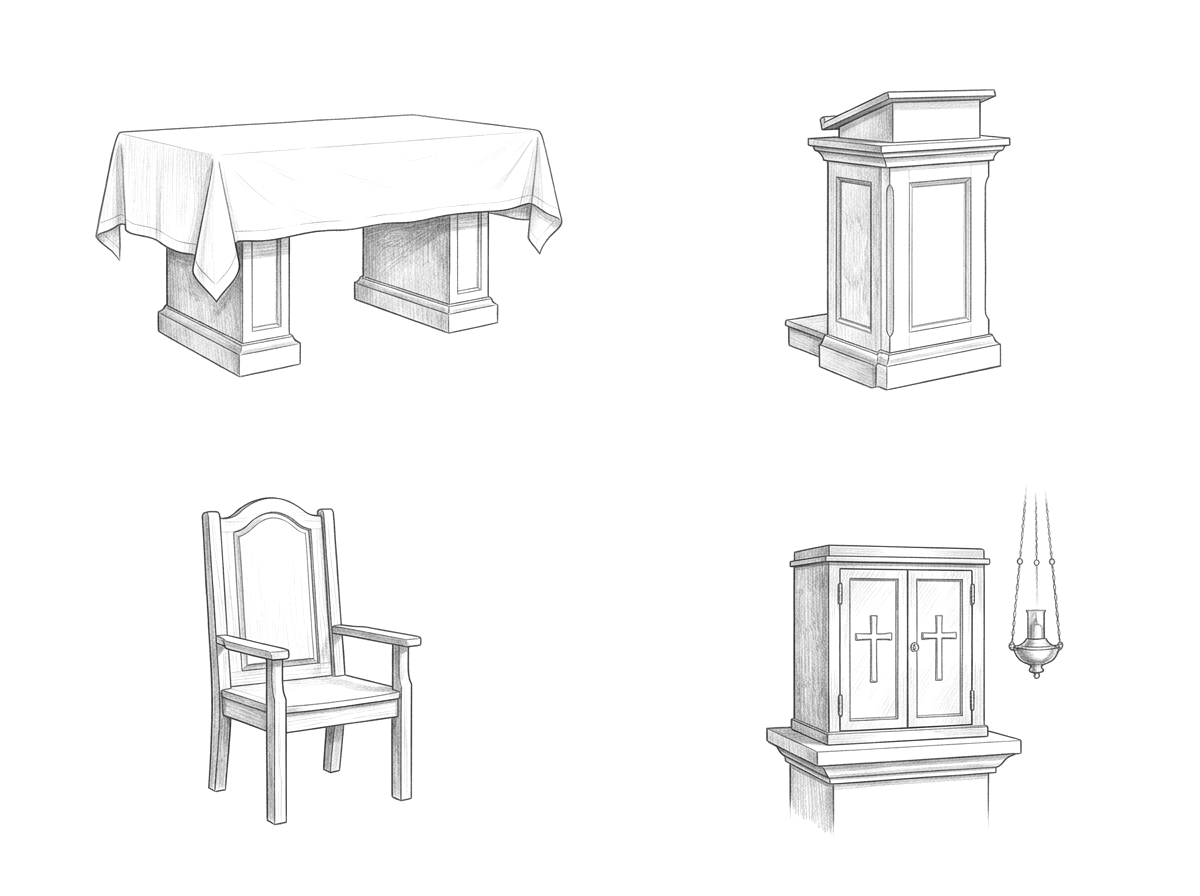 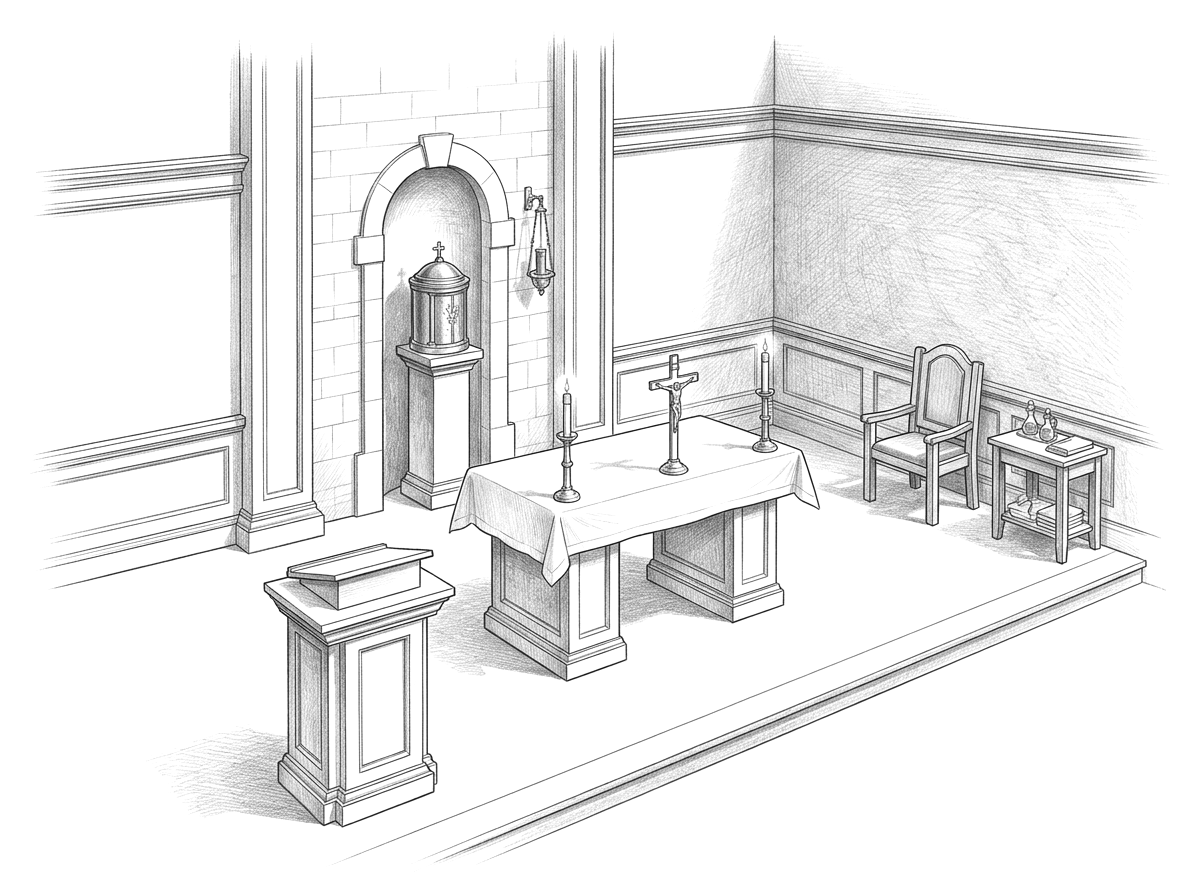 | Altar Altare Details |
Sanctuary furnishings | The altar is the sacred table at the heart of the sanctuary upon which the Sacrifice of the Cross is made present under sacramental signs and the people of God gather for the Eucharistic banquet. |
More about AltarPosition: Top left (Plate II); center (Plate I). Scale: Not to common scale. Plate key: Top left: freestanding Altar covered with white linen cloth; top right: stationary stone Ambo with sloped desk and step; bottom left: dignified wooden Presidential Chair; bottom right: locked double-door Tabernacle on stone pedestal beside suspended oil Sanctuary Lamp. Also shown on this plate: Ambo · Presidential Chair · Tabernacle · Sanctuary Lamp. Image creditProject-owned generated monochrome illustration (CC BY 4.0). Position: Top left (Plate II); center (Plate I). Scale: Not to common scale (architectural perspective). Plate key: Center: freestanding Altar with white Altar Cloth, two Altar Candles, and Altar Cross with corpus; foreground left: stationary Ambo; rear recessed niche: solid locked Tabernacle with hanging Sanctuary Lamp; rear right: Presidential Chair beside Credence Table holding cruets and linens. Also shown on this plate: Ambo · Presidential Chair · Credence Table · Tabernacle · Sanctuary Lamp · Altar Cloth · Altar Candles · Processional Cross · Cruets. Image creditProject-owned generated monochrome illustration (CC BY 4.0); no third-party photographs or copyrighted art incorporated. Disposition (2008 Latin / 2011 U.S.): required (Universal Roman law). United States territorial note: In the Dioceses of the United States of America, the Bishops' Conference adaptation to GIRM 301 permits a fixed altar table to be crafted from dignified, solid, well-worked wood rather than natural stone, provided the structure remains permanently immovable; United States GIRM 304 likewise allows festive colored cloths beneath the required white uppermost cloth. Ordinary ministers: Bishop, Priest, Deacon. Prepared by: Sacristan, Deacon, Instituted acolyte, Altar server. Server boundary (Server recognizes only; does not handle): Servers venerate the altar with a profound bow on approaching or departing (genuflecting instead if the Blessed Sacrament is reserved in the sanctuary), place the Roman Missal and unconsecrated vessels upon it at the Preparation of the Gifts when needed, and never lean upon, clutter, or kiss the mensa (kissing the altar belongs to the bishop, priest, and deacon). Handling and safety: Keep the altar table clear of spare papers, cruets, and extraneous items (GIRM 306), guard against candle flames and dripping wax near the white cloth, and notify the priest or deacon immediately if any Precious Blood is spilled—never attempt to blot or wash a spill yourself (GIRM 280). 1962 Roman Missal counterpart (materially changed): Whereas the 1962 Roman Missal ordinarily presupposed a stone altar (or recessed consecrated altar stone holding relics inside the mensa) dressed with three cloths, candlesticks, central crucifix, three altar cards, and normally the tabernacle, the 2008/2011 Missal recommends a single freestanding altar wherever possible (GIRM 299, 303), deposits saints' relics beneath the altar (GIRM 302), clears the mensa of altar cards and extraneous items (GIRM 306), and in the United States permits solid wood for a fixed altar mensa (US GIRM 301). Shared compositions: Plate I — The Postconciliar Roman Sanctuary. Appearance, placement, symbolism, and sourcesAlso called: Altar Table; Mensa; Mensa Domini; Altare fixum; Altare mobile. Ecclesiastical Latin pronunciation: ahl-TAH-reh Appearance: Shown in Plate II as a freestanding rectangular stone table resting on twin paneled pedestals with molded plinths and dressed smoothly in an overhanging white linen cloth, and in Plate I centered in the sanctuary with two lighted candles and a crucifix—free of gradines, altar cards, or an attached rail. Placement and use: Universal Roman law recommends a single fixed altar in newly built churches, set apart from the rear wall so ministers may walk around it and celebrate Mass facing the people wherever possible (GIRM 299, 303), while the Holy See clarified on 25 September 2000 (Prot. N. 2036/00/L) that this expresses pastoral desirability rather than a juridical ban on historical wall-attached altars or celebration facing the apse. A fixed altar is solemnly dedicated by the bishop (GIRM 300; CIC can. 1235), with relics of saints fittingly placed beneath it rather than recessed into the mensa (GIRM 302). From the start of Mass until the Preparation of the Gifts, only the Book of the Gospels rests upon the dressed mensa; during the Liturgy of the Eucharist, only the corporal, sacred vessels, Roman Missal, and necessary items appear there (GIRM 306). Liturgical colors: Always covered on top with at least one clean white cloth (GIRM 117, 304); in the United States, additional under-cloths of seasonal or festive colors are permitted beneath the white cloth (US GIRM 304). Symbolism: The Church reveres the altar as the sign of Christ Himself—both Priest and Victim—and as the table of the Lord where the Sacrifice of the Cross is made present under sacramental signs. A fixed stone altar permanently signifies Christ the Living Stone, recalling 1 Pet 2:4 (“Unto whom coming, as to a living stone, rejected indeed by men but chosen and made honourable by God:”), 1 Cor 10:4 (“and the rock was Christ.”), and Heb 13:10 (“We have an altar whereof they have no power to eat who serve the tabernacle.”). St. Thomas Aquinas similarly teaches that the altar signifies Christ Himself and, when made of stone, calls to mind both Christ the Rock and the stone sepulchre in which His body rested. (GIRM 296, 298; 1 Pet 2:4; 1 Cor 10:4; Heb 13:10; St. Thomas Aquinas, Summa Theologiae III, q. 83, a. 3) Distinguish from: Credence Table. Related entries: Altar Cloth · Altar Candles · Processional Cross · Corporal · Ambo · Tabernacle.
| |||
| Ambo Ambo Details |
Sanctuary furnishings | The ambo is the stationary architectural stand in the sanctuary reserved exclusively for proclaiming the Word of God during the liturgy. |
More about AmboPosition: Top right (Plate II); left foreground (Plate I). Scale: Not to common scale. Plate key: Top left: freestanding Altar covered with white linen cloth; top right: stationary stone Ambo with sloped desk and step; bottom left: dignified wooden Presidential Chair; bottom right: locked double-door Tabernacle on stone pedestal beside suspended oil Sanctuary Lamp. Also shown on this plate: Altar · Presidential Chair · Tabernacle · Sanctuary Lamp. Image creditProject-owned generated monochrome illustration (CC BY 4.0). Position: Top right (Plate II); left foreground (Plate I). Scale: Not to common scale (architectural perspective). Plate key: Center: freestanding Altar with white Altar Cloth, two Altar Candles, and Altar Cross with corpus; foreground left: stationary Ambo; rear recessed niche: solid locked Tabernacle with hanging Sanctuary Lamp; rear right: Presidential Chair beside Credence Table holding cruets and linens. Also shown on this plate: Altar · Presidential Chair · Credence Table · Tabernacle · Sanctuary Lamp · Altar Cloth · Altar Candles · Processional Cross · Cruets. Image creditProject-owned generated monochrome illustration (CC BY 4.0); no third-party photographs or copyrighted art incorporated. Disposition (2008 Latin / 2011 U.S.): required (Universal Roman law). Ordinary ministers: Bishop, Priest, Deacon, Instituted lector. Prepared by: Sacristan, Instituted lector, Altar server. Server boundary (Server recognizes only; does not handle): Servers flank the ambo with lighted candles and incense during the Gospel proclamation and may confirm before Mass that the Lectionary rests open upon the desk, but never proclaim readings or lead prayers from the ambo unless separately deputed as readers. Handling and safety: Watch the rear step of the ambo when moving into place with lighted Gospel candles or a smoking thurible, keeping flames well clear of the microphone, Lectionary pages, and ministers' vestments. 1962 Roman Missal counterpart (newly provided): The 1962 Roman Missal did not prescribe a permanent sanctuary ambo: at Low Mass the priest read the Epistle and Gospel from opposite corners of the altar, and at Solemn Mass the subdeacon and deacon sang them from the sanctuary floor with the subdeacon holding the Gospel book (RS VI.4–5). Postconciliar law restores a dedicated stationary ambo as a standard architectural appointment of every sanctuary (Inter Oecumenici 96; GIRM 309). Shared compositions: Plate I — The Postconciliar Roman Sanctuary. Appearance, placement, symbolism, and sourcesAlso called: Lectern of the Word; Lectrinum. Ecclesiastical Latin pronunciation: AHM-boh Appearance: Depicted in Plate II as a permanent paneled stone structure resting on a molded base with a rear minister's step and an inclined book desk sized for the Lectionary or Book of the Gospels, and placed in the left foreground of Plate I in clear visual harmony with the freestanding altar. Placement and use: Universal Roman law prescribes a permanent, stationary ambo—never a lightweight movable lectern—positioned so that the attention of the faithful turns naturally toward it during the Liturgy of the Word and ministers can be clearly seen and heard (GIRM 309; Ordo lectionum Missae 32–34). Only the Scripture readings, the Responsorial Psalm, and the Easter Proclamation (Exsultet) are proclaimed from the ambo, together with the homily and the intentions of the Universal Prayer; parish announcements, commentary, and the leading of general singing belong at a separate stand elsewhere. Liturgical colors: Normally left in its unadorned stone or wood architectural finish; where local custom drapes an ambo antependium or hanging, it follows the liturgical color of the day (GIRM 346). Symbolism: The General Instruction pairs the ambo with the altar as the two tables of the Mass—the table of God's Word and the table of Christ's Body—directing that the dignity of Sacred Scripture be honored by a fixed, noble place toward which the congregation naturally turns. Its prominence visibly echoes the Psalmist's confession in Ps 118:105 [Heb 119:105]: “Thy word is a lamp to my feet, and a light to my paths.” (GIRM 28, 309; Ordo lectionum Missae (1981) Praenotanda 32–34; Ps 118:105 [Heb 119:105]) Distinguish from: Missal Stand. Related entries: Lectionary for Mass · Book of the Gospels · Altar · Altar Candles · Thurible.
| |||
| Presidential Chair Sedes sacerdotis celebrantis Details |
Sanctuary furnishings | The presidential chair is the single seat appointed for the priest celebrant from which he presides over the liturgical assembly and leads its opening and closing prayers. |
More about Presidential ChairPosition: Bottom left (Plate II); rear right (Plate I). Scale: Not to common scale. Plate key: Top left: freestanding Altar covered with white linen cloth; top right: stationary stone Ambo with sloped desk and step; bottom left: dignified wooden Presidential Chair; bottom right: locked double-door Tabernacle on stone pedestal beside suspended oil Sanctuary Lamp. Also shown on this plate: Altar · Ambo · Tabernacle · Sanctuary Lamp. Image creditProject-owned generated monochrome illustration (CC BY 4.0). Position: Bottom left (Plate II); rear right (Plate I). Scale: Not to common scale (architectural perspective). Plate key: Center: freestanding Altar with white Altar Cloth, two Altar Candles, and Altar Cross with corpus; foreground left: stationary Ambo; rear recessed niche: solid locked Tabernacle with hanging Sanctuary Lamp; rear right: Presidential Chair beside Credence Table holding cruets and linens. Also shown on this plate: Altar · Ambo · Credence Table · Tabernacle · Sanctuary Lamp · Altar Cloth · Altar Candles · Processional Cross · Cruets. Image creditProject-owned generated monochrome illustration (CC BY 4.0); no third-party photographs or copyrighted art incorporated. Disposition (2008 Latin / 2011 U.S.): required (Universal Roman law). Ordinary ministers: Priest, Bishop. Prepared by: Sacristan, Altar server. Server boundary (Clergy-reserved; server does not touch): Reserved strictly to the priest celebrant (or bishop when celebrating outside his cathedral); altar servers never sit in the presidential chair and approach it solely to hold the Roman Missal or Book of the Chair during prayers. 1962 Roman Missal counterpart (materially changed): In the 1962 Roman Rite, presbyteral seating consisted of a three-seat bench (sedilia) placed along the Epistle side of the sanctuary solely for sitting during sung chants and lessons while all orations were spoken at the altar. Postconciliar law replaces those lateral seats with a focal single chair from which the priest leads the Introductory Rites, Liturgy of the Word, and Concluding Rites (Inter Oecumenici 92; GIRM 310). Shared compositions: Plate I — The Postconciliar Roman Sanctuary. Appearance, placement, symbolism, and sourcesAlso called: Chair for the Priest Celebrant; Presider's Chair; Sedes. Ecclesiastical Latin pronunciation: SEH-dehs sah-chehr-DOH-tees cheh-leh-BRAHN-tees Appearance: Shown at bottom left of Plate II as a dignified wooden armchair with an arched paneled high backrest, sturdy armrests, and squared legs, and positioned at rear right in Plate I beside the credence table—clearly superior to server seating yet deliberately devoid of canopy, royal steps, or throne-like ornament. Placement and use: Under universal Roman law, the chair is best set at the head of the sanctuary facing the congregation unless architectural distance or a centrally placed tabernacle behind the altar makes another clear position more suitable (GIRM 310). From this seat the priest conducts the Introductory Rites (including the Collect), listens to the Scripture readings and may preach the homily, leads the Universal Prayer, and concludes Mass with the Prayer after Communion and dismissal (GIRM 124, 127–130, 165–167). The Roman Missal—or, in the United States, the lighter Book of the Chair—and any needed hymnal are prepared beside it (GIRM 118a). In a cathedral church, the diocesan bishop presides from his permanent cathedra rather than a presbyteral chair (Caeremoniale Episcoporum 1984). Liturgical colors: Left in its natural wood or neutral upholstered finish without seasonal color changes. Symbolism: The General Instruction assigns the presidential chair a clear functional sign value: it manifests the priest celebrant's office of presiding over the gathered assembly and directing its prayer, while explicitly excluding any likeness to a royal throne. (GIRM 310) Related entries: Book of the Chair · Roman Missal · Credence Table · Altar.
| |||
| Credence Table Abacus Details |
Sanctuary furnishings | The credence table is the side table set in a convenient corner of the sanctuary to hold sacred vessels, altar linens, cruets, and lavabo articles off the altar until they are needed. |
More about Credence TablePosition: See Plate I, far right beside the presidential chair. Scale: Not to common scale (architectural perspective). Plate key: Center: freestanding Altar with white Altar Cloth, two Altar Candles, and Altar Cross with corpus; foreground left: stationary Ambo; rear recessed niche: solid locked Tabernacle with hanging Sanctuary Lamp; rear right: Presidential Chair beside Credence Table holding cruets and linens. Also shown on this plate: Altar · Ambo · Presidential Chair · Tabernacle · Sanctuary Lamp · Altar Cloth · Altar Candles · Processional Cross · Cruets. Image creditProject-owned generated monochrome illustration (CC BY 4.0); no third-party photographs or copyrighted art incorporated. Disposition (2008 Latin / 2011 U.S.): required (Universal Roman law). Ordinary ministers: Priest, Deacon, Instituted acolyte. Prepared by: Sacristan, Instituted acolyte, Altar server. Server boundary (Server prepares or sets in place before or during Mass): Servers help arrange clean unconsecrated vessels, linens, cruets, and lavabo equipment on the credence table before Mass, carry needed items to the altar at the Preparation of the Gifts, and bring the water cruet for purification without touching unpurified sacred vessels. Handling and safety: After Communion, never purify sacred vessels at the credence table and never disturb unpurified vessels left suitably covered upon a corporal there; purification belongs strictly to the priest, deacon, or instituted acolyte (GIRM 279; Redemptionis Sacramentum 119; USCCB Norms 53). 1962 Roman Missal counterpart (continued): Both the 1962 Roman Missal (RG 528; RS II.5) and the 2008/2011 GIRM (118c, 139, 279) appoint a sanctuary side table (abacus) for cruets, lavabo articles, Communion-plate, and vessels. In postconciliar Mass with a congregation, its role expands because the chalice and linens also ordinarily wait there until the Preparation of the Gifts (rather than being carried to the altar by the priest at the start of Low Mass) and vessel purification commonly takes place at the credence table (GIRM 279). Appearance, placement, symbolism, and sourcesAlso called: Side Table; Credence; Credentia; Mensa credentiae. Ecclesiastical Latin pronunciation: AH-bah-koos Appearance: Shown at the far right of Plate I beside the presidential chair as a compact, four-legged rectangular wooden side table with a lower shelf, carrying the paired glass cruets on their tray and folded white linens neatly stacked below. Placement and use: GIRM 118c appoints the credence table (abacus) as the preparation station for every Mass with a congregation, holding the chalice, folded corporal, purificator, optional pall and chalice veil, paten, ciboria, bread and wine cruets (unless carried in the Procession of Gifts), vessel of blessed water for the Sunday sprinkling rite, Communion-plate, and lavabo pitcher, basin, and towel. Keeping these items on the credence table preserves an uncluttered altar mensa until the Preparation of the Gifts (GIRM 139, 306). After Communion or immediately after Mass, sacred vessels may also be purified at the credence table by a priest, deacon, or instituted acolyte (GIRM 279). Liturgical colors: Ordinarily dressed with a plain clean white linen cloth, without seasonal color changes. Distinguish from: Altar. Related entries: Chalice · Paten · Cruets · Corporal · Purificator · Lavabo Towel.
| |||
| Tabernacle Tabernaculum Details |
Sanctuary furnishings | The tabernacle is the immovable, solid, locked sacred shrine in which the Most Holy Eucharist is reserved for Viaticum, Communion of the sick, and the adoration of the faithful. |
More about TabernaclePosition: Bottom right (Plate II); recessed rear niche (Plate I). Scale: Not to common scale. Plate key: Top left: freestanding Altar covered with white linen cloth; top right: stationary stone Ambo with sloped desk and step; bottom left: dignified wooden Presidential Chair; bottom right: locked double-door Tabernacle on stone pedestal beside suspended oil Sanctuary Lamp. Also shown on this plate: Altar · Ambo · Presidential Chair · Sanctuary Lamp. Image creditProject-owned generated monochrome illustration (CC BY 4.0). Position: Bottom right (Plate II); recessed rear niche (Plate I). Scale: Not to common scale (architectural perspective). Plate key: Center: freestanding Altar with white Altar Cloth, two Altar Candles, and Altar Cross with corpus; foreground left: stationary Ambo; rear recessed niche: solid locked Tabernacle with hanging Sanctuary Lamp; rear right: Presidential Chair beside Credence Table holding cruets and linens. Also shown on this plate: Altar · Ambo · Presidential Chair · Credence Table · Sanctuary Lamp · Altar Cloth · Altar Candles · Processional Cross · Cruets. Image creditProject-owned generated monochrome illustration (CC BY 4.0); no third-party photographs or copyrighted art incorporated. Disposition (2008 Latin / 2011 U.S.): required (Universal Roman law). Ordinary ministers: Bishop, Priest, Deacon. Prepared by: Priest, Deacon. Server boundary (Clergy-reserved; server does not touch): Strictly reserved to clergy (and to instituted acolytes or duly deputed extraordinary ministers solely for Communion distribution or reposition); altar servers never open the tabernacle, handle its key, or touch reserved vessels, and genuflect before it outside Mass and at the beginning and end of Mass when it stands in the sanctuary (GIRM 274). Handling and safety: Never open the tabernacle, touch the tabernacle key, or retrieve or repose the Blessed Sacrament. Key custody belongs strictly to the pastor or rector (CIC can. 938 §5). Genuflect on the right knee before the tabernacle outside Mass and at the beginning and end of Mass when it stands in the sanctuary (GIRM 274). 1962 Roman Missal counterpart (materially changed): Both the 1917 Code (cann. 1268–1269) and current law (CIC 1983 can. 938; GIRM 314) mandate a single immovable, solid, opaque, securely locked tabernacle. Whereas 1917/1962 discipline ordinarily fixed the veiled tabernacle in the middle of the high altar of celebration, GIRM 315 considers it clearer as a sign not to place it on the altar where Mass is celebrated, entrusting the Diocesan Bishop to choose either another worthy place in the sanctuary or an organically connected adoration chapel, and no longer universally mandating a tabernacle veil. Shared compositions: Plate I — The Postconciliar Roman Sanctuary. Appearance, placement, symbolism, and sourcesAlso called: Eucharistic Tabernacle. Ecclesiastical Latin pronunciation: tah-behr-NAH-koo-loom Appearance: Illustrated at bottom right of Plate II as a rectangular solid metal safe with lockable double doors bearing relief crosses anchored upon a stone pedestal, and in Plate I as a domed opaque metal tabernacle set atop a pillar inside a recessed arched niche at the rear of the sanctuary, accompanied in both views by a hanging sanctuary lamp. Placement and use: Universal Roman law requires ordinarily one tabernacle in a church or oratory, immovable, crafted of solid opaque material, securely locked against danger of profanation, and blessed before liturgical use (GIRM 314; CIC can. 938; Redemptionis Sacramentum 130). Because the sign of Mass is clearer when the tabernacle does not stand upon the altar of celebration, universal law (GIRM 315) entrusts the Diocesan Bishop to place it either in the sanctuary apart from the altar of celebration—not excluding a former high altar no longer used for Mass—or in a distinct chapel suitable for private adoration that is organically connected to the church and readily visible to the faithful. The pastor or rector must diligently safeguard the tabernacle key (CIC can. 938 §5). Liturgical colors: Ordinarily displayed in its noble metal or architectural finish; a traditional fabric tabernacle veil (conopaeum) in white or the seasonal color of the day remains a lawful ornament where local custom retains it, though no longer universally mandated by GIRM 314. Symbolism: The Church honors the tabernacle as the consecrated dwelling of Christ's abiding sacramental presence in the midst of His people, recalling the Lord's promise to Israel in Ex 25:8 (“And they shall make me a sanctuary, and I will dwell in the midst of them:”). Setting the tabernacle apart from the altar of celebration keeps distinct the sign of Christ's reserved presence for adoration and Viaticum from the sacrificial action of Mass, fulfilling the constant pastoral care that St. Thomas Aquinas grounds in bringing the Eucharist to the sick without delay. (GIRM 314–315; Eucharisticum Mysterium (1967) 53–55; Ex 25:8; St. Thomas Aquinas, Summa Theologiae III, q. 83, a. 5, ad 11) Related entries: Sanctuary Lamp · Ciborium · Pyx · Altar.
| |||
| Sanctuary Lamp Lampas peculiaris Details |
Sanctuary furnishings | The sanctuary lamp is the dedicated oil or wax lamp kept burning continuously near the tabernacle to announce and honor the Eucharistic presence of Christ. |
More about Sanctuary LampPosition: Suspended beside the tabernacle at bottom right (Plate II) and in the rear niche (Plate I). Scale: Not to common scale. Plate key: Top left: freestanding Altar covered with white linen cloth; top right: stationary stone Ambo with sloped desk and step; bottom left: dignified wooden Presidential Chair; bottom right: locked double-door Tabernacle on stone pedestal beside suspended oil Sanctuary Lamp. Also shown on this plate: Altar · Ambo · Presidential Chair · Tabernacle. Image creditProject-owned generated monochrome illustration (CC BY 4.0). Position: Suspended beside the tabernacle at bottom right (Plate II) and in the rear niche (Plate I). Scale: Not to common scale (architectural perspective). Plate key: Center: freestanding Altar with white Altar Cloth, two Altar Candles, and Altar Cross with corpus; foreground left: stationary Ambo; rear recessed niche: solid locked Tabernacle with hanging Sanctuary Lamp; rear right: Presidential Chair beside Credence Table holding cruets and linens. Also shown on this plate: Altar · Ambo · Presidential Chair · Credence Table · Tabernacle · Altar Cloth · Altar Candles · Processional Cross · Cruets. Image creditProject-owned generated monochrome illustration (CC BY 4.0); no third-party photographs or copyrighted art incorporated. Disposition (2008 Latin / 2011 U.S.): required (Universal Roman law). Ordinary ministers: Priest, Sacristan. Prepared by: Sacristan. Server boundary (Server recognizes only; does not handle): Servers look to the burning sanctuary lamp as the unmistakable sign that Christ is reserved in the tabernacle and never light, move, or extinguish it during Mass; any maintenance outside Mass follows sacristan direction with fire-safety care. Handling and safety: Never extinguish, move, or adjust the sanctuary lamp during Mass, and never extinguish it while the Blessed Sacrament remains reserved in the tabernacle. If assisting the sacristan outside Mass to replace a sanctuary candle or oil vessel, allow hot glass and oil to cool safely, guard against open flame, and never open the tabernacle. 1962 Roman Missal counterpart (continued): Postconciliar discipline continues the 1917/1962 requirement without interruption: both CIC (1917) can. 1271 and CIC (1983) can. 940 together with GIRM 316 require a special living flame of oil or wax to burn continually before or near the tabernacle whenever the Eucharist is reserved. Shared compositions: Plate I — The Postconciliar Roman Sanctuary. Appearance, placement, symbolism, and sourcesAlso called: Tabernacle Lamp; Presence Lamp; Lampas sanctuarii; Lucerna. Ecclesiastical Latin pronunciation: LAHM-pahs peh-koo-lee-AH-rees Appearance: Shown at bottom right of Plate II and beside the recessed rear niche in Plate I as a rounded metal lamp bowl suspended on three chains from a ceiling mount or wall bracket, cradling a cylindrical glass globe (traditionally red or clear) that shields a living oil or beeswax flame. Placement and use: Universal Roman law and canon law require a special lamp, nourished by oil or wax rather than an electric bulb, to shine permanently day and night beside every tabernacle in which the Most Holy Eucharist is reserved (GIRM 316; CIC can. 940). It is extinguished only when the tabernacle is completely emptied of the Blessed Sacrament, notably from the Mass of the Lord's Supper on Holy Thursday evening until reservation resumes at the Easter Vigil. Liturgical colors: Not governed by the seasonal vestment colors; custom commonly uses a red glass globe (or clear glass) so the living flame stands out unmistakably near the tabernacle. Symbolism: The continuously burning oil or wax lamp openly signals Christ's abiding sacramental presence in the tabernacle and renders silent honor to Him day and night, echoing the perpetual lamp commanded before the Old Covenant sanctuary in Ex 27:20–21 (“Command the children of Israel that they bring thee the purest oil of the olives, and beaten with a pestle: that a lamp may burn always, In the tabernacle of the testimony, without the veil that hangs before the testimony”) and Lev 24:2–3 (“to furnish the lamps continually, Without the veil of the testimony in the tabernacle of the covenant”). (GIRM 316; CIC (1983) can. 940; Ex 27:20–21; Lev 24:2–3) Distinguish from: Altar Candles. Related entries: Tabernacle · Altar Candles.
| |||
 | Baptismal Font Fons baptismalis Details |
Sanctuary furnishings | The baptismal font is the permanent stone or metal water basin required in every parish church for administering the Sacrament of Baptism. |
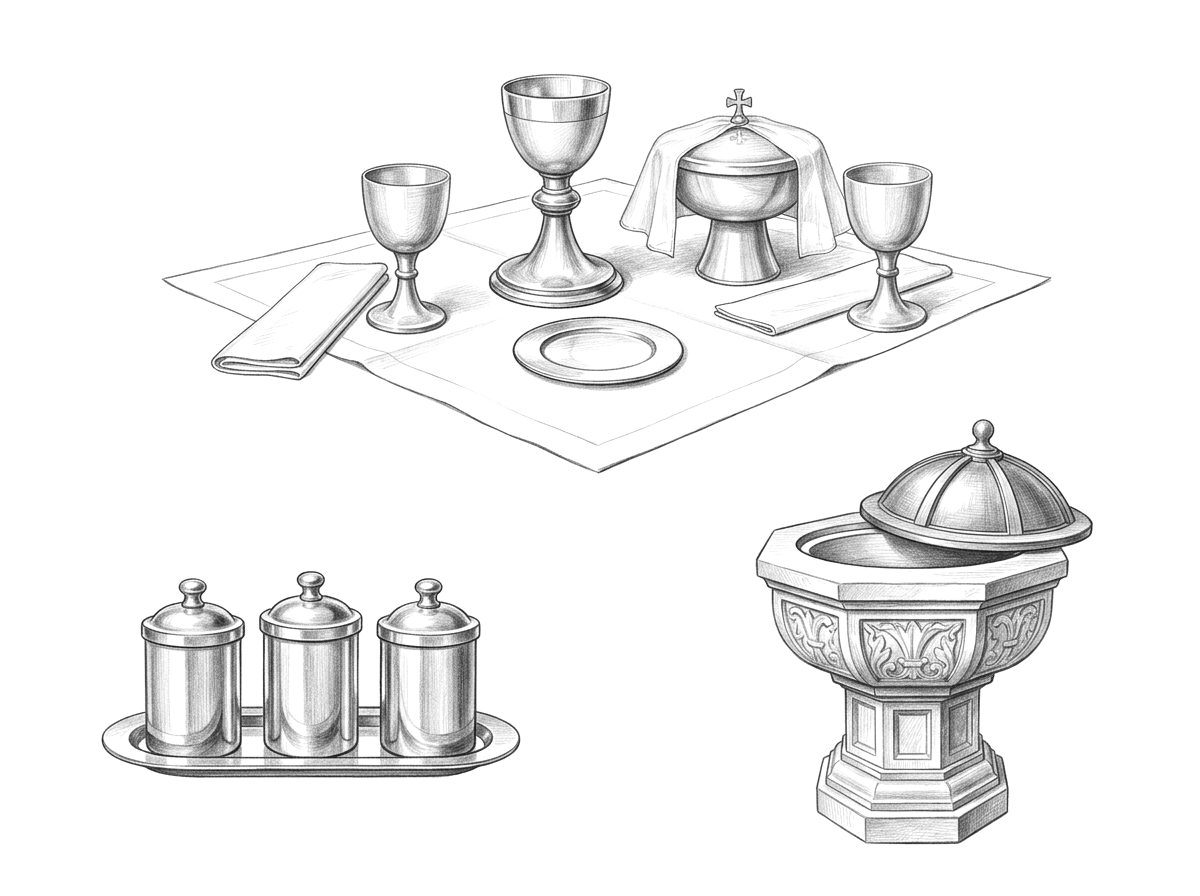
More about Baptismal FontPosition: See Plate X, bottom right. Scale: Not to common scale. Plate key: Top: Communion under both kinds arrangement on an unfolded Corporal (principal Chalice, Paten, veiled covered Ciborium, and two footed Communion Cups each with a folded Purificator); bottom left: three cylindrical lidded metal Holy Oils Stocks on a tray (Sacred Chrism, Oil of Catechumens, Oil of the Sick); bottom right: carved octagonal stone Baptismal Font with removable domed cover ajar. Also shown on this plate: Communion Cup · Ciborium · Chalice · Paten · Corporal · Purificator · Holy Oils and Oil Stocks. Image creditProject-owned generated monochrome illustration (CC BY 4.0). Disposition (2008 Latin / 2011 U.S.): required (Universal Roman law). Ordinary ministers: Bishop, Priest, Deacon. Prepared by: Sacristan, Deacon, Altar server. Server boundary (Server recognizes only; does not handle): Servers walk in procession to the font with cross, candles, ritual book, or drying towels during Baptisms and the Easter Vigil, never pouring sacramental water or disposing of blessed baptismal water improperly. Handling and safety: Never empty blessed baptismal water into an ordinary sink or sewer drain; blessed water must be poured reverently into the sacrarium or directly into clean earth. Wipe any splashed water from stone or tiled steps immediately to prevent slipping. 1962 Roman Missal counterpart (materially changed): Both 1962 discipline and CIC (1983) can. 858 require a baptismal font in every parish church. Whereas 1962 practice ordinarily enclosed the font inside a gated baptistery near the church entrance and blessed the year's water at the Easter Vigil with an infusion of Oil of Catechumens and Sacred Chrism directly into the basin, postconciliar rites bless fresh water at each Baptism outside Easter Time without pouring oils into the font and favor congregationally visible placement suited to pouring or immersion. Appearance, placement, symbolism, and sourcesAlso called: Font; Fons baptismatis. Ecclesiastical Latin pronunciation: fohns bahp-tees-MAH-lees Appearance: Illustrated at bottom right of Plate X as a carved octagonal stone basin decorated with foliate relief panels, raised on a matching paneled pedestal and stepped plinth, with a ribbed domed cover resting ajar to expose the smooth interior basin. Placement and use: The baptismal font is governed by universal canon law (CIC can. 858 §1, requiring a font in every parish church), the Rite of Baptism for Children (General Introduction 25, 45–47), and the Easter Vigil rubrics of the Roman Missal. Local architecture places it either in a distinct baptistery or in a prominent, clearly visible area near the church entrance or sanctuary so the assembly can participate in Baptisms and process to the font at the Easter Vigil; its design accommodates clean flowing or poured water (and, where provided, immersion). Bishops, priests, and deacons are the ordinary ministers of Baptism (CIC can. 861 §1). Liturgical colors: Remains in its natural carved stone, wood, or metal finish; during Easter Time the tall white Paschal Candle stands beside it. Symbolism: The ancient Roman Easter Vigil blessing calls the baptismal font the motherly womb from which the Church brings forth new children in Christ, uniting the Lord's teaching in John 3:5 (“unless a man be born again of water and the Holy Ghost, he cannot enter into the kingdom of God.”) with St. Paul's mystery of death and resurrection in Rom 6:3–4 (“Know you not that all we who are baptized in Christ Jesus are baptized in his death? For we are buried together with him by baptism into death: that, as Christ is risen from the dead by the glory of the Father, so we also may walk in newness of life.”). Early Christian catechesis, including St. Cyril of Jerusalem, expounds the font as both tomb and womb of new creation, reflected architecturally in the classic octagonal basin of the eighth day. (Roman Missal Easter Vigil; CCC 1237–1243; John 3:5; Rom 6:3–4; St. Cyril of Jerusalem, Mystagogical Catechesis 2.4) Distinguish from: Aspergillum and Aspersorium. Related entries: Holy Oils and Oil Stocks · Aspergillum and Aspersorium · Processional Cross · Altar Candles.
| |||
 | Chalice Calix Details |
Sacred vessels | The chalice is the principal footed sacred vessel in which wine mingled with a drop of water is offered, consecrated into the Precious Blood of Christ, elevated in adoration, and consumed at Mass. |
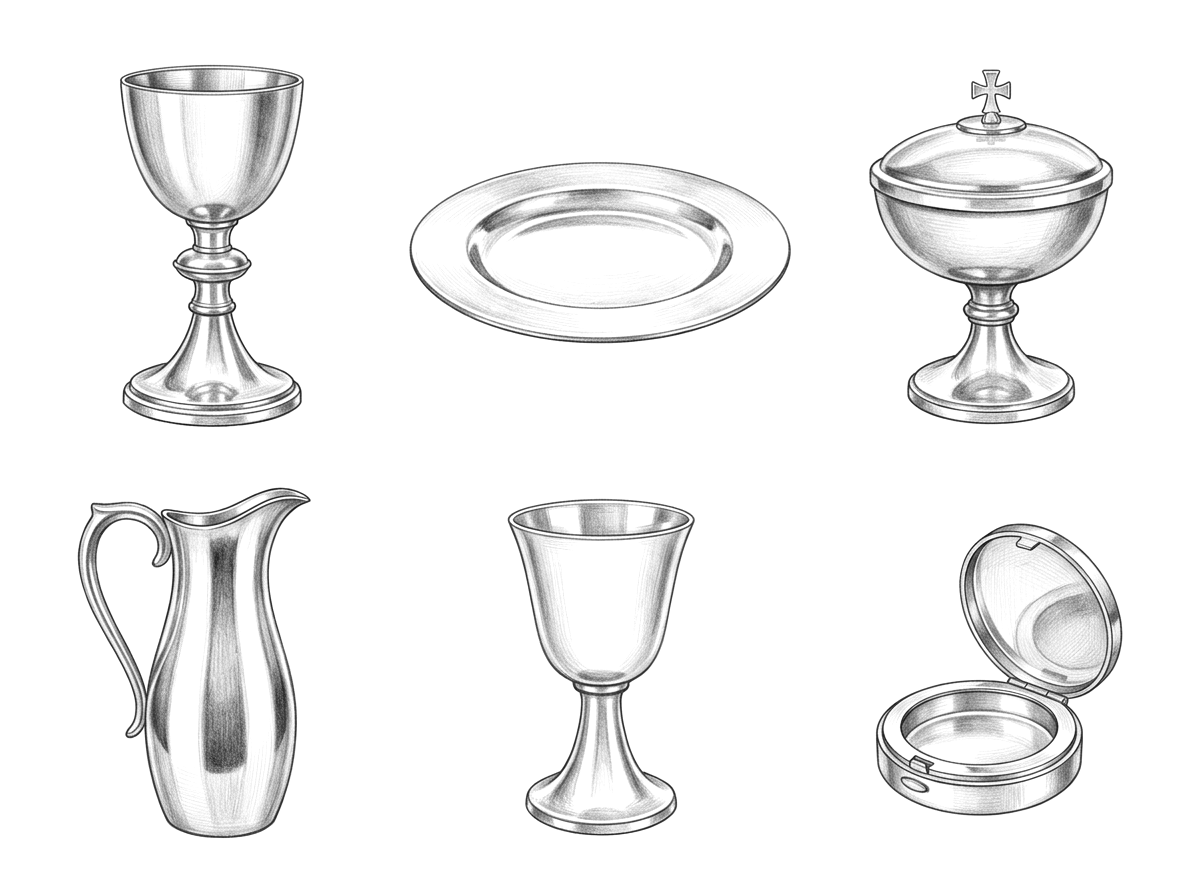
More about ChalicePosition: Top left (Plate III); center of the unfolded corporal (Plate X). Scale: Not to common scale. Plate key: Top row, left to right: Chalice, wide shallow Paten, lidded footed Ciborium with cross finial. Bottom row, left to right: pitcher-style wine Flagon (pre-consecration transport only), footed Communion Cup (chalice), hinged pocket Pyx shown open. Also shown on this plate: Paten · Ciborium · Flagon · Communion Cup · Pyx. Image creditProject-owned generated monochrome illustration (CC BY 4.0). Position: Top left (Plate III); center of the unfolded corporal (Plate X). Scale: Not to common scale. Plate key: Top: Communion under both kinds arrangement on an unfolded Corporal (principal Chalice, Paten, veiled covered Ciborium, and two footed Communion Cups each with a folded Purificator); bottom left: three cylindrical lidded metal Holy Oils Stocks on a tray (Sacred Chrism, Oil of Catechumens, Oil of the Sick); bottom right: carved octagonal stone Baptismal Font with removable domed cover ajar. Also shown on this plate: Communion Cup · Ciborium · Paten · Corporal · Purificator · Holy Oils and Oil Stocks · Baptismal Font. Image creditProject-owned generated monochrome illustration (CC BY 4.0). Disposition (2008 Latin / 2011 U.S.): required (Universal Roman law). United States territorial note: While USCCB GIRM 329 permits solid, noble, non-breaking, non-absorbent materials such as hard woods for patens, ciboria, and pyxes, universal law requires the chalice bowl to be completely nonabsorbent (GIRM 330) and precious metal gilded inside if the metal rusts or is less precious than gold (GIRM 328); glass, earthenware, and clay chalices are strictly reprobated (Redemptionis Sacramentum 117). Ordinary ministers: Bishop, Priest, Deacon. Prepared by: Sacristan, Deacon, Instituted acolyte, Altar server. Server boundary (Server prepares or sets in place before or during Mass): Servers may place the empty, unconsecrated chalice on the credence table before Mass and carry it to the altar at the Preparation of the Gifts if no deacon or instituted acolyte serves (GIRM 139). After consecration, servers never touch a chalice holding the Precious Blood, never consume from it, and never purify it (GIRM 279; RS 119; USCCB Norms 53). Handling and safety: Once consecrated, the chalice contains the Blood of Christ: servers and extraordinary ministers never purify it (strictly reserved to priest, deacon, or instituted acolyte), and remaining Precious Blood is never poured into the sacrarium or onto the ground (USCCB Norms 53–55). 1962 Roman Missal counterpart (materially changed): Whereas the 1962 Roman Missal required a gold or silver-cupped chalice consecrated with Sacred Chrism by a bishop and carried into Low Mass veiled with a stiff burse by the priest himself (RS I.1, II.1), the 2008/2011 Missal appoints a liturgical blessing by bishop or priest (GIRM 333), ordinarily prepares the chalice on the credence table until the Preparation of the Gifts (GIRM 118c, 139), and commends the chalice veil as a praiseworthy optional practice while leaving the burse unnamed. Shared compositions: Plate X — Communion Under Both Kinds and Sacramental Vessels. Appearance, placement, symbolism, and sourcesAlso called: Principal Chalice; Eucharistic Chalice; Calix principalis. Ecclesiastical Latin pronunciation: KAH-leeks Appearance: Shown at top left of Plate III with a deep, smooth flared cup, a baluster stem bearing a central grip node (nodus) for steady elevation, and a broad weighted circular foot; Plate X shows it standing at the center of the unfolded corporal alongside the paten, veiled ciborium, and Communion cups. Placement and use: Before Mass with a congregation, the chalice stands prepared on the credence table with the corporal, purificator, optional pall, and—as a praiseworthy practice commended in GIRM 118c—covered with a chalice veil of the color of the day or white (GIRM 118c). At the Preparation of the Gifts, the deacon, instituted acolyte, or server brings it to the altar, where the priest or deacon pours wine and a little water into it (GIRM 139, 142, 178). After the consecration, the priest elevates the chalice and the deacon elevates it during the final doxology (GIRM 150–151, 180). Following Communion, any remaining Precious Blood is consumed reverently at the altar and the chalice is purified strictly by the priest, deacon, or instituted acolyte—never poured into the sacrarium or ground (GIRM 279; RS 119; USCCB Norms 52–55). Every chalice is blessed before liturgical use according to the Roman Ritual, praiseworthily by the diocesan bishop or by a priest (GIRM 333; RS 118). Liturgical colors: Precious metal (gilded interior); optional chalice veil matches the liturgical color of the day or is white (GIRM 118c). Symbolism: The chalice bears singular honor as the cup of the New Covenant, recalling the Lord’s words at the Last Supper in Matt 26:27–28 (“Drink ye all of this. For this is my blood of the new testament, which shall be shed for many unto remission of sins.”), St. Paul in 1 Cor 10:16 (“The chalice of benediction which we bless, is it not the communion of the blood of Christ?”), and Ps 115:13 [Heb 116:13] (“I will take the chalice of salvation; and I will call upon the name of the Lord.”). St. Thomas Aquinas teaches that the chalice signifies both the Passion of Christ and the joy of the blessed, and explains that non-porous precious metal—rather than wood, stone, or glass—is required out of reverence for Christ’s Blood. (GIRM 327; Matt 26:27–28; 1 Cor 10:16; Ps 115:13 [Heb 116:13]; St. Thomas Aquinas, Summa Theologiae III, q. 83, a. 3, ad 6 & a. 5, ad 9) Distinguish from: Communion Cup · Ciborium · Flagon. Related entries: Paten · Corporal · Purificator · Pall · Cruets · Fragile Vessels, Flagon Pouring, and EMHC Purification.
| |||
| Paten Patena Details |
Sacred vessels | The paten is the shallow circular sacred dish on which the Eucharistic bread is offered, consecrated, broken during the Fraction Rite, and presented at Holy Communion. |
More about PatenPosition: Top center (Plate III); front center of the unfolded corporal (Plate X). Scale: Not to common scale. Plate key: Top row, left to right: Chalice, wide shallow Paten, lidded footed Ciborium with cross finial. Bottom row, left to right: pitcher-style wine Flagon (pre-consecration transport only), footed Communion Cup (chalice), hinged pocket Pyx shown open. Also shown on this plate: Chalice · Ciborium · Flagon · Communion Cup · Pyx. Image creditProject-owned generated monochrome illustration (CC BY 4.0). Position: Top center (Plate III); front center of the unfolded corporal (Plate X). Scale: Not to common scale. Plate key: Top: Communion under both kinds arrangement on an unfolded Corporal (principal Chalice, Paten, veiled covered Ciborium, and two footed Communion Cups each with a folded Purificator); bottom left: three cylindrical lidded metal Holy Oils Stocks on a tray (Sacred Chrism, Oil of Catechumens, Oil of the Sick); bottom right: carved octagonal stone Baptismal Font with removable domed cover ajar. Also shown on this plate: Communion Cup · Ciborium · Chalice · Corporal · Purificator · Holy Oils and Oil Stocks · Baptismal Font. Image creditProject-owned generated monochrome illustration (CC BY 4.0). Disposition (2008 Latin / 2011 U.S.): required (Universal Roman law). United States territorial note: Under the United States adaptation to GIRM 329, patens (along with ciboria and pyxes) may be crafted either from precious metal (GIRM 328) or from other solid, noble materials such as ebony or hard woods that do not break easily, deteriorate, or absorb liquids. Ordinary ministers: Bishop, Priest, Deacon. Prepared by: Sacristan, Deacon, Instituted acolyte, Altar server. Server boundary (Server prepares or sets in place before or during Mass): Servers may bring the unconsecrated paten and hosts to the altar at the Preparation of the Gifts (GIRM 139) and hold the separate Communion-plate level under communicants' chins during distribution (GIRM 118c; RS 93). Servers never touch consecrated hosts on the paten and never purify either the paten or the Communion-plate after Communion (GIRM 278–279; RS 119). Handling and safety: If holding a Communion-plate during Holy Communion, keep it completely level beneath each communicant's chin without tipping it, and hand it back to the priest, deacon, or instituted acolyte at the altar or credence table so any particles are purified properly. 1962 Roman Missal counterpart (materially changed): In the 1962 Roman Missal, the paten was a small flat gilded metal disc consecrated by a bishop, sized for the celebrant's single host, kissed and used to sign the celebrant at the Libera nos, and held veiled by the subdeacon at Solemn Mass (RS I.1, VII.9, X.1–2). The 2008/2011 GIRM omits the signing and kissing at the Libera nos, introduces a broad paten fittingly holding hosts for clergy and faithful alike (GIRM 331), and under USCCB GIRM 329 admits solid noble non-metal materials. Shared compositions: Plate X — Communion Under Both Kinds and Sacramental Vessels. Appearance, placement, symbolism, and sourcesAlso called: Eucharistic Paten; Large Paten; Patena maior. Ecclesiastical Latin pronunciation: pah-TEH-nah Appearance: Rendered at top center of Plate III as a wide, gently dished circular metal plate with a broad rim and slightly recessed central well; Plate X shows it resting at the front center of the unfolded corporal before the principal chalice. Placement and use: Universal Roman law recommends a paten sufficiently wide to hold the Eucharistic bread not only for the priest and deacon, but also for the other ministers and the faithful, manifesting the unity of the one bread (GIRM 331). Before the Preparation of the Gifts, the paten rests either on the credence table or in the Procession of the Gifts; during the Eucharistic Prayer it rests on the unfolded corporal (GIRM 118c, 139, 306). After Communion, any particles are carefully gathered and the paten is purified strictly by the priest, deacon, or instituted acolyte (GIRM 278–279; RS 119). Distinguish the Eucharistic paten holding the host from the separate Communion-plate (patina pro Communione fidelium), retained by GIRM 118c and Redemptionis Sacramentum 93 to be held beneath communicants' chins so no fragment falls. Liturgical colors: Precious metal (gilded surface) or, under USCCB GIRM 329, approved solid noble non-absorbent material. Symbolism: Together with the chalice, the paten receives special honor as the receptacle of the Eucharistic Bread (GIRM 327). A larger paten holding hosts for priest, deacon, ministers, and assembly visibly expresses 1 Cor 10:17 (“For we, being many, are one bread, one body: all that partake of one bread.”). St. Thomas Aquinas pairs the paten with the chalice as a figure of the tomb that held the Lord's Body, grounding the demand for noble, unbreakable material in reverence for Christ. (GIRM 327, 331; 1 Cor 10:17; St. Thomas Aquinas, Summa Theologiae III, q. 83, a. 3, obj. 6 & ad 6) Distinguish from: Ciborium · Pyx. Related entries: Chalice · Corporal · Purificator · Fragile Vessels, Flagon Pouring, and EMHC Purification.
| |||
| Ciborium Pyxis Details |
Sacred vessels | The ciborium is the lidded sacred cup or deep bowl used to consecrate, distribute, and reserve the Sacred Hosts in the tabernacle. |
More about CiboriumPosition: Top right (Plate III); draped in a white veil at rear right of the corporal (Plate X). Scale: Not to common scale. Plate key: Top row, left to right: Chalice, wide shallow Paten, lidded footed Ciborium with cross finial. Bottom row, left to right: pitcher-style wine Flagon (pre-consecration transport only), footed Communion Cup (chalice), hinged pocket Pyx shown open. Also shown on this plate: Chalice · Paten · Flagon · Communion Cup · Pyx. Image creditProject-owned generated monochrome illustration (CC BY 4.0). Position: Top right (Plate III); draped in a white veil at rear right of the corporal (Plate X). Scale: Not to common scale. Plate key: Top: Communion under both kinds arrangement on an unfolded Corporal (principal Chalice, Paten, veiled covered Ciborium, and two footed Communion Cups each with a folded Purificator); bottom left: three cylindrical lidded metal Holy Oils Stocks on a tray (Sacred Chrism, Oil of Catechumens, Oil of the Sick); bottom right: carved octagonal stone Baptismal Font with removable domed cover ajar. Also shown on this plate: Communion Cup · Chalice · Paten · Corporal · Purificator · Holy Oils and Oil Stocks · Baptismal Font. Image creditProject-owned generated monochrome illustration (CC BY 4.0). Disposition (2008 Latin / 2011 U.S.): provided (Universal Roman law). United States territorial note: While universal law prescribes precious metal gilded inside where less precious than gold (GIRM 328), the United States adaptation at GIRM 329 permits ciboria to be crafted from other solid, noble, non-breaking, non-absorbent materials such as ebony or hard woods; fragile ceramic, clay, and glass remain strictly prohibited (Redemptionis Sacramentum 117). Ordinary ministers: Bishop, Priest, Deacon, Instituted acolyte, Extraordinary minister of Holy Communion. Prepared by: Sacristan, Deacon, Instituted acolyte, Altar server. Server boundary (Server prepares or sets in place before or during Mass): Servers may set empty, unconsecrated ciboria on the credence table before Mass and bring empty ciboria to the altar at the Preparation of the Gifts or Fraction Rite when directed (USCCB Norms 37). Servers never open the tabernacle, never carry a ciborium containing consecrated hosts, and never purify a ciborium after Communion (GIRM 279; RS 119). Handling and safety: Never open, lift, or carry a ciborium containing the Blessed Sacrament unless ordained, instituted as an acolyte, or formally deputed as an extraordinary minister of Holy Communion for distribution; never wash an unpurified ciborium. 1962 Roman Missal counterpart (continued): Both the 1962 Roman Missal (using Latin pyxis or vas) and the 2008/2011 IGMR (continuing Latin pyxis, rendered “ciborium” in English) appoint a blessed covered vessel for consecrating, distributing, and reserving the Sacred Hosts. Postconciliar norms expand distribution use to broad dignified bowls alongside stemmed ciboria, admit approved non-metal solid noble materials in the United States (US GIRM 329), and treat the silk ciborium veil as customary rather than universally mandated. Shared compositions: Plate X — Communion Under Both Kinds and Sacramental Vessels. Appearance, placement, symbolism, and sourcesAlso called: Host Vessel; Covered Ciborium; Ciborium; Vas. Ecclesiastical Latin pronunciation: PEEK-sees Appearance: Depicted at top right of Plate III as a wide-bowled footed metal vessel with a fitted domed cover crowned by a small upright cross finial; Plate X shows a covered ciborium draped with a white silk ciborium veil at the back right of the corporal, and Plate IX (right) illustrates a priest holding a lidded ciborium enveloped in a humeral veil. Placement and use: The Latin third typical edition of the General Instruction uses pyxis / pyxides (GIRM 118c, 306, 329; CIC can. 939) where the official English text renders “ciborium” and “ciboria.” Unconsecrated ciboria holding hosts for the congregation are prepared on the credence table or carried in the Procession of the Gifts, and empty ciboria may be brought to the altar at the Fraction Rite if needed for distribution (GIRM 118c, 139; USCCB Norms 37). Any ciborium used for tabernacle reservation requires a fitted cover, and reserved hosts must be renewed frequently (CIC can. 939). A white silk veil (conopaeum) over a reserved ciborium remains a reverent custom though not universally mandated by GIRM. Every ciborium is blessed before use (GIRM 333) and purified after Communion strictly by the priest, deacon, or instituted acolyte (GIRM 279; RS 119; USCCB Norms 53). Liturgical colors: Precious metal gilded inside (or approved solid noble material under US GIRM 329); customary reservation veil is white. Distinguish from: Chalice · Paten · Pyx. Related entries: Tabernacle · Corporal · Humeral Veil · Fragile Vessels, Flagon Pouring, and EMHC Purification.
| |||
| Pyx Pyxis parva Details |
Sacred vessels | The pyx is a small, securely closing circular sacred container used to carry consecrated Hosts reverently from the church to the sick, the homebound, and the dying for Viaticum. |
More about PyxPosition: Bottom right, shown hinged open to display the recessed interior (Plate III). Scale: Not to common scale. Plate key: Top row, left to right: Chalice, wide shallow Paten, lidded footed Ciborium with cross finial. Bottom row, left to right: pitcher-style wine Flagon (pre-consecration transport only), footed Communion Cup (chalice), hinged pocket Pyx shown open. Also shown on this plate: Chalice · Paten · Ciborium · Flagon · Communion Cup. Image creditProject-owned generated monochrome illustration (CC BY 4.0). Disposition (2008 Latin / 2011 U.S.): provided (Universal Roman law). United States territorial note: United States GIRM 329 explicitly enumerates pyxes among the sacred vessels governed by the noble, solid, non-breaking, non-absorbent material standard. Ordinary ministers: Bishop, Priest, Deacon, Instituted acolyte, Extraordinary minister of Holy Communion. Prepared by: Sacristan, Priest, Deacon. Server boundary (Server recognizes only; does not handle): Servers may hand an empty, clean pyx to a priest or deacon in the sacristy when requested, but never handle, carry, open, or purify a pyx containing a consecrated Host. Handling and safety: A closed pyx may contain the Body of Christ. Never open an unattended pyx or place it in ordinary storage; report any closed pyx found in the sanctuary or sacristy immediately to the priest or deacon. 1962 Roman Missal counterpart (continued): The portable hinged metal pyx carried in a pouch for Communion of the sick continues unchanged in construction from the 1962 Roman Ritual (Title IV, ch. 2) into postconciliar discipline (GIRM 329; CIC can. 939). Postconciliar pastoral law narrows English usage of “pyx” specifically to this portable sick-call container and extends its authorized pastoral carriage to formally deputed extraordinary ministers alongside clergy. Appearance, placement, symbolism, and sourcesAlso called: Sick-Call Pyx; Pocket Pyx; Theca; Pyxis. Ecclesiastical Latin pronunciation: PEEK-sees PAHR-vah Appearance: Shown at bottom right of Plate III as a compact, flat circular metal locket-box with a secure clasp and hinged lid opened to display its smooth interior cavity, sized to hold one or several hosts safely inside a protective cloth burse or pouch. Placement and use: Kept clean and empty in the sacristy or with the sick-call kit until needed, a pyx is blessed before liturgical use (GIRM 333; RS 118). Consecrated hosts are placed in it by a bishop, priest, deacon, instituted acolyte, or formally deputed extraordinary minister of Holy Communion strictly for an authorized pastoral visit to the sick—never placed casually in an unauthorized private container (CIC can. 939; Holy Communion and Worship of the Eucharist Outside Mass; RS 133). After Communion of the sick, the pyx is purified reverently with water so no particle of the Host remains. Liturgical colors: Precious metal (gilded inside) or approved solid noble material (US GIRM 329); often carried in a white or dark cloth pouch. Distinguish from: Ciborium · Paten. Related entries: Tabernacle · Corporal · Holy Oils and Oil Stocks.
| |||
| Communion Cup Calix Details |
Sacred vessels | A Communion cup is a supplementary footed chalice placed on the altar before the Eucharistic Prayer so that the Precious Blood of Christ may be distributed to the faithful when Holy Communion is given under both kinds. |
More about Communion CupPosition: Bottom center (Plate III); flanking the principal chalice beside folded purificators (Plate X). Scale: Not to common scale. Plate key: Top row, left to right: Chalice, wide shallow Paten, lidded footed Ciborium with cross finial. Bottom row, left to right: pitcher-style wine Flagon (pre-consecration transport only), footed Communion Cup (chalice), hinged pocket Pyx shown open. Also shown on this plate: Chalice · Paten · Ciborium · Flagon · Pyx. Image creditProject-owned generated monochrome illustration (CC BY 4.0). Position: Bottom center (Plate III); flanking the principal chalice beside folded purificators (Plate X). Scale: Not to common scale. Plate key: Top: Communion under both kinds arrangement on an unfolded Corporal (principal Chalice, Paten, veiled covered Ciborium, and two footed Communion Cups each with a folded Purificator); bottom left: three cylindrical lidded metal Holy Oils Stocks on a tray (Sacred Chrism, Oil of Catechumens, Oil of the Sick); bottom right: carved octagonal stone Baptismal Font with removable domed cover ajar. Also shown on this plate: Ciborium · Chalice · Paten · Corporal · Purificator · Holy Oils and Oil Stocks · Baptismal Font. Image creditProject-owned generated monochrome illustration (CC BY 4.0). Disposition (2008 Latin / 2011 U.S.): territorial adaptation (USCCB territorial adaptation). United States territorial note: Under GIRM 283 and the USCCB Norms for the Distribution and Reception of Holy Communion under Both Kinds in the Dioceses of the United States of America (2002; revised 2011), Communion from the chalice is broadly extended across United States dioceses. Liturgical law treats every Communion cup as a chalice governed by full sacred-vessel standards (GIRM 328, 330; RS 117). Ordinary ministers: Bishop, Priest, Deacon, Instituted acolyte, Extraordinary minister of Holy Communion. Prepared by: Sacristan, Deacon, Instituted acolyte, Altar server. Server boundary (Server prepares or sets in place before or during Mass): Servers may set empty, clean Communion cups and folded purificators on the credence table before Mass and carry empty cups to the altar at the Preparation of the Gifts before consecration. Once the Eucharistic Prayer begins, servers never touch, carry, consume from, or purify Communion cups (GIRM 279; RS 119; USCCB Norms 53). Handling and safety: Strict liturgical law: wine must be poured into Communion cups before consecration—never pour the consecrated Precious Blood from a flagon or between chalices (RS 106). Following the October 2006 non-renewal of the temporary U.S. indult, extraordinary ministers and altar servers never purify Communion cups; purification is reserved strictly to priest, deacon, or instituted acolyte (USCCB Norms 53). 1962 Roman Missal counterpart (newly provided): In the 1962 Roman Missal, lay faithful received Holy Communion exclusively under the species of bread (RG 503; RS X.6), so no supplementary Communion chalices existed. Following Sacrosanctum Concilium 55, GIRM 281–287 and the USCCB Norms newly provide for additional chalices governed by the full sacred-vessel standards of GIRM 328–330. Shared compositions: Plate X — Communion Under Both Kinds and Sacramental Vessels. Appearance, placement, symbolism, and sourcesAlso called: Communion Chalice; Additional Chalice; Calix ad Communionem sub utraque specie. Ecclesiastical Latin pronunciation: KAH-leeks Appearance: Shown at bottom center of Plate III as a simpler footed metal goblet with a smooth flared rim for clean sipping and a weighted base; Plate X displays two Communion cups flanking the principal chalice on the unfolded corporal, each paired with a neatly folded white purificator. Placement and use: Every Communion cup is a true liturgical chalice and must be blessed before use and crafted with a nonabsorbent bowl—precious metal gilded inside if less precious than gold, never glass, earthenware, clay, or common domestic tableware (GIRM 328, 330, 333; RS 117–118; USCCB Norms 35). Wine is poured into all Communion chalices at the Preparation of the Gifts before the Eucharistic Prayer begins; pouring the Precious Blood from a flagon or from one chalice into another after consecration is strictly forbidden (RS 106; USCCB Norms 35–38). Each chalice is accompanied by a clean purificator to wipe the rim after each communicant (GIRM 286). After Communion, remaining Precious Blood is immediately consumed at the altar by the bishop, priest, deacon, or instituted acolyte—or by an extraordinary minister from his or her own chalice only with the diocesan bishop's permission—and all cups are purified strictly by the priest, deacon, or instituted acolyte (GIRM 279; RS 119; USCCB Norms 52–53). Liturgical colors: Precious metal with gilded or nonabsorbent noble interior (GIRM 328, 330); paired with white linen purificator. Symbolism: Holy Communion takes on a fuller form as a sign when received under both kinds, manifesting more clearly the Eucharistic banquet and the new and eternal Covenant ratified in Christ's Blood (GIRM 281; USCCB Norms 32–33). It echoes 1 Cor 11:25–26 (“This chalice is the new testament in my blood. This do ye, as often as you shall drink, for the commemoration of me.”) and Matt 26:27–28 (“Drink ye all of this.”). (GIRM 281; USCCB Norms for Holy Communion under Both Kinds (2011) 32–33; Matt 26:27–28; 1 Cor 10:16; 1 Cor 11:25–26) Distinguish from: Chalice · Flagon · Ciborium. Related entries: Purificator · Corporal · Fragile Vessels, Flagon Pouring, and EMHC Purification.
| |||
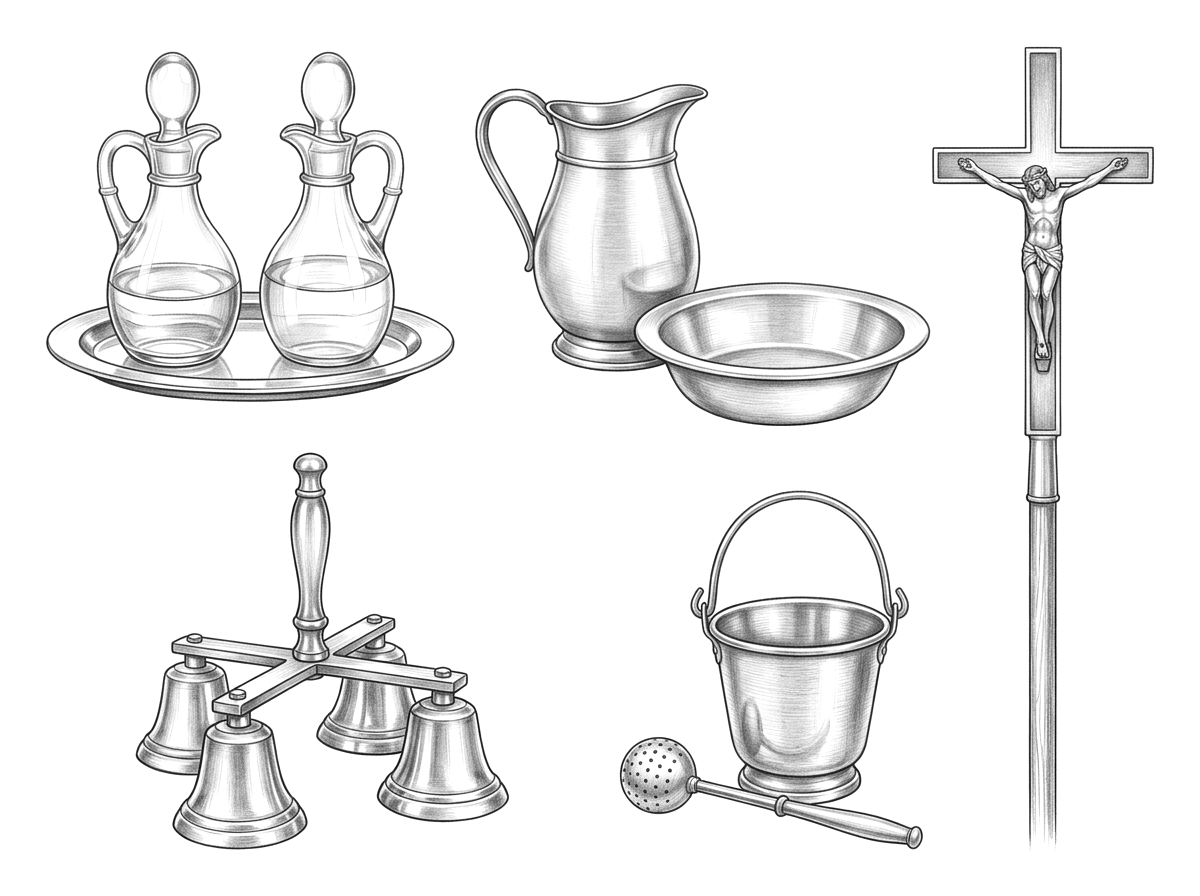 | Cruets Urceoli Details |
Sacred vessels | Cruets are paired small stoppered vessels—ordinarily clear glass or metal—that hold the unconsecrated wine and pure water prepared for the Preparation of the Gifts, the handwashing rite, and the purification of sacred vessels. |
More about CruetsPosition: See Plate VI, top left (paired with stoppers on an oval metal tray); Plate I, atop the credence table. Scale: Not to common scale. Plate key: Top left: paired glass wine and water Cruets with stoppers on a tray; top center: Lavabo pitcher and shallow finger basin; top right: Processional Cross bearing the sculpted corpus of Christ on a staff; bottom left: four-cup mounted brass Sanctuary Bell; bottom right: holy-water Aspersorium bucket and perforated metal Aspergillum. Also shown on this plate: Lavabo Towel · Processional Cross · Sanctuary Bells · Aspergillum and Aspersorium. Image creditProject-owned generated monochrome illustration (CC BY 4.0). Position: See Plate VI, top left (paired with stoppers on an oval metal tray); Plate I, atop the credence table. Scale: Not to common scale (architectural perspective). Plate key: Center: freestanding Altar with white Altar Cloth, two Altar Candles, and Altar Cross with corpus; foreground left: stationary Ambo; rear recessed niche: solid locked Tabernacle with hanging Sanctuary Lamp; rear right: Presidential Chair beside Credence Table holding cruets and linens. Also shown on this plate: Altar · Ambo · Presidential Chair · Credence Table · Tabernacle · Sanctuary Lamp · Altar Cloth · Altar Candles · Processional Cross. Image creditProject-owned generated monochrome illustration (CC BY 4.0); no third-party photographs or copyrighted art incorporated. Disposition (2008 Latin / 2011 U.S.): required (Universal Roman law). Ordinary ministers: Priest, Deacon, Instituted acolyte, Altar server. Prepared by: Sacristan, Altar server. Server boundary (Server carries and presents to priest or deacon): Cruets are core altar-server equipment: servers prepare them cleanly on the credence table, carry them to the altar with stoppers removed and handles turned toward the priest or deacon, return them promptly off the altar mensa (GIRM 306), and bring the water cruet back for vessel purification after Communion. Handling and safety: Remove glass stoppers safely on the credence table before approaching the altar so stoppers are not dropped on stone steps; never leave cruets sitting on the altar table during the Eucharistic Prayer (GIRM 306). 1962 Roman Missal counterpart (continued): Both the 1962 Roman Missal (using Latin ampullae, RG 528) and the 2008/2011 IGMR (using Latin urceoli, GIRM 118c) appoint paired wine and water cruets on the credence table for the Offertory mixing and ablutions. Postconciliar rubrics omit kissing the cruets and signing the water cruet with the cross, and allow the wine to be carried from the nave in the Procession of the Gifts (GIRM 140). Shared compositions: Plate I — The Postconciliar Roman Sanctuary. Appearance, placement, symbolism, and sourcesAlso called: Wine and Water Cruets; Ampullae; Urceoli cum vino et aqua. Ecclesiastical Latin pronunciation: oor-CHEH-oh-lee Appearance: Depicted at top left of Plate VI as two matching clear glass pitchers with looped handles, pouring spouts, and fitted glass stoppers resting on an oval metal tray; Plate I shows them standing ready atop the credence table. Placement and use: Before Mass, the cruets of wine and water are prepared on the credence table (unless the wine is brought forward in the Procession of the Gifts, in which case the water cruet still remains ready on the credence table: GIRM 118c, 140). At the Preparation of the Gifts, the server or instituted acolyte brings the cruets to the deacon or priest at the altar, who pours wine and a few drops of water into the chalice (GIRM 142, 178, 190). After Communion, the server brings the water cruet again so the priest, deacon, or instituted acolyte may purify the paten, chalice, and ciboria (GIRM 163, 279). Because cruets hold unconsecrated elements and are not sacred vessels, clear glass is customary and helpful so ministers tell wine from water at a glance. Liturgical colors: Clear glass or noble metal (non-liturgical color). Distinguish from: Flagon · Lavabo Towel. Related entries: Credence Table · Chalice · Communion Cup.
| |||
| Flagon Lagoena Details |
Sacred vessels | The flagon is a larger pitcher or carafe permitted solely for carrying unconsecrated wine in the Procession of the Gifts and pouring it into chalices before the Eucharistic Prayer begins. |
More about FlagonPosition: Bottom left, tall slender pitcher with curved handle and pouring lip (Plate III). Scale: Not to common scale. Plate key: Top row, left to right: Chalice, wide shallow Paten, lidded footed Ciborium with cross finial. Bottom row, left to right: pitcher-style wine Flagon (pre-consecration transport only), footed Communion Cup (chalice), hinged pocket Pyx shown open. Also shown on this plate: Chalice · Paten · Ciborium · Communion Cup · Pyx. Image creditProject-owned generated monochrome illustration (CC BY 4.0). Disposition (2008 Latin / 2011 U.S.): permitted (Diocesan or local selection). United States territorial note: In United States parishes celebrating Communion under both kinds, a flagon is permitted strictly as a pre-consecration transport vessel in the Procession of the Gifts; Redemptionis Sacramentum 106 and the 2011 USCCB Norms strictly prohibit consecrating wine in a flagon or pouring the Precious Blood from a flagon into Communion cups after consecration. Ordinary ministers: Faithful, Priest, Deacon, Instituted acolyte, Altar server. Prepared by: Sacristan, Altar server. Server boundary (Server handles directly): Servers may set the flagon at the gifts table before Mass, receive the unconsecrated flagon from the priest or deacon at the foot of the altar, and remove the empty flagon promptly from the altar to the credence table before the Eucharistic Prayer begins. Handling and safety: Strict liturgical boundary (Redemptionis Sacramentum 106): never leave a flagon containing wine on the altar during the Eucharistic Prayer, never treat a flagon as a chalice, and never allow the consecrated Precious Blood to be poured from a flagon into Communion cups. 1962 Roman Missal counterpart (no established counterpart): The 1962 Roman Missal had no counterpart to a wine flagon because lay Communion was distributed under the species of bread alone and small cruets on the credence table sufficed (RG 528). The flagon emerged with the postconciliar gifts procession and Communion under both kinds, and was strictly restricted to pre-consecration wine transport by Redemptionis Sacramentum 106 (2004). Appearance, placement, symbolism, and sourcesAlso called: Wine Pitcher; Offertory Carafe; Lagena; Ampulla maior. Ecclesiastical Latin pronunciation: lah-JEH-nah Appearance: Illustrated at bottom left of Plate III as a tall, slender footed metal pitcher with a graceful side handle and pronounced pouring lip—visibly distinct from a chalice or Communion cup by its spout, handle, and carafe silhouette. Placement and use: When a large assembly celebrates Communion under both kinds, representatives of the faithful may carry unconsecrated wine forward in a dignified flagon during the Procession of the Gifts (GIRM 73, 140). At the Preparation of the Gifts, the priest or deacon pours all wine intended for consecration from the flagon into the principal chalice and supplementary Communion chalices, and the empty flagon is removed immediately to the credence table before the Eucharistic Prayer starts (GIRM 306). A flagon is never a sacred vessel for consecration and never holds the Precious Blood: Redemptionis Sacramentum 106 forbids both containing the Blood of Christ in flagons or bowls and pouring the consecrated Precious Blood from one vessel into another. Liturgical colors: Clear glass, crystal, or noble metal (non-consecrated transport vessel). Distinguish from: Chalice · Communion Cup · Cruets. Related entries: Credence Table · Fragile Vessels, Flagon Pouring, and EMHC Purification.
| |||
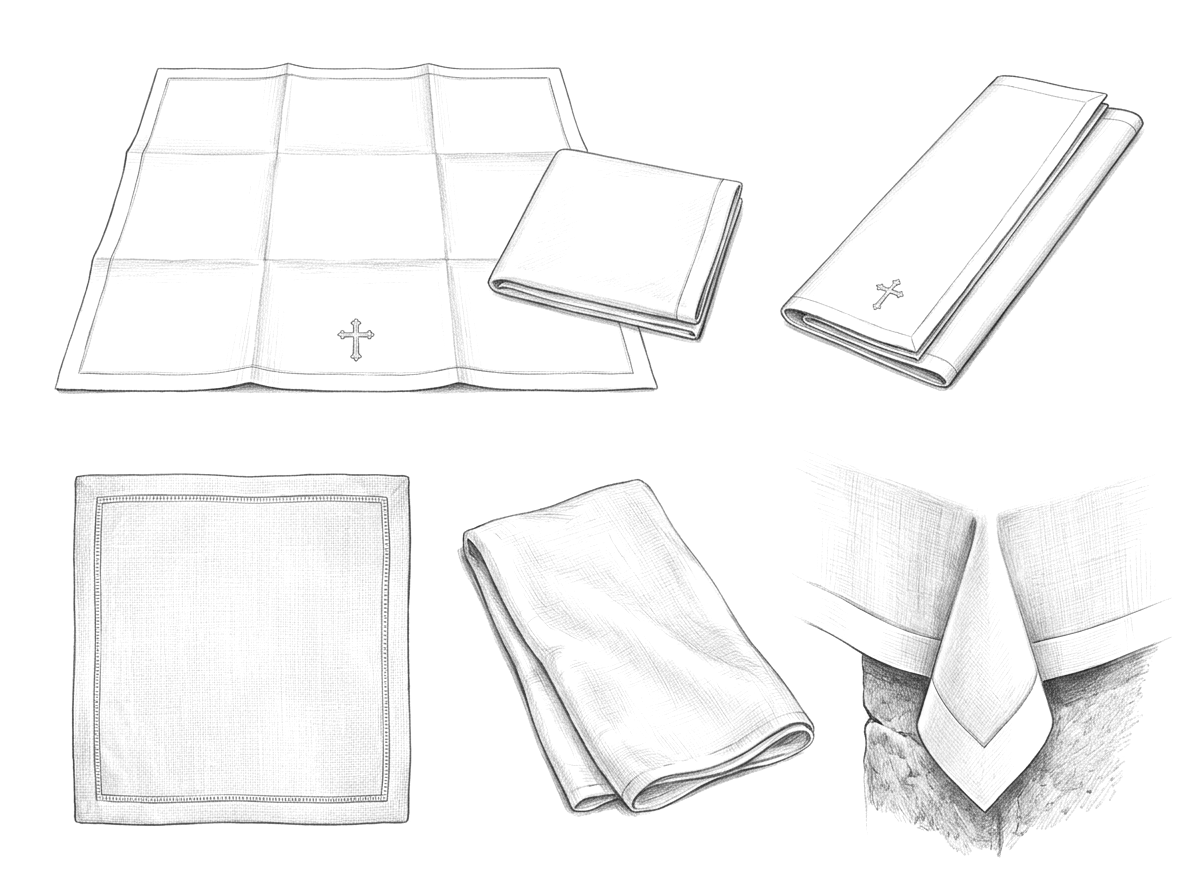 | Altar Cloth Mappa Details |
Altar and vessel linens | A clean white linen cloth dressing the top surface of the altar for every celebration of Mass. |
More about Altar ClothPosition: Bottom right corner drape (Plate IV); dressing the altar (Plates I–II). Scale: Not to common scale. Plate key: Top left: unfolded square Corporal showing its three-by-three fold grid and front stitched cross, paired with a folded Corporal; top right: oblong Purificator folded lengthwise in thirds with stitched cross visible near the lower folded end; bottom left: stiffened square Pall; bottom center: folded Lavabo Towel; bottom right: hemmed corner of white Altar Cloth draped over the mensa. Also shown on this plate: Corporal · Purificator · Pall · Lavabo Towel. Image creditProject-owned generated monochrome illustration (CC BY 4.0). Position: Bottom right corner drape (Plate IV); dressing the altar (Plates I–II). Scale: Not to common scale (architectural perspective). Plate key: Center: freestanding Altar with white Altar Cloth, two Altar Candles, and Altar Cross with corpus; foreground left: stationary Ambo; rear recessed niche: solid locked Tabernacle with hanging Sanctuary Lamp; rear right: Presidential Chair beside Credence Table holding cruets and linens. Also shown on this plate: Altar · Ambo · Presidential Chair · Credence Table · Tabernacle · Sanctuary Lamp · Altar Candles · Processional Cross · Cruets. Image creditProject-owned generated monochrome illustration (CC BY 4.0); no third-party photographs or copyrighted art incorporated. Position: Bottom right corner drape (Plate IV); dressing the altar (Plates I–II). Scale: Not to common scale. Plate key: Top left: freestanding Altar covered with white linen cloth; top right: stationary stone Ambo with sloped desk and step; bottom left: dignified wooden Presidential Chair; bottom right: locked double-door Tabernacle on stone pedestal beside suspended oil Sanctuary Lamp. Also shown on this plate: Altar · Ambo · Presidential Chair · Tabernacle · Sanctuary Lamp. Image creditProject-owned generated monochrome illustration (CC BY 4.0). Disposition (2008 Latin / 2011 U.S.): required (Universal Roman law). United States territorial note: In the Dioceses of the United States of America, the confirmed territorial adaptation at GIRM 304 permits additional altar cloths beneath or alongside the primary cloth to bear other colors of Christian honorific or festive significance, provided the uppermost cloth covering the mensa is always white. Ordinary ministers: Bishop, Priest, Deacon. Prepared by: Sacristan, Instituted acolyte, Altar server. Server boundary (Server prepares or sets in place before or during Mass): Servers may assist the sacristan in laying or smoothing a clean altar cloth before Mass with clean hands, keeping wax, ink, and unauthorized items off the mensa and reporting any spill of the Precious Blood immediately to the priest or deacon. Handling and safety: Never blot or wash a spill of the Precious Blood on the altar cloth yourself; notify the priest or deacon at once so the spot is washed with water and the ablution poured into the sacrarium (GIRM 280; RS 120). Guard the linen against candle flames and molten wax. 1962 Roman Missal counterpart (materially changed): The 1962 Roman Missal required three clean blessed white linen cloths covering the altar, with the uppermost cloth reaching the ground at both sides (RG 526). Postconciliar law requires at least one white cloth suited to the altar's shape and size (GIRM 117, 304), while the United States adaptation permits additional festive colored under-cloths beneath the white top cloth. Shared compositions: Plate I — The Postconciliar Roman Sanctuary · Plate II — Principal Sanctuary Furnishings. Appearance, placement, symbolism, and sourcesAlso called: Fair linen; Altar linen; Mappa altaris; Mappae; Tobalea. Ecclesiastical Latin pronunciation: MAHP-pah Appearance: At bottom right of Plate IV, a finely hemmed corner of smooth white linen drapes cleanly over the stone edge of the mensa; Plates I and II show it dressing the entire freestanding altar. Proportioned to the altar's shape and size, it may bear restrained hemstitching, woven bands, or subtle lace suited to noble simplicity. Placement and use: Laid smoothly over the altar mensa before Mass so that at least one clean white cloth always covers the table of sacrifice (GIRM 117, 304). Any under-cloths—including festive colored under-cloths permitted in United States dioceses—lie neatly beneath the white uppermost cloth. Until the Preparation of the Gifts, the dressed mensa remains uncluttered, holding no cruets, stands, or loose papers (GIRM 306). Liturgical colors: Always white for the required uppermost cloth (GIRM 117, 304); in the United States, additional under-cloths may employ other liturgical or festive colors of Christian honorific significance (US GIRM 304). Symbolism: The white altar cloth expresses reverence for the celebration of the Lord's memorial and the sacred banquet in which his Body and Blood are offered. In the scholastic tradition of St. Thomas Aquinas, the clean linen dressing the altar also evokes the burial cloth of Christ—“And Joseph taking the body wrapped it up in a clean linen cloth” (Matt 27:59)—calling to mind purity of conscience and the Passion of the Lord. (GIRM 304; St. Thomas Aquinas, Summa Theologiae III, q. 83, a. 3, ad 7; Matt 27:59) Distinguish from: Corporal · Lavabo Towel. Related entries: Altar · Corporal · Altar Candles.
| |||
| Corporal Corporale Details |
Altar and vessel linens | A square white linen cloth unfolded at the center of the altar during the Preparation of the Gifts so that every vessel holding the Body and Blood of Christ rests upon it and any sacred fragment is safely gathered. |
More about CorporalPosition: Top left, shown unfolded in a 3x3 crease grid and folded beside it (Plate IV); beneath vessels (Plate X). Scale: Not to common scale. Plate key: Top left: unfolded square Corporal showing its three-by-three fold grid and front stitched cross, paired with a folded Corporal; top right: oblong Purificator folded lengthwise in thirds with stitched cross visible near the lower folded end; bottom left: stiffened square Pall; bottom center: folded Lavabo Towel; bottom right: hemmed corner of white Altar Cloth draped over the mensa. Also shown on this plate: Purificator · Pall · Lavabo Towel · Altar Cloth. Image creditProject-owned generated monochrome illustration (CC BY 4.0). Position: Top left, shown unfolded in a 3x3 crease grid and folded beside it (Plate IV); beneath vessels (Plate X). Scale: Not to common scale. Plate key: Top: Communion under both kinds arrangement on an unfolded Corporal (principal Chalice, Paten, veiled covered Ciborium, and two footed Communion Cups each with a folded Purificator); bottom left: three cylindrical lidded metal Holy Oils Stocks on a tray (Sacred Chrism, Oil of Catechumens, Oil of the Sick); bottom right: carved octagonal stone Baptismal Font with removable domed cover ajar. Also shown on this plate: Communion Cup · Ciborium · Chalice · Paten · Purificator · Holy Oils and Oil Stocks · Baptismal Font. Image creditProject-owned generated monochrome illustration (CC BY 4.0). Disposition (2008 Latin / 2011 U.S.): required (Universal Roman law). United States territorial note: Universal Roman law requires a corporal beneath all Eucharistic vessels on the altar (GIRM 118c, 139, 306) and beneath unpurified vessels awaiting post-Mass purification (GIRM 279; USCCB Norms for Holy Communion under Both Kinds 53). While GIRM 118c commends the optional chalice veil, it does not mention the stiff burse, which remains purely a traditional accessory. Ordinary ministers: Bishop, Priest, Deacon, Instituted acolyte. Prepared by: Sacristan, Deacon, Instituted acolyte, Altar server. Server boundary (Server prepares or sets in place before or during Mass): Servers may set a clean, folded corporal on the credence table before Mass and bring it to the altar at the Preparation of the Gifts when no deacon or instituted acolyte serves; after consecration, servers never shake, refold carelessly, or wash a used corporal, and move a folded corporal flat and level only when directed after purification. Handling and safety: A used corporal may hold fine particles of the Sacred Host. Never shake it out or wash it directly in an ordinary sink; first soak and hand-rinse it in a dedicated basin and pour that first rinse water into the sacrarium or directly into clean earth before ordinary laundering (RS 120). 1962 Roman Missal counterpart (continued): The square white linen corporal folded inward in nine squares continues directly from the 1962 Roman Missal (RS I.1). In postconciliar Mass with a congregation, it is placed on the altar at the Preparation of the Gifts rather than drawn from a stiff burse at the start of Low Mass (1962 RS II.2), and GIRM 118c no longer mandates a burse. Shared compositions: Plate X — Communion Under Both Kinds and Sacramental Vessels. Appearance, placement, symbolism, and sourcesAlso called: Altar corporal; Palla corporalis. Ecclesiastical Latin pronunciation: kor-poh-RAH-leh Appearance: At top left of Plate IV, the corporal appears both unfolded in a crisp three-by-three crease grid of nine equal squares and folded flat beside it; Plate X shows it spread beneath the principal chalice, paten, veiled ciborium, and Communion cups. Woven of fine white linen with a hemmed edge, it ordinarily bears a small stitched cross near the front center border facing the celebrant. Placement and use: Prepared neatly folded on the credence table (GIRM 118c), brought to the altar at the Preparation of the Gifts, and spread open at the center of the mensa by the deacon, instituted acolyte, or priest (GIRM 139, 178, 190). After Communion and vessel purification, the minister folds the sides carefully inward—enclosing the upper surface inside—so no microscopic particle of the Sacred Host can scatter (GIRM 183, 192). Unpurified vessels left on the altar or credence table after Mass likewise rest suitably covered on a corporal (GIRM 279). Liturgical colors: Always pure white linen (customarily marked with a small white or red embroidered cross near the front edge). Symbolism: Named from the Latin corpus (“body”), the corporal is made of pure white linen because Christ's body was wrapped in a clean linen shroud at his burial: “And Joseph taking the body wrapped it up in a clean linen cloth” (Matt 27:59; cf. John 20:6, “and saw the linen cloths lying”). Following ancient Roman tradition expounded by St. Thomas Aquinas, the white linen signifies purity of conscience and recalls the Passion of Christ. (St. Thomas Aquinas, Summa Theologiae III, q. 83, a. 3, ad 7 (citing De Consecr. dist. 1); Matt 27:59; John 20:6) Distinguish from: Purificator · Pall · Lavabo Towel · Altar Cloth. Related entries: Altar · Chalice · Paten · Ciborium · Communion Cup · Credence Table.
| |||
| Purificator Purificatorium Details |
Altar and vessel linens | An oblong white absorbent linen cloth used to wipe the rim of the chalice during Communion and to dry the chalice, paten, and ciboria after purification. |
More about PurificatorPosition: Top right, folded lengthwise in thirds with stitched cross visible near the lower folded end (Plate IV); beside Communion cups (Plate X). Scale: Not to common scale. Plate key: Top left: unfolded square Corporal showing its three-by-three fold grid and front stitched cross, paired with a folded Corporal; top right: oblong Purificator folded lengthwise in thirds with stitched cross visible near the lower folded end; bottom left: stiffened square Pall; bottom center: folded Lavabo Towel; bottom right: hemmed corner of white Altar Cloth draped over the mensa. Also shown on this plate: Corporal · Pall · Lavabo Towel · Altar Cloth. Image creditProject-owned generated monochrome illustration (CC BY 4.0). Position: Top right, folded lengthwise in thirds with stitched cross visible near the lower folded end (Plate IV); beside Communion cups (Plate X). Scale: Not to common scale. Plate key: Top: Communion under both kinds arrangement on an unfolded Corporal (principal Chalice, Paten, veiled covered Ciborium, and two footed Communion Cups each with a folded Purificator); bottom left: three cylindrical lidded metal Holy Oils Stocks on a tray (Sacred Chrism, Oil of Catechumens, Oil of the Sick); bottom right: carved octagonal stone Baptismal Font with removable domed cover ajar. Also shown on this plate: Communion Cup · Ciborium · Chalice · Paten · Corporal · Holy Oils and Oil Stocks · Baptismal Font. Image creditProject-owned generated monochrome illustration (CC BY 4.0). Disposition (2008 Latin / 2011 U.S.): required (Universal Roman law). United States territorial note: Under GIRM 286 and the 2011 USCCB Norms for Holy Communion under Both Kinds (nos. 43, 53), one clean purificator accompanies every Communion chalice to wipe the rim after each communicant, and post-Communion vessel purification using the purificator belongs exclusively to the priest, deacon, or instituted acolyte. Ordinary ministers: Bishop, Priest, Deacon, Instituted acolyte, Extraordinary minister of Holy Communion. Prepared by: Sacristan, Deacon, Instituted acolyte, Altar server. Server boundary (Server prepares or sets in place before or during Mass): Servers may set clean, unused purificators on the credence table before Mass and carry them with unconsecrated chalices at the Preparation of the Gifts; once used with the Precious Blood, servers never wipe sacred vessels with them, shake them, or place them in ordinary laundry. Handling and safety: Used purificators hold traces of the Precious Blood. Never wash a used purificator in an ordinary sink or mix it into regular laundry; soak and hand-rinse it first in a dedicated basin and pour that first rinse water into the sacrarium or directly into clean earth before ordinary laundering (RS 120). 1962 Roman Missal counterpart (continued): The folded white linen purificator continues directly from the 1962 Roman Missal (RS I.1, X.5), where a single purificator served the celebrant's chalice and ablutions. In postconciliar celebration, Communion under both kinds expands its use so that a separate clean purificator accompanies every Communion chalice (GIRM 286). Shared compositions: Plate X — Communion Under Both Kinds and Sacramental Vessels. Appearance, placement, symbolism, and sourcesAlso called: Chalice cloth. Ecclesiastical Latin pronunciation: poo-ree-fee-kah-TOH-ree-oom Appearance: At top right of Plate IV, the oblong linen cloth is folded lengthwise into thirds with a small stitched cross visible on the folded face; Plate X shows a folded purificator paired beside each footed Communion cup. Its narrow triple-folded form and small cross distinguish it clearly from both the square nine-fold corporal and the plain, uncrossed lavabo towel. Placement and use: Prepared on the credence table draped across the principal chalice—and paired one-to-one beside every additional Communion chalice whenever Communion is distributed under both kinds (GIRM 118c, 286). During Communion, the minister of the chalice wipes both sides of the rim with a clean fold after each communicant; after Communion, the priest, deacon, or instituted acolyte dries the purified sacred vessels with it at the altar or credence table (GIRM 279, 306). Liturgical colors: Always pure white absorbent linen (customarily marked with a small white or red embroidered cross). Distinguish from: Lavabo Towel · Corporal · Pall. Related entries: Chalice · Communion Cup · Paten · Ciborium · Corporal.
| |||
| Pall Palla Details |
Altar and vessel linens | A stiffened flat square of white linen placed optionally over the mouth of the chalice to shield the wine and Precious Blood from dust, lint, or insects. |
More about PallPosition: Bottom left, stiffened square (Plate IV). Scale: Not to common scale. Plate key: Top left: unfolded square Corporal showing its three-by-three fold grid and front stitched cross, paired with a folded Corporal; top right: oblong Purificator folded lengthwise in thirds with stitched cross visible near the lower folded end; bottom left: stiffened square Pall; bottom center: folded Lavabo Towel; bottom right: hemmed corner of white Altar Cloth draped over the mensa. Also shown on this plate: Corporal · Purificator · Lavabo Towel · Altar Cloth. Image creditProject-owned generated monochrome illustration (CC BY 4.0). Disposition (2008 Latin / 2011 U.S.): optional (Universal Roman law). Ordinary ministers: Bishop, Priest, Deacon. Prepared by: Sacristan, Deacon, Instituted acolyte, Altar server. Server boundary (Server prepares or sets in place before or during Mass): Servers may set a clean pall atop the unconsecrated chalice on the credence table and bring it to the altar at the Preparation of the Gifts; once the Eucharistic Prayer begins, servers do not place or remove the pall over a chalice containing the Precious Blood. Handling and safety: Remove any rigid insert before washing a slipcover pall; if drops of the Precious Blood ever touch the linen underside, soak and hand-rinse the linen first into the sacrarium or clean earth before ordinary laundering (RS 120). 1962 Roman Missal counterpart (optional): The 1962 Roman Missal required a blessed small linen pall on every prepared chalice stack to cover the host and chalice throughout the Offertory and Canon (RS I.1, VII.5, VIII.7). Postconciliar law expressly makes the pall optional, prescribing it “if appropriate” (pro opportunitate, GIRM 118c). Appearance, placement, symbolism, and sourcesAlso called: Chalice pall; Palla calicis. Ecclesiastical Latin pronunciation: PAHL-lah Appearance: Shown at bottom left of Plate IV: a rigid, flat square of crisp white linen (typically six to seven inches across) bordered with fine hemstitching or drawn-thread work, held flat either by heavy starching of layered linen or by a removable waterproof insert inside a washable linen slipcover. Placement and use: Prepared on the credence table atop the chalice and paten whenever appropriate—explicitly qualified as optional (pro opportunitate, “if appropriate”) in GIRM 118c—and permitted on the altar mensa during the Liturgy of the Eucharist (GIRM 139, 306). The priest or deacon lifts it before pouring, consecrating, or drinking, and replaces it whenever dust, drafts, or insects threaten an open chalice, especially in warm seasons or outdoor Masses. Liturgical colors: White linen on its functional body and underside; restrained white embroidery or subtle decorative trim occasionally adorns the upper face. Distinguish from: Corporal · Purificator. Related entries: Chalice · Paten · Corporal · Credence Table.
| |||
| Lavabo Towel Manutergium Details |
Altar and vessel linens | A soft, absorbent rectangular white hand towel presented with the water pitcher and finger basin so the priest can dry his hands after the Offertory handwashing at the side of the altar. |
More about Lavabo TowelPosition: Bottom center, softly folded rectangular cloth (Plate IV); paired with lavabo pitcher and basin (Plate VI). Scale: Not to common scale. Plate key: Top left: unfolded square Corporal showing its three-by-three fold grid and front stitched cross, paired with a folded Corporal; top right: oblong Purificator folded lengthwise in thirds with stitched cross visible near the lower folded end; bottom left: stiffened square Pall; bottom center: folded Lavabo Towel; bottom right: hemmed corner of white Altar Cloth draped over the mensa. Also shown on this plate: Corporal · Purificator · Pall · Altar Cloth. Image creditProject-owned generated monochrome illustration (CC BY 4.0). Position: Bottom center, softly folded rectangular cloth (Plate IV); paired with lavabo pitcher and basin (Plate VI). Scale: Not to common scale. Plate key: Top left: paired glass wine and water Cruets with stoppers on a tray; top center: Lavabo pitcher and shallow finger basin; top right: Processional Cross bearing the sculpted corpus of Christ on a staff; bottom left: four-cup mounted brass Sanctuary Bell; bottom right: holy-water Aspersorium bucket and perforated metal Aspergillum. Also shown on this plate: Cruets · Processional Cross · Sanctuary Bells · Aspergillum and Aspersorium. Image creditProject-owned generated monochrome illustration (CC BY 4.0). Disposition (2008 Latin / 2011 U.S.): required (Universal Roman law). Ordinary ministers: Bishop, Priest. Prepared by: Sacristan, Instituted acolyte, Altar server. Server boundary (Server carries and presents to priest or deacon): Servers prepare the lavabo towel on the credence table before Mass, carry it with the water pitcher and basin to the side of the altar at the Preparation of the Gifts, present it cleanly unfolded for the priest to dry his hands, bow before and after, and return all three items promptly to the credence table. Handling and safety: Keep plain lavabo towels strictly separate from sacred purificators in both the sacristy and credence setup so the two are never interchanged. Hold the pitcher and basin level so water does not splash onto the altar cloth or sanctuary steps. 1962 Roman Missal counterpart (continued): The hand towel (manutergium) prepared with water and basin on the credence table continues directly from the 1962 Roman Missal (RG 528; RS VII.6–7, VII.10). In the postconciliar rite, the priest washes his hands rather than only thumb and forefinger tips, and replaces Psalm 25:6–12 (Lavabo inter innocentes) with the single verse of Psalm 50:4 [51:2] praying for interior cleansing (GIRM 76, 145). Shared compositions: Plate VI — Processional and Service Equipment. Appearance, placement, symbolism, and sourcesAlso called: Finger towel; Hand towel; Tersorium. Ecclesiastical Latin pronunciation: mah-noo-TEHR-jee-oom Appearance: At bottom center of Plate IV, the lavabo towel appears loosely folded in supple, unstarched absorbent linen or cotton without an embroidered cross—visually distinct from the starched creases and stitched crosses of the corporal and purificator. On Plate VI, it accompanies the metal lavabo pitcher and shallow round finger basin. Placement and use: Prepared on the credence table beside the lavabo pitcher and basin (GIRM 118c appoints whatever is needed for the washing of hands). At the Preparation of the Gifts—immediately after the offerings are placed on the altar or after the incensation—an altar server or instituted acolyte pours water over the priest's hands at the side of the altar and presents the unfolded towel while the priest prays quietly for interior cleansing (GIRM 76, 145, 190). Liturgical colors: Always clean white absorbent linen or cotton without seasonal color change. Distinguish from: Purificator · Corporal. Related entries: Credence Table · Cruets · Altar.
| |||
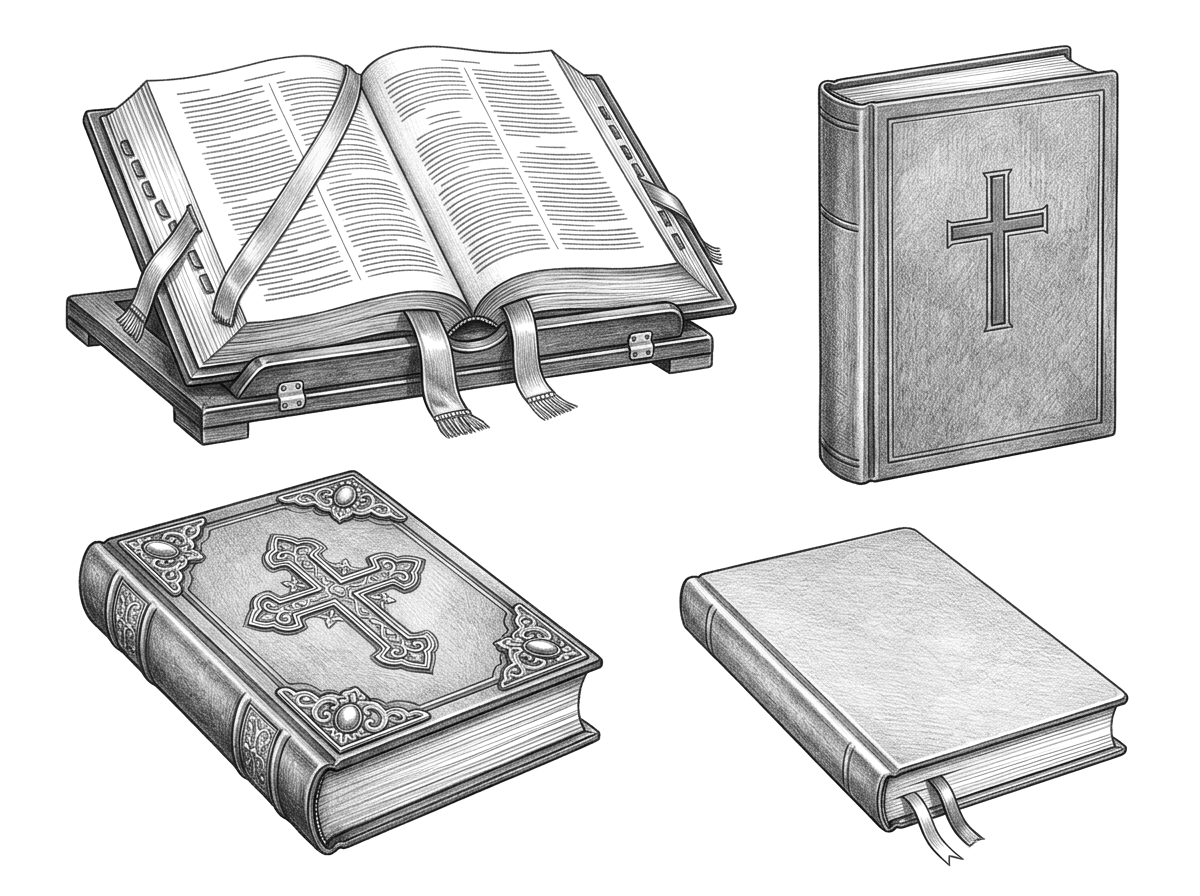 | Roman Missal Missale Romanum Details |
Liturgical books | The principal liturgical book of the Roman Rite containing the Order of Mass, Eucharistic Prayers, Prefaces, presidential prayers, antiphons, and rubrics proclaimed by the priest celebrant. |
More about Roman MissalPosition: Top left, open with edge tabs and ribbons on a low stand (Plate V). Scale: Relative proportions shown. Plate key: Top left: thick Roman Missal open with side tabs and ribbon markers on a low angled Missal Stand; top right: tall closed Lectionary for Mass; bottom left: ornate bound Book of the Gospels (Evangeliary) with metal corner bosses and embossed cross; bottom right: slimmer Book of the Chair (Excerpts from the Roman Missal). Also shown on this plate: Missal Stand · Lectionary for Mass · Book of the Gospels · Book of the Chair. Image creditProject-owned generated monochrome illustration (CC BY 4.0). Disposition (2008 Latin / 2011 U.S.): required (Universal Roman law). United States territorial note: In the Dioceses of the United States of America, the approved vernacular edition is The Roman Missal, Third Edition (USCCB, effective 27 November 2011), translating the 2002/2008 Latin third typical edition in its entirety (GIRM 389) and incorporating confirmed United States adaptations and the 2021 emendations. Ordinary ministers: Bishop, Priest. Prepared by: Sacristan, Deacon, Instituted acolyte, Altar server. Server boundary (Server carries and presents to priest or deacon): Servers check ribbon markers before Mass as directed, hold the open Roman Missal steady at chest or reading height for the priest at the presidential chair when no stand or Book of the Chair is used, place it cleanly on the altar at the Preparation of the Gifts, and remove it after purification when instructed. Handling and safety: Support the heavy altar Missal evenly with both hands or braced cleanly against your upper chest—never by one cover—so the binding does not tear or slip. Never set loose announcements, bulletins, or unapproved sheets atop the Missal or on the altar mensa (GIRM 306). 1962 Roman Missal counterpart (materially changed): The 1962 Missale Romanum was a plenary altar book holding all presidential orations, chants, Epistles, and Gospels, remaining on the altar throughout Mass and carried between the Epistle and Gospel corners (RG 527; RS VI.5, XI.1). In the postconciliar Roman Rite, the Scripture readings are separated into the Lectionary and Book of the Gospels, while the Missal serves at the presidential chair and rests on the altar only from the Preparation of the Gifts through purification (GIRM 118a, 139, 306). Appearance, placement, symbolism, and sourcesAlso called: Altar Missal; Sacramentary (1974–2011 U.S. usage); Missale. Ecclesiastical Latin pronunciation: mees-SAH-leh roh-MAH-noom Appearance: At top left of Plate V, the heavy altar Missal lies open flat in two-column pages on a low wooden stand, fitted with durable side tabs along both fore-edges and multiple fringed silk ribbon markers. Ordinarily bound in red leather or cloth with sturdy sewing, it is thicker and heavier than the other sanctuary volumes shown in relative proportion on Plate V. Placement and use: Prepared beside the presidential chair before Mass (GIRM 118a, unless the Book of the Chair is used for chair prayers) and placed on the altar at the Preparation of the Gifts so the priest prays the Prayer over the Offerings, Preface, Eucharistic Prayer, and Communion rites directly from it (GIRM 139, 306). After the purification of vessels, it may return to the presidential chair for the Prayer after Communion and Solemn Blessing (GIRM 165–167, 306). Liturgical colors: Customarily bound in dignified red leather or cloth with restrained tooling; the binding does not change by liturgical season. Symbolism: The General Instruction of the Roman Missal teaches that liturgical books serve as signs and symbols of heavenly realities, requiring that the Roman Missal be crafted with genuine worth, dignity, and beauty to honor the Eucharistic prayer of the Church. (GIRM 349) Distinguish from: Book of the Chair · Lectionary for Mass · Book of the Gospels. Related entries: Missal Stand · Presidential Chair · Altar · Book of the Chair.
| |||
| Lectionary for Mass Lectionarium Details |
Liturgical books | The official ritual book of Sacred Scripture containing the appointed first and second readings, Responsorial Psalms, Gospel Acclamations, and Gospels organized across the three-year Sunday cycle (Years A, B, and C) and two-year weekday cycle (Years I and II). |
More about Lectionary for MassPosition: Top right, tall closed volume with cover cross (Plate V). Scale: Relative proportions shown. Plate key: Top left: thick Roman Missal open with side tabs and ribbon markers on a low angled Missal Stand; top right: tall closed Lectionary for Mass; bottom left: ornate bound Book of the Gospels (Evangeliary) with metal corner bosses and embossed cross; bottom right: slimmer Book of the Chair (Excerpts from the Roman Missal). Also shown on this plate: Roman Missal · Missal Stand · Book of the Gospels · Book of the Chair. Image creditProject-owned generated monochrome illustration (CC BY 4.0). Disposition (2008 Latin / 2011 U.S.): required (Universal Roman law). United States territorial note: In the Dioceses of the United States of America, Scripture readings at Mass are proclaimed from the approved Lectionary for Mass for Use in the Dioceses of the United States (Confraternity of Christian Doctrine), arranged according to the 1981 editio typica altera of the Ordo lectionum Missae; disposable booklets or parish missalettes never replace the ritual Lectionary on the ambo (GIRM 349; OLM 35–37). Ordinary ministers: Bishop, Priest, Deacon, Instituted lector. Prepared by: Sacristan, Instituted lector, Altar server. Server boundary (Server prepares or sets in place before or during Mass): Servers may confirm before Mass that the Lectionary lies open to the appointed day's readings on the ambo and may return it to the sacristy after Mass; servers never carry the Lectionary in the entrance procession and never proclaim Scripture from it unless separately deputed as readers. Handling and safety: Never carry the Lectionary in the entrance procession—GIRM 120d and 194 strictly reserve the entrance book procession to the Book of the Gospels. Never replace the ritual Lectionary on the ambo with disposable paper leaflets or pew missalettes (GIRM 349). 1962 Roman Missal counterpart (materially changed): In the 1962 Roman Missal, the one-year cycle of Epistles and Gospels was printed inside the Missal itself, with an optional separate Epistle book (liber Epistolarum) for the subdeacon at Solemn Mass (RS VI.4). The postconciliar reform established a dedicated multi-volume Lectionary spanning a three-year Sunday cycle (A, B, C) and two-year weekday cycle (I, II), placed open on the ambo for every Mass with a congregation (GIRM 118b; OLM 1981). Appearance, placement, symbolism, and sourcesAlso called: Lectionary; Ordo lectionum Missae. Ecclesiastical Latin pronunciation: lehk-tsee-oh-NAH-ree-oom Appearance: At top right of Plate V, the closed Lectionary stands upright as a tall, dignified hardcover ritual volume with a plain rectangular border and simple central cross stamped on the cover—stately in proportion, yet visibly less ornate than the metal-bossed Book of the Gospels directly below it. Placement and use: Placed open to the day's readings on the stationary ambo before Mass begins (GIRM 118b). Instituted lectors and deputed readers proclaim the first and second readings from it at the ambo, and the deacon or priest proclaims the Gospel from it whenever a separate Book of the Gospels is not employed. Under universal Roman rubrics (GIRM 120d, 194), the Lectionary is never carried in the entrance procession—only the Book of the Gospels receives that ceremonial procession. Liturgical colors: Bound in dignified cloth or leather (commonly burgundy, deep red, brown, or forest tones); cover color does not change by liturgical season. Symbolism: The General Instruction of the Roman Missal honors the Lectionary alongside the Book of the Gospels as a sign and symbol of heavenly realities serving the proclamation of God's Word, feeding the faithful at the table of God's Word before the table of Christ's Body. In the words of the psalmist, “Thy word is a lamp to my feet, and a light to my paths” (Ps 118:105 [119:105]). (GIRM 28, 349; Ordo lectionum Missae (1981) Praenotanda 35; Ps 118:105 [119:105]) Distinguish from: Book of the Gospels · Roman Missal. Related entries: Ambo · Book of the Gospels · Roman Missal.
| |||
| Book of the Gospels Evangeliarium Details |
Liturgical books | A dedicated, richly ornamented ritual volume containing solely the liturgical Gospels, accorded supreme ceremonial honor among all sanctuary books through entrance procession, placement on the altar, escorted procession to the ambo with candles and incense, and reverent kissing after proclamation. |
More about Book of the GospelsPosition: Bottom left, ornate metal-bossed cover (Plate V). Scale: Relative proportions shown. Plate key: Top left: thick Roman Missal open with side tabs and ribbon markers on a low angled Missal Stand; top right: tall closed Lectionary for Mass; bottom left: ornate bound Book of the Gospels (Evangeliary) with metal corner bosses and embossed cross; bottom right: slimmer Book of the Chair (Excerpts from the Roman Missal). Also shown on this plate: Roman Missal · Missal Stand · Lectionary for Mass · Book of the Chair. Image creditProject-owned generated monochrome illustration (CC BY 4.0). Disposition (2008 Latin / 2011 U.S.): provided (Universal Roman law). United States territorial note: In the Dioceses of the United States of America, the approved Book of the Gospels contains the Sunday and feast-day Gospels in the Lectionary translation and is customarily bound in embossed metallic or richly ornamented covers honoring the dignity commended by GIRM 349 and OLM 36–37. Ordinary ministers: Bishop, Priest, Deacon, Instituted lector. Prepared by: Sacristan, Deacon, Instituted lector. Server boundary (Server recognizes only; does not handle): Altar servers never carry the Book of the Gospels in the entrance procession (reserved strictly to the deacon, or to an instituted or deputed lector if no deacon is present) and never lift it from the altar for the Gospel procession; servers escort it with lighted candles and the thurible, flank the ambo during proclamation, and may reverently return the closed volume to the sacristy after Mass. Handling and safety: Never hand the Book of the Gospels to an altar server to carry in the entrance procession—GIRM 120d and 194 reserve that role strictly to the deacon or, in his absence, a lector. During the Gospel procession, candle-bearers hold flames well clear of the ornate cover and open pages. 1962 Roman Missal counterpart (changed use): In the 1962 Roman Missal, a separate Gospel book (liber Evangeliorum) belonged to Solemn Mass, where it was placed on the altar only before the Gospel, carried by the deacon in the Gospel procession, held by the subdeacon between lighted candles, incensed, and brought to the celebrant to kiss (RS VI.5). Postconciliar rubrics integrate the Book of the Gospels into ordinary Sunday and festive celebrations, carrying it slightly elevated in the entrance procession and resting it on the altar from the start of Mass until the Gospel procession (GIRM 120d, 122, 133–134, 306). Appearance, placement, symbolism, and sourcesAlso called: Evangeliary; Gospel Book; Liber Evangeliorum. Ecclesiastical Latin pronunciation: eh-vahn-jeh-lee-AH-ree-oom Appearance: At bottom left of Plate V, the closed Book of the Gospels stands out immediately from the plainer Lectionary by its heavy embossed cover, sculpted metal corner bosses, raised spine bands, and prominent floriated cross in relief. Placement and use: Strongly commended for cathedrals and parishes (OLM 36). Carried slightly elevated in the entrance procession by the deacon—or, in the deacon's absence, by an instituted or deputed lector—and laid flat on the center of the altar, the sole book permitted upon the mensa from the beginning of Mass until the Gospel (GIRM 120d, 122, 172–173, 194, 306). At the Gospel Acclamation, the deacon (or priest, if no deacon serves) lifts it from the altar and carries it to the ambo accompanied by servers with lighted candles and incense; after three swings of incense (GIRM 277; executed as paired double swings in Roman ceremonial custom, Caeremoniale Episcoporum 92) and proclamation, the minister reverently kisses the book while praying quietly Per evangelica dicta (GIRM 134, 175). Liturgical colors: Rich metallic silver, gilded brass, or embroidered cloth bindings bearing Christ, the Cross, or the Four Evangelists; covers remain constant across liturgical seasons. Symbolism: First among all liturgical books as a sign and symbol of heavenly realities, the Book of the Gospels receives elevation in procession, placement upon the altar, escort with lights and incense, and a reverent kiss because Christ himself speaks directly to his Church in the Gospel. St. Thomas Aquinas similarly distinguishes the earlier readings as preparatory instruction from the Gospel, by which Christ's own teaching instructs the faithful perfectly. (GIRM 62, 134, 175, 349; St. Thomas Aquinas, Summa Theologiae III, q. 83, a. 4, corpus) Distinguish from: Lectionary for Mass · Roman Missal. Related entries: Ambo · Altar · Lectionary for Mass · Altar Candles · Thurible.
| |||
| Book of the Chair No Latin typical edition Details |
Liturgical books | A slimmer, lighter Holy-See-confirmed United States ritual volume containing the presidential texts prayed away from the altar—such as the Introductory Rites, Collects, Prayers after Communion, and Solemn Blessings—designed for comfortable holding at the presidential chair. |
More about Book of the ChairPosition: Bottom right, slimmer handheld ceremonial volume (Plate V). Scale: Relative proportions shown. Plate key: Top left: thick Roman Missal open with side tabs and ribbon markers on a low angled Missal Stand; top right: tall closed Lectionary for Mass; bottom left: ornate bound Book of the Gospels (Evangeliary) with metal corner bosses and embossed cross; bottom right: slimmer Book of the Chair (Excerpts from the Roman Missal). Also shown on this plate: Roman Missal · Missal Stand · Lectionary for Mass · Book of the Gospels. Image creditProject-owned generated monochrome illustration (CC BY 4.0). Disposition (2008 Latin / 2011 U.S.): territorial adaptation (USCCB territorial adaptation). United States territorial note: Officially titled Excerpts from the Roman Missal, this lighter companion ritual volume was prepared by the United States Conference of Catholic Bishops, confirmed by the Congregation for Divine Worship and the Discipline of the Sacraments, and published in 2018 to fulfill GIRM 118a at the presidential chair alongside the complete altar Missal. Ordinary ministers: Bishop, Priest. Prepared by: Sacristan, Altar server. Server boundary (Server carries and presents to priest or deacon): Servers hold the Book of the Chair open flat and steady at the priest's reading angle during the Introductory Rites, Collect, Universal Prayer conclusion, Prayer after Communion, and Final Blessing, and never place it on the altar in place of the complete Roman Missal. Handling and safety: Never carry the Book of the Chair to the altar for the Liturgy of the Eucharist or the Eucharistic Prayer—it does not contain the Order of Mass altar prayers or Eucharistic Prayers, which require the complete Roman Missal (GIRM 306). 1962 Roman Missal counterpart (no established counterpart): Because the priest in the 1962 Roman Missal prayed the Collect and Postcommunion at the altar rather than at a presidential chair (RG 527), there was no presbyteral Book of the Chair (only a minister holding the Missal for a bishop under Caeremoniale Episcoporum I.20). The Holy-See-confirmed USCCB volume Excerpts from the Roman Missal (2018) is a distinct postconciliar practical companion fulfilling GIRM 118a. Appearance, placement, symbolism, and sourcesAlso called: Excerpts from the Roman Missal; Presidential Prayer Book. Appearance: At bottom right of Plate V, the closed Book of the Chair is markedly thinner and lighter than the thick altar Roman Missal at top left, bound in clean dignified covers with two silk ribbon markers extending from the foot of the spine and without the heavy fore-edge tab bank required for the Eucharistic Prayers. Placement and use: Placed beside the presidential chair before Mass (fulfilling GIRM 118a) and held open by an altar server or set on a discreet chair stand for the Introductory Rites, Collect, concluding prayer of the Universal Prayer, Prayer after Communion, and Final Blessing. Because it omits the Prefaces and Eucharistic Prayers, it is never placed on the altar mensa in place of the complete Roman Missal (GIRM 139, 306). Liturgical colors: Dignified cloth or leather binding (commonly red or complementary dark tones); the cover color does not change by liturgical season. Distinguish from: Roman Missal · Lectionary for Mass. Related entries: Roman Missal · Presidential Chair.
| |||
| Missal Stand Pulpitum Details |
Liturgical books | A low, angled wooden, metal, or cushioned bookrest placed on the altar at the Preparation of the Gifts to support the open Roman Missal at a readable slope without obstructing the assembly's view. |
More about Missal StandPosition: Top left, low angled stand beneath the open Missal (Plate V). Scale: Relative proportions shown. Plate key: Top left: thick Roman Missal open with side tabs and ribbon markers on a low angled Missal Stand; top right: tall closed Lectionary for Mass; bottom left: ornate bound Book of the Gospels (Evangeliary) with metal corner bosses and embossed cross; bottom right: slimmer Book of the Chair (Excerpts from the Roman Missal). Also shown on this plate: Roman Missal · Lectionary for Mass · Book of the Gospels · Book of the Chair. Image creditProject-owned generated monochrome illustration (CC BY 4.0). Disposition (2008 Latin / 2011 U.S.): customary (Documented custom). Ordinary ministers: Bishop, Priest. Prepared by: Sacristan, Deacon, Instituted acolyte, Altar server. Server boundary (Server handles directly): Servers keep the Missal stand off the altar mensa before the Preparation of the Gifts, carry it to the altar alongside the Roman Missal at the Preparation of the Gifts, set it neatly to the left of the corporal without overlapping the linen, and remove it cleanly after purification or Mass. Handling and safety: Verify that hinged wooden or metal stands lock firmly at a low angle before setting the heavy Roman Missal upon them so the stand cannot collapse during the Eucharistic Prayer, and never set any edge of the stand over the unfolded corporal. 1962 Roman Missal counterpart (continued): The Missal stand or cushion continues in practical form from the 1962 Roman Missal, which expressly required a cushion or bookstand beneath the Missal on the altar from the start of Mass and directed the server to move it from the Epistle side to the Gospel side and back (RG 527; RS VI.5, XI.1). In the postconciliar Roman Rite, it is neither mandated by name nor kept on the altar before the Preparation of the Gifts, but set once on the mensa for the Liturgy of the Eucharist and removed afterward (GIRM 139, 306). Appearance, placement, symbolism, and sourcesAlso called: Altar bookstand; Missal cushion; Legile; Cussinus. Ecclesiastical Latin pronunciation: POOL-pee-toom Appearance: At top left of Plate V, directly beneath the open Roman Missal, the low hinged wooden stand features a shallow front ledge that holds the heavy volume securely from sliding while keeping the book well below eye level across the altar. Placement and use: Although neither a stand nor a cushion is expressly mandated by name in GIRM 118 or 306, a low stand or firm cushion is widely customary on the altar during the Liturgy of the Eucharist (GIRM 139, 306). Kept off the bare mensa during the Introductory Rites and Liturgy of the Word, it is brought to the altar at the Preparation of the Gifts and positioned cleanly to the left of the corporal—never overlapping the linen and low enough not to impede the faithful's view of what takes place at the altar (GIRM 306–307)—then removed after vessel purification or Mass. Liturgical colors: Finished in natural wood, brass, or subtle metal harmonious with the altar; where a fabric Missal cushion is used, it may match the white altar cloth or the liturgical color of the day. Distinguish from: Ambo. Related entries: Roman Missal · Altar · Credence Table · Corporal.
| |||
| Processional Cross Crux processionalis Details |
Service and incense | The processional cross is a tall staff-mounted crucifix carried at the head of liturgical processions and often stationed beside the altar to serve as the single altar cross during Mass. |
More about Processional CrossPosition: Top right, bearing sculpted corpus on wooden staff (Plate VI); altar cross at center (Plate I). Scale: Not to common scale. Plate key: Top left: paired glass wine and water Cruets with stoppers on a tray; top center: Lavabo pitcher and shallow finger basin; top right: Processional Cross bearing the sculpted corpus of Christ on a staff; bottom left: four-cup mounted brass Sanctuary Bell; bottom right: holy-water Aspersorium bucket and perforated metal Aspergillum. Also shown on this plate: Cruets · Lavabo Towel · Sanctuary Bells · Aspergillum and Aspersorium. Image creditProject-owned generated monochrome illustration (CC BY 4.0). Position: Top right, bearing sculpted corpus on wooden staff (Plate VI); altar cross at center (Plate I). Scale: Not to common scale (architectural perspective). Plate key: Center: freestanding Altar with white Altar Cloth, two Altar Candles, and Altar Cross with corpus; foreground left: stationary Ambo; rear recessed niche: solid locked Tabernacle with hanging Sanctuary Lamp; rear right: Presidential Chair beside Credence Table holding cruets and linens. Also shown on this plate: Altar · Ambo · Presidential Chair · Credence Table · Tabernacle · Sanctuary Lamp · Altar Cloth · Altar Candles · Cruets. Image creditProject-owned generated monochrome illustration (CC BY 4.0); no third-party photographs or copyrighted art incorporated. Disposition (2008 Latin / 2011 U.S.): required (Universal Roman law). Ordinary ministers: Instituted acolyte, Altar server. Prepared by: Sacristan, Altar server. Server boundary (Server carries in procession or movement): The cross-bearer carries the processional cross upright with the figure of Christ facing forward, omits bowing and genuflecting while holding it (GIRM 274), and sets it securely in its floor stand near the altar or puts it away if another altar cross already stands there (GIRM 122). Handling and safety: Do not bow or genuflect while holding the processional cross (GIRM 274), both to honor the rubric and to prevent the tall staff from pitching forward. Keep the staff clear of low doorways and hanging lights, and confirm that its weighted floor stand is level and stable before releasing it. 1962 Roman Missal counterpart (changed use): Whereas the 1962 Roman Missal required a separate crucifix standing in the center of the altar (RG 527) and did not ordinarily prescribe a carried cross at a priest’s High Mass entrance, the 2002/2008 GIRM assigns the processional cross with the figure of Christ crucified a regular place in the entrance procession (GIRM 120b) and permits it to stand near the altar as the sole altar cross (GIRM 122, 308). The 2002 third typical edition also restored the explicit requirement of the sculpted corpus that had been omitted in the 1970 and 1975 editions. Shared compositions: Plate I — The Postconciliar Roman Sanctuary. Appearance, placement, symbolism, and sourcesAlso called: Altar Cross; Crucifix; Crux cum figura Christi crucifixi. Ecclesiastical Latin pronunciation: krooks proh-ches-see-oh-NAH-lees Appearance: A Latin cross bearing the sculpted figure of Christ crucified is fitted into a ringed socket atop a slender cylindrical wooden or metal staff, matching the standing altar crucifix shown at the center of the mensa in Plate I. Placement and use: During the entrance procession, an instituted acolyte or altar server carries the processional cross between two ministers bearing lighted candles (GIRM 120b). On reaching the sanctuary, the cross may be set in a floor stand near the altar to serve as the altar cross, in which case it must be the only cross present; otherwise it is placed away in a dignified spot while a separate crucifix remains clearly visible on or near the altar (GIRM 117, 122, 308). It is fitting that the cross with the figure of Christ crucified remain near the altar even outside liturgical celebrations (GIRM 308). Liturgical colors: Not governed by the seasonal color cycle; crafted in dignified wood, brass, bronze, silver, or other noble metal with a visible sculpted corpus. Symbolism: The cross adorned with the figure of Christ crucified remains visibly before the assembly during Mass and outside liturgical celebrations so as to recall the saving Passion of the Lord (GIRM 308). St. Paul proclaims, “But we preach Christ crucified” (1 Cor 1:23) and “But God forbid that I should glory, save in the cross of our Lord Jesus Christ” (Gal 6:14), through whom God reconciles all things, “making peace through the blood of his cross” (Col 1:20). St. Thomas Aquinas affirms that the consecration of the Eucharist, the acceptance of the sacrifice, and all its fruits flow from the virtue of the Cross of Christ. (GIRM 308; 1 Cor 1:23; Gal 6:14; Col 1:20; St. Thomas Aquinas, Summa Theologiae III, q. 83, a. 5, ad 3) Related entries: Altar · Altar Candles · Thurible · Sanctuary, Cross, Tabernacle, Altar Card, and Veil Clarifications (1970/1975).
| |||
| Altar Candles Candelabra cum cereis Details |
Service and incense | Altar candles are lighted wax or oil candles mounted in dignified candlesticks on or around the altar for every liturgical celebration, as well as paired candlesticks carried in processions. |
More about Altar CandlesPosition: See Plate I, flanking the freestanding altar. Scale: Not to common scale (architectural perspective). Plate key: Center: freestanding Altar with white Altar Cloth, two Altar Candles, and Altar Cross with corpus; foreground left: stationary Ambo; rear recessed niche: solid locked Tabernacle with hanging Sanctuary Lamp; rear right: Presidential Chair beside Credence Table holding cruets and linens. Also shown on this plate: Altar · Ambo · Presidential Chair · Credence Table · Tabernacle · Sanctuary Lamp · Altar Cloth · Processional Cross · Cruets. Image creditProject-owned generated monochrome illustration (CC BY 4.0); no third-party photographs or copyrighted art incorporated. Disposition (2008 Latin / 2011 U.S.): required (Universal Roman law). United States territorial note: GIRM 117 and 307 are universal Roman norms without a separate territorial insertion for the United States. Guidance of the USCCB Committee on Divine Worship maintains real living flames of wax or oil rather than electric lights. Ordinary ministers: Instituted acolyte, Altar server. Prepared by: Sacristan, Altar server. Server boundary (Server handles directly): Servers light altar candles shortly before Mass, extinguish them cleanly with a snuffer afterward, and carry processional and Gospel candles upright at matching heights without bowing or genuflecting while holding them (GIRM 120b, 133, 274). Handling and safety: Keep open flames well clear of hair, albs, ribbons, vestments, and the pages of the Roman Missal. Carry processional candles strictly upright, watch for dripping hot wax, and extinguish every flame with a brass snuffer rather than blowing melted wax onto the white altar cloth. 1962 Roman Missal counterpart (materially changed): Both the 1962 Roman Missal (RG 527) and the 2002/2008 GIRM (117, 307) scale candle counts from two up to six, or seven for the Diocesan Bishop. In 1962, altar candlesticks stood directly on the altar or its gradine flanking the central crucifix, supplemented by separate Sanctus and elevation torches; postconciliar GIRM 117, 122, and 307 permit candlesticks to stand either on or around the altar—including processional candlesticks placed near it—so that the faithful maintain an unobstructed view of the altar table. Appearance, placement, symbolism, and sourcesAlso called: Altar Candlesticks; Processional Candles; Cerei; Candelabra. Ecclesiastical Latin pronunciation: kahn-deh-LAH-brah koom CHEH-reh-ees Appearance: Two slender footed candlesticks bearing tall white wax tapers flank the central crucifix on the freestanding altar in Plate I, each fitted with a shallow wax bobeche to catch melted drips. Placement and use: At every celebration of Mass, lighted candles are placed on or around the altar: at least two candlesticks, or four or six especially for Sunday Mass and Holy Days of Obligation, and seven when the Diocesan Bishop celebrates (GIRM 117). Candlesticks are arranged harmoniously with the architecture of the altar and sanctuary so that they never obstruct the assembly’s clear view of what takes place upon the mensa (GIRM 307). Two lighted candles also accompany the processional cross at the entrance procession and flank the Book of the Gospels during the Gospel procession and proclamation at the ambo (GIRM 120b, 133, 175). Liturgical colors: Not governed by the seasonal color cycle; candles are traditionally white or unbleached natural beeswax, mounted in brass, bronze, silver, wood, or stone candlesticks. Symbolism: Candles are lighted at every liturgical celebration to express reverence and festive honor before God (GIRM 117, 307). Their living flame recalls Christ, who declares in the Gospel, “I am the light of the world. He that followeth me walketh not in darkness, but shall have the light of life” (John 8:12). (GIRM 117, 307; John 8:12) Distinguish from: Sanctuary Lamp. Related entries: Altar · Processional Cross · Book of the Gospels · Altar Cloth.
| |||
| Sanctuary Bells Campanula Details |
Service and incense | Sanctuary bells are a small hand bell or multi-cup brass chime rung optionally by a server during the Eucharistic Prayer to alert the congregation to the consecration. |
More about Sanctuary BellsPosition: Bottom left, four-cup mounted brass altar bell (Plate VI). Scale: Not to common scale. Plate key: Top left: paired glass wine and water Cruets with stoppers on a tray; top center: Lavabo pitcher and shallow finger basin; top right: Processional Cross bearing the sculpted corpus of Christ on a staff; bottom left: four-cup mounted brass Sanctuary Bell; bottom right: holy-water Aspersorium bucket and perforated metal Aspergillum. Also shown on this plate: Cruets · Lavabo Towel · Processional Cross · Aspergillum and Aspersorium. Image creditProject-owned generated monochrome illustration (CC BY 4.0). Disposition (2008 Latin / 2011 U.S.): optional (Documented custom). Ordinary ministers: Altar server, Instituted acolyte. Prepared by: Sacristan, Altar server. Server boundary (Server handles directly): An altar server rings the sanctuary bell cleanly and reverently shortly before the consecration and at each elevation according to local parish custom (GIRM 150), setting it down quietly without rattling the cups. 1962 Roman Missal counterpart (optional): Whereas the 1962 Roman Missal required a small bell on the Epistle-side table and prescribed ringing at the Sanctus and elevations (RG 528; RS VII.8, VIII.6), the 2002/2008 GIRM makes the bell optional according to local custom—shortly before the consecration and at each showing of the Host and Chalice—omitting the mandatory Sanctus and Communion rings (GIRM 150). Appearance, placement, symbolism, and sourcesAlso called: Altar Bell; Sanctus Bell; Parva campanula. Ecclesiastical Latin pronunciation: kahm-PAH-noo-lah Appearance: Four tuned, flared brass bell cups hang from the arms of a horizontal cruciform yoke topped by a central turned vertical handle, though single hand bells and three-cup sets are also common. Placement and use: When used according to local custom, the sanctuary bell rests on the credence table or beside the servers’ kneeling place before the Eucharistic Prayer. Shortly before the consecration—customarily as the priest extends his hands over the gifts at the epiclesis—an instituted acolyte or altar server may give a crisp signal on the bell, and likewise ring it at each showing of the consecrated Host and Chalice (GIRM 150). Bells remain silent from the conclusion of the Gloria at the Evening Mass of the Lord’s Supper on Holy Thursday until the Gloria of the Easter Vigil. Liturgical colors: Not governed by the seasonal color cycle; usually polished cast brass or bronze. Related entries: Credence Table · Altar · Thurible.
| |||
| Aspergillum and Aspersorium Aspergillum et aspersorium Details |
Service and incense | The aspersorium is the portable vessel that holds blessed water, paired with the aspergillum, the handheld sprinkler used to cast holy water over the assembly, altar, or blessed objects. |
More about Aspergillum and AspersoriumPosition: Bottom right, holy-water bucket and perforated sprinkler (Plate VI). Scale: Not to common scale. Plate key: Top left: paired glass wine and water Cruets with stoppers on a tray; top center: Lavabo pitcher and shallow finger basin; top right: Processional Cross bearing the sculpted corpus of Christ on a staff; bottom left: four-cup mounted brass Sanctuary Bell; bottom right: holy-water Aspersorium bucket and perforated metal Aspergillum. Also shown on this plate: Cruets · Lavabo Towel · Processional Cross · Sanctuary Bells. Image creditProject-owned generated monochrome illustration (CC BY 4.0). Disposition (2008 Latin / 2011 U.S.): optional (Universal Roman law). Ordinary ministers: Bishop, Priest, Deacon. Prepared by: Sacristan, Altar server. Server boundary (Server carries and presents to priest or deacon): Servers fill the clean vessel on the credence table before Mass, bring it to the priest for the blessing and sprinkling rite, accompany him through the nave holding the bucket steady, and return both articles cleanly to the credence table afterward (GIRM 51, 118c). Handling and safety: Fill the bucket only half to two-thirds full so water does not slosh over the rim onto stone or polished sanctuary steps and create a slipping hazard for ministers and communicants. 1962 Roman Missal counterpart (changed use): Although the portable metal bucket and sprinkler continue unchanged in form, the 1962 Roman Missal placed the Sunday Asperges me or Vidi aquam before the start of Mass, with the water blessed in the sacristy and the celebrant wearing a cope before putting on the chasuble. In the 2002/2008 Roman Missal, the Blessing and Sprinkling of Water takes place inside the Introductory Rites in place of the Penitential Act, celebrated by the priest already vested in his chasuble (GIRM 51, 118c; Appendix II). Appearance, placement, symbolism, and sourcesAlso called: Holy-Water Sprinkler and Bucket; Holy-Water Vessel; Vas aquae benedicendae; Vas aquae benedictae. Ecclesiastical Latin pronunciation: ahs-pehr-JEEL-loom eht ahs-pehr-SOH-ree-oom Appearance: A tapered cylindrical metal bucket rests on a molded circular foot with an arched wire bail handle hooked to twin rim lugs; beside it lies a turned metal sprinkler handle ending in a perforated hollow sphere (some parishes also use a bristled brush or natural evergreen branch). Placement and use: On Sundays, especially during Easter Time, the Order for the Blessing and Sprinkling of Water may replace the ordinary Penitential Act within the Introductory Rites of Mass (GIRM 51; Roman Missal, Appendix II). When the sprinkling rite is scheduled, the clean vessel of water to be blessed (or already blessed, as at the Easter Vigil) is prepared with the sprinkler on the credence table (GIRM 118c). The priest—vested in his chasuble—blesses the water, sprinkles himself and the ministers, and walks through the church sprinkling the faithful while a deacon or server carries the bucket beside him. The same paired instruments serve at funerals, church blessings, and sacramentals in the Book of Blessings. Liturgical colors: Not governed by the seasonal color cycle; made of brass, bronze, pewter, silver-plate, or stainless metal that resists water corrosion. Symbolism: The bucket and sprinkler are practical service instruments; the sacred symbolism belongs to the sprinkling rite itself, which recalls the grace and cleansing of Baptism (GIRM 51; Roman Missal, Appendix II). Its classic antiphon echoes the Psalmist: “Thou shalt sprinkle me with hyssop, and I shall be cleansed: thou shalt wash me, and I shall be made whiter than snow” (Ps 50:9 [Heb 51:7]). (GIRM 51; Roman Missal, Appendix II; Ps 50:9 [Heb 51:7]) Distinguish from: Cruets · Baptismal Font. Related entries: Baptismal Font · Credence Table · Chasuble · Cope.
| |||
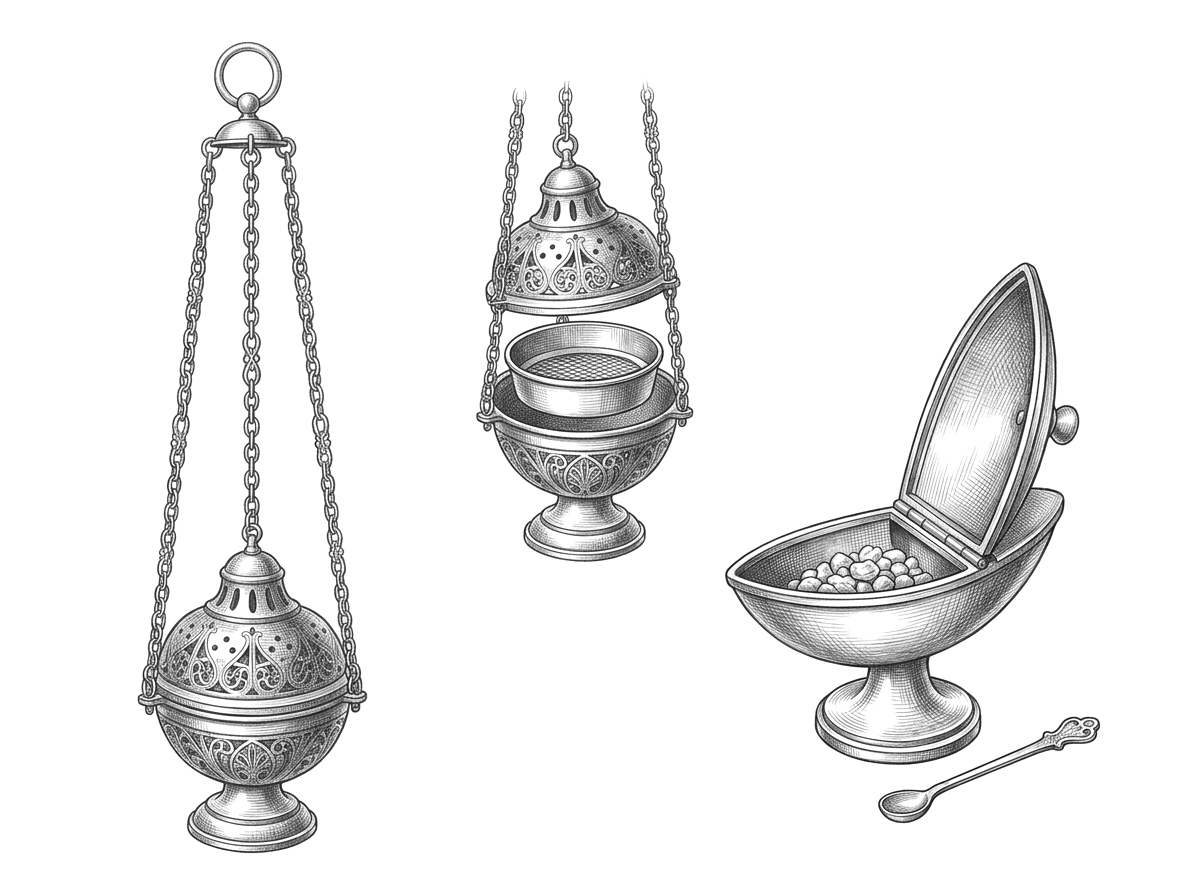 | Thurible Turibulum Details |
Service and incense | The thurible is a chained metal censer in which fragrant resin incense is burned upon glowing charcoal during Mass, Eucharistic Benediction, solemn Liturgy of the Hours, and funerals. |
More about ThuriblePosition: Left (closed on chains) and center inset (dome lifted revealing inner charcoal fire-pan) (Plate VII). Scale: Not to common scale. Plate key: Left: closed metal Thurible suspended on outer rim chains (two visible in profile) and one central lid-lifting chain; center: detail of raised perforated dome revealing removable inner charcoal fire-pan; right: footed Incense Boat (navicula) with hinged half-lid open showing resin grains, accompanied by its metal spoon. Also shown on this plate: Incense Boat. Image creditProject-owned generated monochrome illustration (CC BY 4.0). Disposition (2008 Latin / 2011 U.S.): optional (Universal Roman law). Ordinary ministers: Bishop, Priest, Deacon, Instituted acolyte, Altar server. Prepared by: Sacristan, Altar server, Instituted acolyte. Server boundary (Server handles directly): The thurifer lights charcoal safely in the sacristy, leads the entrance procession with the smoking thurible, raises the dome steadily for the priest to impose incense, hands the censer to the priest or deacon, and—when no deacon serves—incenses the priest, assembly, and consecrated Host and Chalice at the elevations (GIRM 120a, 150, 277). Handling and safety: Handle burning charcoal exclusively with metal tongs, never with bare fingers. Keep the hot bowl and chains clear of vestments, white altar linens, and narrow aisles, swing only with controlled short wrist movements, and empty spent coals into a dedicated fireproof metal ash vessel rather than an ordinary trash bin. 1962 Roman Missal counterpart (changed use): In the 1962 Roman Missal, incense at Mass was restricted to Solemn Mass and permitted sung Masses (never Low Mass) and accompanied by spoken blessing and incensation prayers (Ordo Missae 1035–1038). The 2002/2008 GIRM permits incense optionally in any form of Mass at five enumerated moments, replaces the spoken blessing with a silent Sign of the Cross, and codifies standardized sets of three, two, and single swings (GIRM 276–277). Appearance, placement, symbolism, and sourcesAlso called: Censer; Thuribulum. Ecclesiastical Latin pronunciation: too-REE-boo-loom Appearance: A footed metal bowl decorated in relief hangs from a top finger ring on outer rim chains (two visible in profile on Plate VII), while a central chain lifts the perforated domed cover to expose the removable circular charcoal fire-pan and grate shown in the center detail of Plate VII. Placement and use: Incense may be used optionally in any form of Mass at five appointed moments: during the entrance procession, at the start of Mass to incense the cross and altar, at the Gospel procession and proclamation, after the bread and chalice are placed on the altar to incense the offerings, cross, altar, priest, and people, and at the showing of the Host and Chalice after the consecration (GIRM 120a, 133, 144, 150, 276). The priest imposes incense onto the charcoal and blesses it silently with the Sign of the Cross (GIRM 277). Incensation follows the rhythmic swing pattern of GIRM 277—three swings (tribus ductibus) for the Blessed Sacrament, a relic of the True Cross, images of the Lord, the offerings, the altar cross, the Book of the Gospels, the paschal candle, the priest, and the people; two swings (duobus ductibus) for relics and images of the Saints; and continuous single swings while walking around the altar (each ductus being executed as a paired double swing in Roman ceremonial custom, Caeremoniale Episcoporum 92)—framed by a profound bow before and after except when incensing the altar and offerings. Liturgical colors: Not governed by the seasonal color cycle; crafted in heat-resistant polished brass, bronze, silver-plate, or sterling silver. Symbolism: Incensation expresses reverence and rising prayer before God (GIRM 276), grounded directly in Sacred Scripture: “Let my prayer be directed as incense in thy sight; the lifting up of my hands, as evening sacrifice” (Ps 140:2 [Heb 141:2]), and in the heavenly liturgy of the Apocalypse, “And the smoke of the incense of the prayers of the saints ascended up before God from the hand of the angel” (Apoc 8:4; cf. Apoc 5:8, 8:3). St. Thomas Aquinas adds that the fragrant smoke signifies the grace of Christ spreading through His ministers, echoing St. Paul’s words that God “manifesteth the odour of his knowledge by us in every place” (2 Cor 2:14). (GIRM 276; Ps 140:2 [Heb 141:2]; Apoc 5:8, 8:3–4; 2 Cor 2:14; St. Thomas Aquinas, Summa Theologiae III, q. 83, a. 5, ad 2) Distinguish from: Sanctuary Lamp. Related entries: Incense Boat · Altar · Processional Cross · Book of the Gospels.
| |||
| Incense Boat Navicula Details |
Service and incense | The incense boat is a small lidded metal container with a companion spoon used to hold unburned resin incense grains and transfer them onto the glowing charcoal of the thurible. |
More about Incense BoatPosition: Right, boat-shaped vessel with hinged half-lid open and spoon beside base (Plate VII). Scale: Not to common scale. Plate key: Left: closed metal Thurible suspended on outer rim chains (two visible in profile) and one central lid-lifting chain; center: detail of raised perforated dome revealing removable inner charcoal fire-pan; right: footed Incense Boat (navicula) with hinged half-lid open showing resin grains, accompanied by its metal spoon. Also shown on this plate: Thurible. Image creditProject-owned generated monochrome illustration (CC BY 4.0). Disposition (2008 Latin / 2011 U.S.): optional (Universal Roman law). Ordinary ministers: Priest, Deacon, Instituted acolyte, Altar server. Prepared by: Sacristan, Altar server. Server boundary (Server carries and presents to priest or deacon): The boat-bearer (or lone thurifer) opens the hinged lid and offers the spoon handle toward the priest or deacon before each imposition of incense, closing the lid promptly before walking so resin grains do not spill on sanctuary steps (GIRM 277). 1962 Roman Missal counterpart (continued): Both the 1962 Roman Missal (RS IV.4, VII.10) and the 2002/2008 GIRM (120, 276–277) pair the incense boat and spoon with the thurible. In postconciliar practice, the priest imposes incense silently with a Sign of the Cross rather than speaking the 1962 blessing formula, and neither the spoon nor the celebrant’s hand is kissed at the presentation. Appearance, placement, symbolism, and sourcesAlso called: Incense Boat and Spoon; Navicula cum cochleari. Ecclesiastical Latin pronunciation: nah-VEE-koo-lah Appearance: Shaped like a miniature hull resting on a flared pedestal foot, the vessel features a hinged half-lid lifted by a side knob to reveal granular resin incense inside, accompanied by a slender long-handled metal spoon resting beside its base. Placement and use: Whenever incense is employed during Mass, Benediction, or solemn Liturgy of the Hours (GIRM 120, 276–277), the incense boat accompanies the thurible. A dedicated boat-bearer—or the thurifer holding the boat in the left hand when serving alone—presents the opened vessel to the priest or deacon so that the priest may spoon resin grains onto the hot coals and bless them silently with the Sign of the Cross (GIRM 277). Liturgical colors: Not governed by the seasonal color cycle; finished in matching brass, bronze, pewter, or silver to pair with the thurible. Related entries: Thurible.
| |||
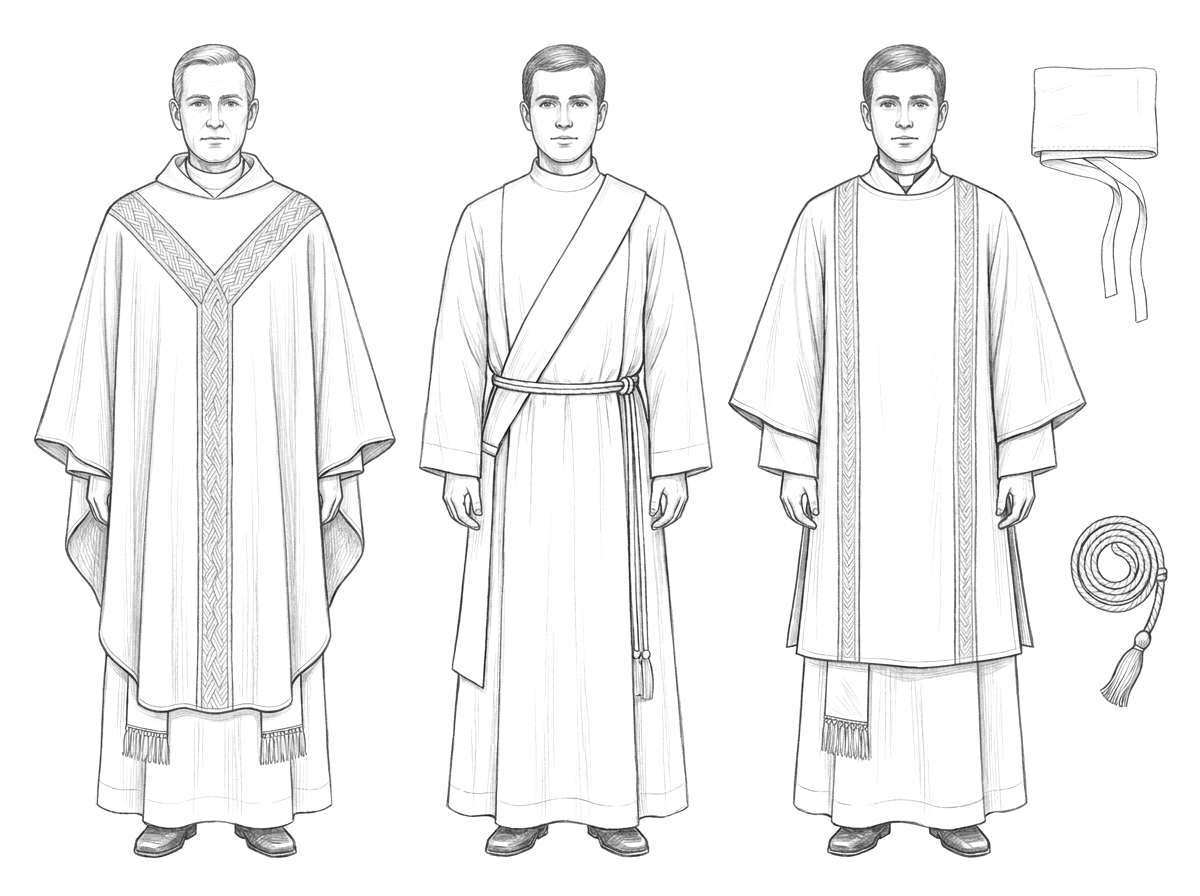 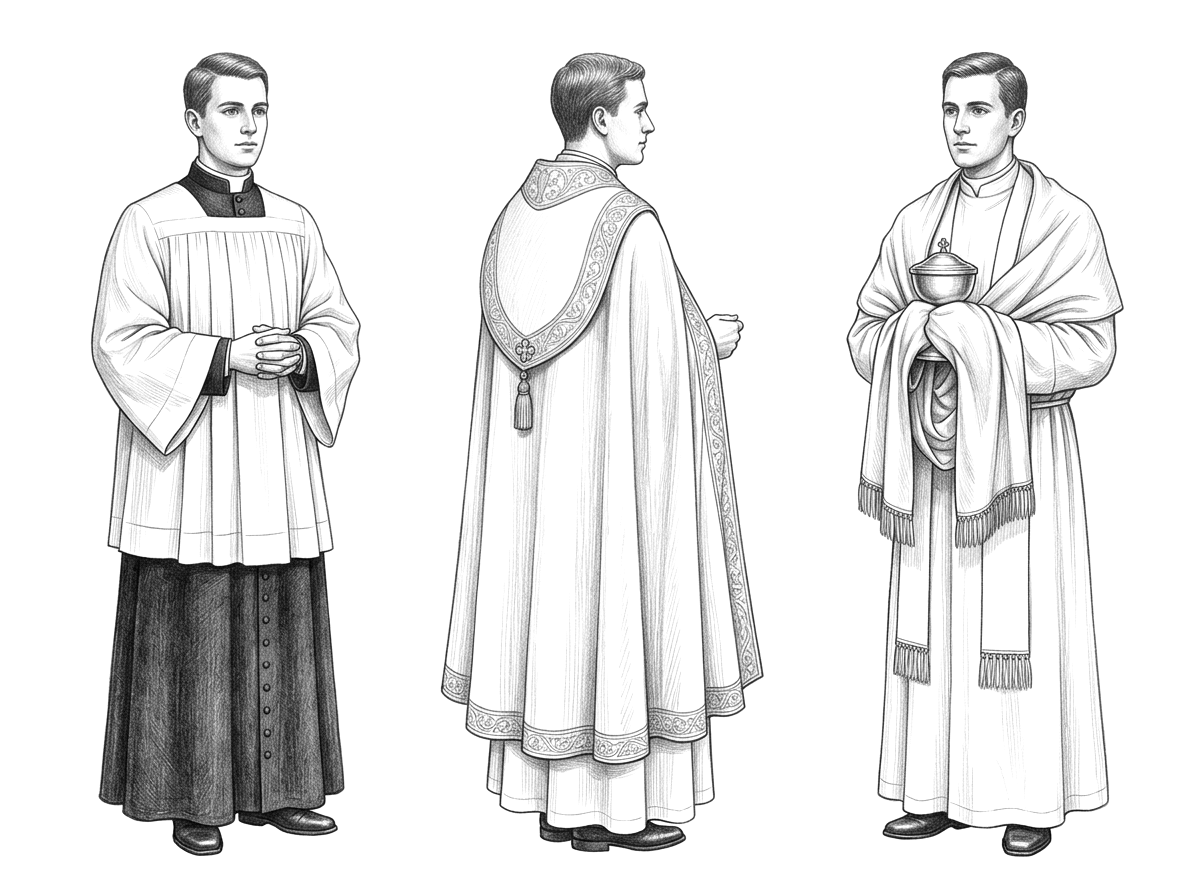 | Alb Alba Details |
Vesture and ministry | The alb is the full-length white liturgical tunic that serves as the common sacred garment of all ordained and instituted ministers of every rank. |
More about AlbPosition: Worn beneath chasuble, diagonal stole, and dalmatic across all three figures (Plate VIII), and under cope and humeral veil (Plate IX). Scale: Standing figures to common scale; insets not to scale. Plate key: Left: Priest in Alb, Amice, straight vertical Stole, and Y-orphrey Chasuble; center: Deacon in Alb, Cincture, and diagonal Stole from left shoulder to right hip without dalmatic; right: Deacon in Alb and sleeved Dalmatic worn over the diagonal Stole (fringed tip peeking at deacon's right side); far right insets: folded Amice with ties (top) and coiled tasseled Cincture (bottom). Also shown on this plate: Cincture · Amice · Stole · Chasuble · Dalmatic. Image creditProject-owned generated monochrome illustration (CC BY 4.0). Position: Worn beneath chasuble, diagonal stole, and dalmatic across all three figures (Plate VIII), and under cope and humeral veil (Plate IX). Scale: Standing figures to common scale. Plate key: Left: choir dress (deep black buttoned clerical Cassock beneath crisp white pleated Surplice); center: three-quarter rear view of semicircular Cope with ornamental hood shield and tassel over an Alb; right: Priest in Alb and straight Stole wearing a fringed Humeral Veil whose cloth completely envelops both hands supporting a closed lidded ciborium. Also shown on this plate: Cassock and Surplice · Cope · Humeral Veil. Image creditProject-owned generated monochrome illustration (CC BY 4.0). Disposition (2008 Latin / 2011 U.S.): required (Universal Roman law). United States territorial note: While GIRM 336 establishes the alb universally for all ordained and instituted ministers, the USCCB adaptation at GIRM 339 permits acolytes, altar servers, readers, and other lay ministers in the Dioceses of the United States to wear either the alb or other dignified attire suited to liturgical service. Ordinary ministers: Bishop, Priest, Deacon, Instituted acolyte, Instituted lector, Extraordinary minister of Holy Communion, Altar server. Prepared by: Sacristan, Altar server. Server boundary (Server handles directly): Altar servers may wear a clean white alb hemmed at ankle height (tied with a cincture if unfitted) where parish custom appoints it under US GIRM 339, hanging it neatly after Mass and never wearing clerical insignia over it (RS 126). Handling and safety: Choose an alb whose hem clears your shoes cleanly at ankle height; an overly long hem catches on sanctuary steps and creates a serious tripping hazard, especially when carrying lighted candles, cruets, or a hot thurible. 1962 Roman Missal counterpart (changed use): In the 1962 Roman Missal, the alb was worn solely by ordained sacred ministers at Mass (bishop, priest, deacon, and subdeacon, RS I.2–3), while altar servers and minor clerics wore cassock and surplice (RS II.1, VI.8). Under the 2002/2008 GIRM, the alb becomes the universal common garment of all ordained and instituted ministers, may never be replaced by a surplice under a chasuble, dalmatic, or stole alone (GIRM 336), and in the United States is also permitted for altar servers, readers, and other lay ministers (US GIRM 339). Shared compositions: Plate IX — Choir Dress and Solemn Ceremonial Vesture. Appearance, placement, symbolism, and sourcesAlso called: White Tunic; Tunica alba. Ecclesiastical Latin pronunciation: AHL-bah Appearance: Cut to ankle length with full-length sleeves in plain white linen or woven fabric, the alb appears beneath the priest’s chasuble, the center deacon’s diagonal stole and cincture, and the right deacon’s dalmatic in Plate VIII, as well as under the cope and humeral veil in Plate IX. Placement and use: Under universal Roman law, bishops, priests, deacons, instituted acolytes, and instituted lectors wear the alb as their shared liturgical garment (GIRM 336; RS 121–122). It is tied at the waist with a cincture unless tailored to fit neatly without one, and preceded by an amice whenever its neckline leaves ordinary clothing visible at the collar (GIRM 336; Caeremoniale Episcoporum 65). A surplice—even worn over a cassock—may never be substituted for the alb when a chasuble, a dalmatic, or a stole alone is worn (GIRM 336). In the United States, altar servers, readers, and extraordinary ministers of Holy Communion may wear the alb or other dignified clothing approved by diocesan norm (US GIRM 339), but lay ministers never add a stole, dalmatic, or chasuble over it (RS 126). Liturgical colors: Always white (GIRM 336), regardless of the liturgical season. Symbolism: As the single white garment shared by ordained and instituted ministers of every rank, the alb outwardly recalls baptismal dignity in Christ (GIRM 335–336), echoing St. Paul, “For as many of you as have been baptized in Christ have put on Christ” (Gal 3:27), and the saints who “have washed their robes and have made them white in the blood of the Lamb” (Apoc 7:14). Outside the norms of the General Instruction, the traditional Roman sacristy vesting prayer asks the Lord to make the minister pure and white in the blood of the Lamb, and Amalarius of Metz interprets the loose linen tunic as Christian freedom and bodily discipline. (GIRM 335–336; Gal 3:27; Apoc 7:13–14; traditional Roman sacristy vesting prayer (Ad Albam); Amalarius of Metz, Liber Officialis II.18) Distinguish from: Cassock and Surplice. Related entries: Cincture · Amice · Stole · Chasuble · Dalmatic · Cope · Humeral Veil.
| |||
| Cincture Cingulum Details |
Vesture and ministry | The cincture is a braided cord or cloth band tied around the waist over an unfitted alb to gather its folds neatly and hold its length clear of the floor. |
More about CincturePosition: Tied at waist of center deacon and coiled in lower right inset (Plate VIII). Scale: Standing figures to common scale; insets not to scale. Plate key: Left: Priest in Alb, Amice, straight vertical Stole, and Y-orphrey Chasuble; center: Deacon in Alb, Cincture, and diagonal Stole from left shoulder to right hip without dalmatic; right: Deacon in Alb and sleeved Dalmatic worn over the diagonal Stole (fringed tip peeking at deacon's right side); far right insets: folded Amice with ties (top) and coiled tasseled Cincture (bottom). Also shown on this plate: Alb · Amice · Stole · Chasuble · Dalmatic. Image creditProject-owned generated monochrome illustration (CC BY 4.0). Disposition (2008 Latin / 2011 U.S.): required (Universal Roman law). Ordinary ministers: Bishop, Priest, Deacon, Instituted acolyte, Instituted lector, Altar server. Prepared by: Sacristan, Altar server. Server boundary (Server handles directly): Altar servers tie the cincture neatly around the waist whenever wearing an unfitted alb, keeping the tasseled ends even and well clear of the floor and never confusing a colored waist cord with an ordained stole. Handling and safety: Tie the cincture securely so loose cord ends cannot drag on sanctuary steps, snag on pew corners or candle stands, or brush against open candle flames and hot thuribles. 1962 Roman Missal counterpart (optional): In the 1962 Roman Missal, the cincture was unconditionally mandatory with every alb both to gather the tunic and to anchor the priest’s crossed stole across the breast (RS I.3). Under the 2002/2008 GIRM, the cincture becomes conditionally optional whenever an alb is tailored to fit cleanly without one (GIRM 336), and the priest’s stole hangs straight rather than crossing through the cincture (GIRM 340). Appearance, placement, symbolism, and sourcesAlso called: Girdle; Waist Cord; Zona. Ecclesiastical Latin pronunciation: CHEEN-goo-loom Appearance: Shown looped at the waist of the center deacon in Plate VIII with twin tasseled ends hanging neatly at his left side, and coiled in the lower right inset, the cincture is a supple rope cord finished with fringed tassels at both ends. Placement and use: Universal Roman law directs that the alb be secured at the waist with a cincture unless the alb is specifically tailored to fit cleanly without one (GIRM 336; RS 122; Caeremoniale Episcoporum 65). Any bishop, priest, deacon, instituted acolyte, instituted lector, or altar server wearing an unfitted alb ties the cincture smoothly around the waist so that the garment hangs evenly at ankle height. For a deacon serving without a dalmatic, the cincture may also steady the diagonal stole at the waist, whereas the postconciliar priest’s straight stole hangs freely over or beside the cincture rather than crossing beneath it (GIRM 340). Liturgical colors: Ordinarily white, though a cord matching the liturgical color of the day may be worn by clergy or by servers where parish custom avoids confusing colored cords with clerical insignia. Symbolism: The General Instruction prescribes the cincture strictly for the practical task of fastening an unfitted alb at the waist (GIRM 336). Distinct from that rubrical rule, the traditional Roman sacristy vesting prayer asks God to gird the minister with the belt of purity, continence, and chastity, echoing the Gospel and Epistles—“Let your loins be girt and lamps burning in your hands” (Luke 12:35) and “Stand therefore, having your loins girt about with truth” (Eph 6:14)—while Amalarius of Metz likewise reads the cincture as an emblem of self-mastery. (Practical norm: GIRM 336; devotional tradition: Roman sacristy vesting prayer (Ad Cingulum); Luke 12:35; Eph 6:14; Amalarius of Metz, Liber Officialis II.22) Distinguish from: Stole. Related entries: Alb · Amice · Stole.
| |||
| Amice Amictus Details |
Vesture and ministry | The amice is a rectangular white linen shoulder cloth with long tie strings worn beneath a wide-necked alb whenever ordinary attire would otherwise show at the collar. |
More about AmicePosition: At collar of priest on left and folded with tie strings in upper right inset (Plate VIII). Scale: Standing figures to common scale; insets not to scale. Plate key: Left: Priest in Alb, Amice, straight vertical Stole, and Y-orphrey Chasuble; center: Deacon in Alb, Cincture, and diagonal Stole from left shoulder to right hip without dalmatic; right: Deacon in Alb and sleeved Dalmatic worn over the diagonal Stole (fringed tip peeking at deacon's right side); far right insets: folded Amice with ties (top) and coiled tasseled Cincture (bottom). Also shown on this plate: Alb · Cincture · Stole · Chasuble · Dalmatic. Image creditProject-owned generated monochrome illustration (CC BY 4.0). Disposition (2008 Latin / 2011 U.S.): required (Universal Roman law). Ordinary ministers: Bishop, Priest, Deacon, Instituted acolyte, Instituted lector, Altar server. Prepared by: Sacristan, Altar server. Server boundary (Server handles directly): Servers wearing a wide-necked alb that exposes ordinary shirt collars put on an amice beforehand (or use a high-collared alb that fully conceals street attire per GIRM 336), and assist in vesting a priest or bishop in the sacristy only when requested. 1962 Roman Missal counterpart (optional): In the 1962 Roman Missal, the amice was unconditionally required as the first Mass vestment for every bishop, priest, deacon, and subdeacon, kissed at its center cross and placed briefly upon the head before settling on the shoulders (RS I.3). Under the 2002/2008 GIRM, the amice is conditionally required only when the alb fails to cover ordinary attire at the neck (GIRM 336). Appearance, placement, symbolism, and sourcesAlso called: Shoulder Cloth. Ecclesiastical Latin pronunciation: ah-MEEK-toos Appearance: Resting neatly around the priest’s neck inside the chasuble collar at left in Plate VIII and shown folded in the upper right inset, the amice is an oblong hemmed white cloth sewn with two long flat cloth ribbons extending from its upper corners to tie around the waist. Placement and use: Universal Roman law directs that before putting on the alb, a minister is to wear an amice whenever the alb does not completely cover ordinary clothing at the neck (GIRM 336; RS 121–122; Caeremoniale Episcoporum 65). Draped across the shoulders, its tie strings pass under the arms, cross behind the back, and tie in front at the waist before the alb is slipped over it; the folded edge is then turned neatly over the neckline of the alb or chasuble so street or clerical collars remain concealed and outer vestments stay protected from perspiration. Liturgical colors: Always white linen or cotton (GIRM 336). Symbolism: The General Instruction assigns the amice a practical purpose—covering ordinary attire at the neck whenever the alb leaves it exposed (GIRM 336). Distinct from that practical rule, the traditional Roman sacristy vesting prayer—recalling the custom of resting the amice momentarily on the head before lowering it to the shoulders—prays for the helmet of salvation against demonic assaults, echoing St. Paul: “And take unto you the helmet of salvation and the sword of the Spirit (which is the word of God)” (Eph 6:17). Amalarius of Metz reads the cloth encircling the neck as a guard over speech, citing the Psalms, “I have set a guard to my mouth” (Ps 38:2 [Heb 39:1]) and “Set a watch, O Lord, before my mouth” (Ps 140:3 [Heb 141:3]). (Practical norm: GIRM 336; devotional tradition: Roman sacristy vesting prayer (Ad Amictum); Eph 6:17; Ps 38:2 [Heb 39:1]; Ps 140:3 [Heb 141:3]; Amalarius of Metz, Liber Officialis II.17) Distinguish from: Corporal · Lavabo Towel. Related entries: Alb · Cincture · Chasuble · Dalmatic.
| |||
| Stole Stola Details |
Vesture and ministry | The stole is the long woven band of liturgical color worn exclusively by ordained ministers—bishops, priests, and deacons—as the outward insignia of Holy Orders. |
More about StolePosition: Hanging straight below priest's chasuble at left; worn diagonally from left shoulder to right hip on center deacon and beneath right deacon's dalmatic with tip peeking at his right hem (Plate VIII). Scale: Standing figures to common scale; insets not to scale. Plate key: Left: Priest in Alb, Amice, straight vertical Stole, and Y-orphrey Chasuble; center: Deacon in Alb, Cincture, and diagonal Stole from left shoulder to right hip without dalmatic; right: Deacon in Alb and sleeved Dalmatic worn over the diagonal Stole (fringed tip peeking at deacon's right side); far right insets: folded Amice with ties (top) and coiled tasseled Cincture (bottom). Also shown on this plate: Alb · Cincture · Amice · Chasuble · Dalmatic. Image creditProject-owned generated monochrome illustration (CC BY 4.0). Position: Hanging straight below priest's chasuble at left; worn diagonally from left shoulder to right hip on center deacon and beneath right deacon's dalmatic with tip peeking at his right hem (Plate VIII). Scale: Standing figures to common scale. Plate key: Left: choir dress (deep black buttoned clerical Cassock beneath crisp white pleated Surplice); center: three-quarter rear view of semicircular Cope with ornamental hood shield and tassel over an Alb; right: Priest in Alb and straight Stole wearing a fringed Humeral Veil whose cloth completely envelops both hands supporting a closed lidded ciborium. Also shown on this plate: Cassock and Surplice · Cope · Humeral Veil. Image creditProject-owned generated monochrome illustration (CC BY 4.0). Disposition (2008 Latin / 2011 U.S.): required (Universal Roman law). United States territorial note: While the stole’s wearing and reservation to ordained ministers follow universal Roman law (GIRM 340; RS 123–126), USCCB adaptations at GIRM 346e and 346h permit white, violet, or black stoles for funerals and Masses for the Dead, and gold or silver stoles on more solemn occasions. Ordinary ministers: Bishop, Priest, Deacon. Prepared by: Sacristan. Server boundary (Clergy-reserved; server does not touch): Strictly reserved to bishops, priests, and deacons; altar servers, instituted acolytes, instituted lectors, and extraordinary ministers of Holy Communion never wear a stole (RS 126). A sacristan lays out the matching seasonal priestly or diaconal stole cleanly in the sacristy. 1962 Roman Missal counterpart (changed use): While the deacon’s diagonal wearing from left shoulder to right hip continues unchanged from 1962, the 1962 Roman Missal required a priest celebrating Mass to cross the stole across his breast and anchor it with the cincture, reserving straight hanging to bishops and prelates (RS I.3–4). Under GIRM 340, every priest now wears the stole hanging straight down in front of his chest. Shared compositions: Plate IX — Choir Dress and Solemn Ceremonial Vesture. Appearance, placement, symbolism, and sourcesAlso called: Priestly Stole; Diaconal Stole. Ecclesiastical Latin pronunciation: STOH-lah Appearance: A narrow scarf-like woven band finished with matching fringed ends hangs straight in twin parallel panels beneath the priest’s chasuble on the left of Plate VIII, crosses diagonally from left shoulder to right hip on the center deacon, and peeks cleanly beneath the right hem of the dalmatic on the right deacon. Placement and use: At Mass, the priest wears the stole around his neck hanging straight down in front of his chest—not crossed over the breast—over the alb and beneath the chasuble, matching the bishop’s manner (GIRM 337, 340). The deacon wears the stole diagonally from his left shoulder across his chest and back to be fastened at his right side, always beneath the dalmatic when the dalmatic is worn (GIRM 338, 340). A priest or deacon may never celebrate Mass wearing only a stole over ordinary street clothes or a monastic habit without the alb and appointed outer vestment, nor may a surplice replace the alb when only a stole is worn (GIRM 336; RS 123–126). Laypersons—including instituted acolytes, instituted lectors, extraordinary ministers of Holy Communion, and altar servers—are strictly prohibited from wearing a stole (RS 126). The stole follows the seasonal color of the day (GIRM 346): white, red, green, violet, rose (Gaudete and Laetare Sundays), black where customary, or festive gold or silver in the United States. Liturgical colors: Follows GIRM 346 seasonal colors: white, red, green, violet, rose (Third Sunday of Advent and Fourth Sunday of Lent), black where customary for Masses for the Dead, and—under USCCB GIRM 346e and 346h—white, violet, or black for funerals and gold or silver on more solemn occasions. Symbolism: The stole outwardly signifies ordained ministry within the Body of Christ, distinguishing episcopal and presbyteral order from diaconal order by the manner in which it is worn (GIRM 335, 340). In devotional tradition distinct from the General Instruction, the traditional Roman sacristy vesting prayer asks the Lord to restore the robe of immortality lost by our first parents, while Amalarius of Metz sees in the stole the sweet yoke of the Gospel (Matt 11:29–30). (GIRM 335, 340; traditional Roman sacristy vesting prayer (Ad Stolam); Matt 11:29–30; Amalarius of Metz, Liber Officialis II.20) Distinguish from: Cincture · Humeral Veil. Related entries: Alb · Chasuble · Dalmatic · Cope · Subdeacon's Tunicle and Maniple.
| |||
| Chasuble Casula Details |
Vesture and ministry | The chasuble is the full-draping sleeveless outer vestment proper to a bishop or priest celebrating Mass and sacred rites immediately joined to Mass. |
More about ChasublePosition: Left figure, Y-orphrey outer vestment of priest celebrant (Plate VIII). Scale: Standing figures to common scale; insets not to scale. Plate key: Left: Priest in Alb, Amice, straight vertical Stole, and Y-orphrey Chasuble; center: Deacon in Alb, Cincture, and diagonal Stole from left shoulder to right hip without dalmatic; right: Deacon in Alb and sleeved Dalmatic worn over the diagonal Stole (fringed tip peeking at deacon's right side); far right insets: folded Amice with ties (top) and coiled tasseled Cincture (bottom). Also shown on this plate: Alb · Cincture · Amice · Stole · Dalmatic. Image creditProject-owned generated monochrome illustration (CC BY 4.0). Disposition (2008 Latin / 2011 U.S.): required (Universal Roman law). United States territorial note: While universal Roman law requires the chasuble for the priest celebrant at Mass (GIRM 337; RS 123–124), USCCB adaptations at GIRM 346e and 346h permit white, violet, or black chasubles at funeral Masses and Masses for the Dead, and gold or silver chasubles on more solemn occasions. Ordinary ministers: Bishop, Priest. Prepared by: Sacristan. Server boundary (Clergy-reserved; server does not touch): Strictly reserved to bishops and priests celebrating or concelebrating Mass (GIRM 337); deacons, instituted acolytes, instituted lectors, extraordinary ministers, and altar servers never wear a chasuble (RS 126). During Mass, servers keep lighted candles and hot thuribles safely clear of its wide flowing drape. 1962 Roman Missal counterpart (continued): Both the 1962 Roman Missal (RG 133–134; RS I.4) and the 2002/2008 GIRM (119a, 337) prescribe the chasuble as the proper Mass vestment of the priest celebrant over alb and stole. Postconciliar rubrics additionally allow the chasuble for rites immediately joined to Mass such as the Sunday sprinkling, Ash Wednesday ashes, and funeral commendation (Tres abhinc annos 26; GIRM 337), emphasize graceful form and noble fabric over heavy ornament (GIRM 344), and introduce a narrow omission faculty for non-principal concelebrants in genuine need (GIRM 209; RS 124). Appearance, placement, symbolism, and sourcesAlso called: Mass Vestment; Planeta. Ecclesiastical Latin pronunciation: KAH-zoo-lah Appearance: Worn over the white alb, amice, and straight stole by the priest on the left of Plate VIII, this ample Gothic-cut chasuble drapes evenly over shoulders and arms without separate sleeves and is accented down the chest and over the shoulders by a woven Y-shaped orphrey band. Placement and use: Unless the rubrics provide otherwise, the chasuble is always worn by the priest celebrant—and by the principal celebrant at a concelebrated Mass—over the alb and stole at Mass and during actions directly connected with Mass, such as the Sunday sprinkling rite, Ash Wednesday imposition of ashes, and the final commendation at a funeral Mass (GIRM 337; RS 123; Tres abhinc annos 26). Concelebrating priests other than the principal celebrant wear the chasuble as well, omitting it only for a just reason such as a large gathering of priests or a scarcity of vestments, in which case they wear the stole over the alb (GIRM 209; RS 124). Deacons, instituted ministers, extraordinary ministers of Holy Communion, and altar servers never wear a chasuble (RS 126). Its nobility derives from quality fabric and graceful form rather than lavish ornament (GIRM 344), following the seasonal color cycle of GIRM 346. Liturgical colors: Follows GIRM 346: white, red, green, violet, rose (Gaudete and Laetare Sundays), black where customary for Masses for the Dead, and—in the United States under USCCB GIRM 346e and 346h—white, violet, or black for funerals and gold or silver on more solemn occasions. Symbolism: The chasuble is the outer liturgical sign proper to the priest celebrant’s presidential and sacrificial office at Mass (GIRM 335, 337). In devotional tradition distinct from the General Instruction, the traditional Roman sacristy vesting prayer echoes Christ’s words, “For my yoke is sweet and my burden light” (Matt 11:30), Christian tradition connects its all-enveloping mantle with charity—“But above all these things have charity, which is the bond of perfection” (Col 3:14)—and Amalarius of Metz sees in it the works of justice and holiness. (GIRM 335, 337; Matt 11:30; Col 3:14; traditional Roman sacristy vesting prayer (Ad Casulam); Amalarius of Metz, Liber Officialis II.19) Distinguish from: Dalmatic · Cope. Related entries: Alb · Stole · Amice · Cincture.
| |||
| Dalmatic Dalmatica Details |
Vesture and ministry | The dalmatic is the wide-sleeved, knee-length outer tunic proper to the deacon, worn at Mass and solemn celebrations over the alb and the diagonal diaconal stole. |
More about DalmaticPosition: Right figure, wide-sleeved rectangular outer vestment worn over the diagonal stole (Plate VIII). Scale: Standing figures to common scale; insets not to scale. Plate key: Left: Priest in Alb, Amice, straight vertical Stole, and Y-orphrey Chasuble; center: Deacon in Alb, Cincture, and diagonal Stole from left shoulder to right hip without dalmatic; right: Deacon in Alb and sleeved Dalmatic worn over the diagonal Stole (fringed tip peeking at deacon's right side); far right insets: folded Amice with ties (top) and coiled tasseled Cincture (bottom). Also shown on this plate: Alb · Cincture · Amice · Stole · Chasuble. Image creditProject-owned generated monochrome illustration (CC BY 4.0). Disposition (2008 Latin / 2011 U.S.): provided (Universal Roman law). United States territorial note: Universal Roman law appoints the dalmatic as the proper vestment of the deacon (GIRM 338), permitting omission out of necessity or on lesser occasions while Redemptionis Sacramentum 125 praises refraining from omitting it; United States GIRM 346e and 346h govern funeral and solemnity color options. Ordinary ministers: Deacon, Bishop. Prepared by: Sacristan. Server boundary (Clergy-reserved; server does not touch): Strictly reserved to deacons (and bishops beneath the chasuble at major pontifical celebrations); never worn by instituted acolytes, instituted lectors, extraordinary ministers, or altar servers (RS 126). Servers recognize the sleeved dalmatic immediately to distinguish a deacon from a priest. 1962 Roman Missal counterpart (continued): The dalmatic continues from the 1962 Roman Missal (RG 137) as the proper outer vestment of the deacon over alb and diagonal stole. Postconciliar GIRM 338 introduces a limited omission faculty for necessity or lesser solemnity (discouraged by RS 125), while Caeremoniale Episcoporum (1984) no. 56 simplifies episcopal solemn vesting to a single dalmatic beneath the chasuble without a separate tunicle. Appearance, placement, symbolism, and sourcesAlso called: Deacon's Dalmatic; Dalmatica diaconalis. Ecclesiastical Latin pronunciation: dahl-MAH-tee-kah Appearance: Illustrated on the right figure of Plate VIII as a structured, wide-sleeved rectangular vestment ornamented with two vertical woven stripes (clavi) descending from the shoulders; the deacon's diagonal stole sits underneath it, with only its fringed end peeking cleanly below the deacon's right side. Placement and use: At Mass, the deacon vests in the alb (with amice and cincture as needed), puts on the stole diagonally from his left shoulder to his right hip, and wears the dalmatic over the stole—never the stole on top of the dalmatic (GIRM 336, 338, 340). Although GIRM 338 permits the dalmatic to be omitted out of necessity or on account of a lesser degree of solemnity, Redemptionis Sacramentum 125 commends keeping the dalmatic in regular use rather than routinely omitting it. On major solemnities and pontifical Masses, a bishop may also wear a lightweight pontifical dalmatic beneath his chasuble (Caeremoniale Episcoporum 1984 no. 56). Lay ministers—including instituted acolytes and altar servers—never wear a dalmatic (RS 126). Liturgical colors: Follows GIRM 346 seasonal colors matching the priest celebrant's chasuble (white, red, green, violet, rose, black where customary, or gold/silver on more solemn occasions under US GIRM 346h). Symbolism: The dalmatic outwardly manifests the diaconal order of service within the Body of Christ (GIRM 335, 338), and when worn by a bishop beneath his chasuble on solemnities it expresses the fullness of Holy Orders (CE 1984 no. 56). In devotional tradition distinct from the General Instruction, the traditional vesting prayer echoes Is 61:10 (“for he hath clothed me with the garments of salvation: and with the robe of justice he hath covered me”), while Amalarius of Metz links its wide sleeves to generous charity toward widows and orphans (James 1:27). (GIRM 335, 338; Caeremoniale Episcoporum (1984) 56; Is 61:10; James 1:27; traditional Roman vesting prayer; Amalarius of Metz, Liber Officialis II.21) Distinguish from: Chasuble · Subdeacon's Tunicle and Maniple. Related entries: Alb · Stole · Cincture · Amice.
| |||
| Cassock and Surplice Vestis talaris et superpelliceum Details |
Vesture and ministry | The cassock and surplice pair an ankle-length buttoned dark robe with a knee- or hip-length pleated white linen over-tunic, worn by non-concelebrating clergy in choir dress and—as a lawful dignified alternative to the alb—by altar servers. |
More about Cassock and SurplicePosition: Left figure, deep charcoal-black ankle-length buttoned cassock under bright pleated white surplice (Plate IX). Scale: Standing figures to common scale. Plate key: Left: choir dress (deep black buttoned clerical Cassock beneath crisp white pleated Surplice); center: three-quarter rear view of semicircular Cope with ornamental hood shield and tassel over an Alb; right: Priest in Alb and straight Stole wearing a fringed Humeral Veil whose cloth completely envelops both hands supporting a closed lidded ciborium. Also shown on this plate: Cope · Humeral Veil. Image creditProject-owned generated monochrome illustration (CC BY 4.0). Disposition (2008 Latin / 2011 U.S.): permitted (Universal Roman law). United States territorial note: Under the United States adaptation to GIRM 339, altar servers, acolytes, readers, and other lay ministers may wear either the alb or other appropriate and dignified clothing such as cassock and surplice. Universal law strictly forbids substituting a surplice over a cassock for the alb whenever a chasuble, dalmatic, or stole alone is worn (GIRM 336), and requires that a surplice always be worn over a cassock (Caeremoniale Episcoporum 1984 no. 65). Ordinary ministers: Bishop, Priest, Deacon, Instituted acolyte, Altar server. Prepared by: Sacristan, Altar server. Server boundary (Server handles directly): Altar servers wear cassock and surplice where parish custom appoints them (US GIRM 339), always wearing the surplice over a properly fitted cassock (never over street clothes alone) and never adding clerical collars, stoles, or prelatial insignia. Handling and safety: Ensure the cassock hem clears the floor cleanly above the shoes so it does not catch on sanctuary steps while carrying candles, the processional cross, or a smoking thurible; never wear a surplice without a cassock underneath (CE 1984 no. 65). 1962 Roman Missal counterpart (changed use): In the 1962 Roman Missal, cassock and surplice were the standard vesture of altar servers, choir clergy, and priests administering many non-Mass rites with a stole (RS II.1, VI.8). Postconciliar GIRM 336 replaces surplice-and-stole with alb-and-stole whenever rubrics prescribe a stole alone or beneath chasuble/dalmatic, while retaining cassock and surplice for choir dress (RS 128) and permitting them for altar servers alongside the alb (US GIRM 339; CE 1984 no. 65). Appearance, placement, symbolism, and sourcesAlso called: Choir Dress; Server's Cassock and Surplice; Talaris; Superpelliceum; Cotta. Ecclesiastical Latin pronunciation: VEHS-tees tah-LAH-rees eht soo-pehr-pehl-LEE-cheh-oom Appearance: Rendered on the left figure of Plate IX in clerical choir dress: a deep charcoal-black buttoned cassock reaching the ankles beneath a crisp, bright white square-yoked pleated surplice with wide open sleeves. Placement and use: In postconciliar discipline, two sharp rules govern cassock and surplice. First, the alb may never be exchanged for a surplice, not even over a cassock, when a chasuble or dalmatic is worn or when rubrics prescribe only a stole without an outer vestment (GIRM 336; CE 1984 no. 65). Second, whenever a surplice is worn, it must always be worn over a cassock—never directly over ordinary street clothing (CE 1984 no. 65). Non-concelebrating priests attending Mass in choir wear choir dress or a surplice over a cassock (Redemptionis Sacramentum 128). For altar servers in the United States, cassock and surplice remain a widely esteemed, dignified traditional alternative to the white alb (US GIRM 339). Liturgical colors: Black cassock (or red/purple only by established local/cathedral custom for servers; violet/scarlet piping reserved to prelates and bishops) with white linen surplice. Distinguish from: Alb. Related entries: Cope · Stole.
| |||
| Cope Pluviale Details |
Vesture and ministry | The cope is a long, open-fronted semicircular ceremonial mantle fastened across the chest with a clasp (morse), worn by a bishop, priest, or presiding deacon in processions, Solemn Vespers, Eucharistic Benediction, and other non-Mass rites. |
More about CopePosition: Center figure, three-quarter rear view showing full semicircular cloak, embroidered hood shield, and tassel over an alb (Plate IX). Scale: Standing figures to common scale. Plate key: Left: choir dress (deep black buttoned clerical Cassock beneath crisp white pleated Surplice); center: three-quarter rear view of semicircular Cope with ornamental hood shield and tassel over an Alb; right: Priest in Alb and straight Stole wearing a fringed Humeral Veil whose cloth completely envelops both hands supporting a closed lidded ciborium. Also shown on this plate: Cassock and Surplice · Humeral Veil. Image creditProject-owned generated monochrome illustration (CC BY 4.0). Disposition (2008 Latin / 2011 U.S.): provided (Universal Roman law). United States territorial note: GIRM 341 governs the cope universally according to the rubrics of individual rites; United States GIRM 346e and 346h apply to funeral and festive gold/silver color choices. Ordinary ministers: Bishop, Priest, Deacon. Prepared by: Sacristan, Altar server. Server boundary (Clergy-reserved; server does not touch): Strictly reserved to bishops, priests, and deacons presiding at proper non-Mass rites; servers never wear a cope, though servers may assist in vesting it in the sacristy and—when directed during Benediction or processions—hold back its front edges as the celebrant incenses or blesses. Handling and safety: When holding the edges of a priest's or bishop's cope during incensation or procession, keep the heavy front fabric well clear of lighted candles and hot thurible chains, and unfasten the chest clasp gently without tugging delicate embroidery. 1962 Roman Missal counterpart (continued): The cope continues from 1962 usage in processions, solemn Office, and Eucharistic Benediction (GIRM 341; HCWEOM nn. 91–92). Following Tres abhinc annos (1967) no. 26 and GIRM 51 and 337, postconciliar rubrics permit the chasuble rather than requiring a cope for rites integrated directly into Mass such as the Sunday sprinkling rite and Ash Wednesday imposition of ashes. Appearance, placement, symbolism, and sourcesAlso called: Processional Mantle; Cappa. Ecclesiastical Latin pronunciation: ploo-vee-AH-leh Appearance: Shown on the center figure of Plate IX in three-quarter rear view over a white alb: a sweeping floor-length semicircular cloak bordered with ornamental trim and carrying a flat, shield-shaped decorative hood finished with a single tassel across the upper back. Placement and use: GIRM 341 specifies that the cope is worn by the priest in processions and during other sacred actions in accordance with the rubrics proper to individual rites—such as Solemn Benediction with the monstrance (where a white cope and humeral veil are prescribed: Holy Communion and Worship of the Eucharist Outside Mass nn. 91–92), Eucharistic processions, Solemn Liturgy of the Hours, solemn blessings, and funeral rites outside Mass. A priest never celebrates the Mass itself in a cope: if worn for an entrance procession such as Palm Sunday, he exchanges it for the chasuble before beginning the Mass prayers (GIRM 337, 341). A deacon wears the cope only when presiding at specific non-Mass rites such as Solemn Benediction or Solemn Vespers. Liturgical colors: Follows GIRM 346 seasonal color of the celebration; strictly white for Eucharistic Exposition, Benediction, and Corpus Christi processions. Distinguish from: Chasuble · Humeral Veil. Related entries: Alb · Stole · Cassock and Surplice.
| |||
| Humeral Veil Velum humerale Details |
Vesture and ministry | The humeral veil is a long oblong fringed white cloth draped across the shoulders and fastened across the chest so that its ends completely envelop the hands of the bishop, priest, or deacon when holding the monstrance or ciborium during Eucharistic Benediction and processions. |
More about Humeral VeilPosition: Right figure, oblong fringed white cloth draped over shoulders with ends wrapping completely over both hands around a lidded ciborium (Plate IX). Scale: Standing figures to common scale. Plate key: Left: choir dress (deep black buttoned clerical Cassock beneath crisp white pleated Surplice); center: three-quarter rear view of semicircular Cope with ornamental hood shield and tassel over an Alb; right: Priest in Alb and straight Stole wearing a fringed Humeral Veil whose cloth completely envelops both hands supporting a closed lidded ciborium. Also shown on this plate: Cassock and Surplice · Cope. Image creditProject-owned generated monochrome illustration (CC BY 4.0). Disposition (2008 Latin / 2011 U.S.): provided (Universal Roman law). Ordinary ministers: Bishop, Priest, Deacon. Prepared by: Sacristan, Altar server. Server boundary (Server carries and presents to priest or deacon): Servers never wear the Eucharistic humeral veil to carry or bless with the Blessed Sacrament. During Benediction or Holy Thursday transfer, a server places the humeral veil evenly across the priest's or deacon's shoulders, fastens the front clasp securely, and removes and folds it cleanly afterward. Handling and safety: Fasten the front clasp cleanly and evenly without pulling the priest's stole or collar, and ensure the long fringed ends do not brush against lighted candles on the altar steps while the celebrant ascends to lift the monstrance or ciborium. 1962 Roman Missal counterpart (changed use): In the 1962 Roman Missal, the humeral veil served both Eucharistic Benediction and processions and—at Solemn High Mass—the subdeacon, who wore it from Offertory to the Pater Noster to hold the empty paten (RS VII.9, X.8). After Paul VI's Ministeria quaedam (1972) suppressed the subdiaconate and the 1969/1970 Order of Mass omitted subdiaconal paten-holding, the humeral veil's liturgical use is dedicated exclusively to Eucharistic Benediction, processions, and Holy Thursday transfer. Appearance, placement, symbolism, and sourcesAlso called: Benediction Veil; Velum. Ecclesiastical Latin pronunciation: VEH-loom oo-meh-RAH-leh Appearance: Shown on the right figure of Plate IX over an alb and straight priestly stole: a broad rectangular white shawl with fringed ends fastened in front, whose generous fabric wraps completely around both hands holding a closed lidded ciborium—never leaving bare hands gripping the vessel. Placement and use: The Eucharistic humeral veil is required whenever a bishop, priest, or deacon imparts Benediction with the monstrance (over a white cope) or with a ciborium, carries the Blessed Sacrament in a solemn procession (such as Corpus Christi), or transfers the Blessed Sacrament to the altar of reposition at the close of the Holy Thursday Evening Mass of the Lord's Supper (Holy Communion and Worship of the Eucharist Outside Mass nn. 91–92; Roman Missal, Holy Thursday). Extraordinary ministers of Holy Communion and altar servers never impart Eucharistic Benediction and never wear the Eucharistic humeral veil. Distinguish the Eucharistic humeral veil from the narrower vimpa worn by miter- and crosier-bearers during pontifical liturgies (Caeremoniale Episcoporum 1984). Liturgical colors: White (or gold where appropriate for solemn Eucharistic worship). Symbolism: Covering the minister's hands in clean white cloth while raising the monstrance or ciborium expresses profound reverence before Christ's Real Presence and visibly manifests that Christ Himself—not the human minister—imparts the Eucharistic blessing. (Holy Communion and Worship of the Eucharist Outside Mass (1973) nn. 91–92; Roman Missal (2008/2011), Evening Mass of the Lord's Supper) Distinguish from: Cope · Stole. Related entries: Ciborium · Alb · Subdeacon's Tunicle and Maniple.
| |||
| Holy Oils and Oil Stocks Olea sancta et vasa oleorum Details |
Sacramental and adjacent rites | The three Holy Oils—Sacred Chrism (SC), Oil of Catechumens (OC), and Oil of the Sick (OI)—are olive or other plant oils consecrated or blessed annually by the diocesan bishop for sacramental anointing, kept in matching labeled metal or glass oil stocks and safeguarded in a locked ambry (armarium oleorum). |
More about Holy Oils and Oil StocksPosition: Bottom left, three matching cylindrical lidded metal oil stocks on an oval tray (Plate X). Scale: Not to common scale. Plate key: Top: Communion under both kinds arrangement on an unfolded Corporal (principal Chalice, Paten, veiled covered Ciborium, and two footed Communion Cups each with a folded Purificator); bottom left: three cylindrical lidded metal Holy Oils Stocks on a tray (Sacred Chrism, Oil of Catechumens, Oil of the Sick); bottom right: carved octagonal stone Baptismal Font with removable domed cover ajar. Also shown on this plate: Communion Cup · Ciborium · Chalice · Paten · Corporal · Purificator · Baptismal Font. Image creditProject-owned generated monochrome illustration (CC BY 4.0). Disposition (2008 Latin / 2011 U.S.): required (Universal Roman law). United States territorial note: Universal canon law (CIC can. 847) requires every parish to obtain newly consecrated and blessed oils each year from its diocesan bishop and safeguard them diligently. In the United States, parishes commonly receive the new oils during the Evening Mass of the Lord's Supper on Holy Thursday using the USCCB Order for the Reception of the Holy Oils, and many churches display the locked ambry visibly near the baptismal font or sanctuary. Ordinary ministers: Bishop, Priest, Deacon. Prepared by: Priest, Sacristan. Server boundary (Server moves only at celebrant’s or sacristan’s direction): Carry closed oil urns in procession only when designated (such as at the Chrism Mass or Holy Thursday reception of the oils) and hold a service tray with cotton and towel for the minister during Baptism or Confirmation; never open a stock, anoint anyone, transpose caps, or handle the ambry key. Handling and safety: Never open an oil stock, attempt to anoint anyone, or interchange caps between SC, OC, and OI vessels. Hold closed oil urns upright with both hands during processions to prevent oil spills on sanctuary steps, and never discard previous year's oils in ordinary sinks, trash, or plumbing; old oils are burned reverently (commonly absorbed in cotton or consumed in the Easter fire) or poured into the sacrarium or clean earth according to diocesan direction. 1962 Roman Missal counterpart (materially changed): The 1962 rites required pure olive oil exclusively, blessed strictly on Holy Thursday morning, and poured both Oil of Catechumens and Sacred Chrism directly into the Easter Vigil baptismal font. Postconciliar discipline (Ordo benedicendi oleum 1970; CIC 1983 can. 847, par. 1) permits oil pressed from olives or other plants, allows moving the Chrism Mass to an earlier day in Holy Week to foster presbyteral participation, discontinues pouring oils into the font water, and encourages prominent reservation in a locked ambry near the baptistery or sanctuary. Appearance, placement, symbolism, and sourcesAlso called: Sacred Chrism (SC), Oil of Catechumens (OC), and Oil of the Sick (OI); oil stocks; chrismatory; oil urns; ambry (oil cabinet); Sanctum Chrisma; Oleum catechumenorum; Oleum infirmorum; ampullae oleorum; thecae; armarium oleorum. Ecclesiastical Latin pronunciation: OH-leh-ah SAHNK-tah eht VAH-sah oh-leh-OH-room Appearance: Matching cylindrical metal stocks with tightly fitted domed lids and rounded finials stand together on a rimmed tray; larger display urns hold the parish supply in the locked ambry, while smaller screw-top pocket stocks lined with oil-saturated cotton serve baptisms and sick calls. In parish use, actual stocks and lids bear unmistakable marks—SC or CHR for Sacred Chrism, OC (or older Latin OS, Oleum Sanctum—never to be confused with English “Oil of the Sick”) for Oil of Catechumens, and OI or INF for Oil of the Sick—so that vessels and caps are never transposed. Placement and use: At the annual Chrism Mass (Missa Chrismatis), celebrated on Holy Thursday morning or an earlier day in Holy Week close to Easter, the diocesan bishop blesses the Oil of the Sick and the Oil of Catechumens and mixes balsam or fragrance into oil to consecrate Sacred Chrism (Ordo benedicendi oleum 1970; Caeremoniale Episcoporum 1984 no. 274). Parishes receive fresh oils each year and reserve them under lock in a clean, dignified ambry in the sanctuary, baptistery, or sacristy (CIC can. 847, par. 2). Sacred Chrism anoints the newly baptized, the confirmed, newly ordained priests and bishops, and dedicated churches and altars; Oil of Catechumens is used in pre-baptismal anointing; and Oil of the Sick is administered in the Anointing of the Sick. Liturgical colors: Not applicable to the vessels themselves; white vestments are worn at the Chrism Mass and Baptism, red or white at Confirmation, and violet or white at Anointing of the Sick according to the rite. Symbolism: The metal stocks themselves are practical protective containers; sacramental symbolism belongs to the consecrated and blessed oils they hold. In the Church's liturgy, oil signifies cleansing, healing, strength, and spiritual joy, while balsam-perfumed Sacred Chrism signifies the seal of the Holy Spirit conforming the anointed to Christ as priest, prophet, and king and spreading the “fragrance of innocence” prayed for in the Roman Chrism Preface. St. Paul writes, “Now he that confirmeth us with you in Christ and that hath anointed us, is God: Who also hath sealed us and given the pledge of the Spirit in our hearts” (2 Cor 1:21–22), and St. James instructs the Church concerning the sick, “Is any man sick among you? Let him bring in the priests of the church and let them pray over him, anointing him with oil in the name of the Lord. And the prayer of faith shall save the sick man” (James 5:14–15). (CCC 1294–1300; Ordo benedicendi oleum (1970); Roman Chrism Preface; 2 Cor 1:21–22; James 5:14–15) Distinguish from: Pyx · Cruets. Related entries: Baptismal Font · Altar · Lavabo Towel.
| |||
| Superseded form (no current plate) | Subdeacon's Tunicle and Maniple Tunicella et manipulus Details |
Superseded postconciliar forms | Historically superseded (1967–1972): Between 1967 and 1975, two vestments inherited from the preconciliar sanctuary passed out of postconciliar Roman use in stages. First, the Sacred Congregation of Rites Instruction Tres abhinc annos (4 May 1967, effective 29 June 1967), no. 25, declared that the maniple—the ornamental strip of liturgical cloth worn on the left forearm of the priest, deacon, and subdeacon—was no longer required; it ceased to be prescribed and was omitted from the 1970 General Instruction of the Roman Missal rather than being formally banned by decree. Second, the first typical edition of the postconciliar Missale Romanum (26 March 1970, Prot. 166/70) briefly retained the liturgical office of the subdeacon (1970 IGMR nos. 142–152) and his sleeved outer vestment, the tunicle (no. 301). Pope Paul VI's Motu Proprio Ministeria quaedam (15 August 1972, AAS 64:529–534; effective 1 January 1973) then suppressed first tonsure, the four minor orders, and the major order of subdeacon in the Latin Church, establishing the lay instituted ministries of Lector and Acolyte. The second typical edition of the Missale Romanum (27 March 1975) excised the subdeacon and tunicle from the General Instruction, and the Caeremoniale Episcoporum (14 September 1984) no. 56 retained only a single light pontifical dalmatic beneath the bishop's chasuble on solemnities, omitting the separate pontifical tunicle. |
More about Subdeacon's Tunicle and ManipleHistorical transition (superseded): 1967–1972 — Tres abhinc annos (1967) no. 25; Ministeria quaedam (1972); 1975 Missale Romanum; CE (1984) no. 56. Current discipline (2008/2011): The 2002/2008 Latin and 2011 United States Roman Missal prescribe neither the subdiaconate nor the tunicle and maniple (GIRM nos. 119, 335–341). Duties formerly assigned to the subdeacon belong to instituted lectors and acolytes vested in the alb (GIRM no. 336; CIC can. 230, par. 1, as amended by Spiritus Domini, 2021), and on major pontifical occasions the bishop wears only a single light dalmatic beneath the chasuble (Caeremoniale Episcoporum 1984 no. 56). Disposition (2008 Latin / 2011 U.S.): superseded (Historically superseded postconciliar form). United States territorial note: Neither the subdiaconate nor the tunicle and maniple appear in the 2002/2008 Latin or 2011 United States Roman Missal; the suppression of the subdiaconate took effect uniformly across the Latin Church on 1 January 1973 under Ministeria quaedam. Ordinary ministers: Subdeacon (pre-1973 Latin Rite), Bishop, Priest, Deacon. Prepared by: Sacristan. Server boundary (Historically superseded; not used in current practice): Historically superseded; neither the tunicle nor the maniple is prepared or worn in celebrations governed by the 2008/2011 Roman Missal. 1962 Roman Missal counterpart (superseded): In the 1962 Roman Missal, the maniple was required on the left forearm of the priest, deacon, and subdeacon during Mass, and the tunicle served both as the proper outer vestment of the subdeacon at Solemn Mass and as the inner layered garment beneath the bishop's dalmatic and chasuble. Both vestments passed out of postconciliar law between 1967 and 1975 (and from episcopal layering in 1984), remaining in liturgical use only where the 1962 Missal is celebrated. Appearance, placement, symbolism, and sourcesAlso called: subdiaconal tunicle; maniple; transitional postconciliar subdeacon (1967–1972); subdiaconus; tunicella; manipulus; sudarium. Ecclesiastical Latin pronunciation: too-nee-CHEL-lah eht mah-NEE-poo-loos Appearance: The tunicle was a sleeved, knee-length tunic matching the liturgical color of the day, slightly narrower and less ornate than the deacon's dalmatic; the maniple was a short, narrow band of matching fabric bearing a central cross, fastened over the left forearm. Placement and use: During the 1967–1972 transition, the maniple ceased to be required in June 1967 and disappeared from the 1970 Missal, while the subdeacon wore the tunicle over the alb at solemn celebrations under the 1970 typical edition until the subdiaconate ended on 1 January 1973. Liturgical colors: Historically matched the seasonal or festive liturgical color of the Mass vestments (white, red, green, violet, rose, or black). Symbolism: In the traditional Roman sacristy vesting prayers, the maniple evoked faithful endurance in sorrowful labor rewarded with joy, echoing the psalmist's words, “They that sow in tears shall reap in joy. Going they went and wept, casting their seeds. But coming they shall come with joyfulness, carrying their sheaves” (Ps 125:5–7), while Amalarius of Metz traced it to the linen cloth carried on the left hand to wipe tears and sweat. The traditional episcopal vesting prayer for the tunicle asked to be clothed with the tunic of gladness and garment of joy, and Amalarius interpreted the inner tunic as signifying interior virtues of mercy, humility, patience, faith, and hope. (Traditional Roman Missal vesting prayers (Praeparatio ad Missam); Ps 125:5–7; Amalarius of Metz, Liber Officialis II.22, II.24) Distinguish from: Dalmatic · Stole. Related entries: Alb · Chasuble · Humeral Veil.
| |||
| Superseded form (no current plate) | Fragile Vessels, Flagon Pouring, and EMHC Purification Vasa fragilia et infusio Details |
Superseded postconciliar forms | Historically superseded (1970–2006/2011): The 1970 and 1975 editions of the General Instruction of the Roman Missal (nos. 290–291) omitted precious metal as an explicit primary norm for sacred vessels, directing only that vessels be fashioned from solid materials esteemed as noble in each region (with preference for materials not easily broken or rendered unusable) and that the chalice bowl be nonabsorbent. Over the next three decades, some parishes adopted glass, stoneware, ceramic, or clay chalices and bowls, and consecrated wine in large flagons or pitchers from which the Precious Blood was poured into Communion cups after consecration. The third typical edition (2002/2008 GIRM nos. 328–330) restored precious metal—gilded inside whenever the metal rusts or is less precious than gold—as the universal primary standard, while the United States adaptation (US GIRM no. 329) narrowed secondary solid noble materials such as hard woods to patens, ciboria, and pyxes that do not easily break, deteriorate, or absorb liquids. On 25 March 2004, the Congregation for Divine Worship and the Discipline of the Sacraments issued Redemptionis Sacramentum, which strictly forbade post-consecration pouring of the Precious Blood and barred flagons or bowls from holding the Blood of Christ (no. 106), while explicitly reprobating glass, earthenware, clay, and fragile or rusting vessels (no. 117). Finally, a temporary three-year United States indult (2002–2005) allowing extraordinary ministers of Holy Communion to purify sacred vessels expired without renewal per the Congregation's letter of October 2006, and the 2011 USCCB Norms (no. 53) strictly reserve purification to the priest, deacon, or instituted acolyte. |
More about Fragile Vessels, Flagon Pouring, and EMHC PurificationHistorical transition (superseded): 1970–2006/2011 — GIRM (2002/2008) nos. 279, 328–330; Redemptionis Sacramentum (2004) nos. 106, 117, 119; CDWDS letter (Oct 2006); USCCB Norms (2011) no. 53. Current discipline (2008/2011): Sacred vessels are made primarily of precious metal gilded inside where necessary (GIRM no. 328), with nonabsorbent bowls for all chalices (no. 330) and the United States adaptation limiting solid noble alternatives to hard, non-breaking, non-absorbent patens, ciboria, and pyxes (US GIRM no. 329). Glass, earthenware, and clay vessels and post-consecration pouring from flagons are strictly prohibited (Redemptionis Sacramentum nos. 106, 117). Wine brought in a flagon is poured into chalices before the Eucharistic Prayer, and vessel purification belongs exclusively to the priest, deacon, or instituted acolyte (GIRM no. 279; USCCB Norms no. 53). Disposition (2008 Latin / 2011 U.S.): superseded (Historically superseded postconciliar form). United States territorial note: In the United States, the 2002/2008 GIRM restoration of precious metal (with the narrow USCCB GIRM 329 adaptation for solid, non-breaking, non-absorbent patens, ciboria, and pyxes), Redemptionis Sacramentum (2004) nos. 106 and 117, the October 2006 CDWDS decision declining to renew the 2002–2005 EMHC purification indult, and the revised 2011 USCCB Norms (no. 53) definitively supersede these earlier practices. Ordinary ministers: Priest, Deacon, Instituted acolyte. Prepared by: Sacristan. Server boundary (Historically superseded; not used in current practice): Historically superseded and prohibited; glass, earthenware, or clay sacred vessels, post-consecration pouring from flagons, and vessel purification by non-instituted lay ministers are never permitted. Handling and safety: Never set glass, earthenware, or clay vessels on the altar for consecration, never leave a wine flagon on the mensa during the Eucharistic Prayer for post-consecration pouring, and never permit an altar server or extraordinary minister of Holy Communion to purify sacred vessels. 1962 Roman Missal counterpart (no established counterpart): Fragile or porous sacred vessels, post-consecration pouring from flagons, and lay vessel purification had no counterpart in the 1962 Roman Missal, which mandated gold or interior-gilded silver chalices and patens, distributed Communion to the laity under bread alone, and restricted ablutions exclusively to the priest celebrant. The 2002/2008 Missal, Redemptionis Sacramentum (2004), and the 2011 United States norms restore precious metal as the universal primary norm, bar fragile materials and post-consecration pouring, and restrict purification to the priest, deacon, or instituted acolyte. Appearance, placement, symbolism, and sourcesAlso called: glass, ceramic, or earthenware sacred vessels; post-consecration pouring from flagons; 2002–2005 U.S. EMHC vessel purification indult; vasa sacra; lagoena; purificatio vasorum. Ecclesiastical Latin pronunciation: VAH-sah frah-JEE-lee-ah eht een-FOO-zee-oh Appearance: Superseded items included glass, ceramic, pottery, or earthenware chalices and host bowls, as well as glass or stoneware wine flagons placed directly on the altar for consecration and subsequent pouring into smaller Communion cups. Placement and use: Employed in some parishes between 1970 and 2004 under the broader vessel wording of the 1970/1975 General Instruction, alongside the temporary 2002–2005 United States indult permitting vessel purification by extraordinary ministers; all three practices are excluded under current 2008/2011 law. Distinguish from: Flagon · Communion Cup. Related entries: Chalice · Paten · Ciborium · Pyx.
| |||
| Superseded form (no current plate) | Sanctuary, Cross, Tabernacle, Altar Card, and Veil Clarifications (1970/1975) Crux, tabernaculum, tabellae et velum Details |
Superseded postconciliar forms | Historically superseded (1970–2002/2008): The third typical edition of the Roman Missal (2002/2008) together with a formal Roman clarification in 2000 resolved four sanctuary ambiguities inherited from the 1970 and 1975 editions. First, whereas 1975 GIRM no. 270 spoke only of a cross visible to the assembly without specifying a corpus—producing widespread bare crosses—2002/2008 GIRM no. 308 explicitly mandates a cross bearing the figure of Christ crucified (cum figura Christi crucifixi) on or near the altar, remaining there appropriately even outside Mass. Second, when the freestanding altar wording of GIRM no. 299 raised questions about historic churches, the Congregation for Divine Worship and the Discipline of the Sacraments issued its Response of 25 September 2000 (Prot. N. 2036/00/L; Notitiae 36:171–173), clarifying that expedit expresses desirability rather than an absolute ban on historic wall-attached altars or celebration ad orientem. Third, 2002/2008 GIRM nos. 314–315 refined 1975 GIRM no. 276 by placing two tabernacle locations on equal footing under the judgment of the diocesan bishop: either in the sanctuary apart from the altar of celebration (including on a former altar no longer used for Mass) or in an organically connected, readily noticeable adoration chapel. Fourth, the three 1962 altar cards (tabellae secretarum) were omitted from the 1970 Missal and remain excluded from the mensa under GIRM no. 306, whereas 2002/2008 GIRM no. 118c restored explicit praise of covering the prepared chalice with a veil (color of the day or white), leaving the burse unnamed as a customary accessory. |
More about Sanctuary, Cross, Tabernacle, Altar Card, and Veil Clarifications (1970/1975)Historical transition (superseded): 1970–2002/2008 — CDWDS Response (25 Sept 2000, Prot. N. 2036/00/L); GIRM (2002/2008) nos. 118c, 299, 306, 308, 314–315. Current discipline (2008/2011): The altar or processional cross must display the figure of Christ crucified (GIRM no. 308); freestanding altars are recommended where possible without banning historic wall altars or celebration ad orientem (GIRM no. 299; CDWDS 25 Sept 2000); the diocesan bishop judges between placing the tabernacle in the sanctuary apart from the altar of celebration or in an organically connected adoration chapel (GIRM nos. 314–315); altar cards are excluded from the mensa (GIRM no. 306); and covering the prepared chalice with a veil of the color of the day or white is explicitly praised, with the burse remaining an unnamed customary accessory (GIRM no. 118c). Disposition (2008 Latin / 2011 U.S.): superseded (Historically superseded postconciliar form). United States territorial note: All four clarifications belong to universal Roman law (2002/2008 IGMR and the 25 September 2000 CDWDS Response) and stand unchanged in the 2011 United States Roman Missal. Ordinary ministers: Bishop, Priest, Deacon. Prepared by: Sacristan. Server boundary (Historically superseded; not used in current practice): Historically superseded ambiguities; current practice requires a corpus on the altar or processional cross, keeps altar cards off the mensa, follows the diocesan bishop's judgment on tabernacle placement, and welcomes an optional chalice veil. 1962 Roman Missal counterpart (materially changed): The 1962 Roman Missal required a central altar crucifix, ordinarily placed the tabernacle in the middle of the high altar, prescribed three altar cards during Mass, and mandated a silk chalice veil with matching burse. Postconciliar clarifications in 2000–2008 reaffirm the crucifix, permit freestanding or historic wall altars, place sanctuary and chapel tabernacle sites on equal footing under the diocesan bishop's judgment, supersede the three altar cards on the mensa, and commend the chalice veil as a praiseworthy optional practice while leaving the burse as an unnamed custom. Appearance, placement, symbolism, and sourcesAlso called: bare altar cross ambiguity (1975 GIRM 270); freestanding altar clarification (GIRM 299; CDWDS 2000); tabernacle placement refinement (GIRM 314–315); altar cards (superseded) and chalice veil (commended in GIRM 118c); altare a pariete seiunctum; crux cum figura Christi crucifixi; tabernaculum; tabellae secretarum; velum calicis; bursa. Ecclesiastical Latin pronunciation: KROOKS, tah-behr-NAH-koo-loom, tah-BEL-leh eht VEH-loom Appearance: These four clarifications govern the visual profile of the postconciliar sanctuary: a crucifix rather than a bare cross at or near the altar, preservation of historic wall altars alongside freestanding altars, a solid locked tabernacle placed either in the sanctuary apart from the altar of celebration or in a connected chapel, a mensa free of framed altar cards, and an optional cloth veil draped over the prepared chalice on the credence table. Placement and use: Records the normative clarifications introduced between the 1970/1975 first and second typical editions and the 2002/2008 third typical edition of the Roman Missal. Liturgical colors: When used, the chalice veil is either the liturgical color of the day or white (GIRM no. 118c); not applicable to the altar cross, tabernacle, or superseded altar cards. Distinguish from: Processional Cross · Tabernacle. Related entries: Altar · Chalice · Corporal · Roman Missal.
| |||
About the illustrations, editions, and sources
This gallery presents 40 current sanctuary furnishings, sacred vessels, linens, liturgical books, service items, and vestments of the postconciliar Roman Rite (2008 Latin third typical edition and 2011 United States Roman Missal, as of 2026-11-25) across 10 monochrome graphite plates, together with 3 historically superseded postconciliar forms separated into their own grouping and never conflated with current norms. Forms from the 1962 Roman Missal appear only in explicit comparison fields and source notes. See also the 1962 Sanctuary Picture Dictionary for the 1962 Roman Rite.
All 10 monochrome graphite plates are original project-created illustrations. Project-created content follows the Triptych licensing statement. Source and third-party material follows the third-party material notice; this is a study reference, not an official liturgical book or local direction.