Sanctuary Picture Dictionary
Objects of the Roman sanctuary at the 1962 horizon, arranged by use. Select a drawing to enlarge it. Details include related views, qualifications, and sources.
Scroll horizontally for identification and use.
| Picture | Identification / use | ||
|---|---|---|---|
 | Altar altare Details |
Sanctuary and altar | The altar is the place on which the Sacrifice of the Mass is celebrated. |
More about AltarImage creditProject-generated content; project-created artwork input only. No third-party image supplied. The 1962 Missal requires a consecrated stone altar, or at least a consecrated altar stone large enough for the Host and most of the chalice; a blessed antimension is an alternative only by Apostolic indult. A fixed altar has its stone top, or mensa, permanently joined to its base; an altar stone may instead rest in a supporting table or framework. Handling: Recognize the altar and keep its surface for the Mass and its appointed adornment; arranging or moving furnishings requires direction. Use and sourcesStatus: Universal Roman. Location: The place in the sanctuary where the priest celebrates Mass. The altar is distinct from the credence table and from the furnishings placed upon it. Ordinary handler: priest. Server: recognizes only. Liturgical use: The bare study shows the altar’s construction before preparation. For Mass the altar has three blessed cloths, one reaching the ground at the sides, a central crucifix, and the appointed lighted candles; only things belonging to the sacrifice or the altar adornment are placed upon it. Sacristan: Prepare the three altar cloths and the appointed cross and lights; keep unrelated objects off the mensa. Mc trainer: Distinguish the altar from its appointments and from the credence. The altar-stone and indult-antimension branches require their own preparation. Pontifical: The ordinary altar requirements remain the starting point; this entry supplies no complete pontifical arrangement.
| |||
 | Altar cloths tobaleae Details |
Sanctuary and altar | The altar cloths are the three clean blessed cloths that cover the altar for Mass. |
More about Altar clothsThe checked locus does not prescribe material, dimensions, markings, ornament, folds, edge drop, or a method of arranging the three cloths; those features in the relationship drawing are illustrative only. Handling: Recognition does not authorize a server to lift, smooth, shift, fold, remove, or replace an altar cloth. Use and sourcesStatus: Universal Roman. Location: Covering the altar. The altar prepared for Mass is covered with three clean blessed cloths. Ordinary handler: sacristan. Server: must not handle. Ceremonial presence: The 1962 Missal directs that the altar be covered with three clean blessed cloths. Altar server: Recognize the three-cloth covering relationship, but do not lift, smooth, shift, fold, remove, or replace an altar cloth. Sacristan: Prepare three clean blessed cloths to cover the altar; this record does not prescribe their material, dimensions, markings, folds, edge drop, or arrangement method. Mc trainer: Teach the required three-cloth altar covering without turning its illustrative folds, extents, or spacing into a ceremonial instruction or server assignment. General reader: These are the three cloths that cover the altar, distinct from the corporal spread beneath the sacred vessels. Pontifical: These are ordinary supporting altar linens in the pontifical Mass composition, not distinct pontifical insignia or a special pontifical form.
| |||
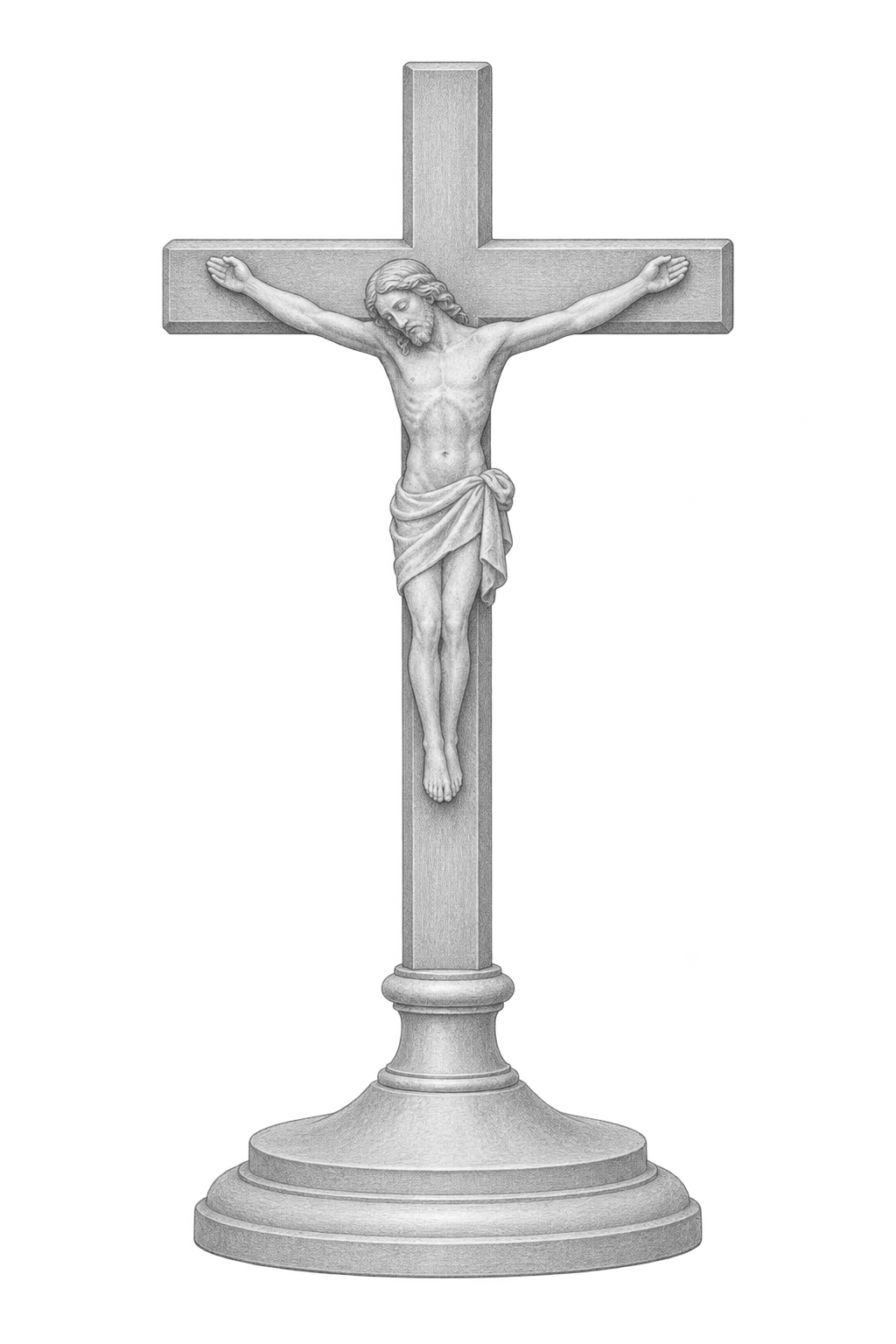 | Altar crucifix crux cum Crucifixo Details |
Sanctuary and altar | The altar crucifix is the cross bearing the figure of the crucified Christ at the middle of the altar. |
More about Altar crucifixImage creditProject-generated content; project-created artwork input only. No third-party image supplied. The required identifying feature is the crucified figure on the cross; the Missal calls for a cross of sufficient size without giving a measurement or prescribing ornament. For Mass the crucifix stands centrally on the altar, with the required candlesticks and lighted candles to either side. Handling: Recognize the altar crucifix by the figure of the crucified Christ; leave its arrangement to the appointed preparation. Use and sourcesStatus: Universal Roman. Location: At the middle of the altar, with the appointed lighted candles to either side. The crucifix is an altar appointment; a processional cross is a separate carried object. Ordinary handler: sacristan. Server: recognizes only. Sacristan: Place the crucifix centrally with the appointed lights on either side. The required number of candles depends on the Mass. Mc trainer: Recognize the crucified figure and central placement; do not confuse the altar crucifix with the carried processional cross. Pontifical: Use the central altar crucifix as an ordinary altar appointment; rank-specific light arrangements require their own source.
| |||
 | Altar candle candela Details |
Sanctuary and altar | The candle is the wax light set in a candlestick; the ceremonial distinguishes the light from its support. |
More about Altar candleThe Ceremonial directs attendants to watch that lamps and candles do not go out and that candle flames do not flare excessively or cause an unseemly incident. Handling: Keep flame, hot wax, hair, sleeves, veils, and other textiles separated. Use and sourcesStatus: Universal Roman. Location: On altar candlesticks and on carried candlesticks or torches as appointed. Liturgical light at Mass and ceremonies surrounding Mass. Ordinary handler: acolyte, torchbearer, sacristan. Server: varies by ceremony. Liturgical use: It supplies an appointed altar or carried light. Ceremonial presence: The Ceremonial repeatedly distinguishes candlesticks from the wax candles they support and appoints both altar and carried lights. Sacristan: Prepare the appointed lights and maintain the flame-watch boundary; this plate prescribes no candle dimensions or exclusive form. Mc trainer: Distinguish the candle from its support and assign flame work only within the named ceremony and local safety practice. General reader: Read the candle as the light itself, not the candlestick beneath it; the drawing is representative. Pontifical: The ceremonial appoints altar and carried lights and requires attendants to watch them; it does not make this silhouette or a candle count universal.
Related views: Historical chapel. | |||
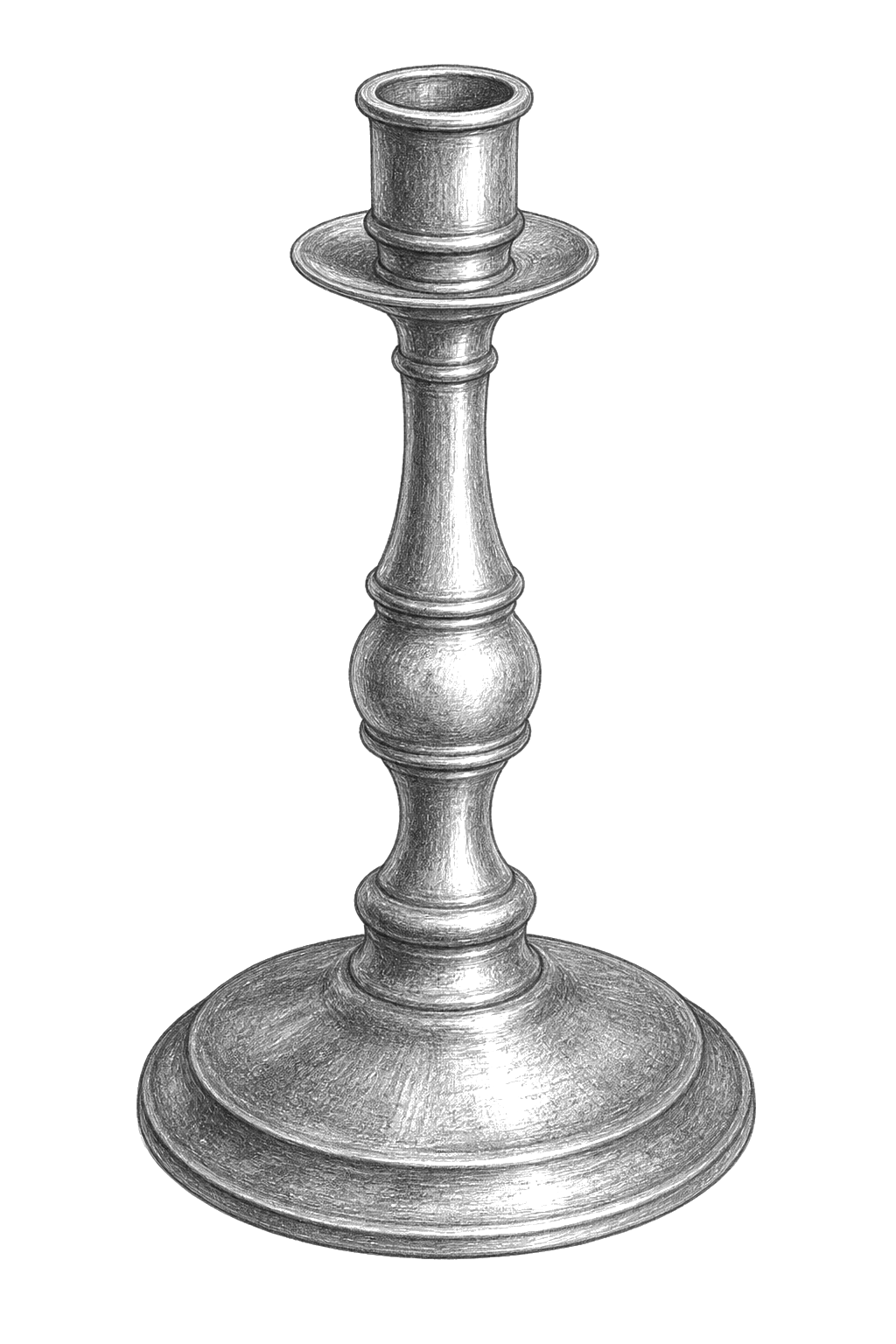 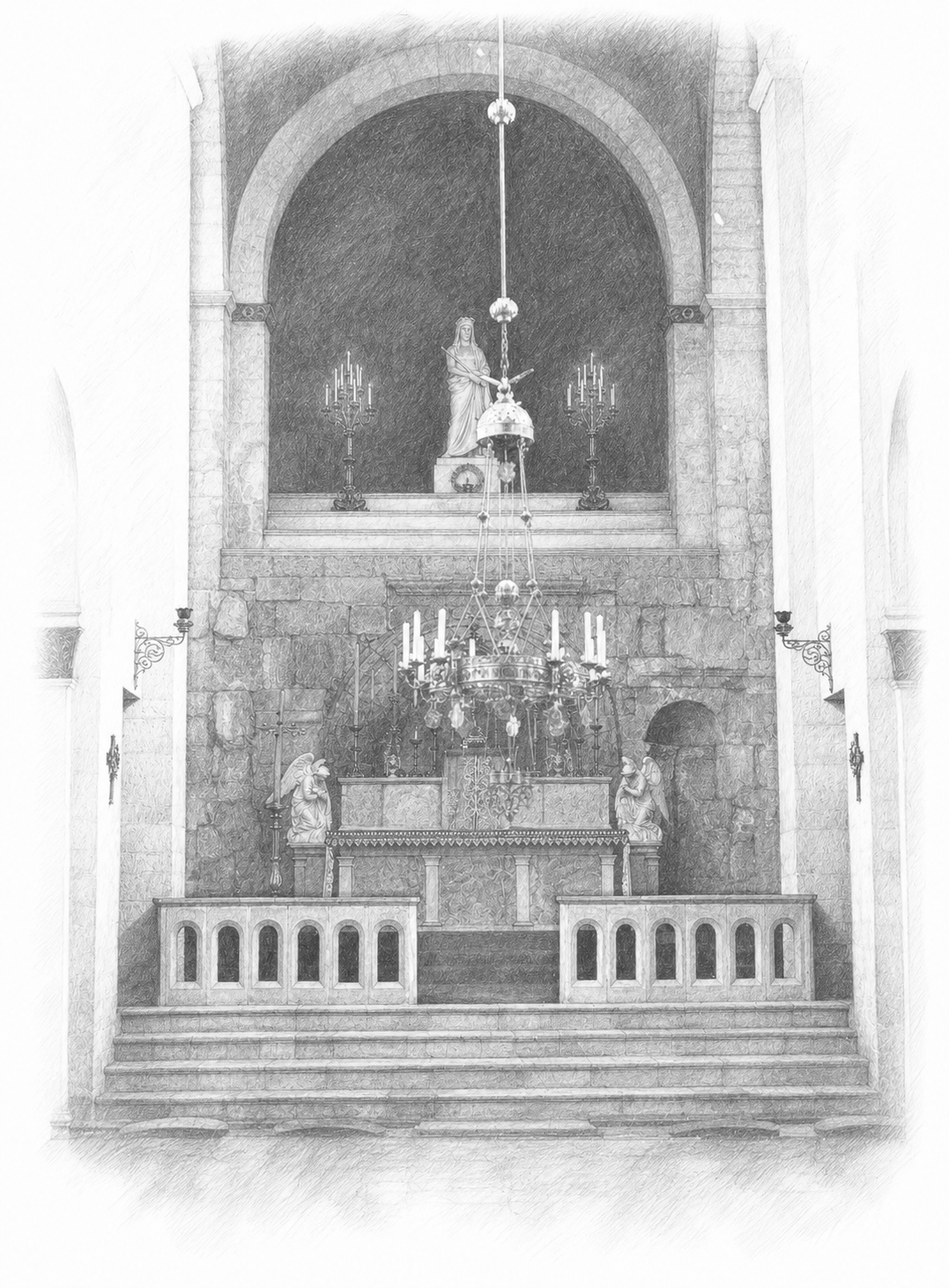 | Altar candlestick candelabrum Details |
Sanctuary and altar | A candlestick is the support that holds the candle; it is distinct from the wax light. |
More about Altar candlestickAlso shown: Altar candle · Communion rail. Altar candle: The Ceremonial directs attendants to watch that lamps and candles do not go out and that candle flames do not flare excessively or cause an unseemly incident. Keep flame, hot wax, hair, sleeves, veils, and other textiles separated. Image creditProject-generated graphite derivative of a retained Public Domain Rijksmuseum image; derivative distributed under the repository license with source and transformation disclosed. The two candle-bearing acolytes carry their candlesticks level with one hand at the foot and the other at the central knop. Handling: Keep a carried candlestick upright and support it with both hands according to the appointed method. Use and sourcesStatus: Universal Roman. Location: On the altar; at the credence or in procession where the ceremony appoints carried lights. Supports an altar candle or a candle carried by an acolyte. Ordinary handler: sacristan. Server: recognizes only. Liturgical use: At the altar it supports an appointed candle. Ceremonial presence: The Ceremonial names candlesticks and wax candles among objects prepared for episcopal ceremonies and describes two acolytes carrying them. Sacristan: Prepare the altar support and candle as distinct objects; material, ornament, and proportions vary. Mc trainer: Do not transfer the carried-candlestick grip rule to this altar-support record; carried lights have their own entry. General reader: This is the support beneath an altar candle, shown empty so that support and light remain distinct. Pontifical: Distinguish altar candlesticks from the candlesticks carried by candle-bearing acolytes.
| |||
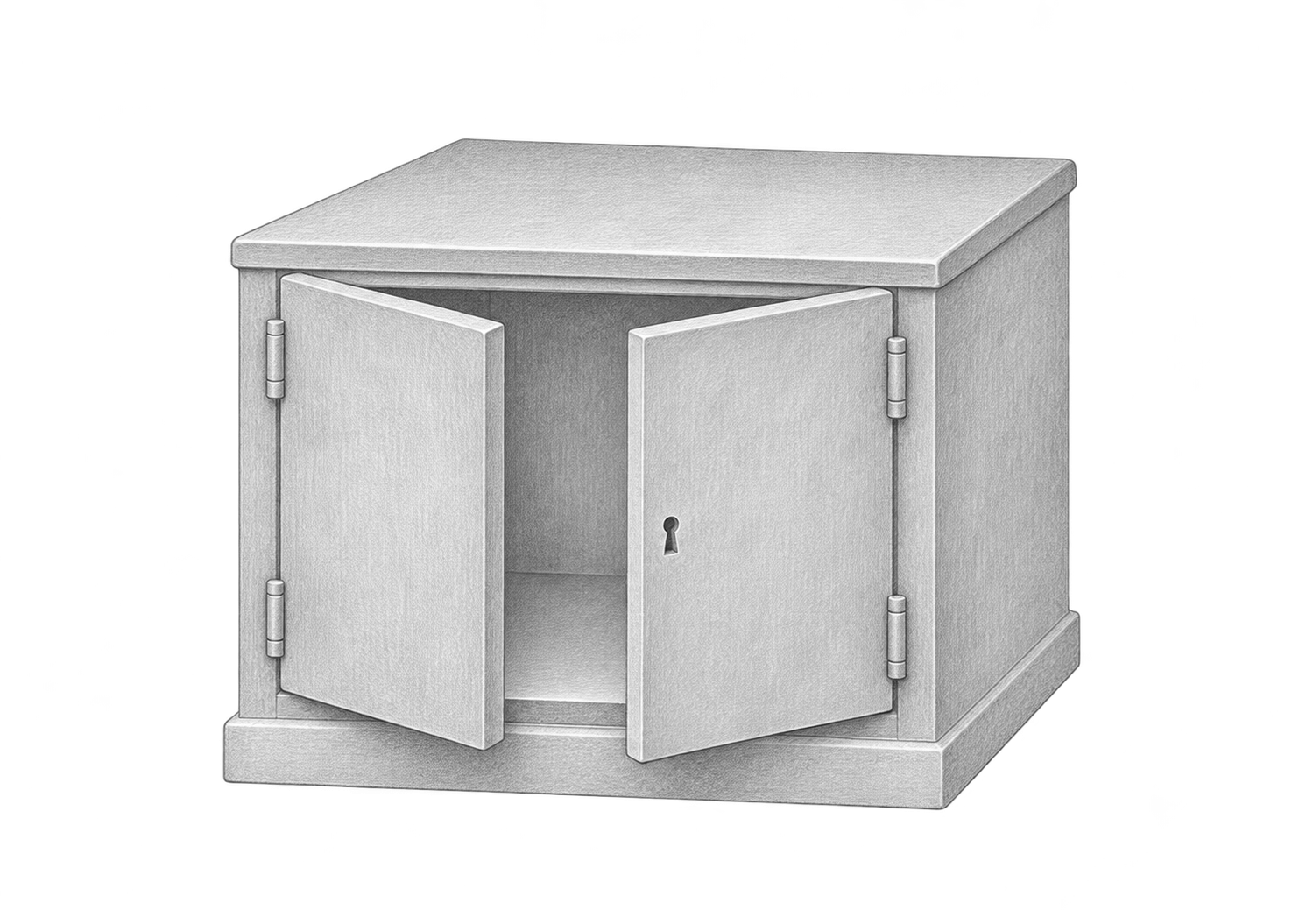 | Tabernacle tabernaculum Details |
Sanctuary and altar | The tabernacle is the secure enclosure in which the Blessed Sacrament is reserved. |
More about TabernacleImage creditProject-generated content; project-created artwork input only. No third-party image supplied. The contemporary ceremonial describes a fixed safe or casket, usually with outward-opening doors, leaving space in front for the vessels used at the altar. At the 1962 horizon canon 1269 requires an immovable tabernacle in the middle part of the altar, solidly closed and guarded, and empty of unrelated things. The contemporary ceremonial describes a veil covering the tabernacle where the Blessed Sacrament is reserved; an unveiled identification view does not show the complete prepared arrangement. Canon 1269 places the serious responsibility for safeguarding the tabernacle key on the priest in charge of the church or oratory. Handling: The celebrant opens and closes the tabernacle in the Communion rite. Recognize it without opening it or handling its key. Use and sourcesStatus: Universal Roman. Location: Fixed in the middle part of the altar at which the Blessed Sacrament is reserved. Reservation furniture; its presence is conditional on reservation at that altar, not on every celebration of Mass. Ordinary handler: priest. Server: recognizes only. Liturgical use: The unveiled study shows the enclosure; a veil covers it where the Blessed Sacrament is reserved. When Communion is given from reserved Hosts, the celebrant opens the tabernacle and takes out the ciborium; after Communion he covers and replaces it, genuflects, and closes the door. Sacristan: Leave sufficient space before the tabernacle for the altar vessels, and follow the responsible priest’s direction for access and the key. Mc trainer: Distinguish the fixed enclosure from the ciborium the celebrant removes and returns during Communion. Pontifical: Identify the actual place of reservation; a tabernacle is not inferred on every altar from the presence of pontifical furnishings.
| |||
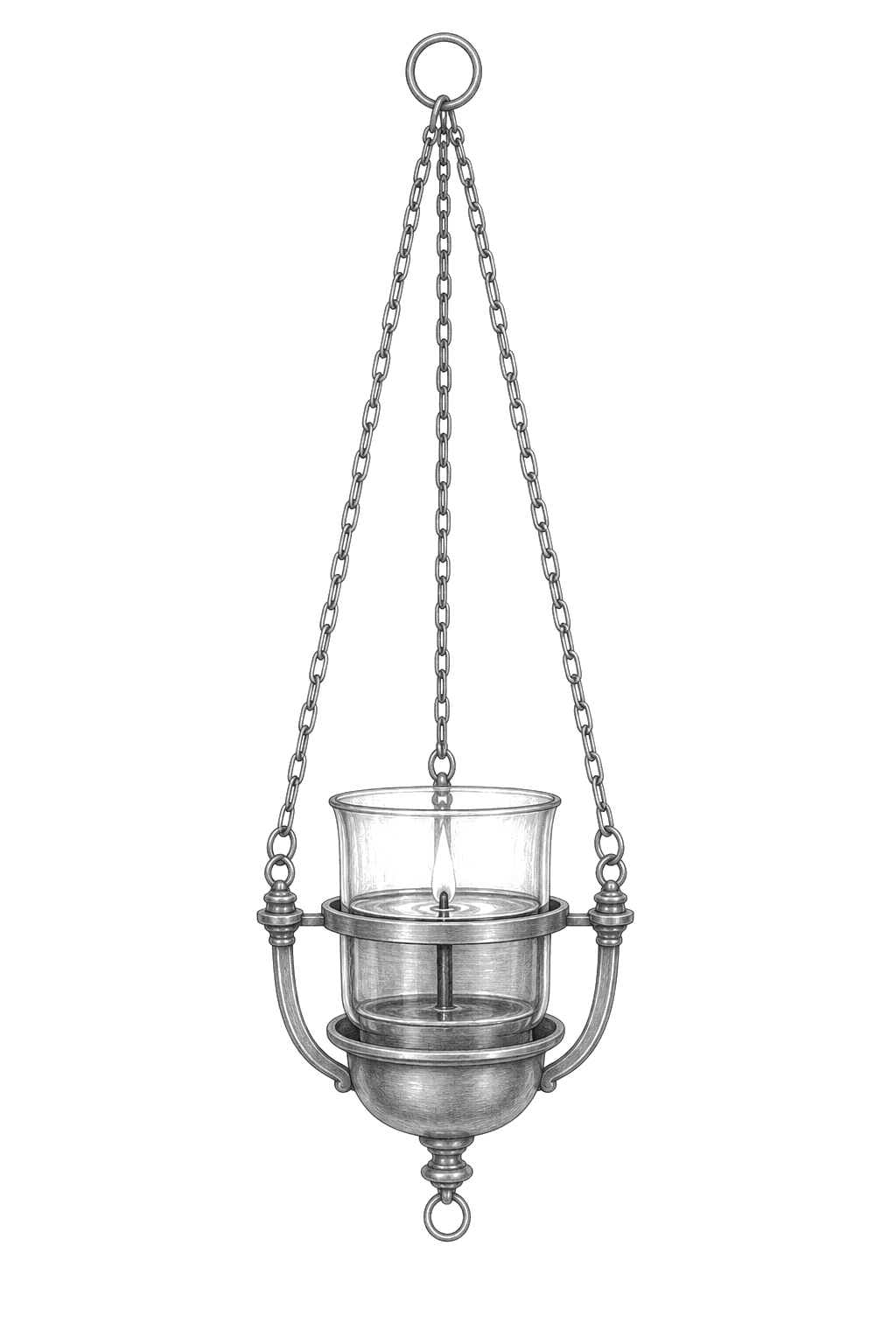 | Sanctuary lamp lampas Details |
Sanctuary and altar | At least one sanctuary lamp burns continuously before the tabernacle in which the Blessed Sacrament is reserved. |
More about Sanctuary lampThe Ceremonial places burning lamps especially before the altar or place where the Blessed Sacrament is reserved and describes hanging lamp stands that may support several lamps. Handling: Do not touch, lower, refill, or relight a hanging lamp unless specifically trained and directed. Use and sourcesStatus: Universal Roman. Location: Before the tabernacle in which the Blessed Sacrament is reserved. At least one continually burning reservation light; additional lamps may form larger hanging arrangements. Ordinary handler: sacristan, cleric. Server: recognizes only. Liturgical use: The Ceremonial directs that lamps around the place of reservation burn perpetually. Sacristan: Maintain the reservation light at its appointed place; lowering, refilling, and relighting require training and direction. Mc trainer: Treat this as a reservation-place furnishing, not as an ordinary object transfer. General reader: The single suspended vessel is one recognizable form; the ceremonial also describes arrangements with several lamps. Pontifical: This is an ordinary reservation furnishing in a pontifical setting, not pontifical insignia.
| |||
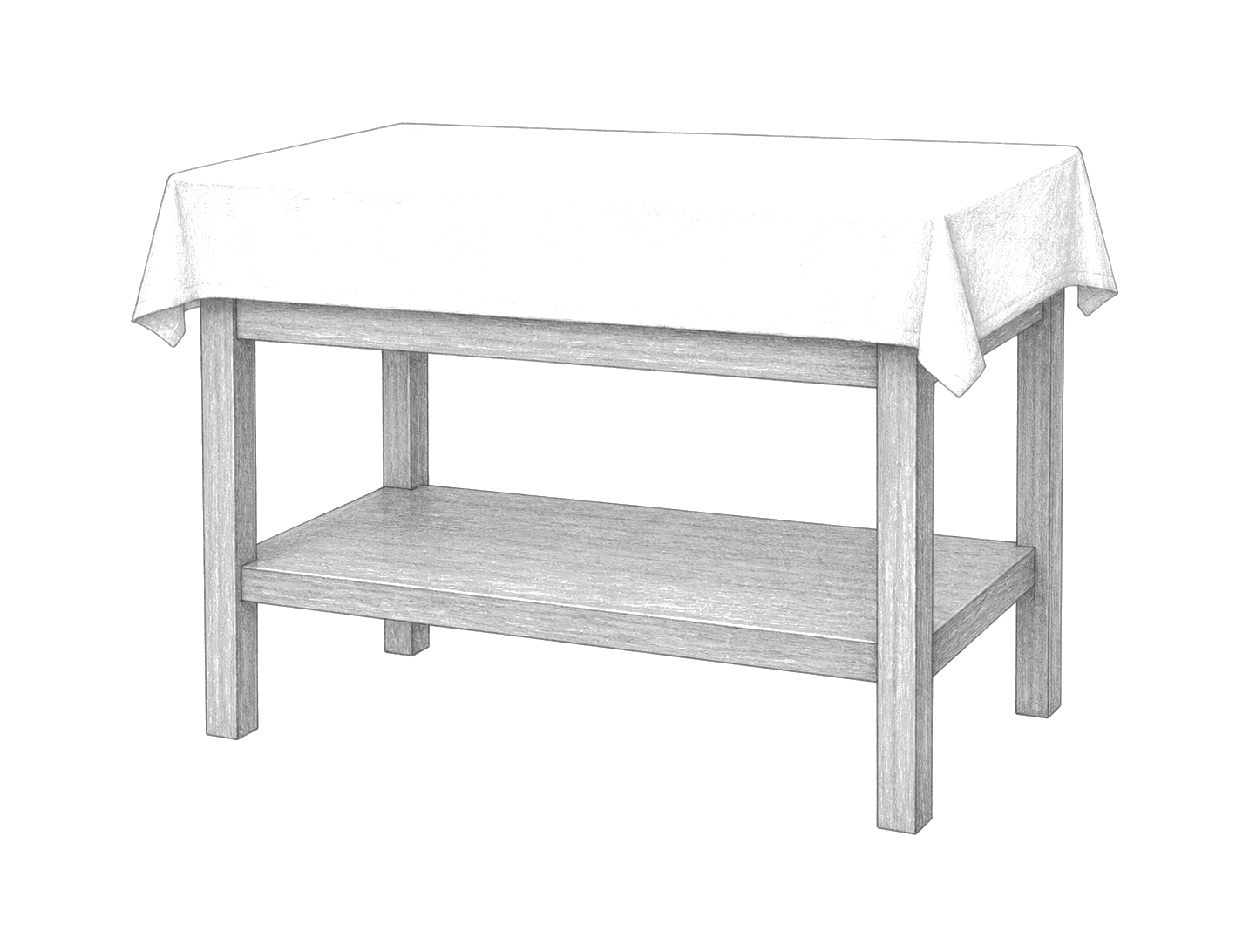 | Credence table abacus Details |
Sanctuary and altar | The credence is a sanctuary service table for objects needed in the ceremony. |
More about Credence tableUse and sourcesStatus: Universal Roman. Location: Sanctuary, ordinarily at a locally appointed side position; the Epistle side belongs to the selected teaching model. Preparation and temporary placement of vessels, books, linens, and service objects required by the selected ceremony. Ordinary handler: sacristan, master of ceremonies, acolyte, cleric. Server: varies by ceremony. Liturgical use: The credence is a sanctuary service table on which objects needed for the selected ceremony are prepared or temporarily placed; construction, covering, contents, and exact location vary.
| |||
 | Lectern legile Details |
Sanctuary and altar | The 1962 Holy Week rites use freestanding legilia for readings, Passions, and the Paschal proclamation. |
More about LecternHandling: Do not confuse a freestanding lectern with the low altar Missal stand. Use and sourcesStatus: Universal Roman. Location: At the reading position appointed by the particular ceremony. A freestanding support for a book; it may be bare or covered as the ceremony directs. Ordinary handler: master of ceremonies, acolyte, other server, sacristan, cleric. Server: varies by ceremony. Liturgical use: A lectern supports a book at the appointed reading position. Ceremonial presence: Palm Sunday and Good Friday specify bare lecterns; the Easter Vigil specifies a lectern covered with a white cloth. Sacristan: Prepare the bare or white-cloth-covered state only for the named Holy Week rite; the drawing prescribes no construction. Mc trainer: Keep the Passion and reading placements distinct from the covered Easter Vigil proclamation arrangement. General reader: The Holy Week rites distinguish bare lecterns from a lectern covered with white cloth; the pedestal form is illustrative.
| |||
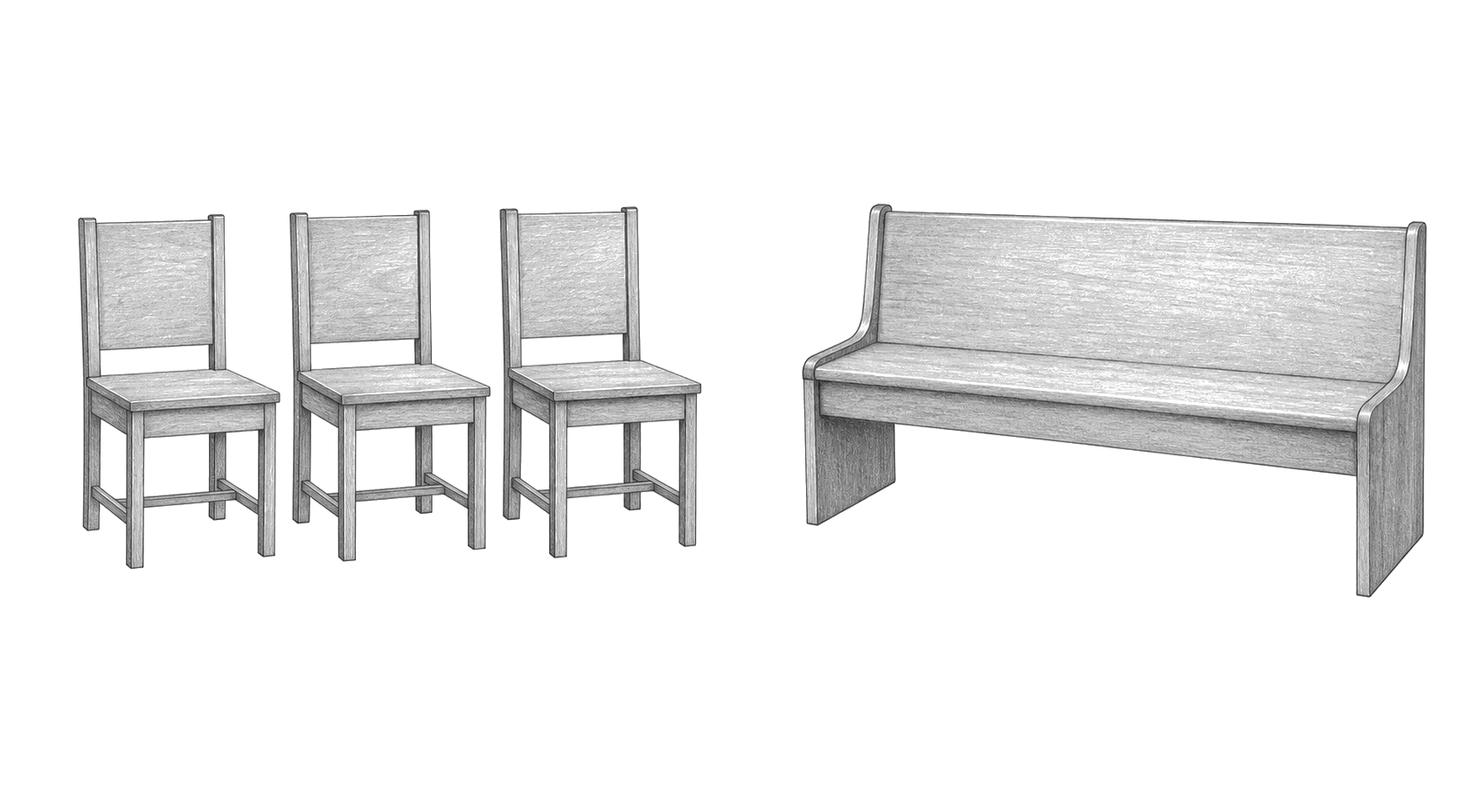 | Sedilia sedilia Details |
Sanctuary and altar | Sedilia are sanctuary seats for the celebrant, deacon, and subdeacon in the ceremonies that appoint them; separate movable chairs and a movable three-place bench are representative forms, while construction and placement vary. |
More about SediliaUse and sourcesStatus: Universal Roman. Location: Sanctuary, on the Epistle side in the selected teaching model; exact placement varies locally. Seating for the celebrant and sacred ministers when the ceremony calls for them to sit. Ordinary handler: priest, deacon, subdeacon, sacristan. Server: recognizes only.
| |||
 | Sacristy cross or suitable image crux vel imago Details |
Sanctuary and altar | The sacristy cross or suitable image is the locally appointed visual focus for the ministers' reverence. |
More about Sacristy cross or suitable imageThe governing rubric permits a cross or image and therefore does not prescribe a crucifix, frame, ornament, support, or one visual form. Handling: Recognize and reverence the locally appointed cross or suitable image; the representative drawing does not prescribe the form or authorize moving it. Use and sourcesStatus: Universal Roman. Location: A prominent or locally appointed place in the sacristy. Visual focus for the ministers' departure and return reverence. Ordinary handler: sacristan. Server: recognizes only. Liturgical use: Before proceeding to the altar, the vested celebrant makes a reverence toward the cross or image in the sacristy. Liturgical use: The checked ceremonial and specialist witnesses direct or describe a corresponding reverence on return to the sacristy. Ceremonial presence: The appointed cross or image is presupposed by the sacristy departure rubric and is identified locally. Altar server: Recognize the locally appointed cross or suitable image and make the reverence your guide assigns; do not assume the drawn cross is the only permitted form. Sacristan: Confirm the locally appointed focus and keep it visible; do not replace, move, or discard a cross or image merely from this drawing or from appearance.
| |||
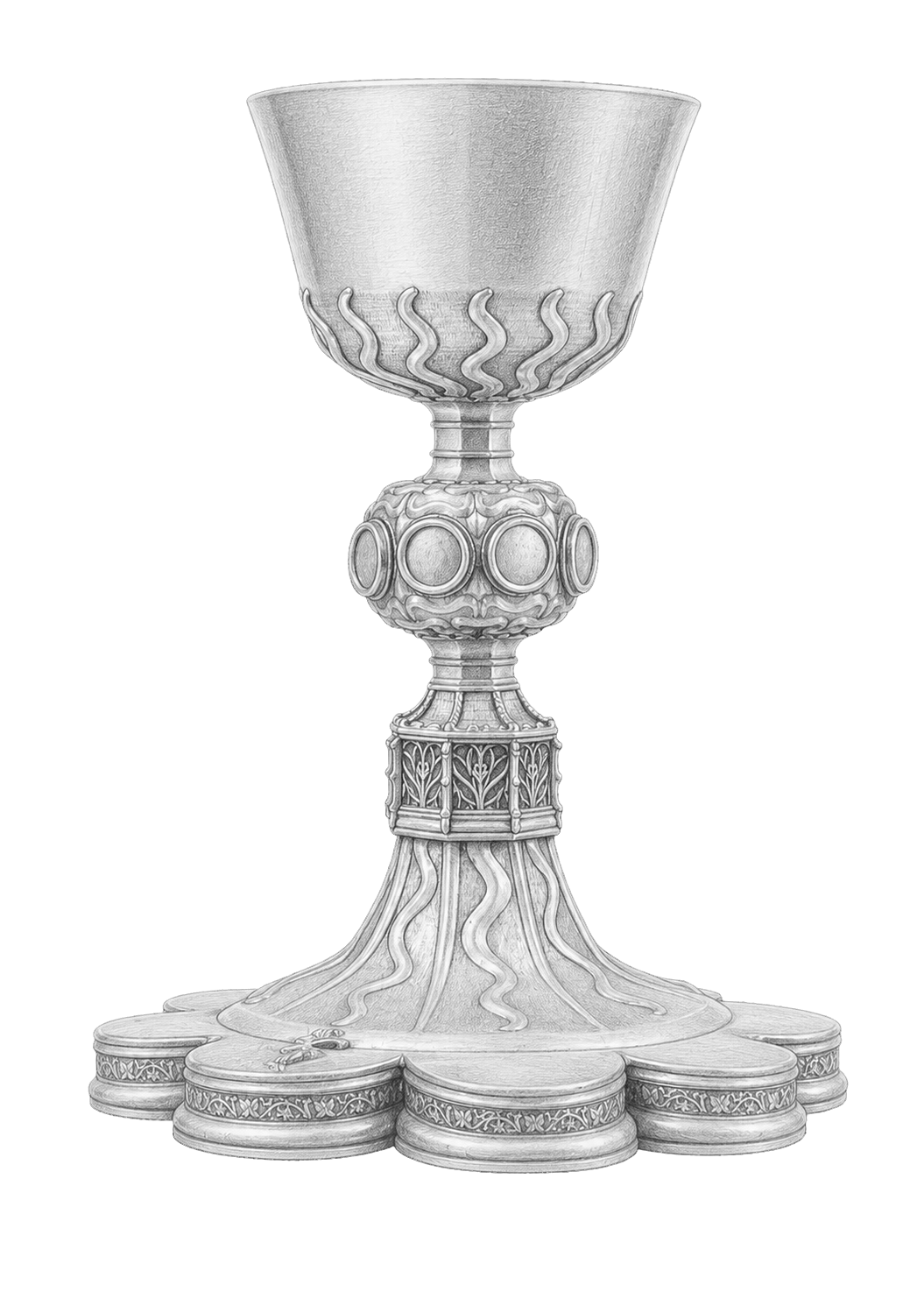 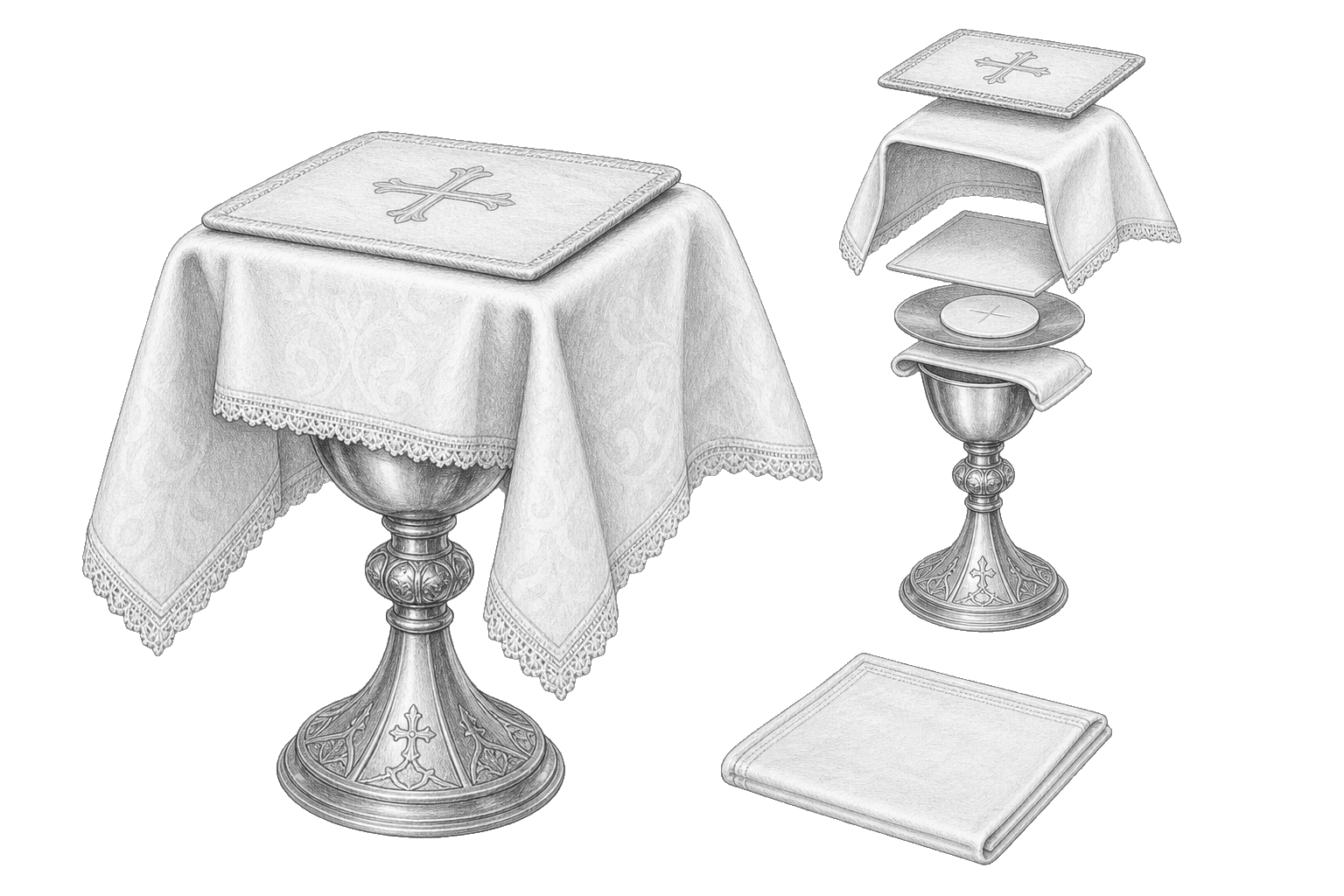 | Chalice calix Details |
Vessels and chalice cloths | The chalice is the sacred vessel named by the 1962 Missal throughout the Offertory, Canon, Communion, ablutions, and removal from the altar. |
More about ChaliceImage creditProject-generated raster derived with the Met's Public Domain Open Access image as a visual reference; the exact prompt, received chroma output, local background removal, normalized identity, source ceiling, consumers, and checks are recorded. Distributed under the repository's project-content terms. Also shown: Burse · Chalice pall · Chalice veil · Corporal · Paten · Purificator. Burse: Recognition does not authorize opening it or removing the corporal. Chalice pall: Do not mistake this small square cover for the corporal or burse. Chalice veil: In the selected Low-Mass model the priest, not the server, removes and replaces it. Corporal: Recognition does not authorize a server to unfold, refold, move, or arrange it. Paten: Met object 463080 is one shallow circular paten cataloged at 1.2 by 16.3 cm with its paired chalice. The priest's paten is not the Communion plate held beneath a communicant's chin. Purificator: Do not treat it as an ordinary towel or rearrange it from appearance. Image creditProject-generated raster made without a reference image; prompt, selected asset identity, transformation, and consumer boundary are recorded. Distributed under the repository's project-content terms. Met object 463080 is one cataloged chalice-and-paten set whose chalice is recorded as 23.6 by 17.8 cm overall. Handling: The server recognizes the chalice but does not treat it as the Communion plate or an altar cruet. Use and sourcesStatus: Universal Roman. Location: On the altar during the celebration of Mass. Used for the wine and water offered and consecrated at Mass. Ordinary handler: bishop, priest, deacon, subdeacon, sacristan. Server: must not handle. Liturgical use: The 1962 Missal names the calix throughout the Offertory, Canon, Communion, ablutions, and concluding removal from the altar. Altar server: Recognize the isolated vessel and the prepared formation; the separately folded corporal is carried with it but is not a stacked layer. Sacristan: Compare the isolated vessel with the prepared formation; the cutaway shows the checked order, not universal ornament, proportions, or a local handling method. Mc trainer: Teach the prepared order from the cutaway and keep the folded corporal beside, not inside, the stack; this is not a transfer prescription. General reader: The isolated exemplar and prepared cutaway distinguish the vessel from its assembled formation; the design and ornament are not universal. Pontifical: This ordinary sacred vessel remains supporting equipment in pontifical Mass; the prepared cutaway establishes no distinct pontifical form.
| |||
 | Paten patena Details |
Vessels and chalice cloths | The paten is the celebrant's shallow sacred vessel, distinct in the 1962 Missal from the plate held beneath communicants' chins. |
More about PatenImage creditProject-generated raster derived with the Met's Public Domain Open Access image as a visual reference; the exact prompt, received chroma output, local background removal, normalized identity, source ceiling, consumers, and checks are recorded. Distributed under the repository's project-content terms. Met object 463080 is one shallow circular paten cataloged at 1.2 by 16.3 cm with its paired chalice. Handling: The priest's paten is not the Communion plate held beneath a communicant's chin. Use and sourcesStatus: Universal Roman. Location: With the chalice and on the altar during the celebration of Mass. Used by the celebrant in the Offertory and Communion rites. Ordinary handler: bishop, priest, deacon, subdeacon, sacristan. Server: must not handle. Liturgical use: The 1962 Missal distinguishes the patena used by the celebrant from the plate held beneath communicants' chins. Liturgical use: In the prepared chalice stack, a clean purificator lies over the chalice mouth and the paten with host lies over the purificator. Altar server: Recognize the priest's shallow sacred vessel and keep it distinct from the Communion plate. Sacristan: Recognize the paten in the prepared chalice relationship; the pictured exemplar supplies no universal preparation or handling method. Mc trainer: Teach the paten's identity and prepared relationship without turning the exemplar's morphology into a transfer prescription. General reader: The drawing shows one cataloged paten and its Missal-controlled prepared relationship, not a universal Roman design. Pontifical: This ordinary sacred vessel remains supporting equipment in pontifical Mass; the plate establishes no distinct pontifical form.
Related views: Prepared chalice. | |||
 | Corporal corporale Details |
Vessels and chalice cloths | The corporal is the wholly white linen kept folded in the burse for preparation and spread in the middle of the altar. |
More about CorporalHandling: Recognition does not authorize a server to unfold, refold, move, or arrange it. Use and sourcesStatus: Universal Roman. Location: Folded in the burse during preparation; spread in the middle of the altar for Mass. Supports the chalice and paten at the altar. Ordinary handler: bishop, priest, deacon, subdeacon, sacristan. Server: must not handle. Liturgical use: The 1962 Missal requires a wholly white linen corporal, folded in the burse during preparation and spread in the middle of the altar. Altar server: Recognize the square altar linen beneath the sacred vessels; leave its handling to the appointed minister or sacristan. Sacristan: Prepare the wholly white linen in its folded-in-burse relationship; this record does not prescribe a fold pattern, dimensions, markings, or ornament. Mc trainer: Teach the folded-in-burse and spread-on-altar relationships without assigning an unsupported server handling role. General reader: The corporal is the wholly white linen spread beneath the sacred vessels, not the narrow purificator or small chalice pall. Pontifical: This is an ordinary supporting linen in the pontifical Mass composition; its identity and altar relationship do not become a distinct pontifical form.
Related views: Prepared chalice. | |||
 | Purificator purificatorium Details |
Vessels and chalice cloths | The purificator is the clean linen placed over the chalice mouth during preparation and used by the celebrant to wipe the chalice and his fingers. |
More about PurificatorHandling: Do not treat it as an ordinary towel or rearrange it from appearance. Use and sourcesStatus: Universal Roman. Location: Over the chalice mouth in the prepared chalice stack; used at the chalice during Mass. Used by the celebrant while handling the chalice and fingers. Ordinary handler: bishop, priest, deacon, subdeacon, sacristan. Server: must not handle. Liturgical use: The 1962 Missal places a clean purificator over the chalice mouth during preparation and names it in the celebrant's wiping of the chalice and fingers. Altar server: Recognize the narrow linen used at the chalice; do not confuse it with the square corporal or stiff pall. Sacristan: Prepare the clean purificator over the chalice mouth; this record does not prescribe dimensions, folds, markings, ornament, or construction. Mc trainer: Distinguish this narrow chalice linen from the corporal and pall while preserving the celebrant's verified use. General reader: The purificator is the narrow linen used at the chalice, distinct from the square corporal and small pall. Pontifical: This ordinary chalice linen remains part of the pontifical Mass preparation without acquiring a separate pontifical identity.
Related views: Prepared chalice. | |||
 | Chalice pall palla Details |
Vessels and chalice cloths | The chalice pall is the small linen cover placed above the paten in the prepared composition and used over the chalice during Mass. |
More about Chalice pallHandling: Do not mistake this small square cover for the corporal or burse. Use and sourcesStatus: Universal Roman. Location: Above the paten in the prepared chalice stack; used over the chalice during Mass. Covers the prepared chalice composition and the chalice at named stages. Ordinary handler: bishop, priest, deacon, subdeacon, sacristan. Server: must not handle. Liturgical use: The 1962 Missal names a small linen pall placed above the paten in the prepared chalice stack and used over the chalice during Mass. Altar server: Recognize the small square cover in the prepared chalice composition; leave it to the priest or appointed sacristan. Sacristan: Prepare the small linen pall above the paten; the stiff square shown is a recognition model, not a prescribed construction or universal form. Mc trainer: Teach its position above the paten and its use over the chalice without turning the illustrated stiff form into a universal rule. General reader: The chalice pall is the small square cover used over the chalice, not the larger corporal or closed burse. Pontifical: The ordinary chalice pall retains the same prepared relationship in pontifical Mass; no special pontifical construction is asserted.
Related views: Prepared chalice. | |||
 | Chalice veil velum sericum Details |
Vessels and chalice cloths | The chalice veil is the silk covering placed over the prepared chalice. |
More about Chalice veilHandling: In the selected Low-Mass model the priest, not the server, removes and replaces it. Use and sourcesStatus: Universal Roman. Location: Draped over the prepared chalice beneath the burse. Removed and replaced by the celebrant at the appointed stages of Mass. Ordinary handler: bishop, priest, deacon, subdeacon, sacristan. Server: must not handle. Liturgical use: The 1962 Missal places a silk veil over the prepared chalice and names its removal and replacement during Mass. Altar server: Recognize the draped cover over the prepared chalice; do not confuse it with the stiff square burse above it. Sacristan: Prepare the silk veil over the chalice while treating the illustrated drape, dimensions, ornament, and construction as non-prescriptive. Mc trainer: Teach the veil's removal and replacement relationship without inferring an exact drape or unsupported handling assignment. General reader: The chalice veil is the textile draped over the prepared chalice, distinct from the stiff burse placed above it. Pontifical: This ordinary prepared-chalice veil remains a supporting object in pontifical Mass; this record does not supply a pontifical color or form rule.
Related views: Prepared chalice. | |||
 | Burse bursa Details |
Vessels and chalice cloths | The burse is the case that contains the folded corporal and rests above the chalice veil in the prepared composition. |
More about BurseHandling: Recognition does not authorize opening it or removing the corporal. Use and sourcesStatus: Universal Roman. Location: Above the chalice veil in the prepared composition. Contains the folded corporal during preparation and transport to the altar. Ordinary handler: bishop, priest, deacon, subdeacon, sacristan. Server: must not handle. Liturgical use: The 1962 Missal places the folded corporal in the burse and the burse above the chalice veil in the prepared composition. Altar server: Recognize the stiff square case above the veil; it contains the folded corporal but is not the small chalice pall. Sacristan: Prepare the burse with the folded corporal and place it above the veil; no opening, closure, fold method, dimensions, or ornament is prescribed here. Mc trainer: Teach the burse-corporal relationship and its position above the veil without assigning an unsupported server action. General reader: The burse is the stiff square case containing the folded corporal, not the smaller chalice pall. Pontifical: The ordinary burse and corporal relationship remains part of pontifical Mass preparation; no separate pontifical form is asserted.
Related views: Prepared chalice. | |||
 | Ciborium pyxis Details |
Vessels and chalice cloths | The ciborium is the covered vessel containing the small Hosts for Holy Communion and reservation. |
More about CiboriumImage creditProject-generated content; project-created artwork input only. No third-party image supplied. The contemporary ceremonial describes a chalice-like vessel with a fitted cover; the cover distinguishes this form from the open chalice. For reservation, canon 1270 describes a clean vessel of solid, suitable material, closed with its own lid and covered with a white silk veil. Handling: The celebrant handles the ciborium in the Communion rite. A server recognizes it and does not open, carry, or distribute its sacred contents. Use and sourcesStatus: Universal Roman. Location: On the corporal when used at Mass, and within the tabernacle when reserved. The covered vessel for the small Hosts distributed in Communion; the Missal calls it pyxis. Ordinary handler: priest. Server: recognizes only. Liturgical use: The unveiled study shows the vessel’s form; for reservation it is covered with a white silk veil. In the Communion rite the celebrant holds the ciborium or paten in his left hand and takes a Host with his right; when Hosts remain in the ciborium, he covers it and replaces it in the tabernacle. Terminology: Pyxis is the Missal term at this locus. The contemporary English ceremonial calls the chalice-like covered vessel a ciborium and also uses pyx for smaller containers with distinct uses. Sacristan: Distinguish the vessel’s own fitted lid from the white silk veil used for reservation. An unveiled study shows the vessel’s form. Mc trainer: Teach vessel and enclosure separately: the ciborium is held for Communion and returned to the tabernacle by the celebrant. Pontifical: Recognize this as a Communion and reservation vessel, distinct from the chalice used for the consecrated wine.
| |||
 | Communion plate patina Details |
Vessels and chalice cloths | The Communion plate is the plate placed beneath communicants' chins, distinct from the celebrant's paten. |
More about Communion plateImage creditDeterministic crop and alpha-boundary derivative of a project-generated raster made without a reference image. Its exact command, unchanged grayscale-content check, source ceiling, normalized identity, and consumers are recorded here. Distributed under the repository's project-content terms. A 1952 Hirten catalog offers one round 7 3/4-inch Communion paten with a wood handle and a separate round 7-inch two-handle form measuring 9 1/2 inches across its handles. Handling: Keep the plate level beneath the communicant's chin without touching the communicant. Handling: Do not treat it as the priest's paten, a lavabo basin, or a general tray. Handling: Fragments remain for the priest; do not brush, wipe, discard, or attempt to remove them. Use and sourcesStatus: Universal Roman. Location: Prepared on the Epistle-side service table and held beneath communicants' chins when Communion is distributed. Used to catch fragments during the distribution of Communion. Ordinary handler: other server, acolyte, priest. Server: handles. Liturgical use: The 1962 Missal names a distinct patina placed beneath communicants' chins and directs the celebrant to put any fragments found on it into the chalice. Altar server: When assigned, hold the Communion plate level beneath the communicant's chin; never substitute or handle the priest's paten. Sacristan: Prepare the Communion plate where local direction assigns it; the pictured one-handle form is one dated exemplar, while the Missal controls the under-chin function rather than material, dimensions, or handle count. Mc trainer: Teach the plate's under-chin function, level handling, and fragment boundary without turning one server assignment or the pictured one-handle form into a universal rule. General reader: This is the distinct under-chin Communion plate, not the priest's smaller paten; the pictured handle belongs to one dated commercial exemplar rather than a prescribed universal form. Pontifical: This is an ordinary supporting object used when Communion is distributed, not pontifical insignia or a distinct pontifical form; the smaller paten in the figure is comparison context only.
| |||
 | Altar Missal Missale Romanum Details |
Books and supports | The Missale Romanum is the altar book required for Mass at the 1962 Roman horizon. |
More about Altar MissalAlso shown: Book marker · Missal stand. Book marker: Do not rearrange a prepared book's markers without direction. Missal stand: Keep the book and support stable when moving them together. Handling: Move the Missal only on the assigned route and keep its support secure. Use and sourcesStatus: Universal Roman. Location: At the altar in the positions appointed by the rite. The celebrant's liturgical book for Mass. Ordinary handler: priest, deacon, subdeacon, master of ceremonies, acolyte, sacristan. Server: moves only by direction. Liturgical use: The book supplies the texts and rubrics used by the celebrant at Mass. Ceremonial presence: The 1962 rubrics require the Missal and direct its preparation, placement, and movement. Altar server: Recognize the Missal and move it with its support only when assigned. Sacristan: Prepare the Missal, its assigned places, and a stable support; binding and marker count are not universal identifiers. Mc trainer: Keep the book, support, placement, and assigned movement together; this plate is recognition, not a full transfer sequence. General reader: This is the celebrant's Mass book; the substantial binding and ribbons are representative. Pontifical: The Missal appears here as an ordinary supporting book in the pontifical composition, not as insignia.
| |||
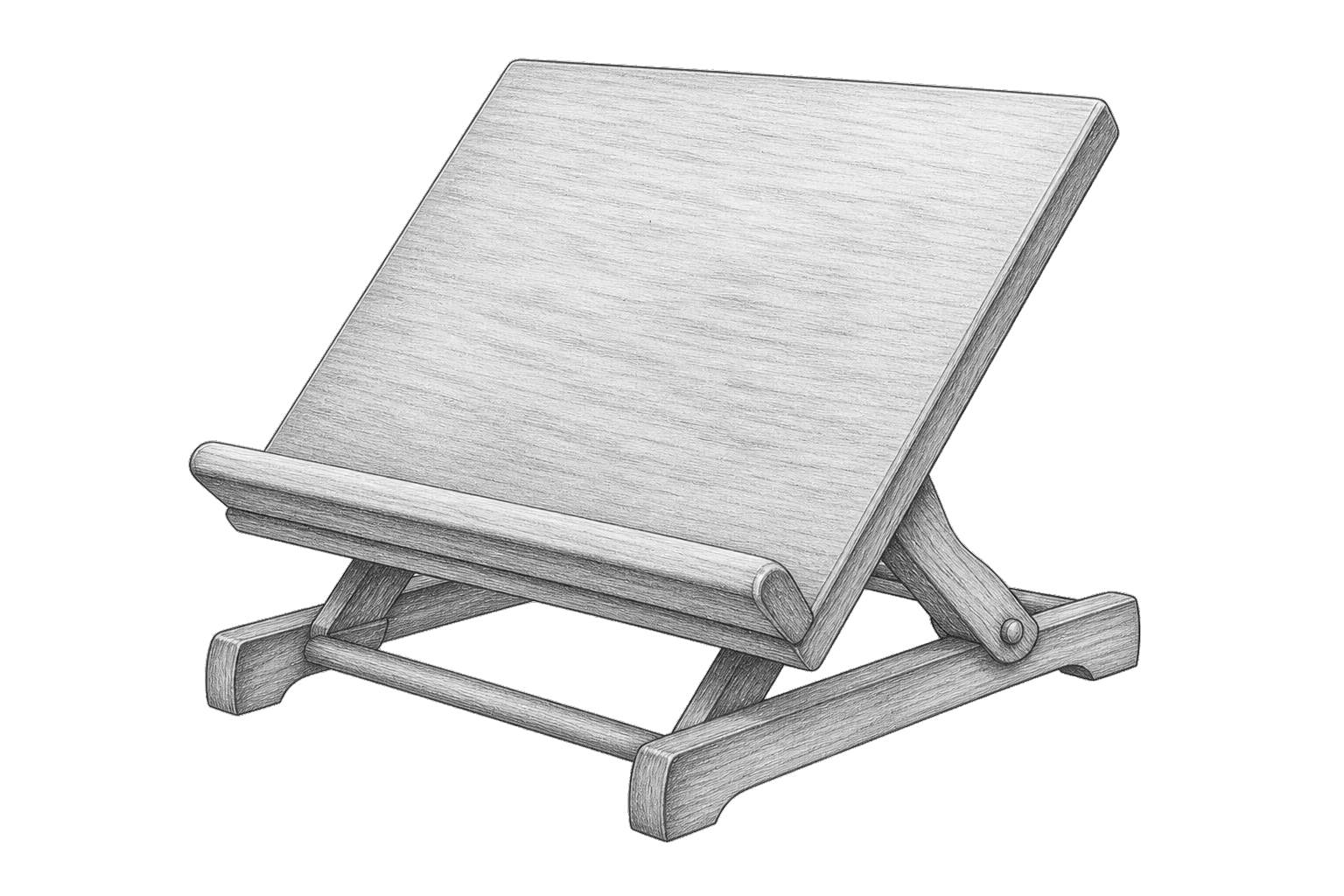 | Missal stand legile Details |
Books and supports | The 1962 Missal names the legile as the stand alternative beneath the Missal. |
More about Missal standImage creditProject-generated raster made without a reference image; exact prompt, received and normalized hashes, transformation, and consumers are recorded here. Distributed under the repository's project-content terms. Handling: Keep the book and support stable when moving them together. Use and sourcesStatus: Universal Roman. Location: On the altar beneath the Missal when this alternative is used. A low support for the altar Missal. Ordinary handler: priest, deacon, subdeacon, master of ceremonies, acolyte, sacristan. Server: moves only by direction. Liturgical use: The stand supports the altar Missal as an alternative to a cushion. Ceremonial presence: A cushion or stand is placed beneath the Missal. Sacristan: Prepare a stable stand when this alternative is used; the source prescribes neither folding construction nor material. Mc trainer: Treat stand and cushion as alternatives and keep the Missal secure during any assigned movement. General reader: This low stand is one of two named supports beneath the altar Missal; its construction varies. Pontifical: This is an ordinary supporting object in a pontifical composition, not an insignium.
Related views: Missal on its stand. | |||
 | Missal cushion cussinus Details |
Books and supports | The 1962 Missal names the cussinus as a support beneath the Missal. |
More about Missal cushionHandling: Keep the Missal centered and stable; follow the rehearsed local handling. Use and sourcesStatus: Universal Roman. Location: On the altar beneath the Missal when this alternative is used. A padded support for the altar Missal. Ordinary handler: priest, deacon, subdeacon, master of ceremonies, acolyte, sacristan. Server: moves only by direction. Liturgical use: The cushion supports the altar Missal as an alternative to a stand. Ceremonial presence: At Low Mass the Missal is opened on its cushion; the general rubric also permits a stand instead. Sacristan: Prepare the cushion when this support alternative is used; slope, fabric, fringe, and dimensions are not prescribed here. Mc trainer: Treat cushion and stand as alternatives and preserve the assigned book-support relationship. General reader: The cushion is the soft alternative to the stand beneath the altar Missal; this silhouette is illustrative. Pontifical: This movable support belongs to the book relationship; context-specific silk and color directions are not universalized.
| |||
 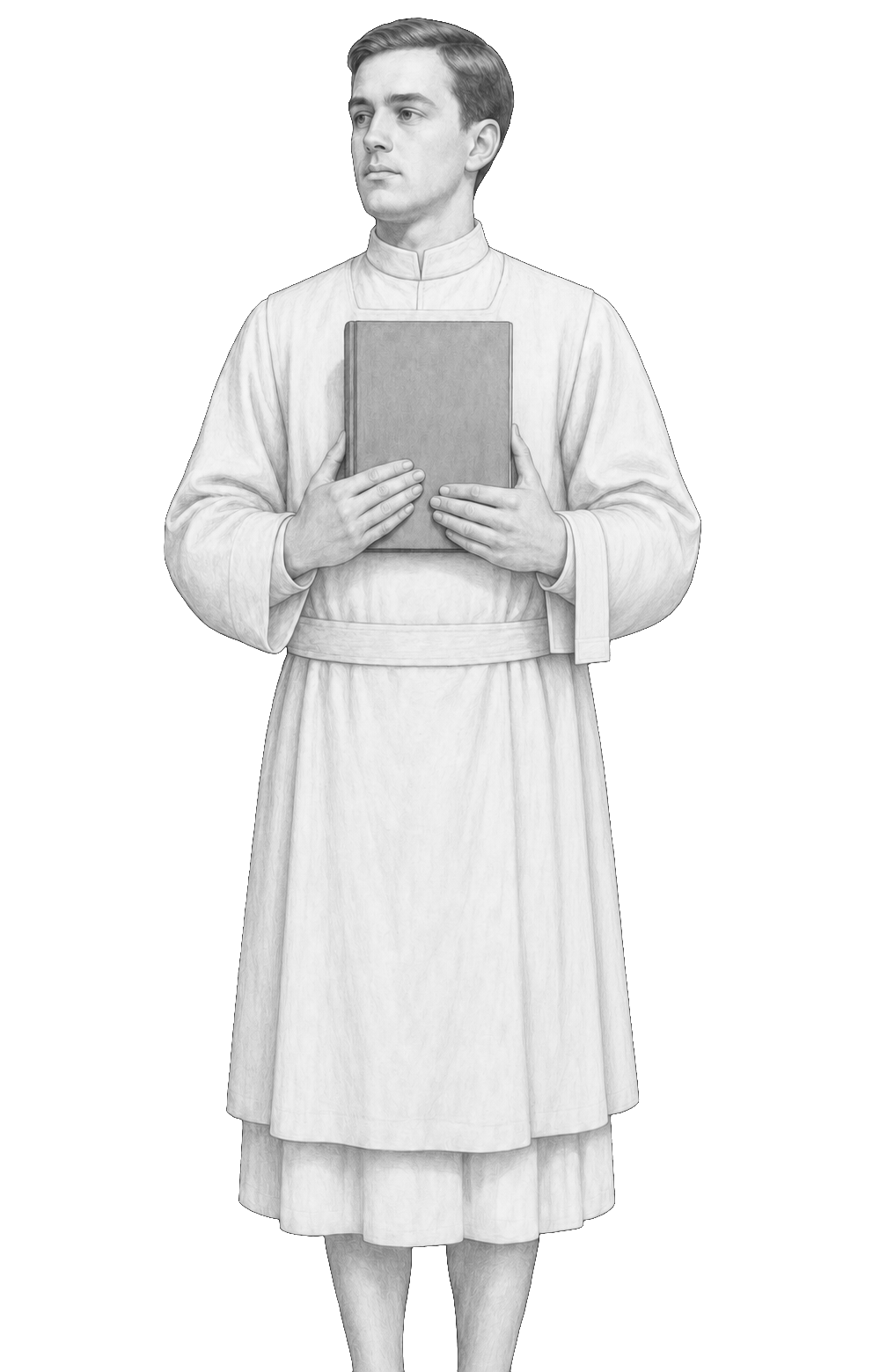 | Epistle book liber Epistolarum Details |
Books and supports | The 1962 Ritus names the separate liber Epistolarum used by the subdeacon at Solemn Mass. |
More about Epistle bookImage creditProject-generated raster made without a reference image; prompt and transformation are recorded. Handling: Do not identify a book by representative binding ornament alone. Use and sourcesStatus: Universal Roman. Location: Carried by the subdeacon for the sung Epistle in the Solemn-Mass rite. A separate book containing the Epistle text used in the solemn ceremonial. Ordinary handler: subdeacon, master of ceremonies, sacristan, cleric. Server: recognizes only. Liturgical use: The subdeacon carries it in both hands against his breast and sings the Epistle from it. Ceremonial presence: It is present as a distinct book in the Solemn-Mass Epistle ceremonial. Sacristan: Prepare the lesson book appointed for the Solemn-Mass Epistle; identify it by contents and use rather than representative cover ornament. Mc trainer: Teach the checked subdeacon relationship: he carries the book in both hands against his breast and sings the Epistle from it. General reader: This distinct lesson book is identified by the subdeacon's Solemn-Mass use, not by a universal binding design. Pontifical: Recognize this ordinary supporting book by its checked Solemn-Mass minister and use; no distinct pontifical form is asserted.
| |||
 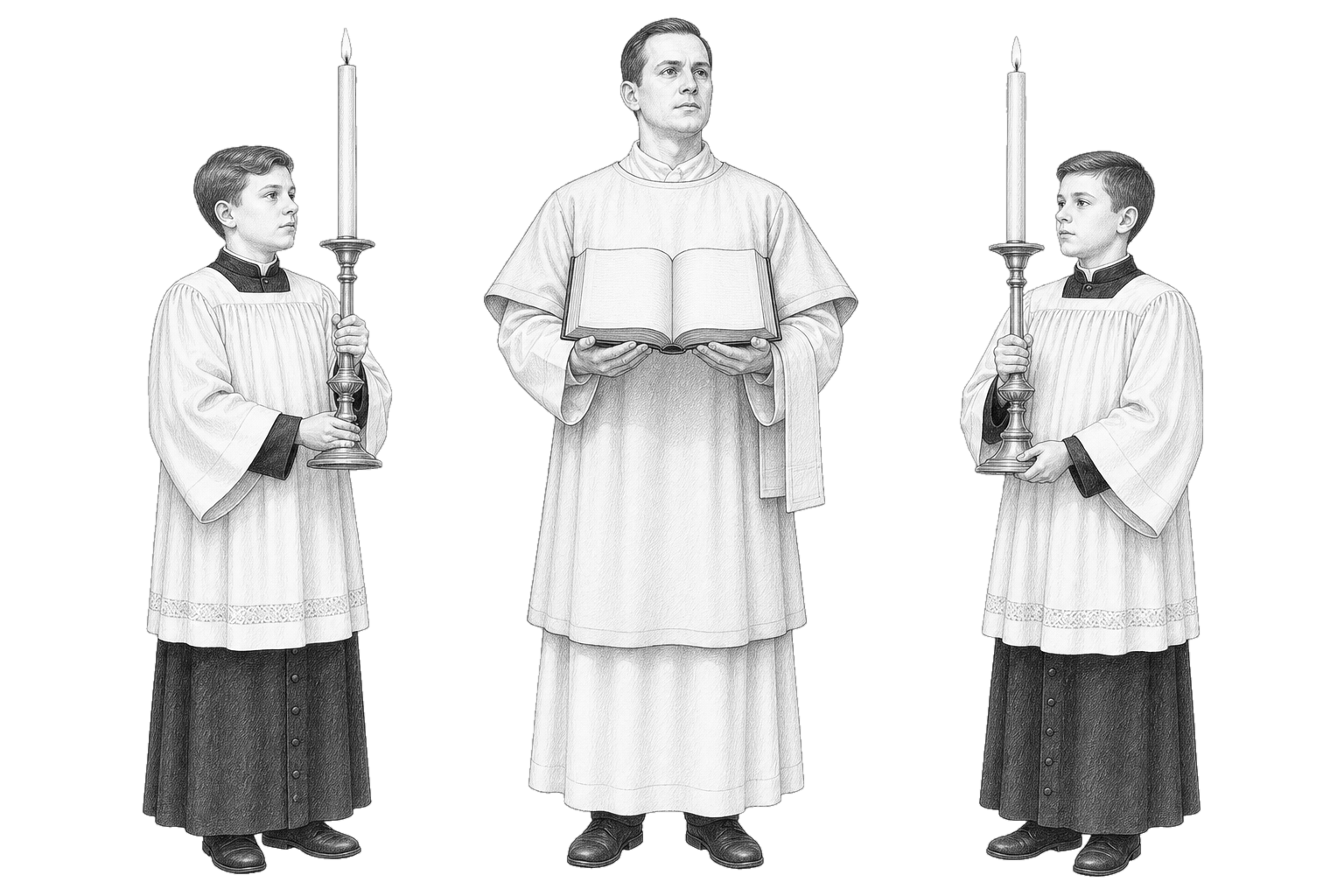 | Gospel book liber Evangeliorum Details |
Books and supports | The 1962 Ritus names the separate liber Evangeliorum used by the deacon and subdeacon at Solemn Mass. |
More about Gospel bookImage creditProject-generated raster made without a reference image; prompt and transformation are recorded. Also shown: Acolyte candlestick. Acolyte candlestick: Fortescue describes the acolytes’ candles as tall, footed candlesticks that can stand on the credence, unlike footless elevation torches that require a rack. The separate empty acolyte-candlestick drawing is a representative support form; it does not assert universal material, ornament, dimensions, proportions, or exact silhouette. Keep the light upright and at the rehearsed common height; keep flame and hot wax clear of people, hair, and textiles. Handling: At ordinary Solemn Mass the source describes the subdeacon holding the open book; do not insert a freestanding lectern into that formation. Use and sourcesStatus: Universal Roman. Location: At the altar and then in the Gospel formation as the rite directs. A separate book containing the Gospel text used in the solemn ceremonial. Ordinary handler: deacon, subdeacon, master of ceremonies, sacristan, cleric. Server: recognizes only. Liturgical use: The deacon places and takes the book at the altar; the subdeacon holds it while the Gospel is sung. Ceremonial presence: It is present as a distinct book in the Solemn-Mass Gospel ceremonial. Sacristan: Prepare the Gospel book appointed for the Solemn Mass; identify it by contents and use rather than representative cover ornament. Mc trainer: Teach the checked route: the deacon places and takes the book at the altar, and the subdeacon holds it open while the Gospel is sung. General reader: This distinct Gospel book is identified by its Solemn-Mass use; the ordinary checked formation has the subdeacon hold it open. Pontifical: Recognize this ordinary supporting book by its checked altar and minister relationships; no distinct pontifical form is asserted.
| |||
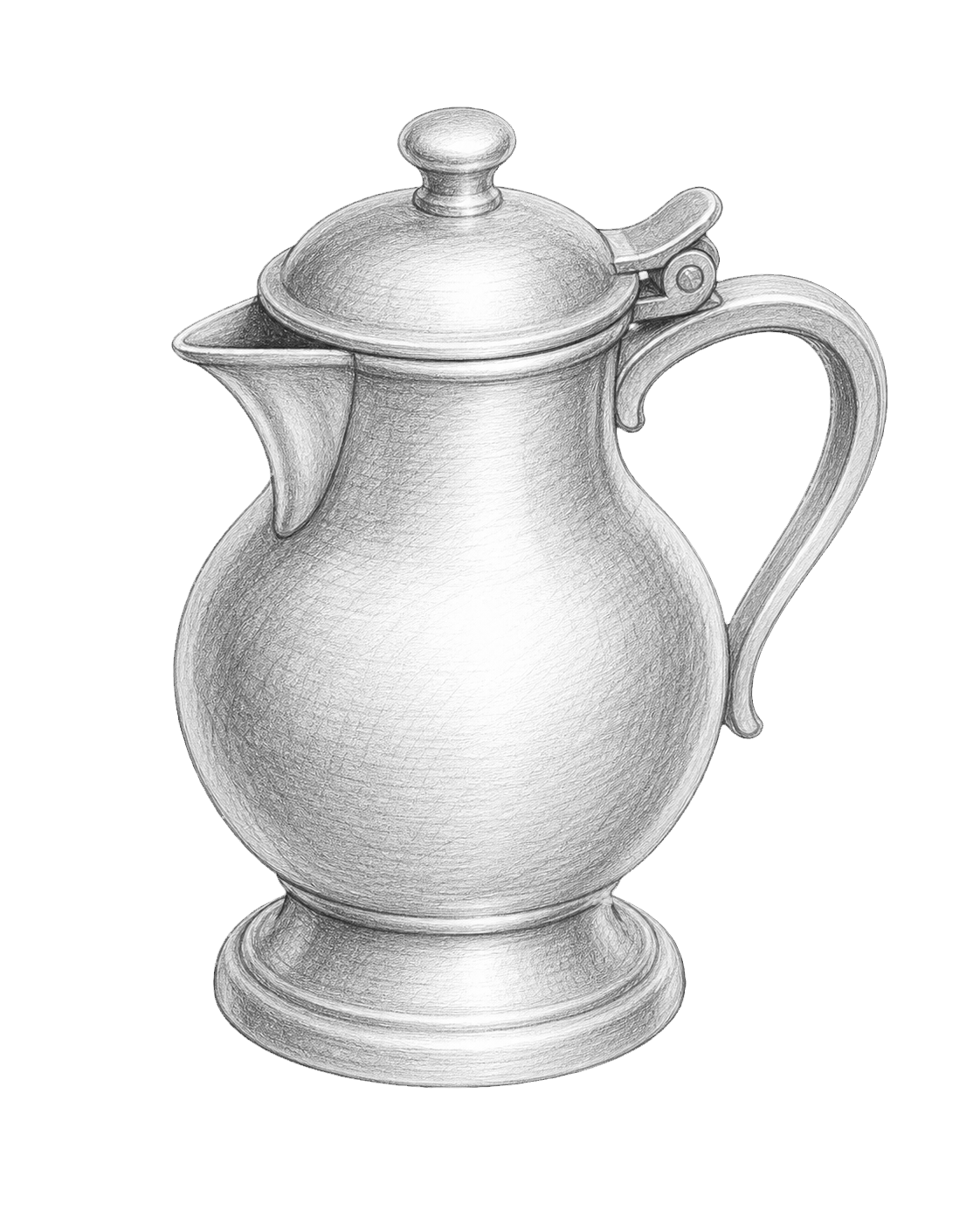 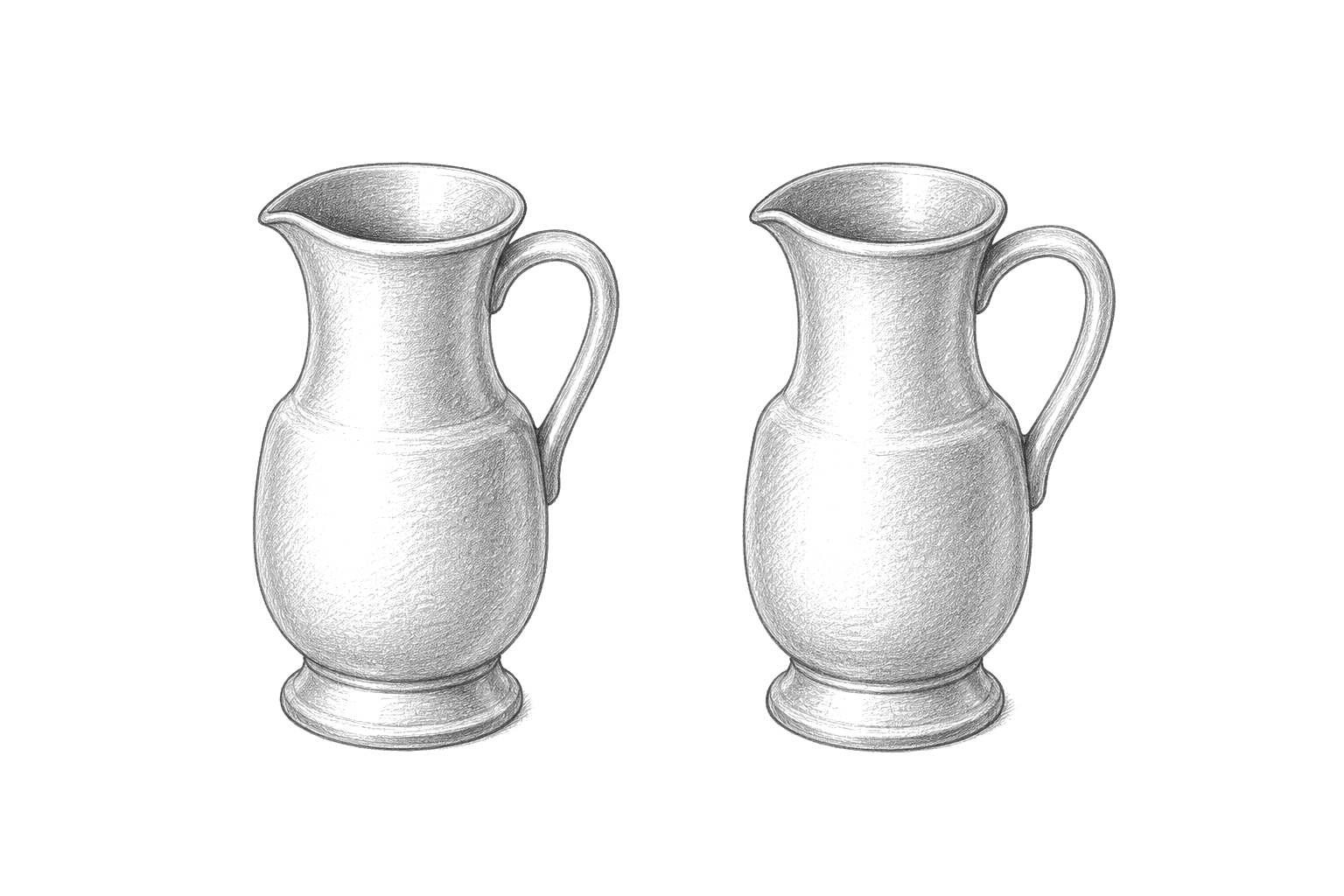 | Altar cruet Details |
Service and procession | An altar cruet is a small pouring vessel prepared to supply wine or water for the Mass; two are ordinarily prepared together for the wine-and-water service. |
More about Altar cruetImage creditDeterministic alpha derivative of the project-generated predecessor; its provenance, source ceiling, and rights disposition remain recorded. Checked witnesses support small pouring vessels used as a pair, with stable bases and pouring lips; body, material, ornament, marking, closure, and handle vary. Checked material-culture witnesses support small pouring vessels used as a pair and show stable bases and pouring lips, while also demonstrating that body, material, ornament, marking, closure, and handle are not universal. Handling: Identify which cruet contains wine and which contains water before presentation; markings and vessel forms vary locally. Use and sourcesStatus: Universal Roman. Location: Prepared near the altar, ordinarily at the credence. A cruet supplies wine or water at the Offertory or ablutions; two are ordinarily prepared together for the wine-and-water service. Ordinary handler: acolyte, other server, sacristan, priest, deacon, subdeacon. Server: presents. Liturgical use: The 1962 Offertory and ablution rites require wine and water to be supplied to the celebrant; Fortescue–O’Connell (1943) describes preparing two cruets for wine and water. Ceremonial presence: The pair is prepared near the altar for the Offertory and later ablutions. Altar server: The same basic vessel form may contain wine or water; identify the contents from the church's rehearsed markings and arrangement. Sacristan: Prepare the wine and water vessels as the church directs; material, closure, markings, tray, and left-right arrangement vary and are not prescribed by this plate. Mc trainer: Teach the verified wine-and-water service and local content-identification method without turning one vessel form, bearer split, handoff, or left-right order into a universal rule. General reader: The pictured handled pair is a clear representative teaching form; checked examples also vary in material, ornament, closure, and whether a handle is present. Pontifical: These are ordinary supporting vessels used in pontifical Mass, not pontifical insignia or a distinct pontifical form.
| |||
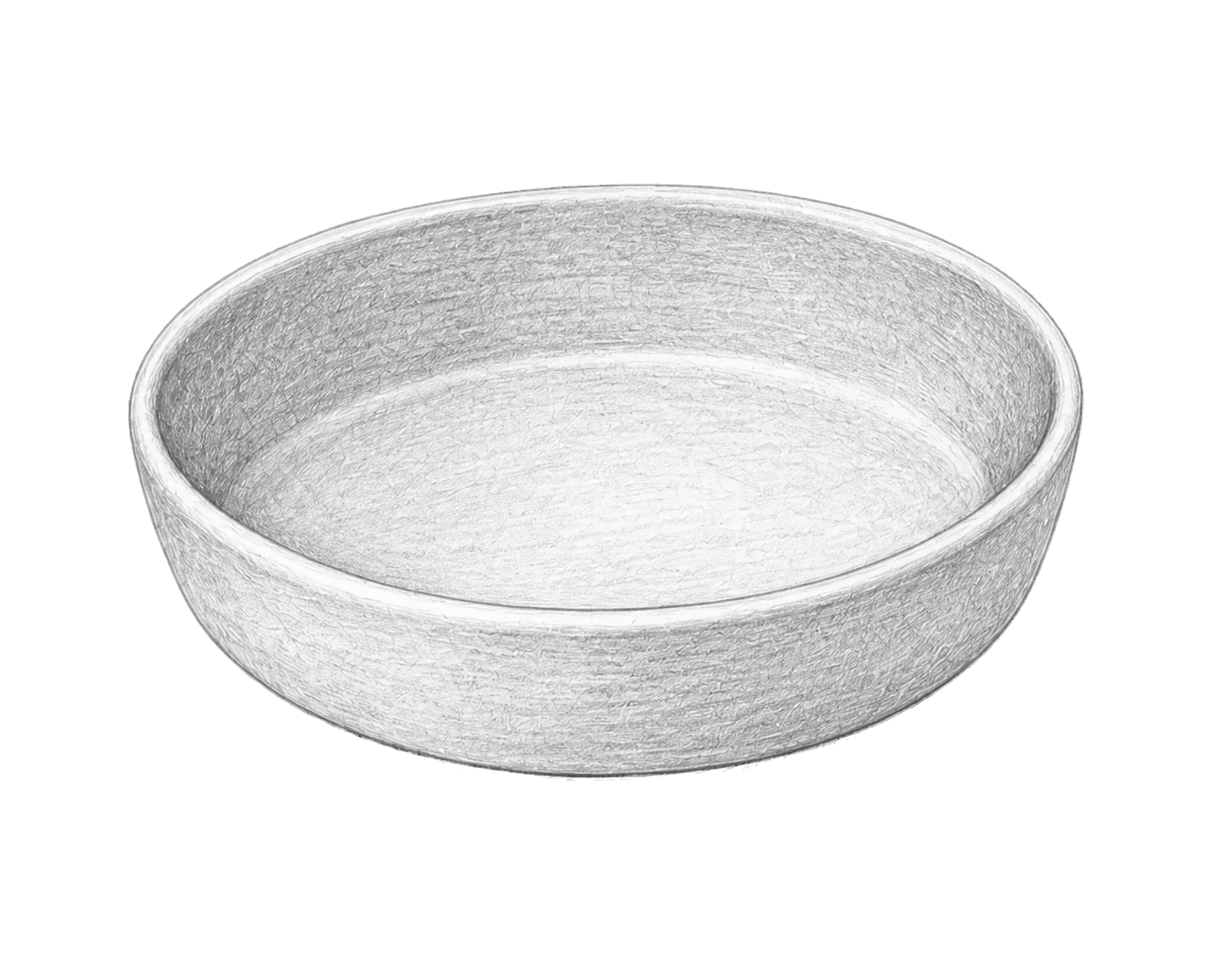 | Lavabo basin pelvicula Details |
Service and procession | The lavabo basin is the small basin that receives the water when the celebrant washes his fingertips at the Offertory Lavabo. |
More about Lavabo basinImage creditProject-generated raster derived from the prior project-generated combined study as a style and recognition-class reference; the exact prompt, received chroma output, local background removal, normalized identity, source ceiling, consumers, and checks are recorded. Distributed under the repository's project-content terms. The governing Missal prescribes no basin material, ornament, dimensions, or silhouette; the teaching drawing is deliberately source-minimal. Handling: Carry level with both hands when the local method requires; if water spills or the route is obstructed, stop safely and follow the appointed direction. Handling: Return it to its prepared place and do not improvise where its contents are poured or disposed. Use and sourcesStatus: Universal Roman. Location: Prepared with the cruets and manuterge on the Epistle-side service table; brought to the appointed washing station. Receives the water used when the celebrant washes his fingertips at the Offertory Lavabo. Ordinary handler: acolyte, other server, sacristan. Server: handles. Ceremonial presence: The 1962 Missal requires a small basin to be prepared with the wine and water cruets and manuterge on the Epistle-side service table. Liturgical use: At the Offertory Lavabo the basin receives the water used when the celebrant washes his fingertips; at Solemn Mass the acolytes minister it with the water cruet and manuterge. Altar server: Carry the bowl level at the appointed cue, keep it under the washing fingers, and return it without improvising disposal.
| |||
 | Lavabo towel manutergium Details |
Service and procession | The lavabo towel, historically called the manuterge in English, is the hand towel used after the celebrant washes his fingertips at the Offertory Lavabo. |
More about Lavabo towelImage creditProject-generated raster derived from the prior project-generated combined study as a style and recognition-class reference; the exact prompt, received chroma output, local background removal, normalized identity, source ceiling, consumers, and checks are recorded. Distributed under the repository's project-content terms. The governing Missal prescribes no towel material, ornament, dimensions, or fold; the teaching drawing therefore shows a plain broad once-folded rectangle. Handling: Present and receive only by the rehearsed method; keep the towel clear of the water basin, lighted candles, hot fittings, and the floor. Handling: Return it to its prepared place; do not substitute a purificator or an ordinary sacristy towel by appearance. Use and sourcesStatus: Universal Roman. Location: Prepared with the cruets and small basin on the Epistle-side service table; presented at the appointed washing station. Used by the celebrant to dry his hands after the Offertory Lavabo. Ordinary handler: acolyte, other server, sacristan, priest. Server: presents. Ceremonial presence: The 1962 Missal requires the manuterge to be prepared with the cruets and small basin on the Epistle-side service table. Liturgical use: After the celebrant washes his fingertips at the Offertory Lavabo, he dries his hands; at Solemn Mass the acolytes minister the hand towel with the water cruet and small basin. Terminology: Manuterge is a historical English name for this liturgical hand towel; it must be distinguished from the separate sacristy towel. Altar server: Present and receive the towel at the appointed cue, keeping it clear of water, flame, hot fittings, and the floor.
| |||
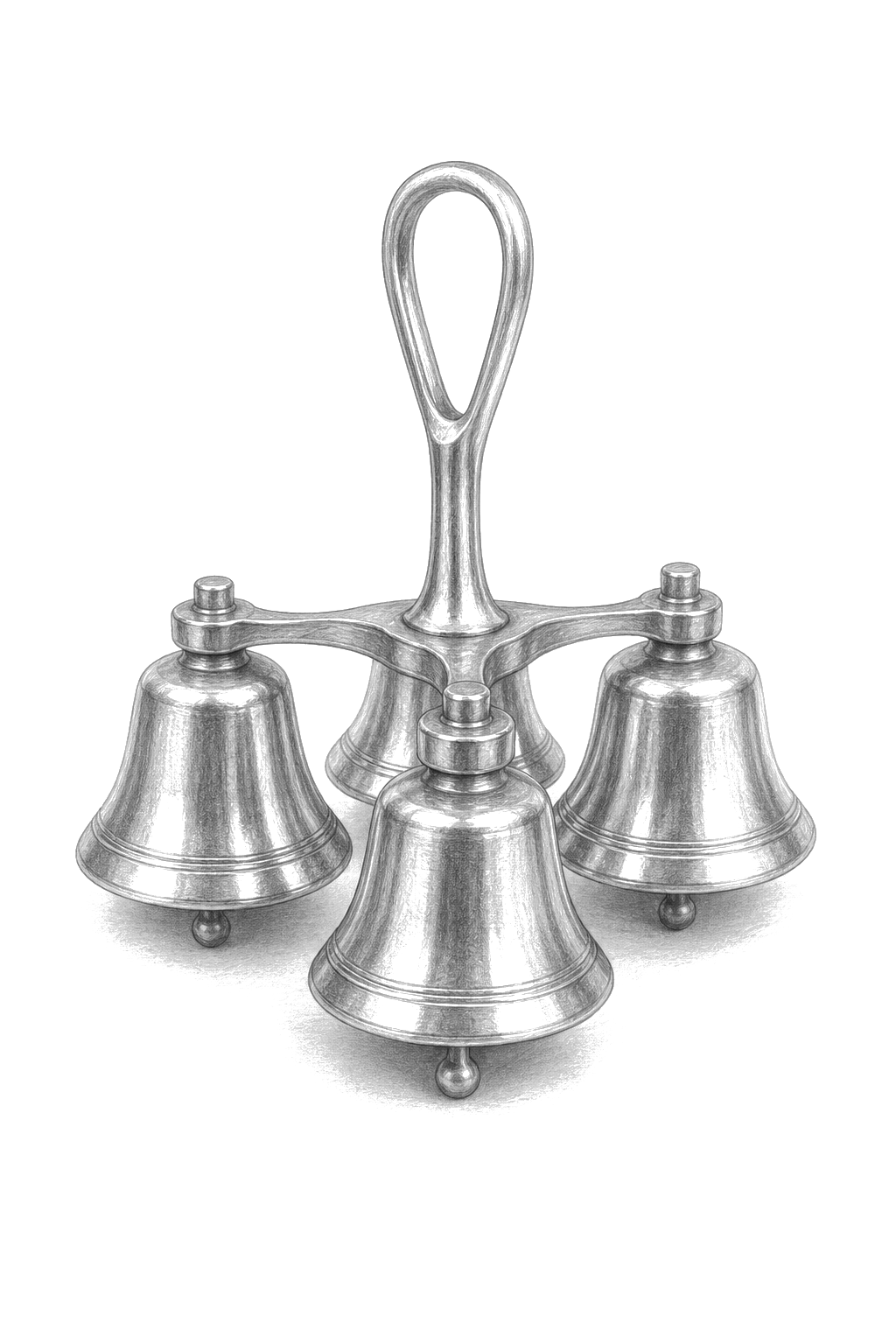 | Altar bells campanula Details |
Service and procession | The altar bell is the small bell prepared for the appointed Mass signals. |
More about Altar bellsHandling: Carry and replace quietly so that only intentional signals sound. Use and sourcesStatus: Universal Roman. Location: Prepared at the Epistle-side service table or credence; brought to the minister's appointed station. The small bell warns before the Consecration, sounds at each elevation, and may warn communicants. Ordinary handler: acolyte, other server. Server: handles. Ceremonial presence: The 1962 Missal orders a small bell prepared with the credence-side service objects. Liturgical use: The minister warns shortly before the Consecration and rings three times, or continuously, at each elevation; the Missal also provides a warning when faithful are to communicate. Altar server: Recognize the prepared bell and learn its assigned cues; avoid accidental ringing while carrying or replacing it. Sacristan: Prepare the small bell with the credence-side service objects; the Missal prescribes no cup count or mechanism. Mc trainer: Teach the appointed signals without making this four-cup cluster a universal form. General reader: The governing text requires a small bell and names its signals, but not this cluster form.
| |||
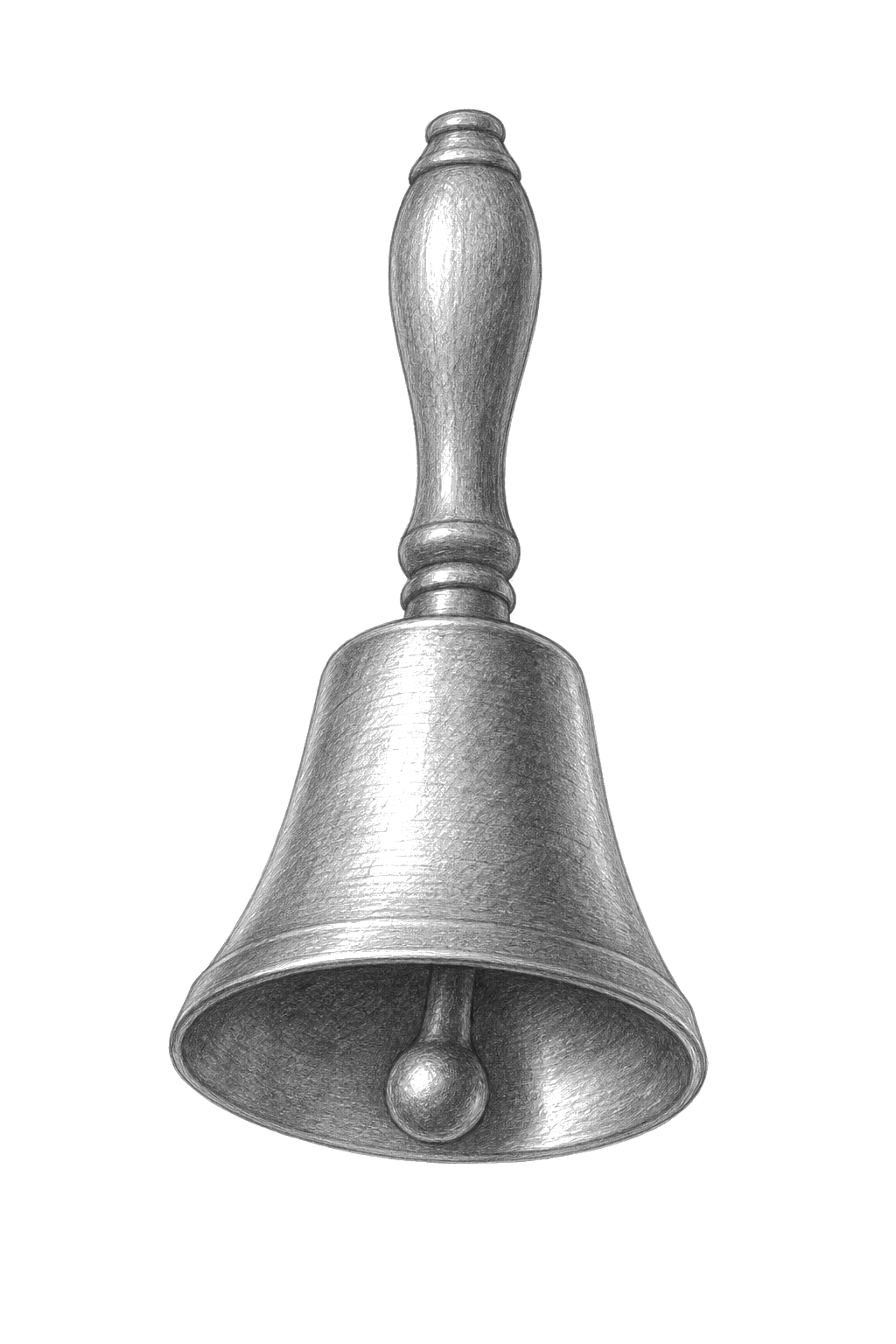 | Local sacristy signal bell campanula Details |
Service and procession | A local sacristy signal bell is a small bell used in some churches at the ministers' departure. |
More about Local sacristy signal bellThe witnesses establish a bell but not its mechanism, mount, placement, operator, material, dimensions, ornament, or one visual form. Handling: Ring only when and as locally directed; mechanism, placement, operator, and cue vary. Handling: Do not confuse this departure signal with the altar bells used at Mass. Use and sourcesStatus: Institutional. Location: At a locally appointed sacristy or departure point; the checked witnesses mention the sacristy door. Where locally used, signals that the clergy and ministers are about to enter. Ordinary handler: sacristan, other server, cleric. Server: varies by ceremony. Liturgical use: Where this practice is used, the bell warns or notifies the congregation that Mass or the clergy's entrance is about to begin. Ceremonial presence: The checked sources describe local or usual practice in many churches, not a universal 1962 requirement. Altar server: This is a local departure signal, not the altar bells: use it only at the cue and by the method assigned in this church. Sacristan: Identify the local bell, cue, mechanism, and operator before preparation; do not infer any of them from the representative isolated figure.
| |||
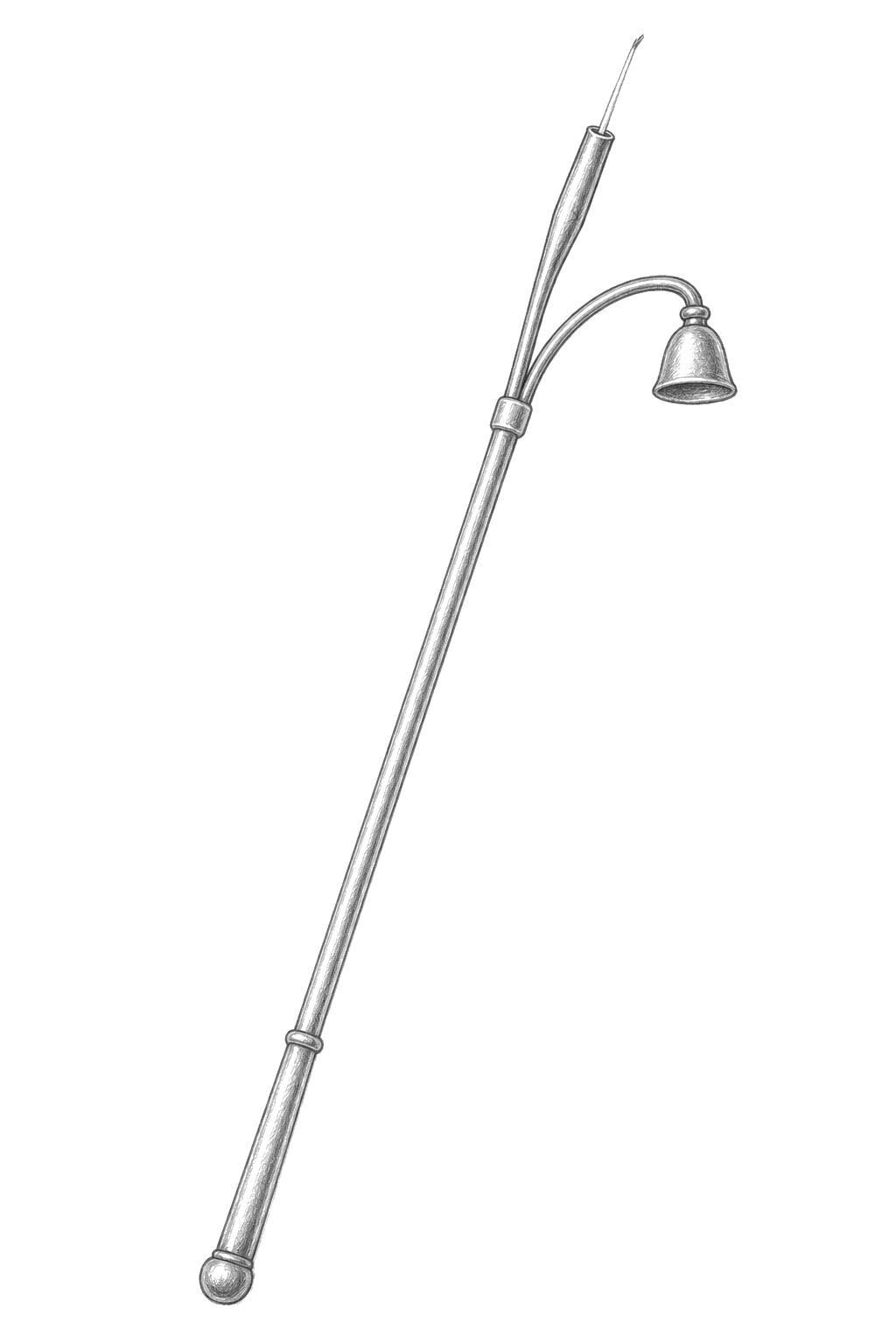 | Candle lighter and extinguisher instrumentum ad candelas accendendas et exstinguendas Details |
Service and procession | One secular 1902 patent shows a long-shaft practical tool combining a taper tube for lighting elevated candles with a separate branch ending in an extinguisher bell; it is material-culture evidence, not a Roman prescription or proof of Catholic prevalence. |
More about Candle lighter and extinguisherHandling: Flame work is an adult-controlled, locally trained assignment. Keep flame and hot metal clear of people and textiles, and confirm the taper is extinguished before storage. Use and sourcesStatus: Institutional. Location: Sacristy or a designated sanctuary equipment stand. Practical preparation and reset of elevated candles; not itself a liturgical furnishing established by the governing books audited so far. Ordinary handler: sacristan, lay assistant. Server: moves only by direction. Altar server: Recognize this as practical/local equipment only when an adult assigns it; the plate supplies no ignition, approach, wick-treatment, or extinguishing procedure. Sacristan: Treat the combined lighter-and-bell form as one dated practical-tool family, not prescribed Catholic equipment; preparation, use, cooling, and storage follow trained local fire-safety practice. Mc trainer: Use the plate only to recognize and assign locally present practical equipment; it establishes no Roman office, universal server task, ceremonial cue, handoff, or operating method. Pontifical: Recognize this only as practical/local candle equipment that may support the same elevated lights, not as pontifical insignia, a distinct pontifical form, or prescribed equipment.
| |||
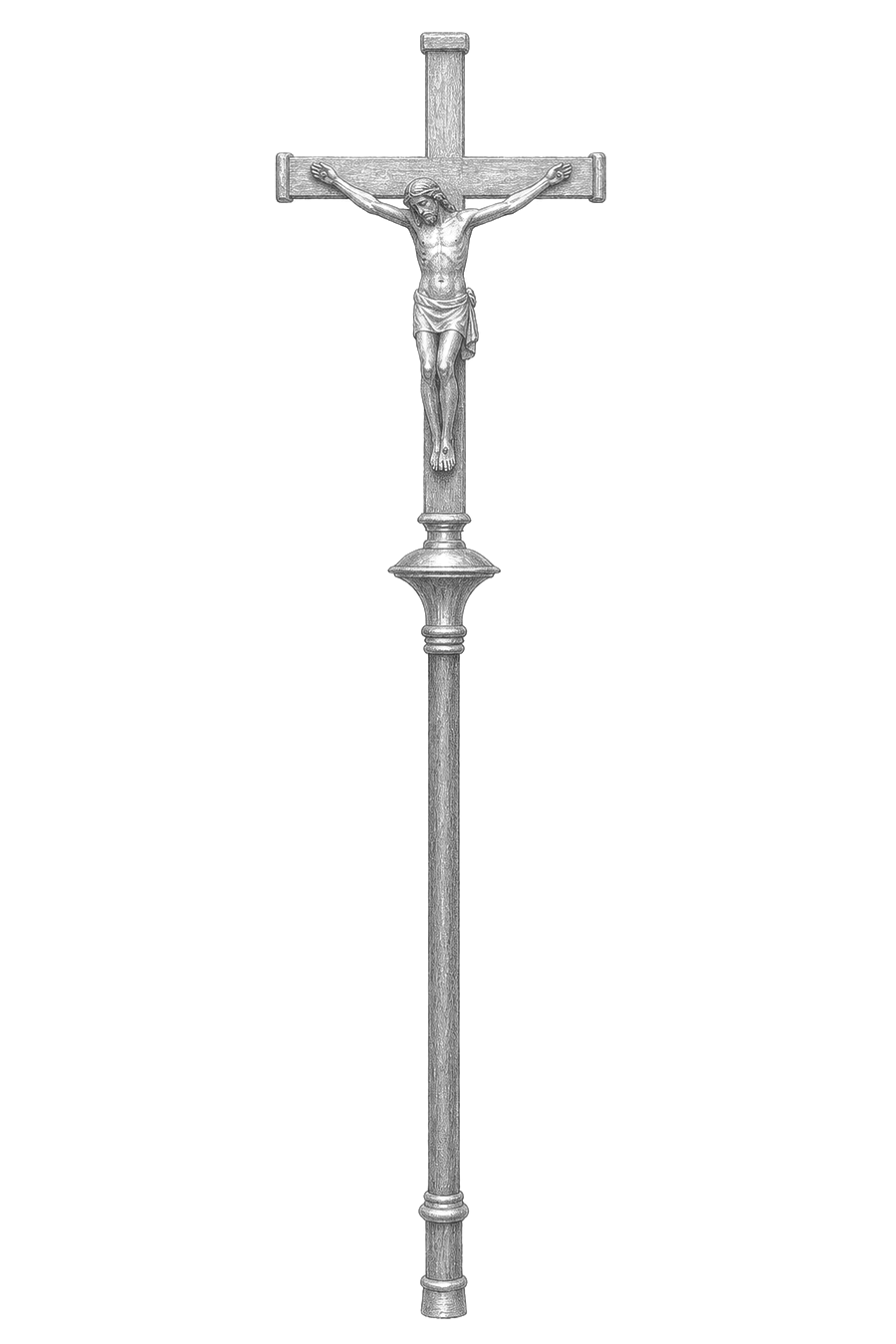 | Processional cross crux processionalis Details |
Service and procession | Fortescue identifies the processional cross as a crucifix fixed to a long carrying staff that cannot stand alone. |
More about Processional crossImage creditDeterministic alpha derivative of the project-generated v3 raster. The precursor's exact prompt intent, built-in mode, received and normalized hashes, source ceiling, and rights disposition remain recorded. Distributed under the repository's project-content terms. The candidate artwork shows a crucifix mounted on one tall carrying staff; it does not establish one ornamental form as universal. For a priest’s High Mass, Fortescue reports that carrying a cross is not the Roman custom and is not usually named by the Roman ceremonial books, but is permitted and customary in many churches. When used at a priest’s High Mass, the cross is carried between the acolytes and placed in an appointed sanctuary stand before being retrieved for the recession. Handling: Maintain overhead and doorway clearance; use the appointed stand. Use and sourcesStatus: Institutional. Location: Processional staging area or appointed stand. Candidate record for Roman processions and entrances. Ordinary handler: crossbearer. Server: carries.
| |||
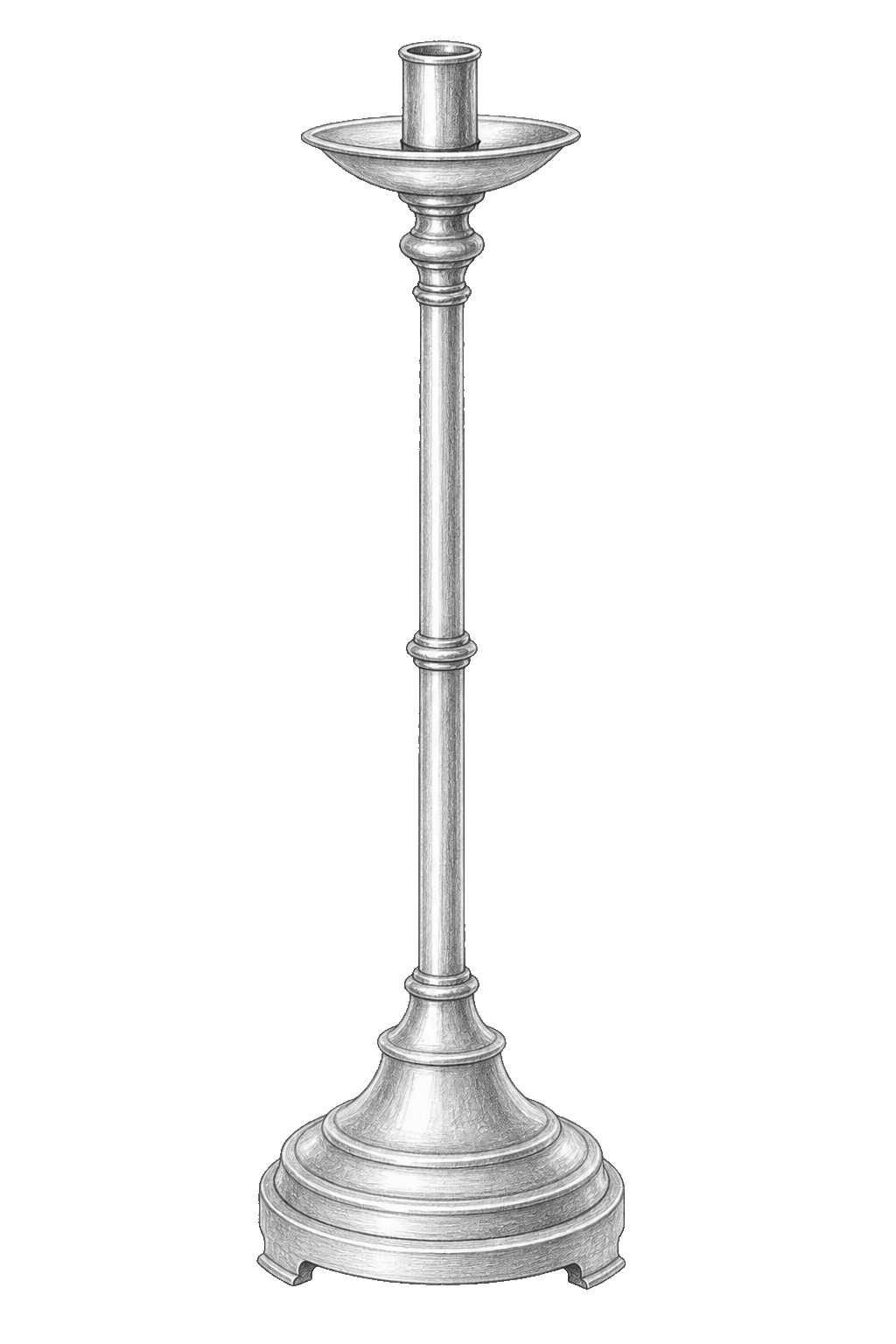 | Acolyte candlestick candelabrum acolythi Details |
Service and procession | An acolyte candlestick is the tall, footed, self-standing candle support distinguished from a footless elevation torch. |
More about Acolyte candlestickImage creditProject-generated raster made without a supplied reference image. The exact prompt, received and normalized identities, source ceiling, consumer boundary, and local background-removal transformation are recorded. Distributed under the repository's project-content terms. Fortescue describes the acolytes’ candles as tall, footed candlesticks that can stand on the credence, unlike footless elevation torches that require a rack. The separate empty acolyte-candlestick drawing is a representative support form; it does not assert universal material, ornament, dimensions, proportions, or exact silhouette. Handling: Keep the light upright and at the rehearsed common height; keep flame and hot wax clear of people, hair, and textiles. Use and sourcesStatus: Universal Roman. Location: Sacristy before and after use; carried in the entrance and Gospel formation; set on the credence when not carried. The candle-bearing acolytes at solemn Mass. Ordinary handler: acolyte. Server: carries. Ceremonial presence: The 1962 Missal names two candle-bearing acolytes in the solemn entrance and places them on either side of the subdeacon holding the Gospel book. Liturgical use: At solemn Mass, two candle-bearing acolytes carry their lights in the entrance and flank the subdeacon holding the Gospel book. Sacristan: Prepare a stable footed candlestick that can stand on the credence; this representative drawing does not prescribe material, ornament, dimensions, proportions, exact silhouette, or one universal form. Mc trainer: Teach the two candle-bearing acolytes and the footed, self-standing distinction without deriving one universal grip, height, or silhouette from this representative drawing. General reader: This is the footed candlestick of a candle-bearing acolyte, distinct from both an altar candlestick and a footless elevation torch; the pictured turned form is representative. Pontifical: Treat the acolyte candlestick as an ordinary supporting object used by candle-bearing acolytes, not as pontifical insignia or a distinct pontifical form.
Related views: Gospel book in use. | |||
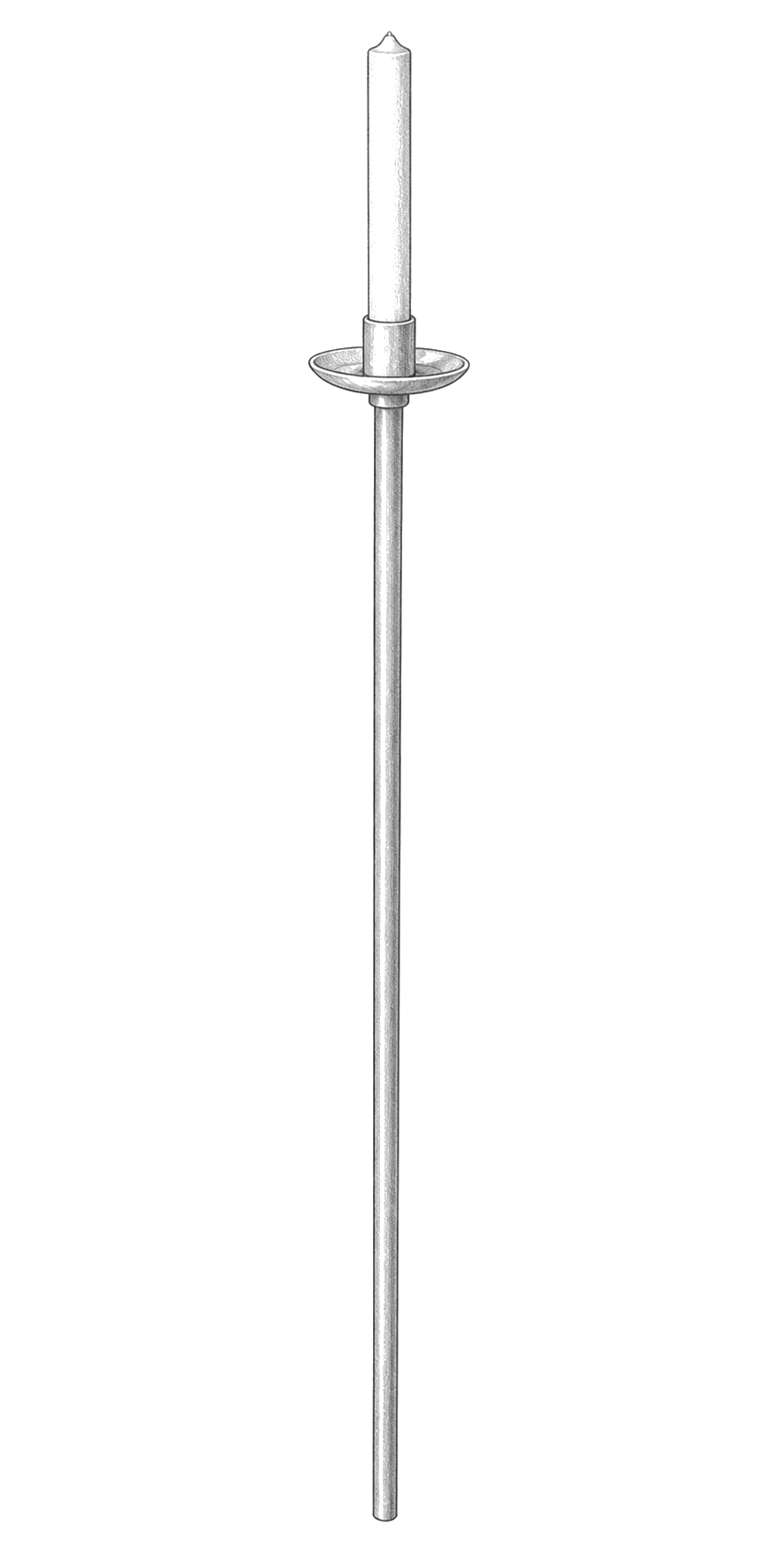 | Elevation torch intortitium Details |
Service and procession | Fortescue distinguishes footless elevation torches, which cannot stand alone and are stored in a rack, from the acolytes’ footed carried candlesticks. |
More about Elevation torchHandling: Keep the flame upright and clear of hair, cloth, people, and ceilings. Use and sourcesStatus: Institutional. Location: Appointed sacristy rack; carried to the sanctuary for the Elevation service and, on identified occasions, through Communion. Light carried by a torchbearer for the Elevation service, not an entrance light. Ordinary handler: torchbearer. Server: carries. Ceremonial presence: Torchbearers take lighted torches in the sacristy and bring them to the sanctuary at the Sanctus for the Elevation service; this is not the entrance use of the acolytes’ candlesticks. Sacristan: Keep the footless torch in its appointed rack and follow trained local fire-safety practice; this plate prescribes no material, dimensions, ornament, number, arrangement, or operating method. Mc trainer: Teach the Elevation-service timing and the footless, rack-stored distinction without turning this recognition plate into a route, grip, height, number, or flame-handling procedure. General reader: The elevation torch is a footless carried light used for the Elevation service, not the footed candlestick carried by an acolyte in the entrance. Pontifical: Treat the elevation torch as an ordinary supporting object used by torchbearers, not as pontifical insignia or a distinct pontifical form.
| |||
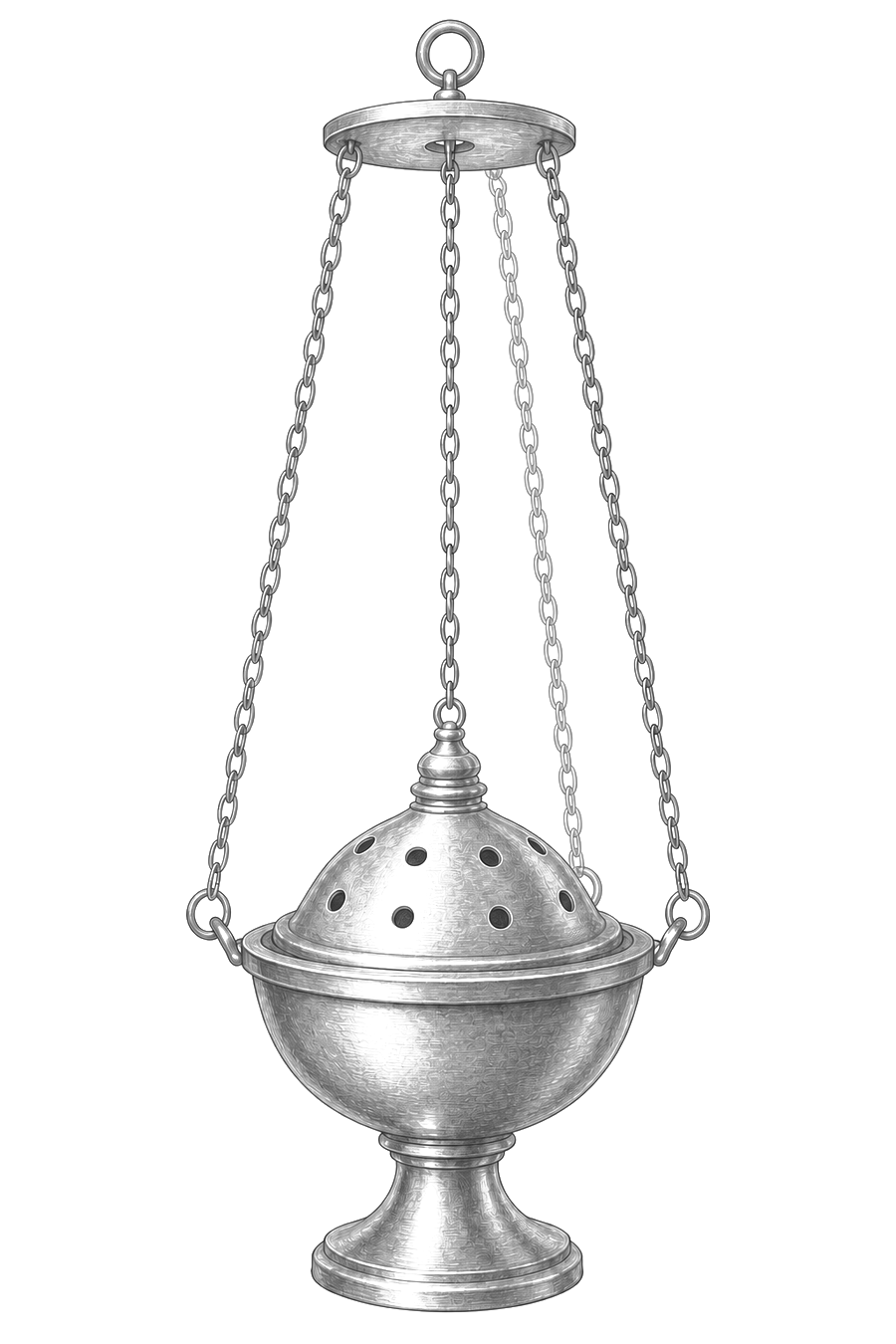 | Thurible thuribulum Details |
Incense | The 1962 Missal names the thuribulum and thuriferarius in the checked Solemn-Mass and sung-Mass incense loci. |
More about ThuribleImage creditDeterministic alpha derivative of the project-generated predecessor. Its exact prompts, source ceiling, corrections, normalized identity, and rights disposition remain recorded. Distributed under the repository's project-content terms. The artwork shows a pierced removable lid over a footed bowl, three support chains, a separate central lid-lifting chain, and an upper disc and ring as one source-bounded representative construction. Handling: Treat the bowl, removable pierced lid, and chains as hot. A trained thurifer maintains control by the upper ring and chains, rehearses only with a cold empty vessel, and uses an appointed safe resting place. This record gives no charcoal-lighting, loading, extinguishing, or swinging instructions. Use and sourcesStatus: Universal Roman. Location: Presented at the altar or Gospel station and carried by the thurifer in the checked Mass loci. Vessel in which incense is placed and from which the checked incensations are made. Ordinary handler: thurifer. Server: carries. Altar server: Distinguish the three bowl-support chains from the separate central lid chain; rehearse recognition only with a cold empty vessel, and use the hot thurible only in the appointed trained route. Sacristan: Prepare and store the thurible only by the church's trained fire-safe practice; the representative drawing prescribes no material, dimensions, ornament, charcoal procedure, or resting arrangement. Mc trainer: Teach the named thurifer relationship and the four-chain component distinction without converting this recognition plate into a handoff, swinging, charcoal, or route procedure. General reader: The thurible is the vessel used for the appointed incensations; the pictured four-chain construction is one source-bounded representative form, not a universal silhouette. Pontifical: Treat the thurible as an ordinary incense-service object used in pontifical Mass, not as pontifical insignia or a distinct pontifical form.
| |||
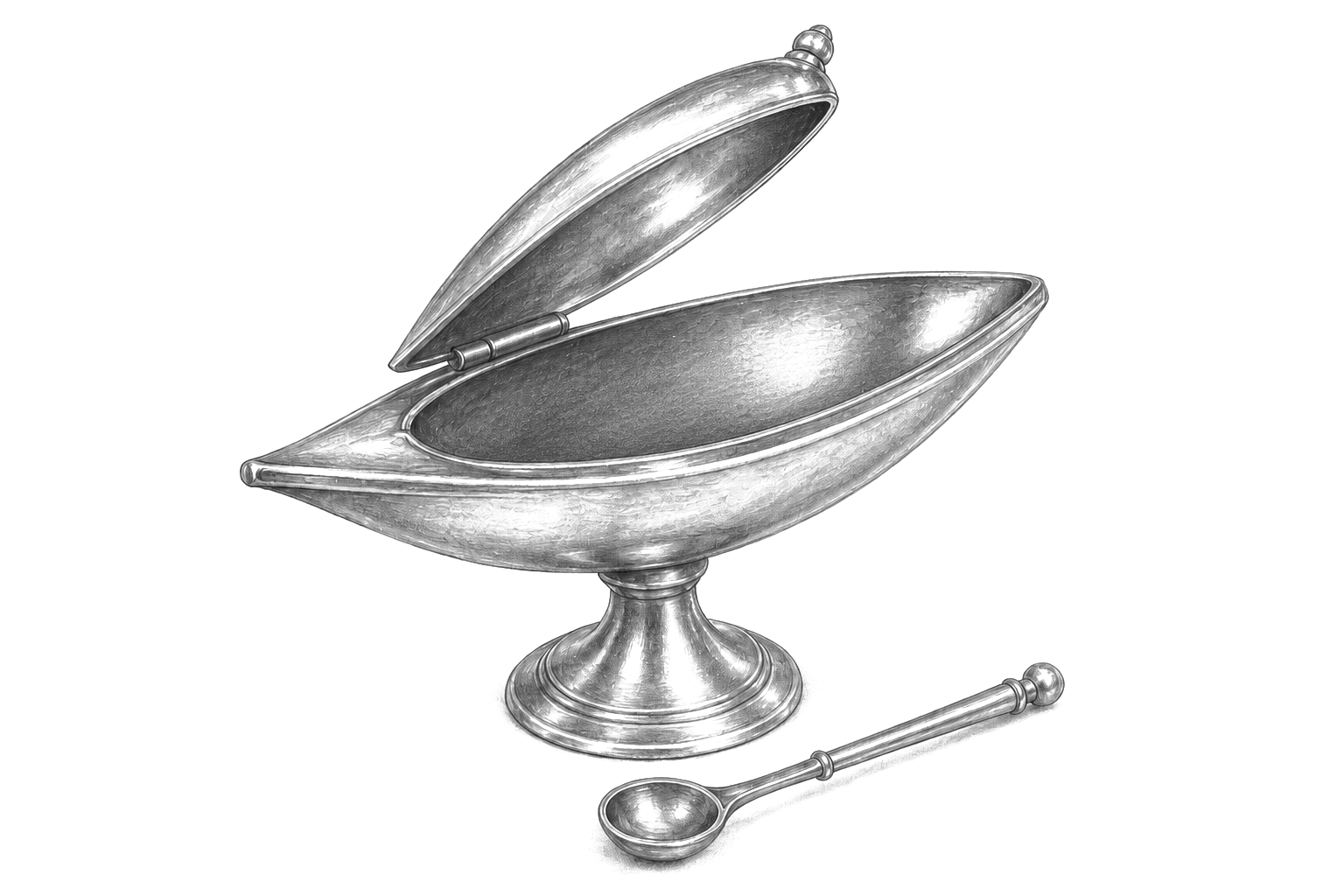 | Incense boat and spoon navicula; cochlear Details |
Incense | The 1962 Missal names the navicula as the container ministered with a spoon when incense is imposed at the checked Solemn-Mass stations. |
More about Incense boat and spoonImage creditDeterministic alpha derivative of the project-generated predecessor. Its exact prompt, source ceiling, normalized identity, and rights disposition remain recorded. Distributed under the repository's project-content terms. One cataloged 1708-9 exemplar is a small lidded boat-form vessel 10.2 cm long; this does not prescribe a universal silhouette, foot, hinge, ornament, or material. The cataloged 1708-9 boat-and-spoon exemplar includes a separate spoon 8.9 cm long; this is one material-culture witness, not a universal specification. Handling: Keep the boat and spoon separate from the hot thurible; follow the appointed local handoff without reaching across chains or hot metal. Use and sourcesStatus: Universal Roman. Location: Presented with the spoon when incense is imposed in the checked Solemn-Mass loci. Functional set comprising the loose-incense container and its separate transfer spoon. Ordinary handler: cleric. Server: varies by ceremony. Identity: The 1962 Missal names a cochlear ministered with the incense boat when incense is imposed at the checked Solemn-Mass stations. Altar server: Recognize the boat as the loose-incense container and the spoon as its separate transfer tool; keep the set together. A lay holder or handoff is local training, because the checked Solemn-Mass rubric names the deacon ministering it to the celebrant. Sacristan: Prepare and store the boat with its separate spoon; do not treat the exemplar's silver, dimensions, foot, hinge, or ornament as a universal specification. Mc trainer: Name the boat and spoon distinctly while teaching them as one functional set. Keep the checked deacon-to-celebrant relationship separate from any local lay boat-bearer assignment and both objects away from the hot thurible. General reader: The boat is the container and its spoon the separate transfer tool; they form one functional set. The pictured hinged, footed form is illustrative rather than prescribed. Pontifical: Treat the boat and spoon as one ordinary incense-service set, not as pontifical insignia or a distinct pontifical form.
| |||
 | Amice amictus Details |
Priest’s vestments | The amice is the first vestment in the 1962 Missal's ordinary priestly vesting sequence. |
More about AmiceImage creditProject-generated content; project-created artwork input only. No third-party image supplied. A rectangular linen cloth with ties; the Missal describes a cross at its middle. The cited Missal passage gives no dimensions or decorative scheme. A checked contemporary ceremonial permits preparation by the sacristan or partly by the server according to custom and describes server assistance with handing vestments; this is a practical/custom model, not a universal assignment. Handling: A server's preparation or assistance is a checked practical/custom model, not a universal assignment in the Missal. Use and sourcesStatus: Universal Roman. Location: Worn around the neck and shoulders beneath the alb; put on first before Mass. The first layer in the ordinary priest's six-vestment sequence. Ordinary handler: priest. Server: varies by ceremony. Liturgical use: Before the alb, the priest briefly lays the amice on his head, lowers it around his neck to cover the clothing collar, and secures its ties. Ceremonial presence: It belongs to the ordinary priestly vesture for Mass at the 1962 horizon. Altar server: Recognize the amice as the first layer. Offer or arrange it only under the celebrant's or local ceremonial direction. Sacristan: In the checked reverse-order table arrangement, ready the amice uppermost so it is taken first; exact folding and local allocation are not prescribed here. Mc trainer: Teach the amice before the alb; distinguish Missal sequence from locally assigned assistance. General reader: The rectangular linen amice covers the neck and clothing collar beneath the alb. Pontifical: Use this as the ordinary priestly baseline only; it does not establish an episcopal vesting sequence.
| |||
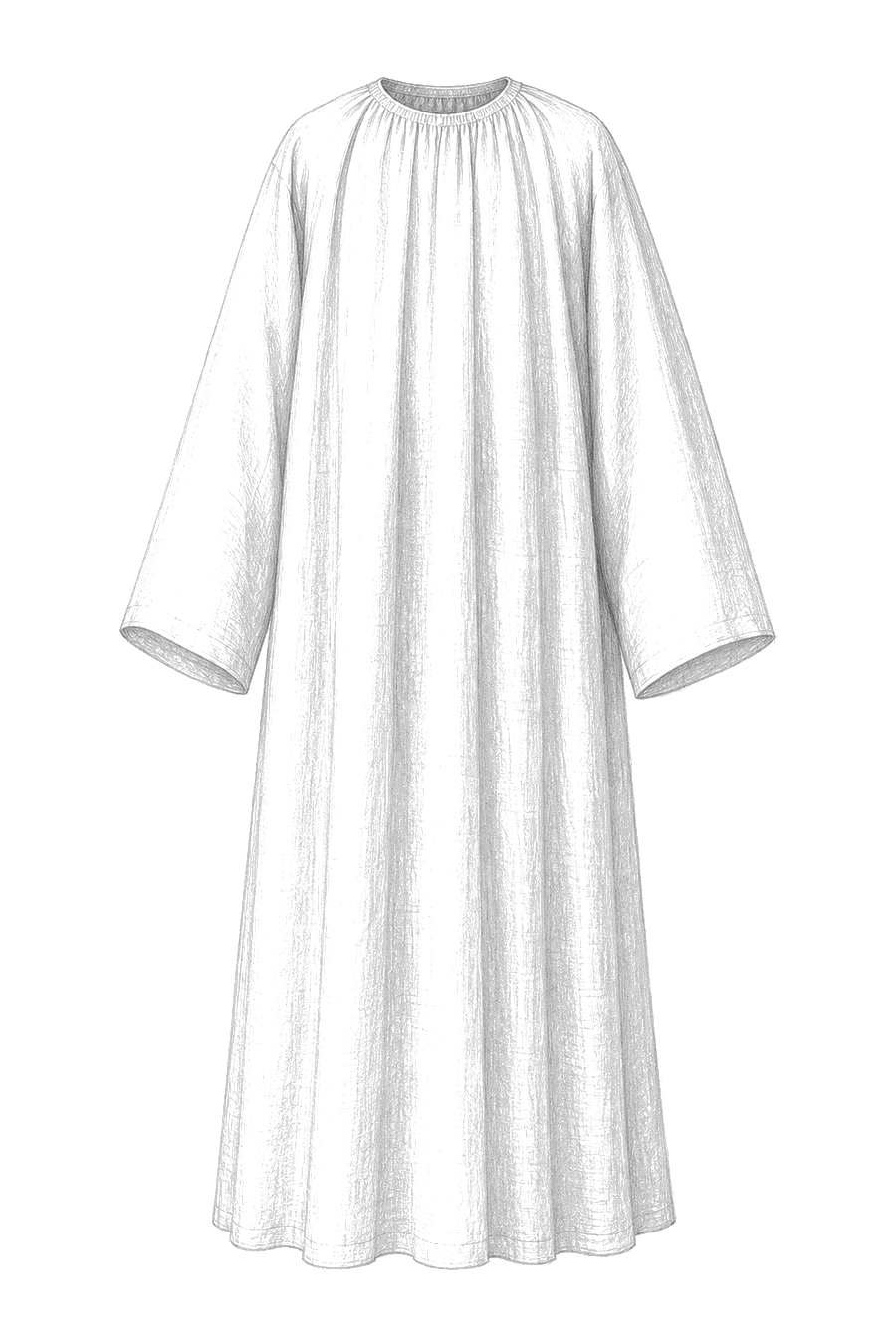 | Alb alba Details |
Priest’s vestments | The alb is the long linen vestment put on after the amice. |
More about AlbImage creditDeterministic alpha derivative of the project-generated predecessor; its provenance and rights disposition remain recorded. A checked contemporary ceremonial describes a loose, long-sleeved linen garment reaching to the feet; the plate does not prescribe lace, apparels, crosses, construction, ornament, or exact folds. In the exact Missal branch a minister presents the cincture from behind while raising and arranging the alb; a checked contemporary ceremonial also gives a practical/custom preparation and assistance model, not a universal assignment. Handling: The Missal expressly describes a minister raising and arranging the alb when presenting the cincture from behind; this does not authorize a universal handling rule for every server. Use and sourcesStatus: Universal Roman. Location: Put on over the amice and under the cincture. The second layer in the ordinary priest's six-vestment sequence. Ordinary handler: priest. Server: varies by ceremony. Liturgical use: The priest puts on the alb after the amice and before the cincture. Ceremonial presence: It belongs to the ordinary priestly vesture for Mass at the 1962 horizon. Altar server: Recognize the alb as the second layer. In the exact Missal branch a minister raises and arranges it while presenting the cincture from behind; do not generalize that action beyond direction. Sacristan: In the checked reverse-order table arrangement, ready the alb immediately beneath the amice; this record prescribes no fold or storage method. Mc trainer: Teach alb after amice and before cincture, and keep the Missal's exact minister action distinct from local assignments. General reader: The alb is the long linen layer worn over the amice. Pontifical: Use this as a relational base layer only; ordinary-priest arrangement does not establish episcopal timing or assistance.
| |||
 | Cincture cingulum Details |
Priest’s vestments | The cincture is the girdle fastened over the alb at the waist. |
More about CinctureImage creditDeterministic alpha derivative of the project-generated predecessor; its provenance and rights disposition remain recorded. The plate shows one plain smooth cord; no fiber, braid, twist, knot, tassel, length, color, end treatment, or decorative scheme is prescribed. The Missal describes a minister presenting the cincture from behind while raising and arranging the alb; the checked manual's wider preparation and assistance model remains practical/custom rather than universal. Handling: The Missal's minister presents it from behind while raising and arranging the alb; do not infer a universal server, knot, or handoff method. Use and sourcesStatus: Universal Roman. Location: Fastened at the waist over the alb. The third item in the ordinary priest's six-vestment sequence; it also secures the crossed stole ends. Ordinary handler: priest. Server: varies by ceremony. Liturgical use: The priest fastens the cincture after the alb; later it secures the crossed ends of the priest's stole. Ceremonial presence: It belongs to the ordinary priestly vesture for Mass at the 1962 horizon. Altar server: Recognize the cincture and the exact minister-assisted branch; present or arrange it only under direction. Sacristan: In the checked reverse-order table arrangement, ready the cincture immediately beneath the alb; no knot, coil, fold, or storage method is prescribed. Mc trainer: Teach the waist layer, the exact minister presentation, and its later stole-securing relation without inventing a universal handoff. General reader: The cincture girds the alb and secures the priest's crossed stole ends. Pontifical: Use this only as a relational layer; the ordinary priest's stole arrangement is not the bishop's arrangement.
| |||
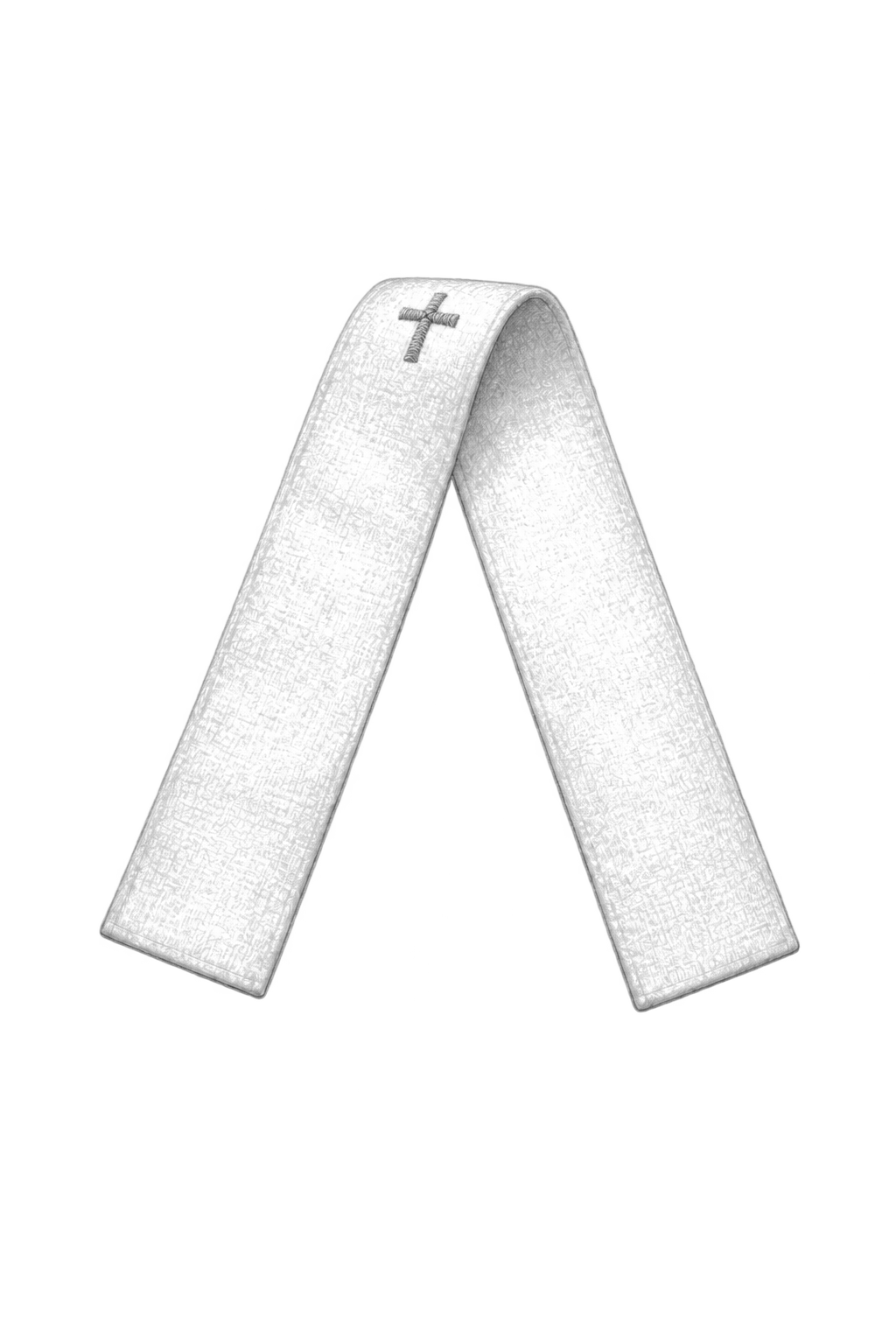 | Maniple manipulus Details |
Priest’s vestments | The maniple is the short vestment band worn on the priest's left arm. |
More about ManipleImage creditProject-generated content; project-created artwork input only. No third-party image supplied. A short, narrow vestment band worn on the left arm; the Missal describes a cross at its middle. The cited Missal passage gives no dimensions or fastening method. A checked contemporary ceremonial permits preparation by the sacristan or partly by the server according to custom and describes handing vestments; it does not prescribe a universal server handoff or fastening method. A bishop or blessed abbot with pontifical privileges ordinarily receives the maniple at the altar during the preparatory prayers; at a Requiem he puts it on before the stole. Handling: The checked practical manual's assistance model is conditional/custom; no fastening method or universal server handoff is prescribed. Use and sourcesStatus: Universal Roman. Location: Worn on the priest's left arm for Mass. Put on after the cincture and before the stole in the ordinary priest's sequence. Ordinary handler: priest. Server: varies by ceremony. Liturgical use: The ordinary priest puts it on the left arm after the cincture and before the stole. Ceremonial presence: It is part of ordinary priestly Mass vesture; the 1962 General Rubrics distinguish the cope branch, in which the maniple is not worn. Altar server: Recognize the short left-arm band and keep it distinct from the longer stole; assist only under direction. Sacristan: In the checked reverse-order table arrangement, ready it beneath the cincture and above the stole; the cope branch excludes it. Mc trainer: Teach left-arm placement, sequence, and the cope branch; keep priest, bishop, deacon, and subdeacon timing distinct. General reader: The maniple is the short band worn on the left arm, not the longer neck-worn stole.
| |||
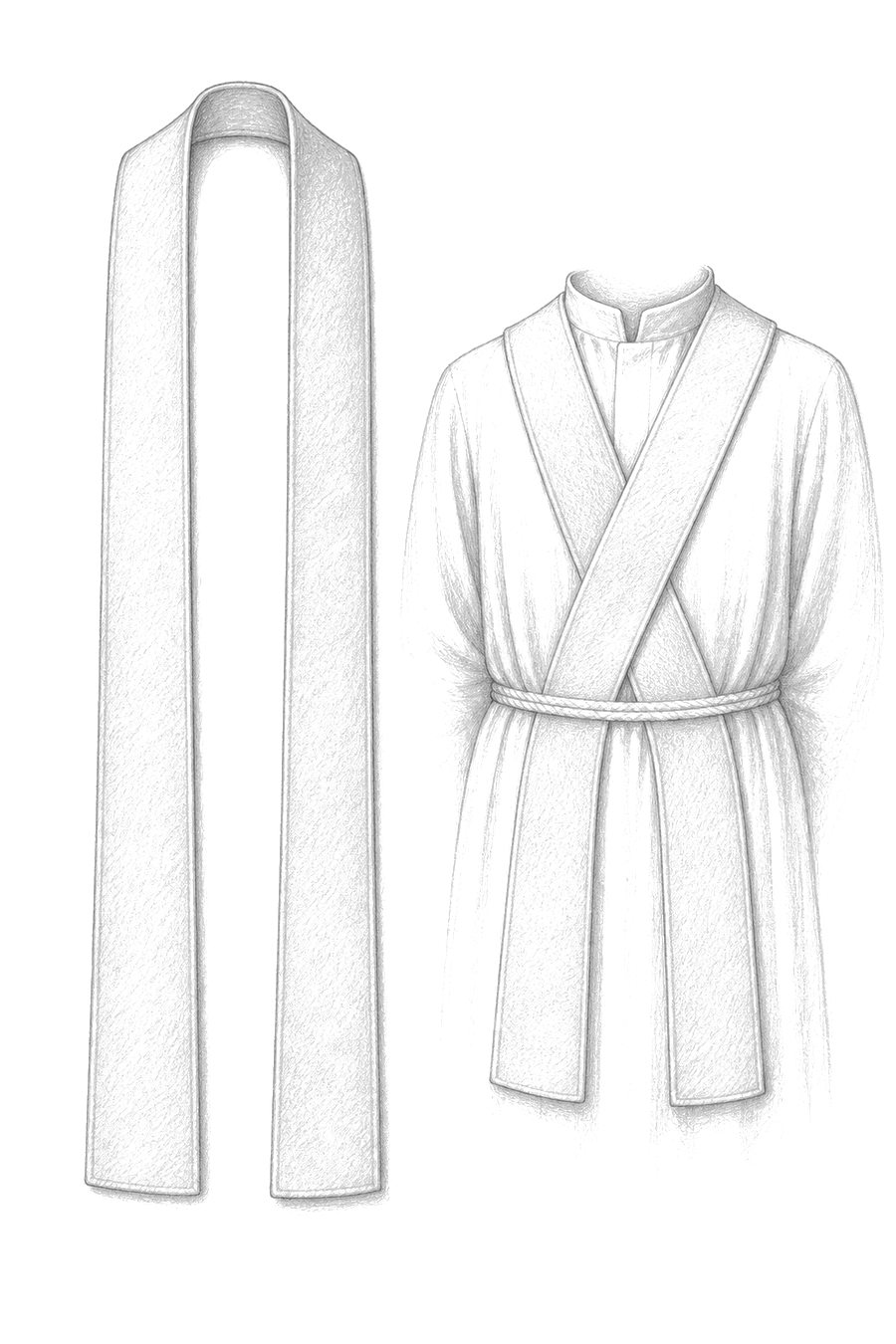 | Priest's stole stola Details |
Priest’s vestments | The priest's stole is the long narrow neck-worn vestment put on after the maniple. |
More about Priest's stoleImage creditDeterministic alpha derivative of the project-generated predecessor; its provenance and rights disposition remain recorded. The plate pairs one plain long narrow band with the checked ordinary priestly crossed-front arrangement; fringe, end shape, crosses, dimensions, textile, and ornament are representative only. A checked contemporary ceremonial permits preparation by the sacristan or partly by the server according to custom and describes handing or arranging the stole; this is not a universal server assignment. Handling: The crossed arrangement is the ordinary priest's arrangement in this exact 1962 locus; it is not the bishop's or deacon's arrangement. Use and sourcesStatus: Universal Roman. Location: Placed around the priest's neck, crossed over the breast, and secured by the cincture. Put on after the maniple and before the chasuble in the ordinary priest's sequence. Ordinary handler: priest. Server: varies by ceremony. Liturgical use: The ordinary priest places it around his neck, crosses it over the breast, and secures both ends with the cincture. Ceremonial presence: It belongs to the ordinary priestly vesture for Mass at the 1962 horizon. Altar server: Recognize the priest's long stole and crossed-front arrangement; offer or arrange it only under direction. Sacristan: In the checked reverse-order table arrangement, ready it beneath the maniple and above the chasuble; this record gives no folding or storage prescription. Mc trainer: Teach sequence and the priest's crossed arrangement while distinguishing the bishop's hanging and deacon's diagonal arrangements. General reader: The priest wears this long band around the neck, crossed and secured by the cincture. Pontifical: Use this to contrast the ordinary priest's crossed arrangement with the bishop's hanging stole.
| |||
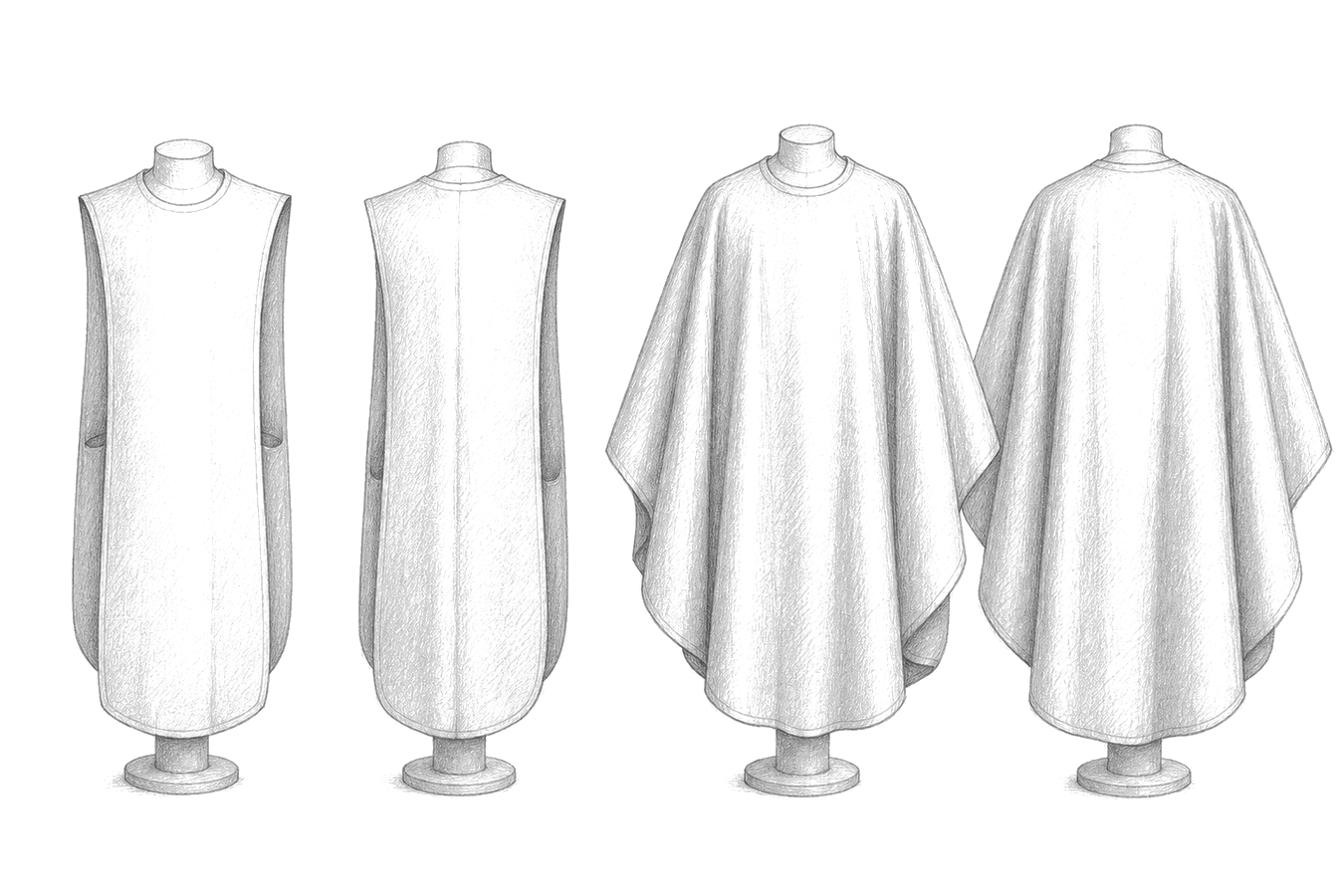 | Chasuble planeta seu casula Details |
Priest’s vestments | The chasuble is the outer priestly vestment put on last for Mass. |
More about ChasubleImage creditDeterministic alpha derivative of the project-generated predecessor; its provenance and rights disposition remain recorded. The comparison plate shows representative narrower Roman-cut and fuller Gothic silhouettes as material-culture variation; neither form is normative or exhaustive, and no orphrey, neckline, length, textile, ornament, tie, or exact proportion is prescribed. The vestment color follows the Mass or Office under the 1962 General Rubrics, with legitimate indults and customs preserved; the monochrome plate does not encode color. The Missal requires the vestments to be intact, clean, beautiful, and blessed where blessing applies; a checked contemporary ceremonial's reverse-stack preparation and handing model remains practical/custom rather than a universal assignment. Handling: A checked practical manual's preparation or assistance is conditional/custom; no universal tie, fold, storage, or server handoff is prescribed. Use and sourcesStatus: Universal Roman. Location: Outermost ordinary priestly vestment for Mass. Put on last over the stole. Ordinary handler: priest. Server: varies by ceremony. Liturgical use: The priest puts the chasuble on after the stole as the final layer. Ceremonial presence: The 1962 General Rubrics direct the priest always to use the planeta or casula at Mass; they separately abolish folded chasubles and the broad stole. Altar server: Recognize the chasuble as the final outer layer; present or arrange it only under direction. Sacristan: In the checked reverse-order table arrangement, ready it lowest so it is taken last, checking condition and the applicable color; no folding, storage, or tie method is prescribed. Mc trainer: Teach it as the final layer and keep ordinary priest, bishop, deacon, cope, and abolished folded-chasuble branches distinct. General reader: The chasuble is the priest's outer Mass vestment; the two pictured cuts are representative variations. Pontifical: Use this as the ordinary outer-vestment baseline while keeping episcopal layering and assistance distinct.
Related views: Layered pontifical vestments. | |||
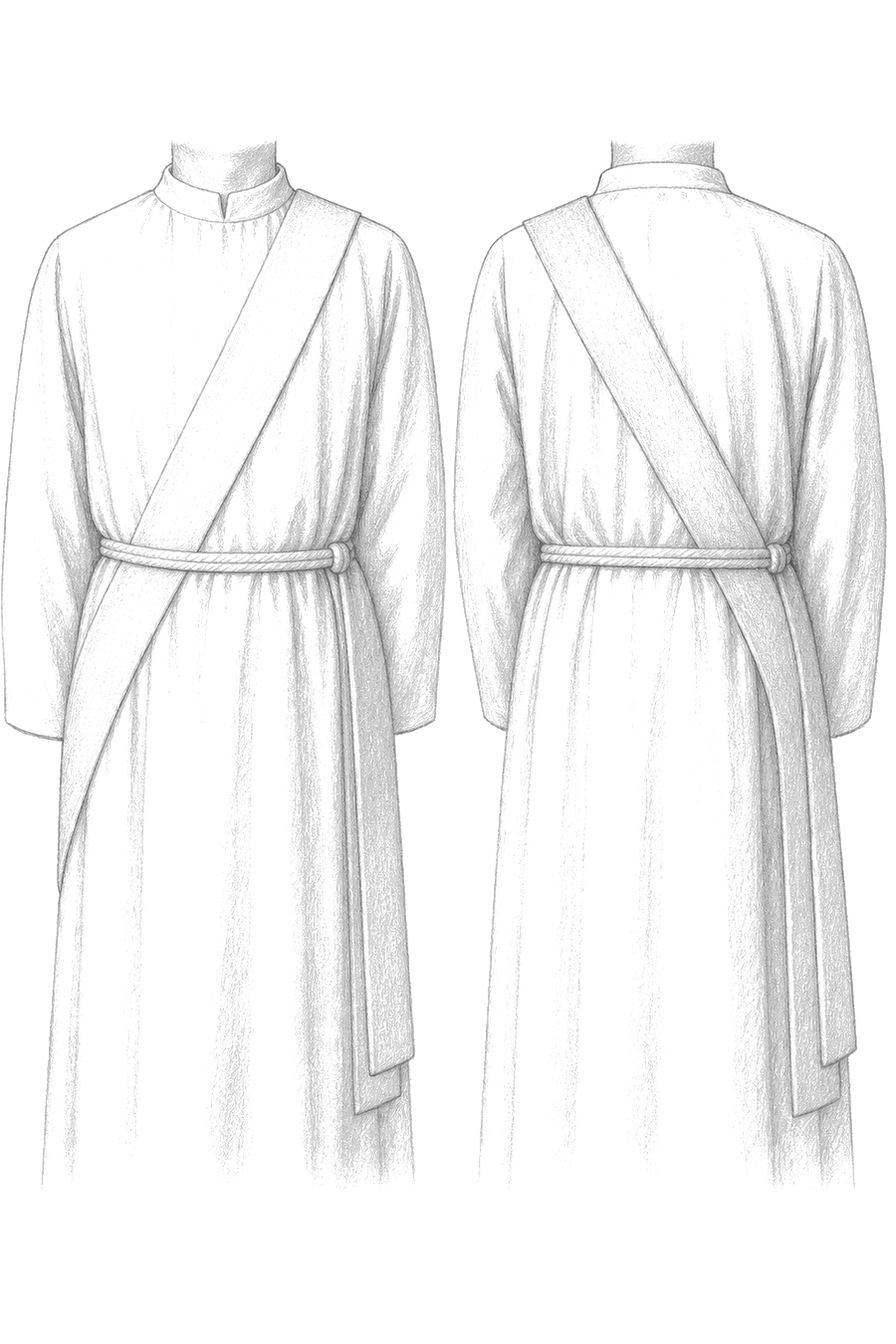 | Deacon's stole stola Details |
Deacon and subdeacon | The deacon's stole is the long narrow vestment worn diagonally from the left shoulder under the right arm. |
More about Deacon's stoleImage creditDeterministic alpha derivative of the checkpointed project-generated predecessor; its custody limitations and rights disposition remain recorded. The plate shows one representative complete diagonal arrangement on an anonymous front-and-back torso study; proportions, fastening, hanging lengths, textile, and ornament are illustrative rather than prescribed. The vestment color follows the Mass or Office under the 1962 General Rubrics, with legitimate indults and customs preserved; the monochrome plate does not encode color. A checked contemporary ceremonial describes an acolyte assisting the deacon to vest in particular Solemn-Mass preparations; that practical branch is conditional, not a universal server assignment. The deacon wears the stole from the left shoulder to the right side; the ordinary priest at Mass crosses it over the breast. Handling: The diagonal arrangement belongs to the deacon, not the priest. Handling: Checked ceremonial assistance is conditional and does not create a universal acolyte assignment. Use and sourcesStatus: Universal Roman. Location: Worn by the deacon over the alb and beneath the dalmatic. Part of the deacon's ordinary Mass vesture in ceremonies that appoint a deacon. Ordinary handler: deacon. Server: varies by ceremony. Liturgical use: The checked ceremonial baseline places it over the alb and beneath the dalmatic, with the two ends secured at the right side. Ceremonial presence: At the 1962 horizon the deacon retains the stole and dalmatic; the folded chasuble and broad stole are expressly no longer used. Altar server: Recognize the deacon by the stole running from left shoulder to right side; assist with it only under direction. Sacristan: Ready it with the deacon's Mass vestments and applicable color; this record prescribes no fold, storage, or fastening method. Mc trainer: Teach the left-shoulder diagonal route beneath the dalmatic, while keeping conditional assistance and the abolished broad-stole branch distinct. General reader: The deacon's stole runs from the left shoulder to the right side; the priest's Mass stole crosses over the breast. Pontifical: Use this as the ordinary diaconal recognition baseline within pontifical compositions; it does not establish a pontifical vesting sequence.
| |||
 | Dalmatic dalmatica Details |
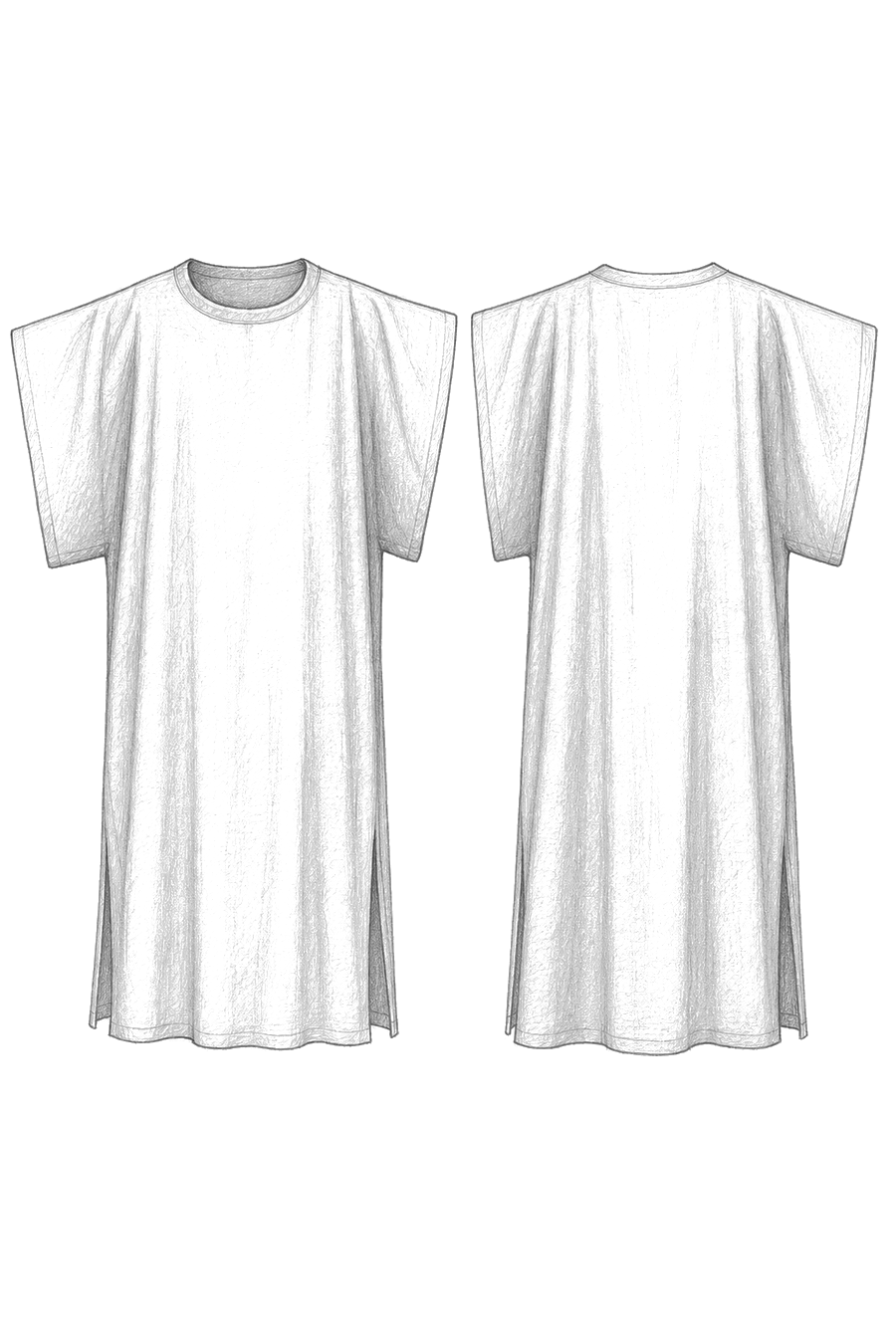
Deacon and subdeacon | The dalmatic is the deacon's outer Mass vestment, worn over the alb and diagonal stole. |
More about DalmaticImage creditDeterministic alpha derivative of the checkpointed project-generated predecessor; its custody limitations and rights disposition remain recorded. The plate shows one representative loose T-shaped form with a round head opening, broad short sleeves, and modest lower side openings; cut, length, opening, textile, ornament, and proportion are not prescribed here. The vestment color follows the Mass or Office under the 1962 General Rubrics, with legitimate indults and customs preserved; the monochrome plate does not encode color. A checked contemporary ceremonial describes an acolyte assisting the deacon to vest in particular Solemn-Mass preparations; that practical branch is conditional, not a universal server assignment. Handling: The pictured plain T-shaped form is representative, not a prescribed or universal cut. Handling: Checked ceremonial assistance is conditional and does not create a universal acolyte assignment. Use and sourcesStatus: Universal Roman. Location: Worn as the deacon's outer Mass vestment. Part of the deacon's ordinary Mass vesture in ceremonies that appoint a deacon. Ordinary handler: deacon. Server: varies by ceremony. Liturgical use: The checked ceremonial baseline places the dalmatic on the deacon over the alb, cincture, maniple, and diagonal stole. Ceremonial presence: The 1962 General Rubrics retain the deacon's dalmatic while expressly discontinuing folded chasubles and the broad stole. Altar server: Recognize the dalmatic as the deacon's outer Mass vestment; present or arrange it only under direction. Sacristan: Ready it with the deacon's vestments and applicable color; no fold, storage, fastening, or decorative form is prescribed. Mc trainer: Teach it as the deacon's outer layer over the diagonal stole, while separating conditional assistance from universal rules. General reader: The dalmatic is the deacon's outer Mass vestment; the pictured cut is representative. Pontifical: Use this as the ordinary diaconal recognition baseline within pontifical compositions; no pontifical layering sequence is inferred.
| |||
 | Tunicle tunicella Details |
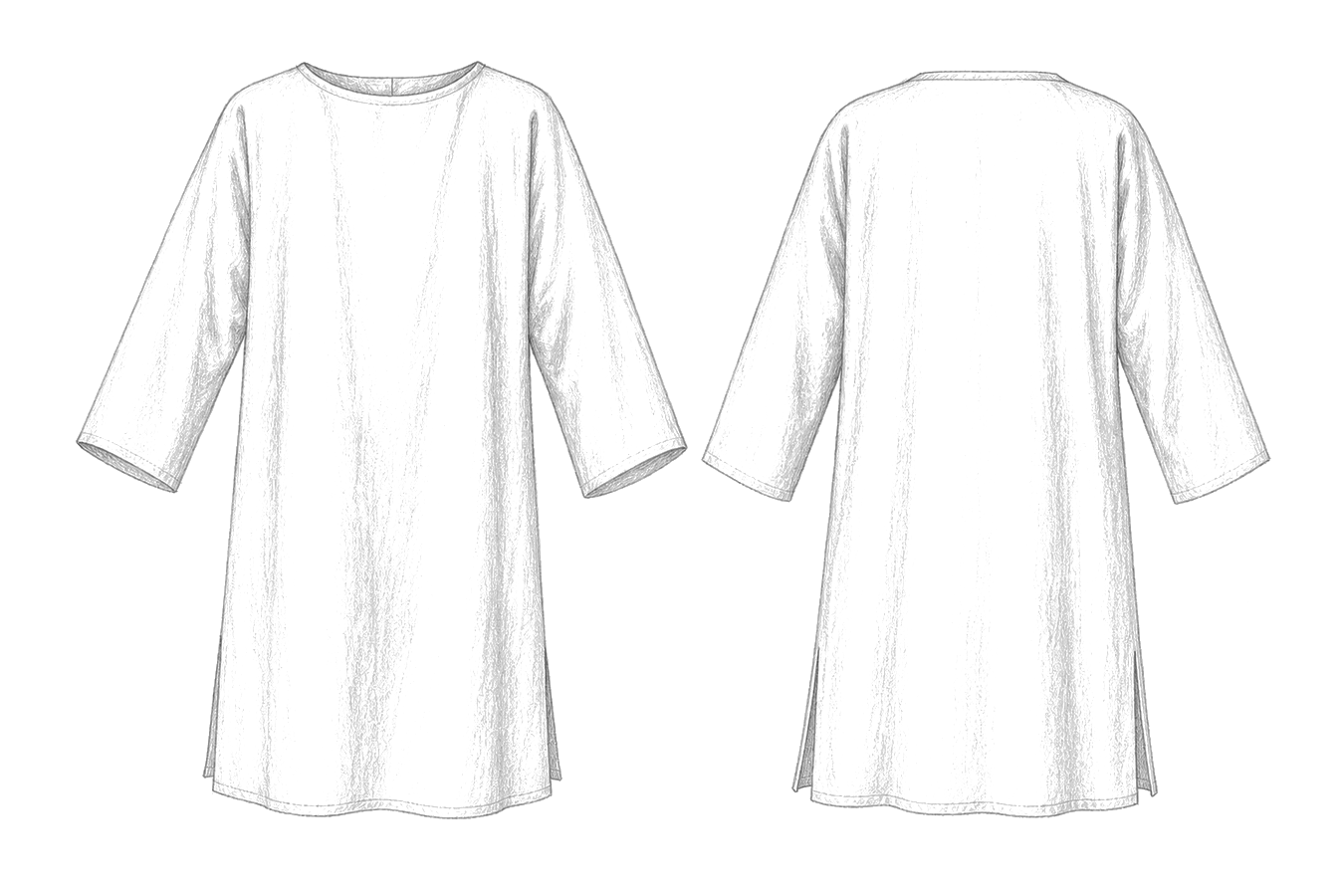
Deacon and subdeacon | The tunicle is the subdeacon's outer Mass vestment. |
More about TunicleImage creditDeterministic alpha derivative of the checkpointed project-generated predecessor; its custody limitations and rights disposition remain recorded. A checked ceremonial places the tunicle in the same vestment family as the dalmatic and notes a form with sleeves somewhat longer and narrower; the plate presents that distinction as representative, modest, and non-universal. The vestment color follows the Mass or Office under the 1962 General Rubrics, with legitimate indults and customs preserved; the monochrome plate does not encode color. A checked contemporary ceremonial describes an acolyte assisting the subdeacon to vest in particular Solemn-Mass preparations; that practical branch is conditional, not a universal server assignment. Handling: Its distinction from the dalmatic can be modest and contextual; the pictured sleeve relation is representative, not universal. Handling: Checked ceremonial assistance is conditional and does not create a universal acolyte assignment. Use and sourcesStatus: Universal Roman. Location: Worn as the subdeacon's outer Mass vestment. Part of the subdeacon's ordinary Mass vesture in ceremonies that appoint a subdeacon. Ordinary handler: subdeacon. Server: varies by ceremony. Liturgical use: The subdeacon wears the tunicle with amice, alb, cincture, and maniple; he wears no stole. Ceremonial presence: The 1962 General Rubrics retain the subdeacon's tunicle while expressly discontinuing folded chasubles and the broad stole. Altar server: Recognize the tunicle as the subdeacon's outer Mass vestment; present or arrange it only under direction. Sacristan: Ready it with the subdeacon's vestments and applicable color; no fold, storage, fastening, or decorative form is prescribed. Mc trainer: Teach it as the subdeacon's outer layer, with dalmatic comparison kept contextual and assistance kept conditional. General reader: The subdeacon wears the tunicle without a stole; its visual distinction from the deacon's dalmatic may be modest. Pontifical: Use this as the ordinary subdiaconal recognition baseline within pontifical compositions; no pontifical layering sequence is inferred.
| |||
 | Pontifical tunicle tunica Details |
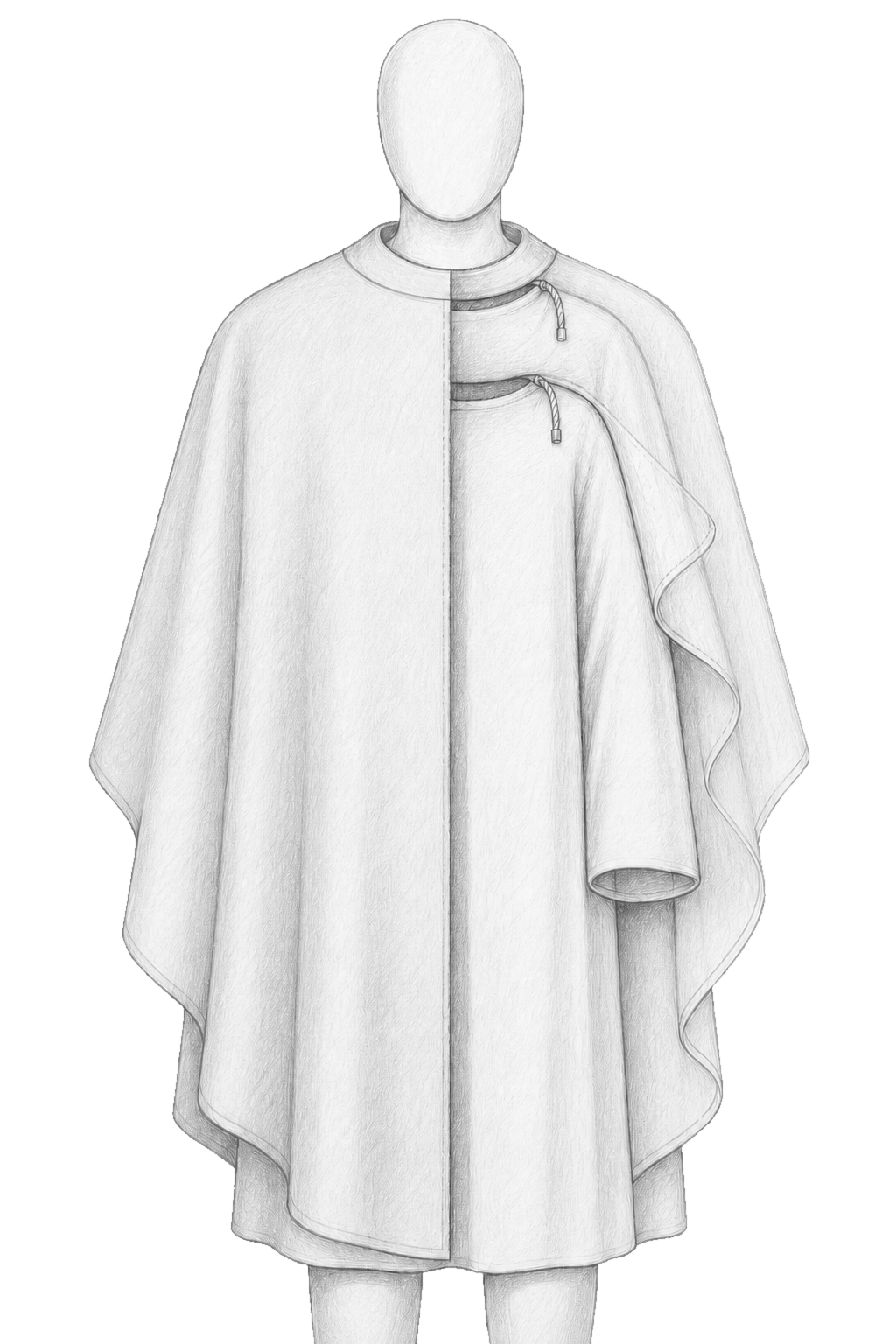
Bishop’s vestments and insignia | The 1962 Missal and Ceremonial identify the pontifical tunicle as a distinct episcopal vestment, separate from the pontifical dalmatic and from the subdeacon's outer tunicle. |
More about Pontifical tunicleAlso shown: Chasuble · Pontifical dalmatic. Chasuble: The comparison plate shows representative narrower Roman-cut and fuller Gothic silhouettes as material-culture variation; neither form is normative or exhaustive, and no orphrey, neckline, length, textile, ornament, tie, or exact proportion is prescribed. The vestment color follows the Mass or Office under the 1962 General Rubrics, with legitimate indults and customs preserved; the monochrome plate does not encode color. The Missal requires the vestments to be intact, clean, beautiful, and blessed where blessing applies; a checked contemporary ceremonial's reverse-stack preparation and handing model remains practical/custom rather than a universal assignment. A checked practical manual's preparation or assistance is conditional/custom; no universal tie, fold, storage, or server handoff is prescribed. Pontifical dalmatic: The checked sources establish the dalmatic's middle layer and separate vesting action but prescribe no universal cut, sleeve relation, dimensions, textile, or ornament. The checked sources establish the tunicle's inner layer and separate vesting action but prescribe no universal cut, sleeve relation, dimensions, textile, or ornament. Handling: Do not infer exact cut, ornament, fastening, or universal thickness from the cutaway. Use and sourcesStatus: Universal Roman. Location: Worn beneath the pontifical dalmatic and chasuble when appointed. Pontifical vesting and Mass. Ordinary handler: bishop, cleric, sacristan. Server: recognizes only. Liturgical use: The 1962 Missal and checked Ceremonial place the tunicle beneath the pontifical dalmatic and chasuble in the appointed vesting sequence. Ceremonial presence: The 1962 General Rubrics appoint the tunicle beneath the dalmatic and chasuble when a bishop or another person enjoying pontificals celebrates solemnly, and at specified Low Masses, while permitting omission for a reasonable cause. Pontifical: Use the cutaway for layer order only, not as a universal garment-pattern or ornament guide.
| |||
| Shown in Layered pontifical vestments | Pontifical dalmatic dalmatica Details |
Bishop’s vestments and insignia | The 1962 Missal and Ceremonial identify the pontifical dalmatic as a distinct episcopal vestment, separate from the pontifical tunicle and from the deacon's outer dalmatic. |
More about Pontifical dalmaticThe checked sources establish the dalmatic's middle layer and separate vesting action but prescribe no universal cut, sleeve relation, dimensions, textile, or ornament. Handling: Do not infer exact cut, ornament, fastening, or universal thickness from the cutaway. Use and sourcesStatus: Universal Roman. Location: Worn over the pontifical tunicle and beneath the chasuble when appointed. Pontifical vesting and Mass. Ordinary handler: bishop, cleric, sacristan. Server: recognizes only. Liturgical use: The 1962 Missal and checked Ceremonial place the dalmatic over the pontifical tunicle and beneath the chasuble in the appointed vesting sequence. Ceremonial presence: In the checked pontifical vesting sequence, the dalmatic is put on as a distinct layer after the tunicle and before the chasuble. Pontifical: Use the cutaway for layer order only, not as a universal garment-pattern or ornament guide.
| |||
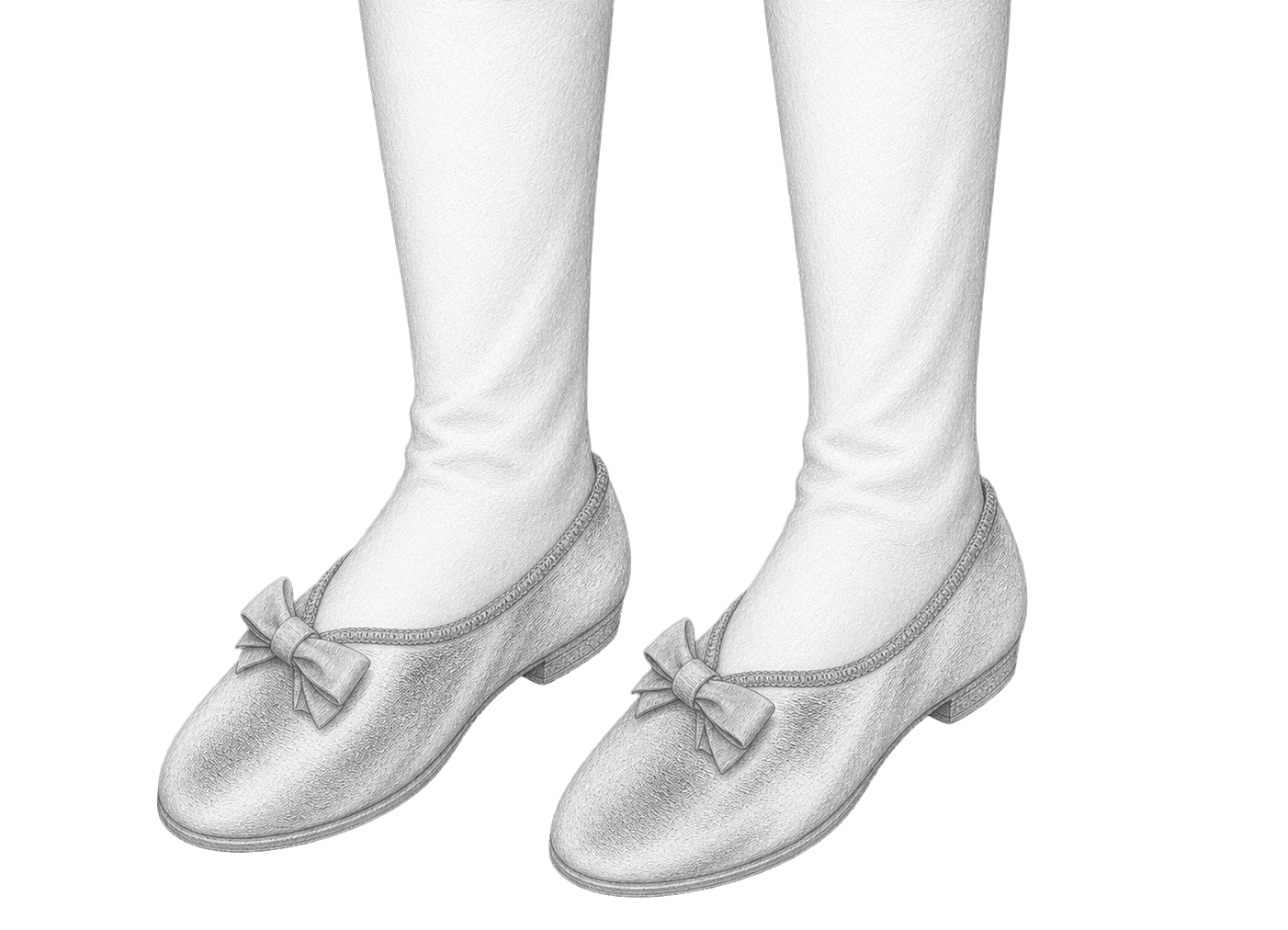 | Pontifical buskin caliga Details |
Bishop’s vestments and insignia | The Ceremonial distinguishes the pontifical buskin from the sandal and treats it as the inner member of the appointed footwear pair. |
More about Pontifical buskinAlso shown: Pontifical sandal. Pontifical sandal: The Pisa photograph supports one low closed-shoe exemplar; its bow, trim, material, proportions, and construction are not generalized. Do not confuse the outer sandal with the buskin worn beneath it. The checked source establishes the buskin's place beneath the sandal but prescribes no universal material, color, ornament, dimensions, fastening, or height. Handling: Identify the buskin beneath the outer sandal in the worn comparison; the two layers are distinct objects. Use and sourcesStatus: Universal Roman. Location: Worn beneath the pontifical sandal when appointed. Pontifical vesting, right leg and foot before left in the checked sequence. Ordinary handler: bishop, cleric, sacristan. Server: recognizes only. Liturgical use: The Ceremonial distinguishes buskins from sandals, appoints them in combination, and gives the right-then-left vesting sequence. Ceremonial presence: At the checked Solemn Pontifical Mass vesting, buskins and sandals are brought covered from the credence and put on together, right side before left. Pontifical: Teach the buskin only within the combined wearing formation and state the right-first sequence in text.
| |||
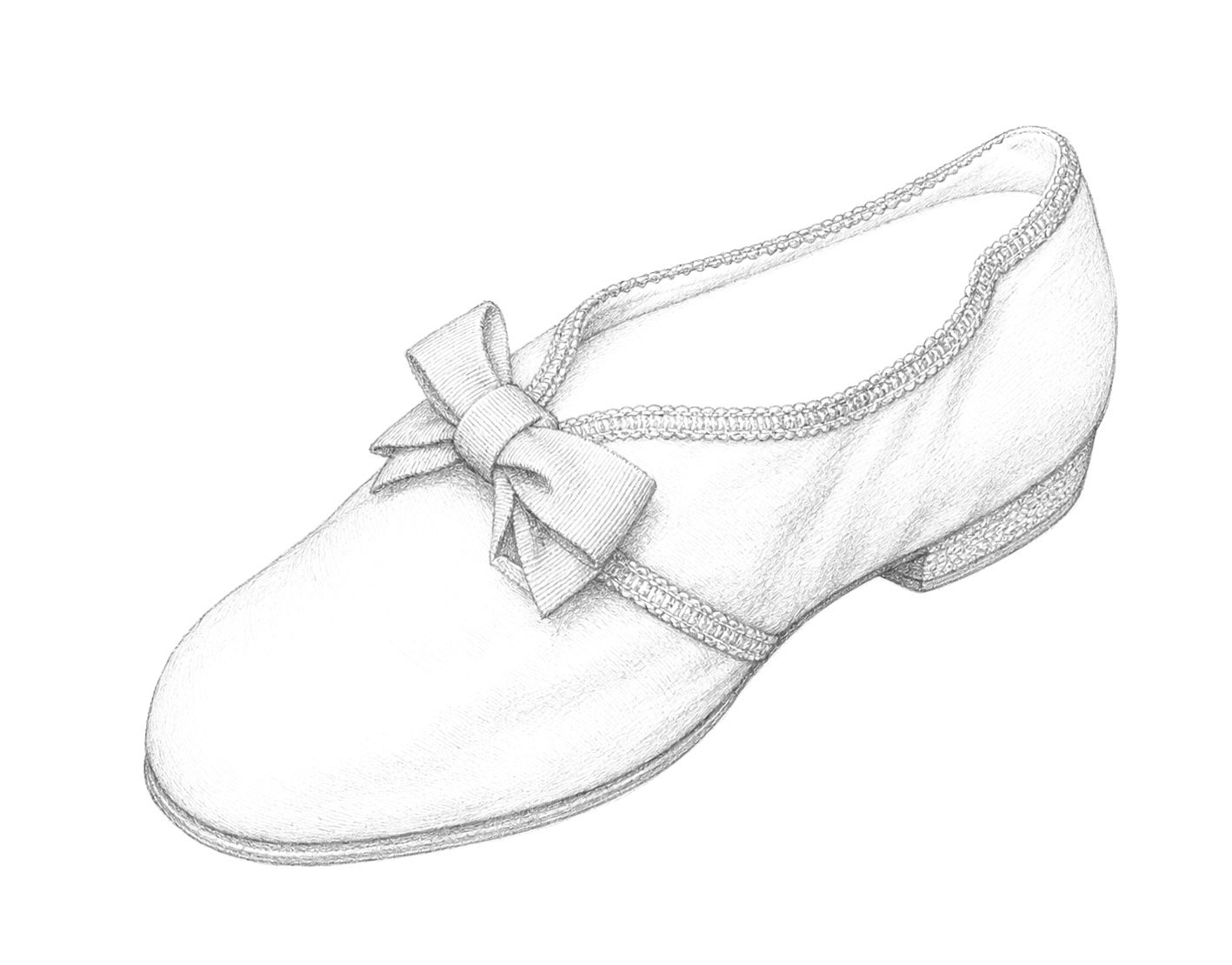 | Pontifical sandal sandale Details |
Bishop’s vestments and insignia | The Ceremonial distinguishes the pontifical sandal from the buskin and treats it as the outer member of the appointed footwear pair. |
More about Pontifical sandalThe Pisa photograph supports one low closed-shoe exemplar; its bow, trim, material, proportions, and construction are not generalized. Handling: Do not confuse the outer sandal with the buskin worn beneath it. Use and sourcesStatus: Universal Roman. Location: Worn over the pontifical buskin when appointed. Pontifical vesting, right foot before left in the checked sequence. Ordinary handler: bishop, cleric, sacristan. Server: recognizes only. Liturgical use: The Ceremonial distinguishes sandals from buskins, appoints them in combination, and gives the right-then-left vesting sequence. Ceremonial presence: At the checked Solemn Pontifical Mass vesting, sandals and buskins are brought covered from the credence and put on together, right side before left. Pontifical: Teach sandal over buskin and state right first, then left in text; do not infer the Pisa exemplar's decoration as normative.
Related views: Buskin and sandal. | |||
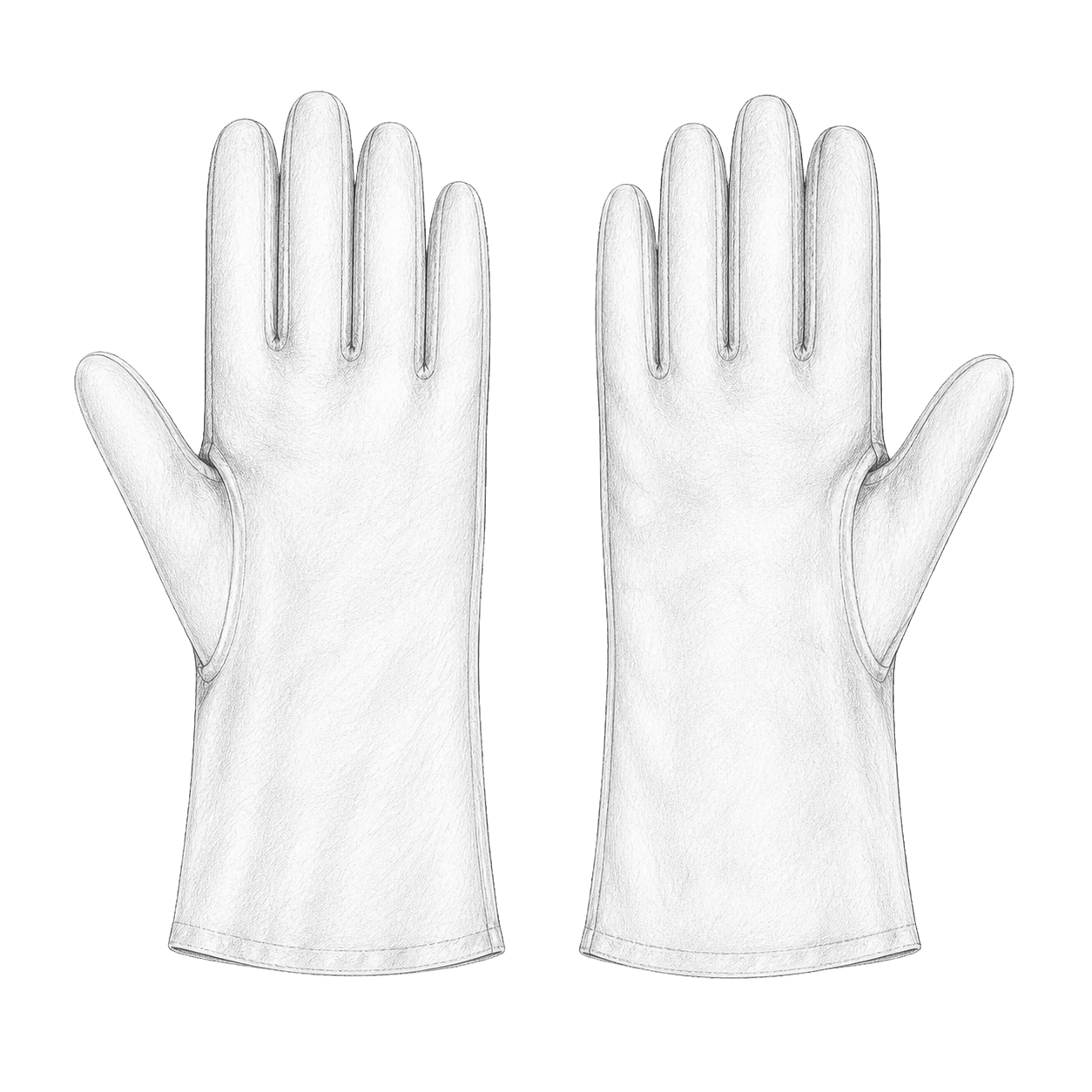 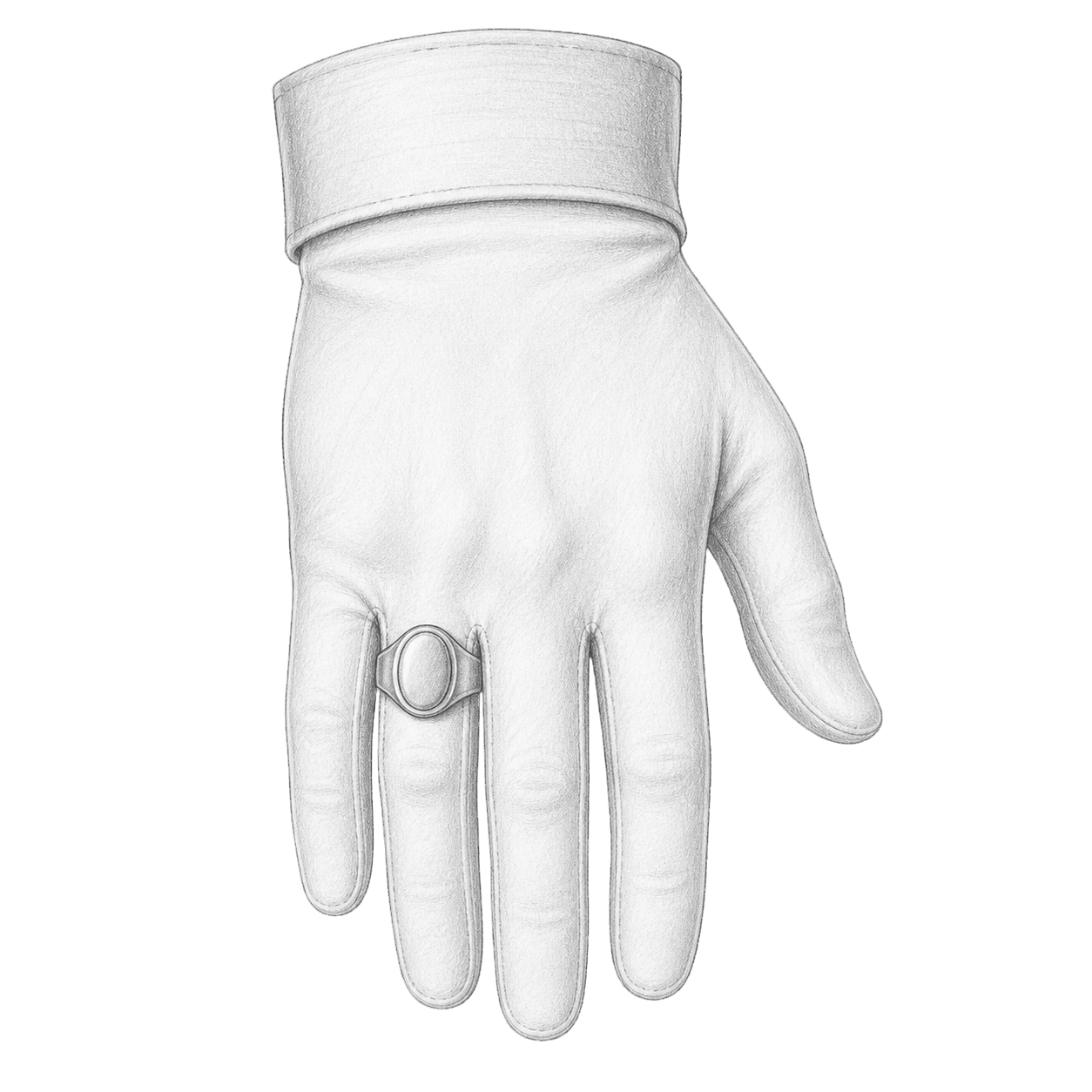 | Pontifical gloves chirothecae Details |
Bishop’s vestments and insignia | The Ceremonial identifies the pontifical gloves as a paired episcopal vesting object, one for each hand. |
More about Pontifical glovesAlso shown: Pontifical ring. Pontifical ring: The 1893 catalog identifies episcopal rings as a manufactured class but does not prescribe a universal stone, bezel, metal, heraldry, ornament, or dimensions. The 1893 catalog documents bishops' gloves in several colors, plain or with embroidered crosses, without making any treatment universal. The catalog witness shows that pontifical gloves may be plain or cross-embroidered and occur in several colors; it establishes no universal cuff, textile, dimensions, or construction. Use and sourcesStatus: Universal Roman. Location: Prepared for pontifical vesting and worn when appointed. The deacon gloves the right hand and the subdeacon the left in the checked pontifical-vesting sequence. Ordinary handler: bishop, deacon, subdeacon, sacristan. Server: recognizes only. Liturgical use: In the checked pontifical-vesting sequence the deacon puts the glove on the bishop's right hand and the subdeacon puts the glove on his left. Ceremonial presence: In the checked Solemn Pontifical Mass vesting, the gloves are put on before the chasuble and before the ring. Pontifical: Teach the right/left ministers and the later ring-over-right-glove relationship without prescribing glove decoration.
| |||
 | Pontifical ring annulus pontificalis Details |
Bishop’s vestments and insignia | The checked sources identify a distinct pontifical or episcopal ring used in the bishop's vesting. |
More about Pontifical ringThe 1893 catalog identifies episcopal rings as a manufactured class but does not prescribe a universal stone, bezel, metal, heraldry, ornament, or dimensions. Use and sourcesStatus: Universal Roman. Location: On the ring finger of the bishop's right hand when appointed. Pontifical vesting after the gloves in the checked sequence. Ordinary handler: bishop, priest, sacristan. Server: recognizes only. Liturgical use: After the intervening vesting actions, the assistant priest puts the pontifical ring on the ring finger of the bishop's right hand. Ceremonial presence: In the checked Solemn Pontifical Mass vesting, the assistant priest places the ring after the intervening actions that follow gloving. Pontifical: Teach the right ring-finger placement and its sequence after gloving; treat the isolated form as recognition art only.
Related views: Glove and ring. | |||
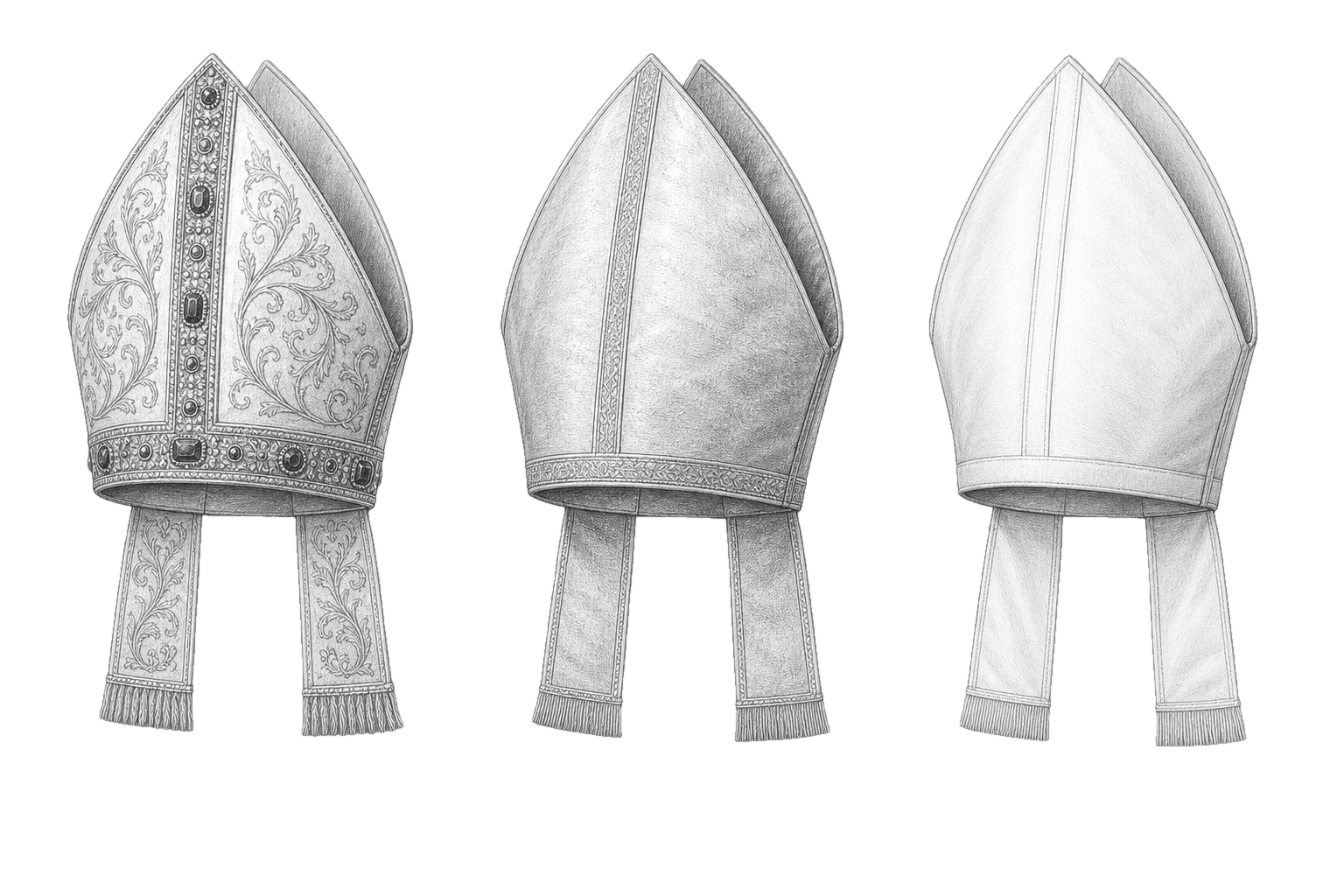 | Mitre mitra Details |
Bishop’s vestments and insignia | The Ceremonial identifies the mitre as a pontifical object and distinguishes three forms: precious, gold-cloth, and simple. |
More about MitreThe Ceremonial distinguishes precious, gold-cloth, and simple mitres by material and ornament. The museum witness confirms one two-panel body with paired lappets but does not prescribe profile, height, construction, iconography, or dimensions. Handling: Support the mitre as directed; do not treat the three forms as interchangeable decoration. Use and sourcesStatus: Universal Roman. Location: Worn by the bishop or held by the appointed mitre minister according to the ceremony. Pontifical functions with form and use selected by the Ceremonial. Ordinary handler: bishop, cleric. Server: recognizes only. Liturgical use: The appointed form is selected by the feast, season, Office, or Mass according to the Ceremonial's distinctions. Ceremonial presence: The Ceremonial appoints mitres at pontifical Vespers and Mass, with form and alternation governed by the occasion. Pontifical: Identify the appointed form from the ceremony; the three drawings compare source-defined classes rather than prescribe one construction.
Related views: Mitre and minister’s veil. | |||
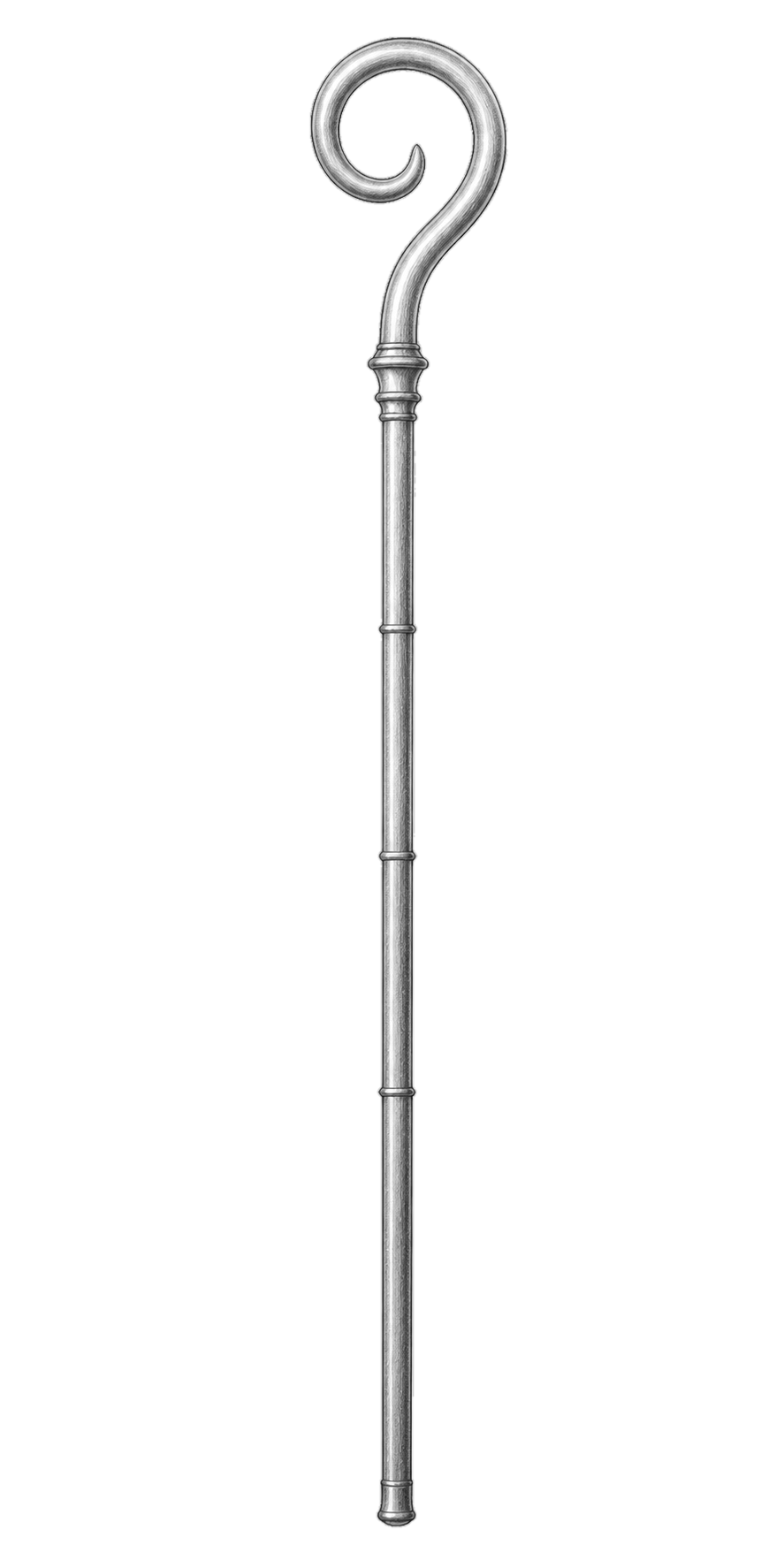 | Crosier baculus pastoralis Details |
Bishop’s vestments and insignia | The baculus pastoralis is the bishop's pastoral staff. |
More about CrosierThe checked museum record supplies one dated crosier morphology; it does not establish a universal profile, material, ornament, or dimensions. Handling: Do not infer that every bishop carries the crosier in every place or ceremony. Use and sourcesStatus: Universal Roman. Location: With its designated minister or the bishop when appointed by the ceremony. Pontifical functions in which the bishop uses the pastoral staff. Ordinary handler: bishop, cleric. Server: recognizes only. Liturgical use: The Ceremonial assigns a minister to the pastoral staff and describes the bishop's use of it under jurisdictional and ceremonial conditions. Ceremonial presence: The Ceremonial places the pastoral staff in specified pontifical Vespers, Masses, and processions; Offices and Masses of the Dead are excluded. Pontifical: Teach the staff together with its designated minister and the applicable jurisdictional branch, not as an always-carried episcopal accessory.
| |||
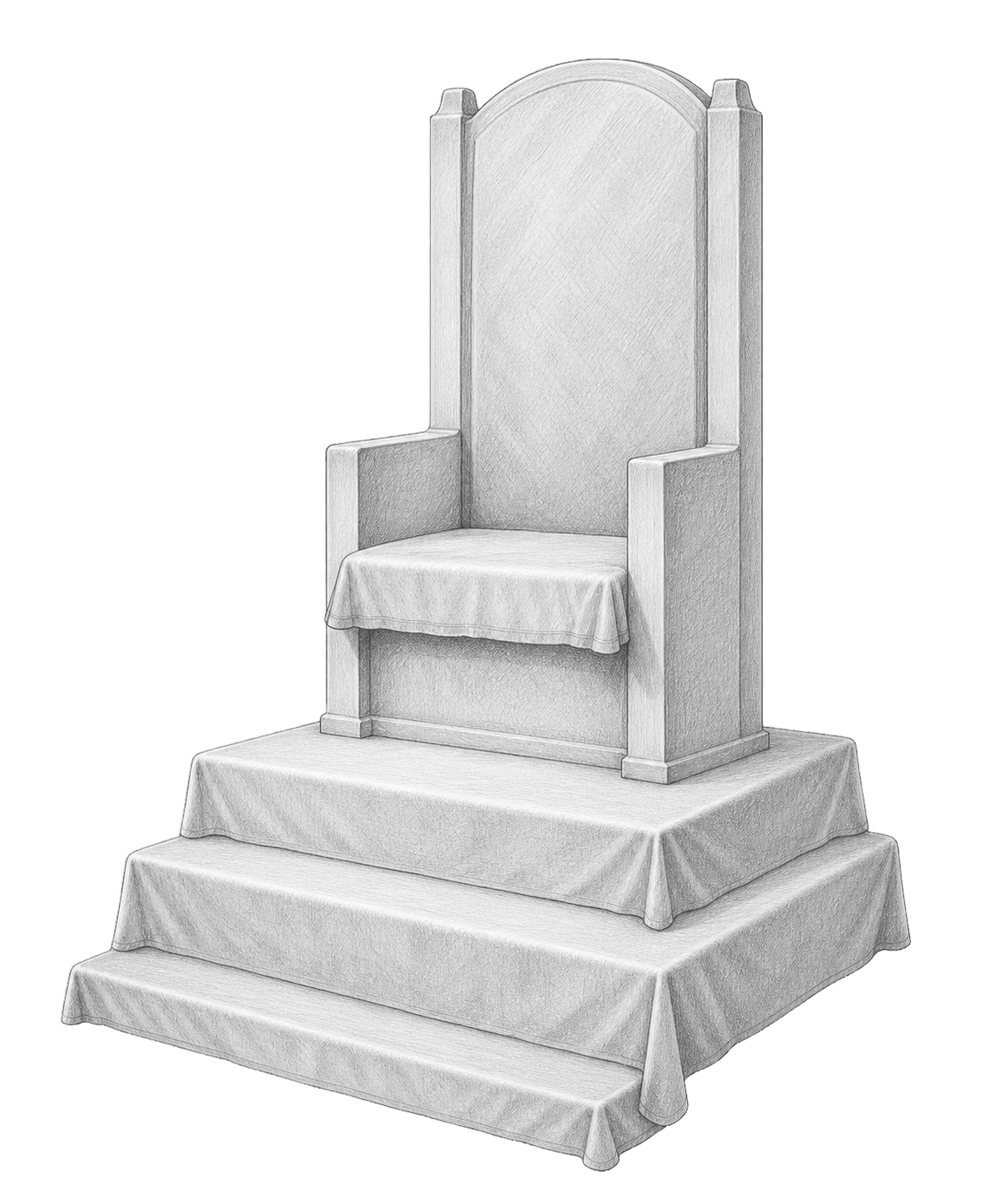 | Episcopal throne solium episcopale Details |
Bishop’s vestments and insignia | The Ceremonial names the bishop's proper pontifical seat or episcopal throne and distinguishes it from a faldstool. |
More about Episcopal throneThe Ceremonial prescribes a high, elevated cathedra or immovable throne on three covered steps, with a silk covering matching the other appointments; a canopy is conditional rather than universal. Use and sourcesStatus: Universal Roman. Location: The bishop's proper appointed sanctuary station. The proper pontifical seat, distinguished in the Ceremonial from the faldstool. Ordinary handler: bishop, cleric, sacristan. Server: recognizes only. Liturgical use: The bishop uses this proper seat at solemn Vespers and solemn Mass. Ceremonial presence: The seat is appointed within the sanctuary according to the arrangement of the sanctuary and choir.
| |||
 | Faldstool faldistorium Details |
Bishop’s vestments and insignia | The faldistorium is an episcopal seat distinct from the bishop's proper pontifical seat or throne. |
More about FaldstoolFor the governed use, the faldstool is covered to the ground in silk matching the vestments, with a cushion beneath; a low platform may be added when the altar steps would otherwise leave it too low. Use and sourcesStatus: Universal Roman. Location: Before the altar or at the appointed pontifical station, according to the ceremony. A portable episcopal seat or kneeling support used when the bishop does not occupy his proper throne, with use determined by the ceremony. Ordinary handler: bishop, cleric, sacristan. Server: recognizes only. Liturgical use: The Ceremonial distinguishes the bishop's use of a faldistorium from his use of the proper pontifical seat or episcopal throne. Ceremonial presence: The celebrant's faldstool is placed near the lowest altar step on the Epistle side.
| |||
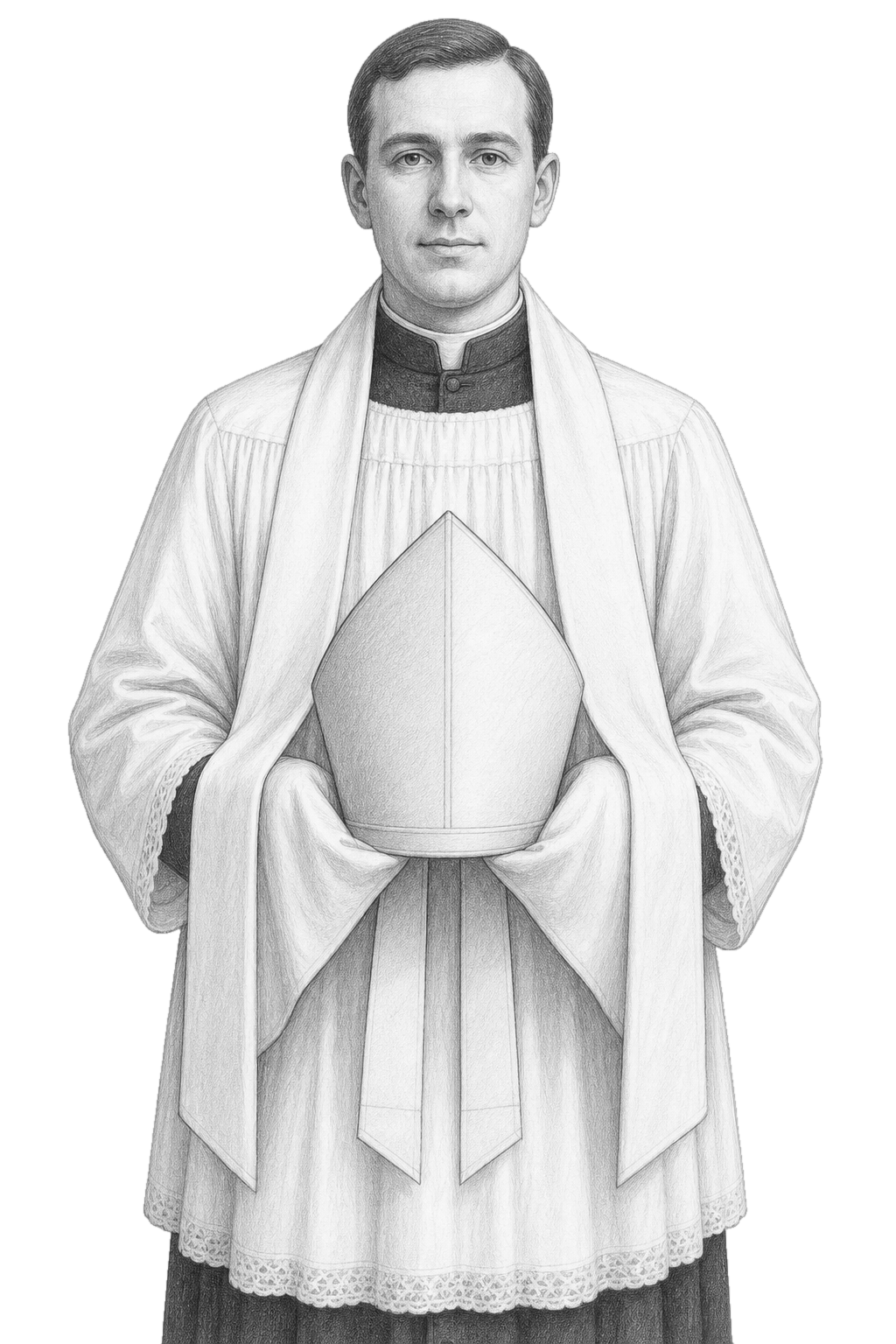 | Mitre minister's veil velum seu mappa sericea oblonga Details |
Bishop’s vestments and insignia | The Ceremonial identifies a veil or oblong silk cloth assigned to the mitre minister; this checked locus does not call it a vimpa. |
More about Mitre minister's veilAlso shown: Mitre. Mitre: The Ceremonial distinguishes precious, gold-cloth, and simple mitres by material and ornament. The museum witness confirms one two-panel body with paired lappets but does not prescribe profile, height, construction, iconography, or dimensions. Support the mitre as directed; do not treat the three forms as interchangeable decoration. The governing description establishes an oblong silk textile hung from the neck, but does not prescribe its dimensions, fastening, breadth, or drape. Handling: Do not infer dimensions, fastening, or a universal identity with every veil called a vimpa. Use and sourcesStatus: Universal Roman. Location: Worn from the neck by the mitre minister when appointed. Used to support the mitre without bare-hand contact, except in the Ceremonial's cope branch. Ordinary handler: cleric. Server: recognizes only. Liturgical use: The Ceremonial directs the mitre minister to wear a neck-hung oblong silk veil or cloth and use it to support the mitre without bare-hand contact, unless he wears a cope. Ceremonial presence: When appointed and not vested in a cope, the mitre minister wears the cloth from his neck while supporting the mitre. Pontifical: Teach the checked neck-hung, hands-covered function and the cope exception; do not generalize the drawing's breadth or drape.
| |||
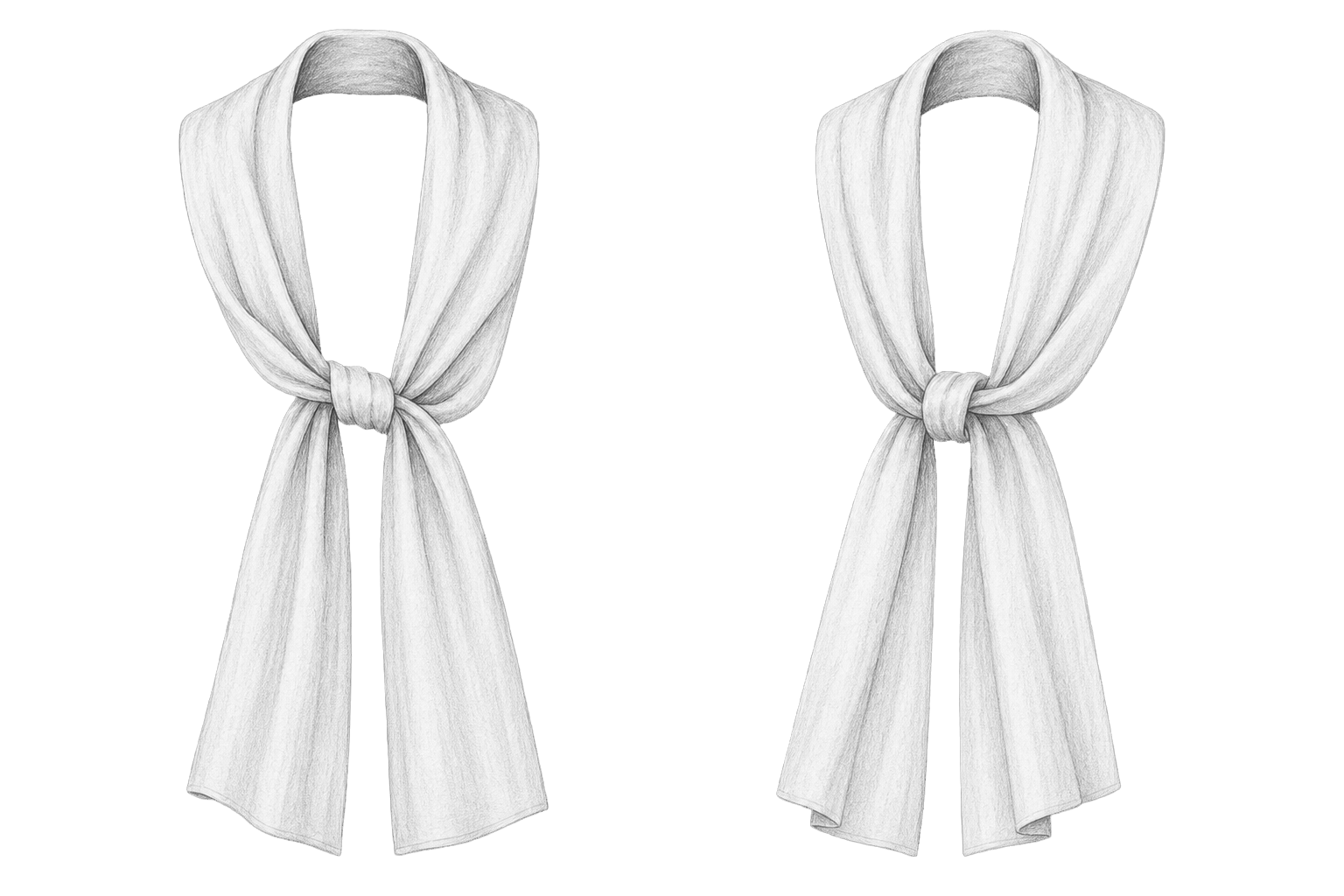 | Vimpa vimpa Details |
Bishop’s vestments and insignia | Fortescue calls the thin silk scarf-like veil a vimpa and describes matching use by the mitre- and crosier-bearers. |
More about VimpaFortescue describes the customary vimpa as a thin white silk scarf, like a broad stole, worn around the neck and tied in front; this account does not prescribe exact dimensions, ornament, or construction. Handling: Do not describe the crosier-bearer vimpa as an express prescription of the checked official passage. Use and sourcesStatus: Universal Roman. Location: Worn by an appointed insignia bearer. Mitre-bearing under the checked official locus and mitre- or crosier-bearing in the checked contemporary customary account. Ordinary handler: cleric. Server: recognizes only. Liturgical use: The Ceremonial expressly provides the mitre minister a neck-hung oblong silk veil or cloth with which to support the mitre without bare-hand contact. Ceremonial presence: At pontifical functions in Fortescue's account, the mitre- and crosier-bearers hold those insignia through matching vimpae; the checked Ceremonial expressly prescribes the neck-hung cloth for the mitre minister, while its crosier provision instead directs use of the cotta's end. Pontifical: Distinguish the official mitre-minister function from the Fortescue-attested crosier-bearer custom and retain that qualification in captions.
| |||
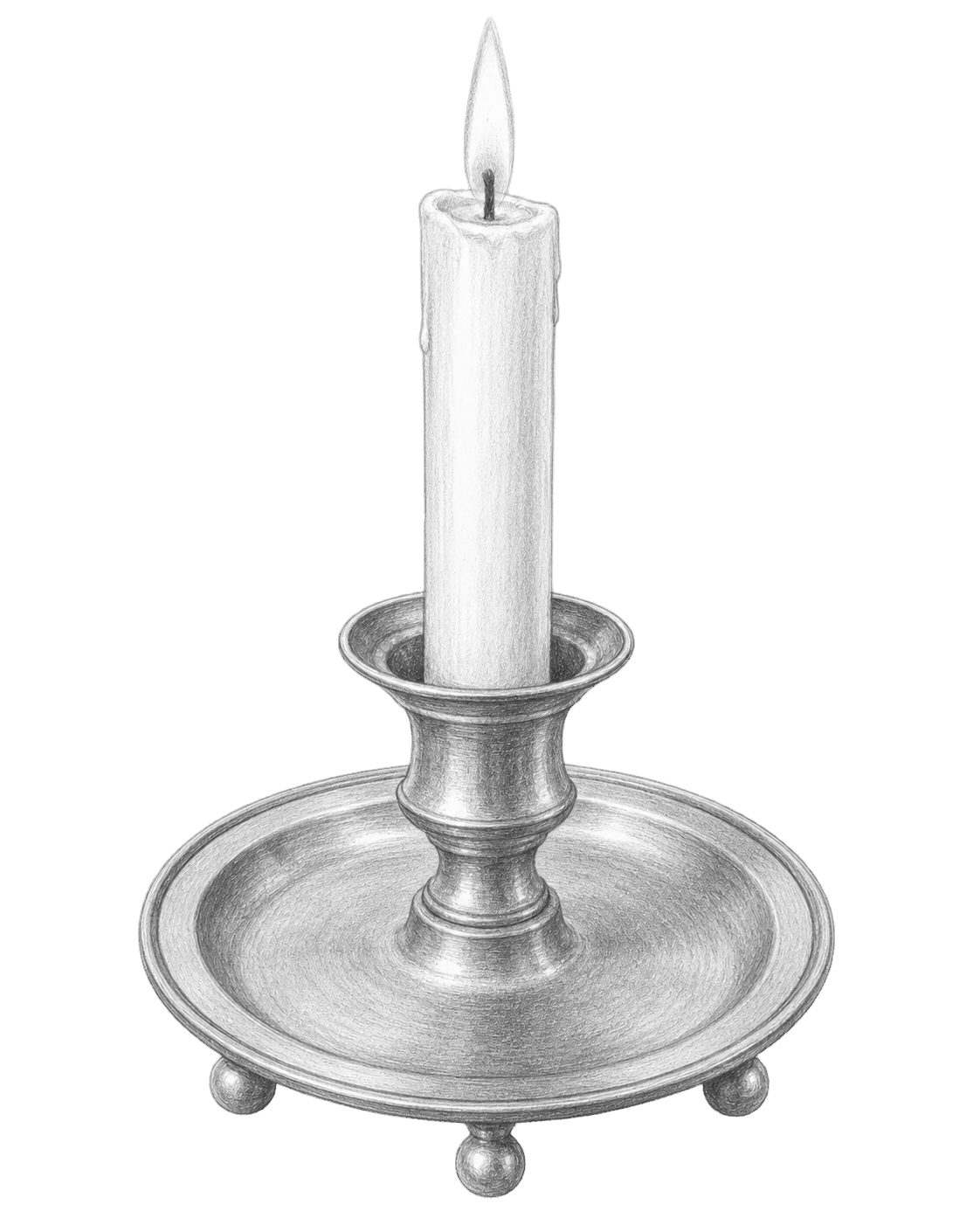 | Bugia bugia Details |
Bishop’s vestments and insignia | The Ceremonial calls the small silver candle-bearing implement used beside the bishop's book the bugia. |
More about BugiaThe Watterson photograph supports one low circular pan, stepped socket, small-footed exemplar without establishing a universal handle or morphology. Handling: Treat a lighted bugia as an open flame and do not infer a handle from the English name hand candle. Use and sourcesStatus: Universal Roman. Location: Beside the book presented to the bishop. Book service in pontifical functions, even when ambient light is sufficient. Ordinary handler: cleric. Server: recognizes only. Liturgical use: The Ceremonial describes a small silver implement commonly called the bugia, bearing a lit candle beside the presented book even in sufficient daylight. Ceremonial presence: At solemn Mass, a distinct candle minister normally approaches at the book minister's right and holds the lighted bugia near the bishop while the book is presented, even when daylight is sufficient. Pontifical: Place the bugia in its book-service relationship; the illustrated Watterson form is one licensed exemplar, not a universal construction.
| |||
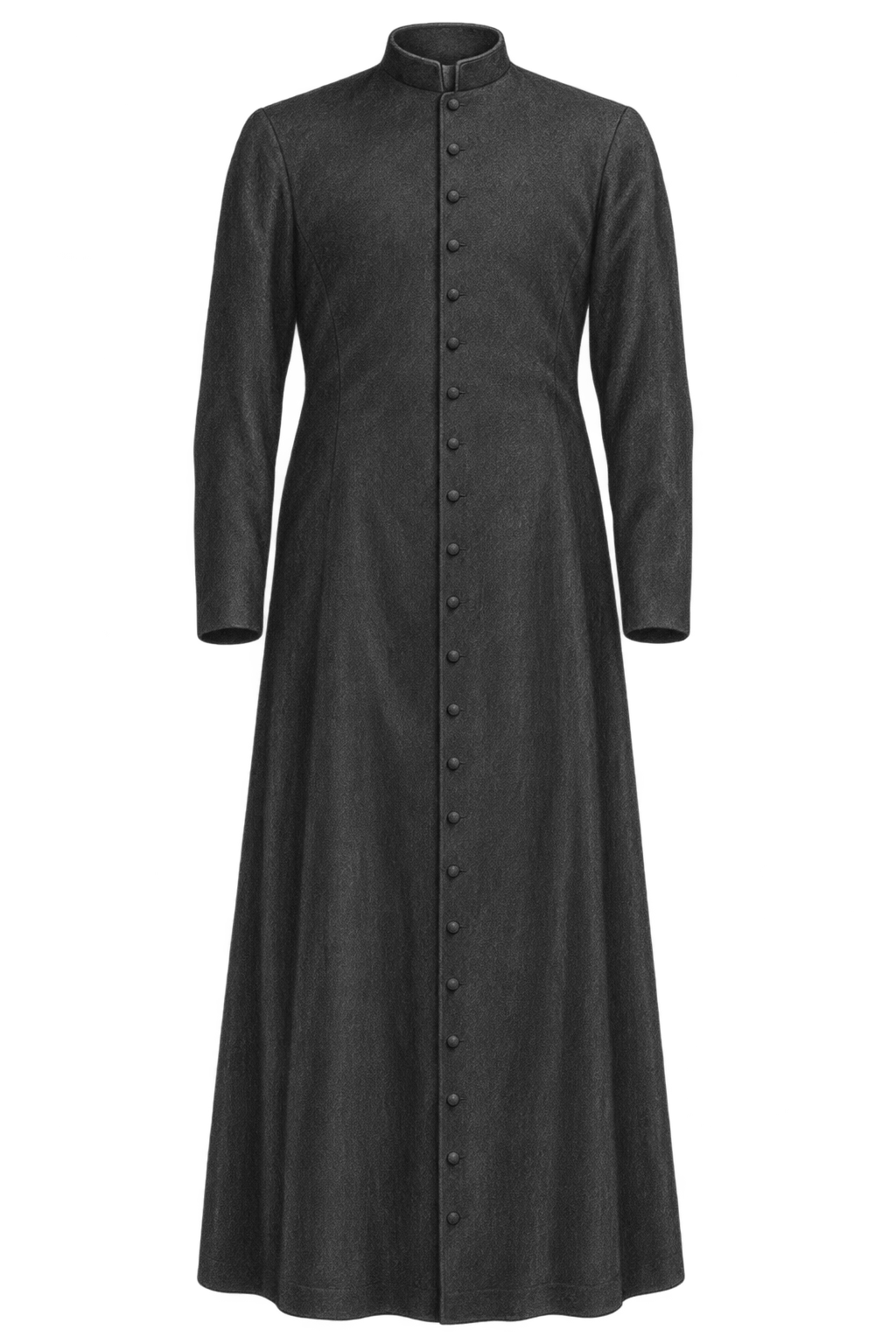 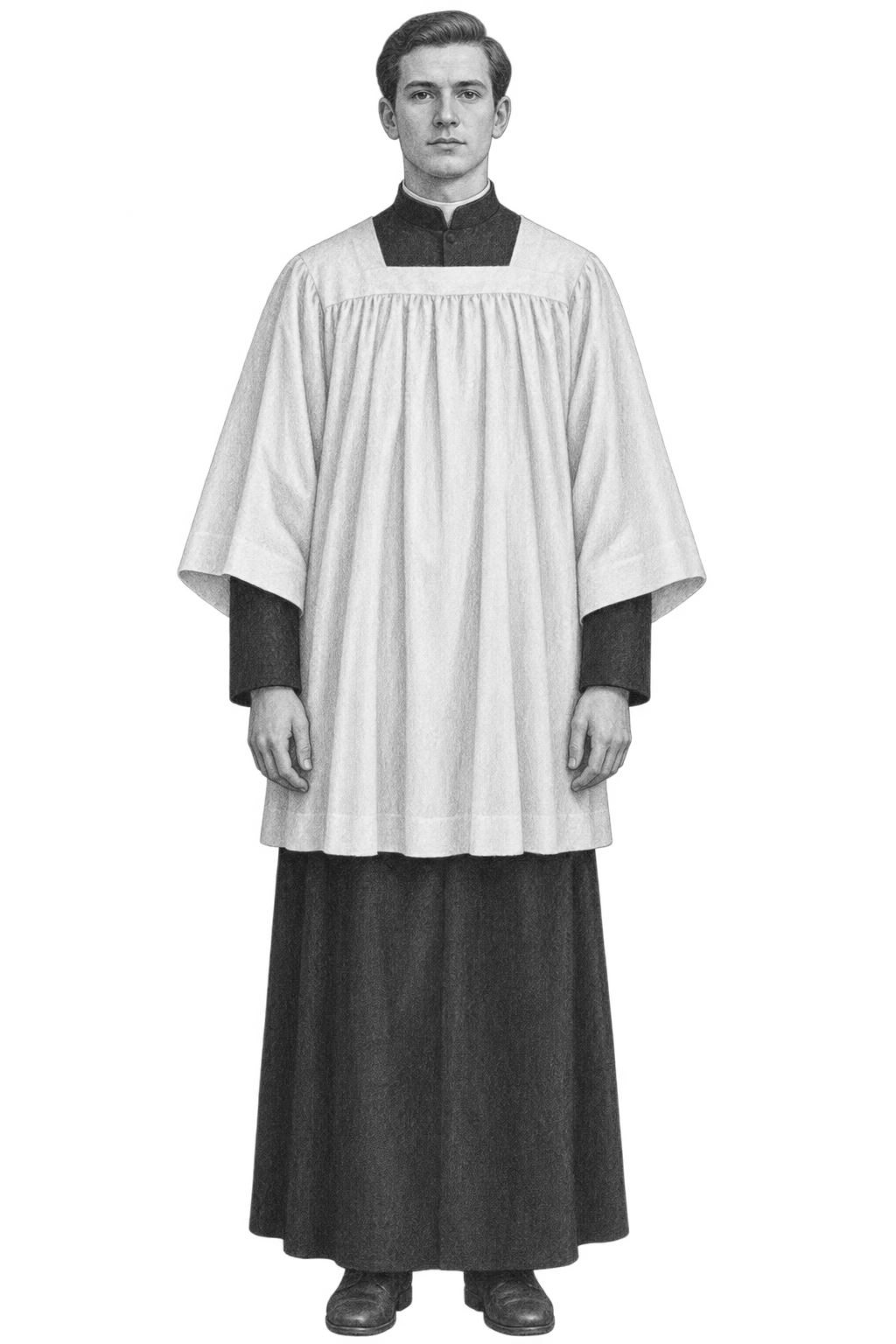 | Cassock vestis talaris Details |
Servers and choir | The cassock is the long garment worn beneath the surplice in ordinary server dress. |
More about CassockImage creditProject-generated artwork without supplied third-party image inputs; exact prompt retained. The checked remote source artifacts supply facts only and are not redistributed. Project-content terms apply to this new illustration. Also shown: Surplice. Surplice: The 1952 catalog's plain surplice has a short gathered body, broad open sleeves and no waist girdle. Its neckline and proportions are representative. The ceremonial also records a recognized custom of serving Low Mass in lay dress in several countries, including England. The pictured neckline, gathers, sleeve length and hem are representative; the source does not prescribe one pattern for every surplice. Image creditProject-generated artwork without supplied third-party image inputs; exact prompt retained. The checked remote source artifacts supply facts only and are not redistributed. Project-content terms apply to this new illustration. A 1952 catalog shows a long-sleeved, full-length cassock. The drawing represents that general form; its tailoring and button count are not prescribed. Its Low-Mass directions also record a recognized custom of serving in lay dress in several countries, including England. Handling: The checked ceremonial records a recognized custom of serving in lay dress; the pictured black cassock is a common arrangement, not a color rule for every server. The pictured tailoring and button count are representative. Use and sourcesStatus: Universal Roman. Location: Worn beneath the surplice by a server in the checked ordinary dress arrangement. Ordinary server and choir dress described by Fortescue–O'Connell (1943). Ordinary handler: other server, cleric, choir member. Server: handles. Liturgical use: Fortescue–O'Connell describes the server putting on cassock and surplice before Low Mass. Ceremonial presence: Fortescue–O’Connell identifies black cassock and white linen surplice as common server and choir dress. Altar server: The cassock is the long lower layer in the pictured cassock-and-surplice arrangement. Sacristan: Keep the two garments distinct: the surplice is worn over the cassock. Mc trainer: Teach the common arrangement together with the ceremonial's recorded lay-dress custom. General reader: The long dark garment beneath the white surplice is the cassock. Pontifical: This is an ordinary server-clothing example; it assigns no prelatial rank or privilege.
| |||
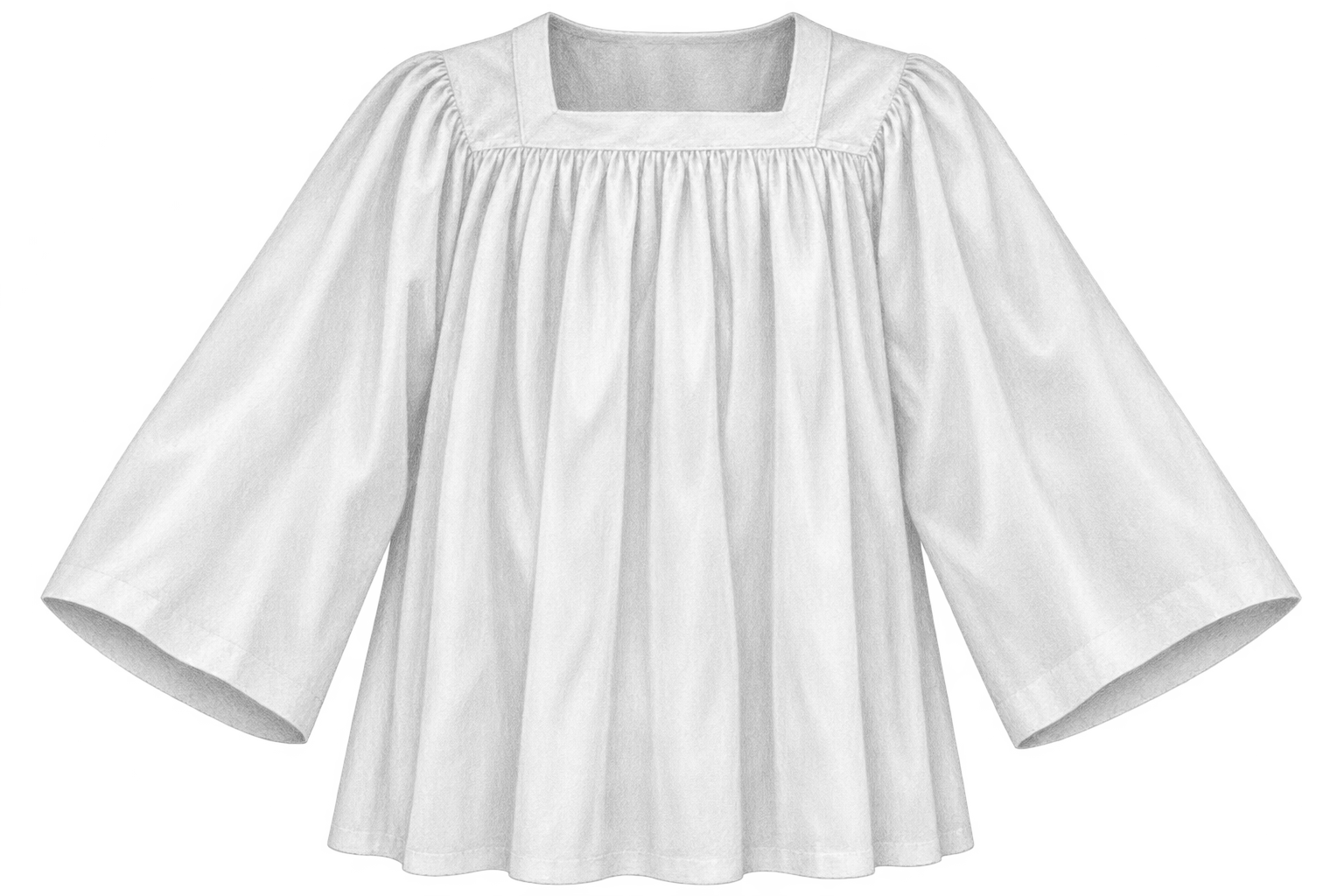 | Surplice superpelliceum Details |
Servers and choir | The surplice is the short, loose white garment worn over the cassock in ordinary server dress. |
More about SurpliceImage creditProject-generated artwork without supplied third-party image inputs; exact prompt retained. The checked remote source artifacts supply facts only and are not redistributed. Project-content terms apply to this new illustration. The 1952 catalog's plain surplice has a short gathered body, broad open sleeves and no waist girdle. Its neckline and proportions are representative. The ceremonial also records a recognized custom of serving Low Mass in lay dress in several countries, including England. Handling: The pictured neckline, gathers, sleeve length and hem are representative; the source does not prescribe one pattern for every surplice. Use and sourcesStatus: Universal Roman. Location: Worn over the cassock in the ordinary server-clothing arrangement. The 1962 Missal describes the minister preceding the priest to the altar wearing a surplice. Ordinary handler: other server, cleric, choir member. Server: handles. Liturgical use: The 1962 Missal describes the minister preceding the priest to the altar wearing a surplice. Ceremonial presence: Fortescue–O'Connell identifies white linen surplice over black cassock as common server and choir dress and describes this dressing before Low Mass. Terminology: Fortescue–O'Connell gives cotta as the Italian name for the surplice. Altar server: The surplice is the short white upper garment; the cassock remains visible below it. Sacristan: The plain example shows the surplice as a separate garment worn over the cassock. Mc trainer: The Missal names the minister's surplice. The ceremonial describes the common ensemble and records a lay-dress custom. General reader: Cotta is the Italian name given for this garment by the checked ceremonial. Pontifical: This ordinary server-clothing example establishes no rank-specific vesture or privilege.
Related views: Cassock and surplice worn together. | |||
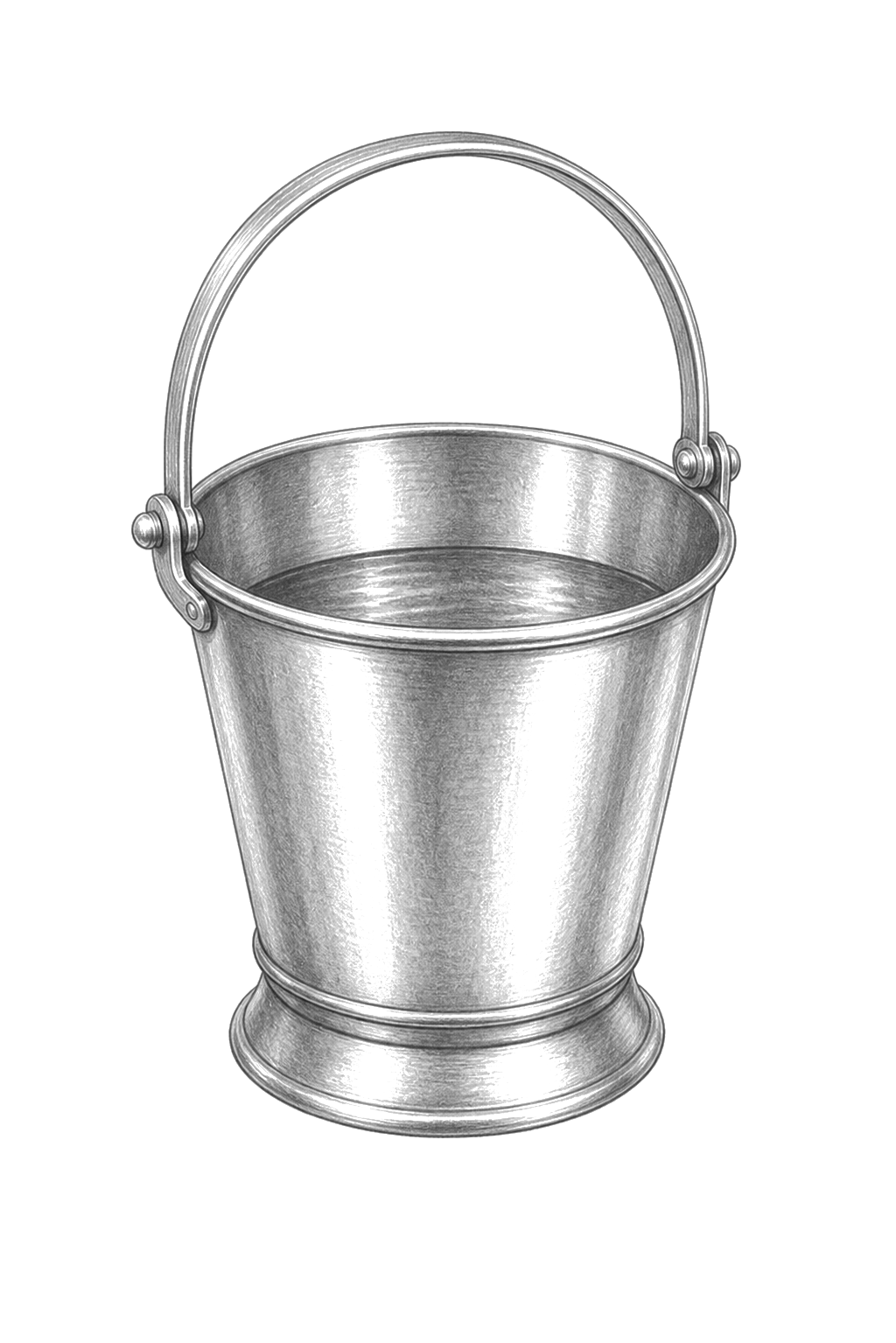 | Portable holy-water vessel vas aquae benedictae Details |
Related rites and insignia | A portable metal vessel holds holy water for use with the aspergillum in the named Asperges ceremony. |
More about Portable holy-water vesselImage creditDeterministic alpha derivative of the project-generated predecessor; its provenance and rights disposition remain recorded. Handling: Keep the vessel upright and avoid spills. This record does not assign preparation, storage, carrying, or a server handoff beyond the named Asperges evidence. Use and sourcesStatus: Universal Roman. Location: Used with the aspergillum in the named Asperges ceremony. Portable metal vessel that holds holy water for the sprinkling. Ordinary handler: deacon, priest. Server: recognizes only. Sacristan: Recognize the portable holy-water vessel as a paired Asperges object; this source-bounded record gives no preparation, storage, filling, cleaning, or local placement procedure. Mc trainer: Teach only the checked Asperges relationship: the sprinkler is dipped in the holy water and passed from deacon to priest; do not infer a universal server carrier or handoff. General reader: This is the portable metal vessel paired with the sprinkler for the Asperges; the pictured handle, taper, foot, and waterline are one illustrative form. Pontifical: Treat this as an ordinary related-ceremony vessel, not pontifical insignia or a distinct pontifical form.
| |||
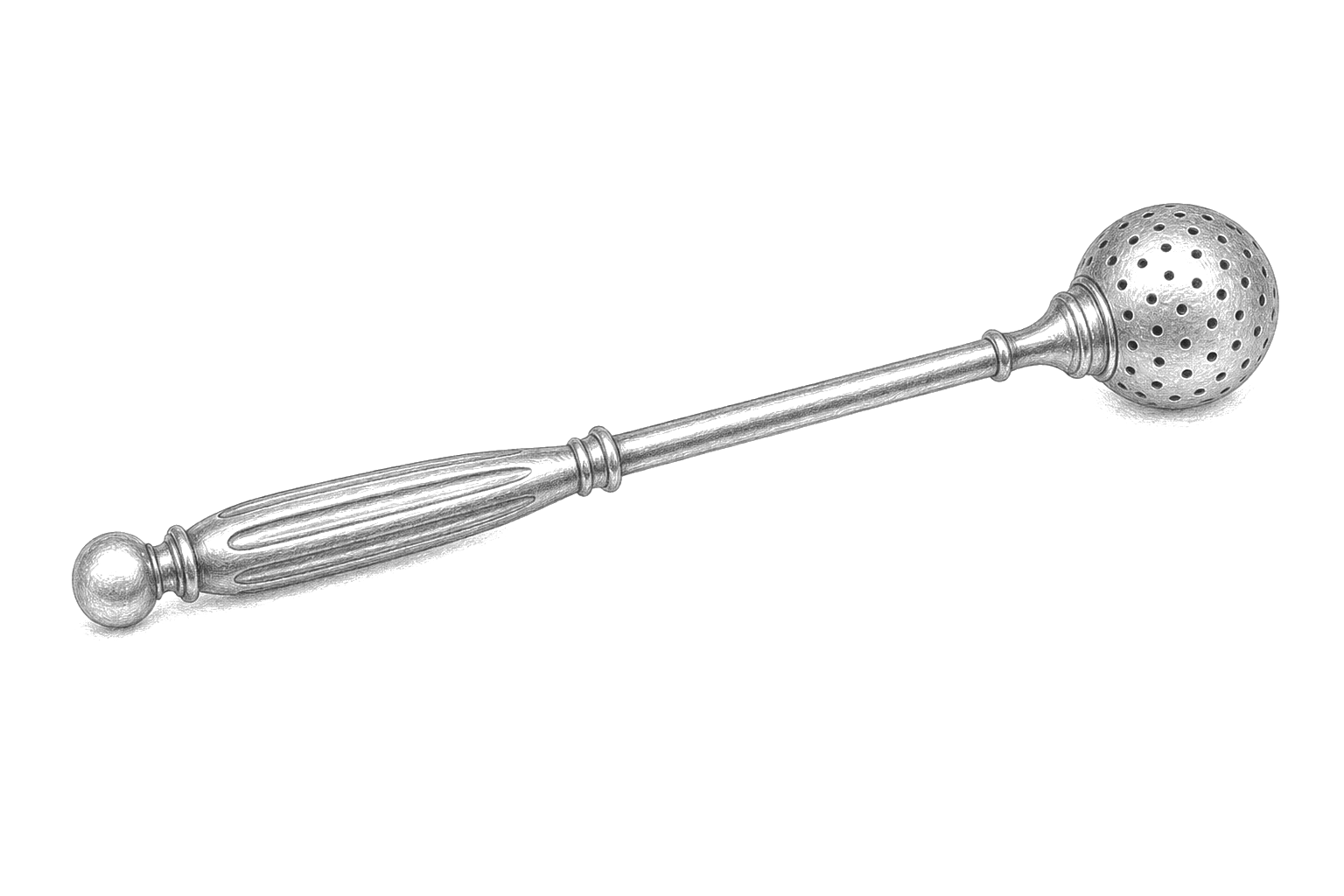 | Aspergillum aspergillum Details |
Related rites and insignia | An aspergillum is a holy-water sprinkler; checked sources document brush-ended and perforated hollow-globe forms, and the plate shows the latter. |
More about AspergillumImage creditDeterministic alpha derivative of the project-generated predecessor; its provenance and rights disposition remain recorded. The candidate artwork shows a straight metal handle and perforated spherical sprinkler head as one representative form. Handling: Keep the wet head controlled and away from faces, books, textiles, and electrical fittings. This record gives no server handoff beyond the named Asperges evidence. Use and sourcesStatus: Universal Roman. Location: Used with the portable holy-water vessel in the named Asperges ceremony. Sprinkler dipped into holy water and used by the priest. Ordinary handler: priest, deacon. Server: recognizes only. Liturgical use: In the named Asperges ceremony, the sprinkler is dipped into holy water, handed by the deacon to the priest, and used by the priest for the sprinkling. Sacristan: No preparation, storage, drying, cleaning, or local placement procedure is supplied. Mc trainer: Do not infer a universal server route from the checked deacon-to-priest relation. Pontifical: This is an ordinary related-ceremony implement, not pontifical insignia or a distinct pontifical form.
| |||
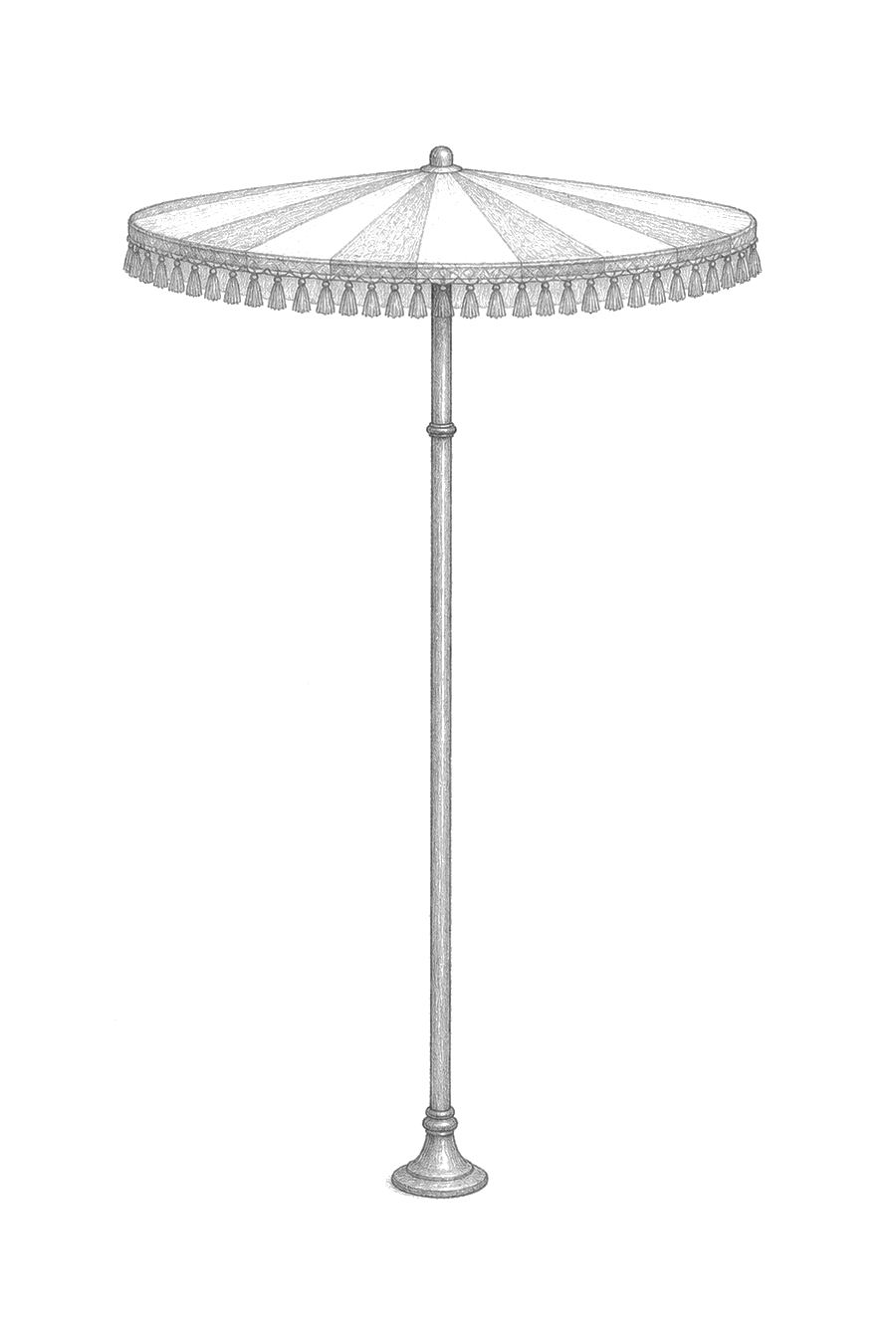 | Eucharistic ombrellino umbella Details |
Related rites and insignia | The Eucharistic ombrellino is the small one-staff umbrella form, distinct both from the larger processional baldachin and from the institutional basilical conopaeum. |
More about Eucharistic ombrellinoImage creditDeterministic alpha derivative of the project-generated predecessor; its provenance and rights disposition remain recorded. The plate shows one representative shallow, nearly flat canopy on a single long staff. The historical secondary witness supports that recognition class, not a universal material, color, fringe, panel pattern, dimensions, foot, or ornament. Handling: The checked witnesses describe earlier practice; the 1952 Ritual was not collated. Recognition does not assign a bearer or supply a complete ceremonial direction; consult the exact applicable rite and local assignment. Use and sourcesStatus: Universal Roman. Location: Carried over the Blessed Sacrament in the particular routes described by the checked earlier witnesses. The 1925 Ritual's public Communion-to-the-sick route, and short transfers within a church described in 1943; the small Eucharistic canopy is distinct from basilical insignia. Ordinary handler: other server, cleric. Server: varies by ceremony. Ceremonial presence: The checked 1925 Ritual text calls for an umbrella or baldachin, where available, over the priest carrying the Blessed Sacrament to the sick. Its wording has not been collated against the 1952 Ritual. Liturgical use: Fortescue–O'Connell (1943) describes a smaller umbrella-like canopy on one rod for short transfers of the Blessed Sacrament within a church, such as from one altar to another. Altar server: Recognize the small canopy in the earlier Communion-to-the-sick and transfer contexts described here; the plate gives no ordinary Mass assignment. Sacristan: The earlier witnesses identify this small canopy; any preparation depends on the exact applicable rite and local assignment. The plate prescribes no fabric, color, dimensions, fringe, construction, or storage method. Mc trainer: The where-available clause belongs to the checked 1925 text. Keep the small canopy distinct from both the larger baldachin and basilical conopaeum; determine carrying assignments from the applicable ceremonial plan. Pontifical: Include this only in Eucharistic processional contexts; it is neither pontifical insignia nor the basilical conopaeum.
| |||
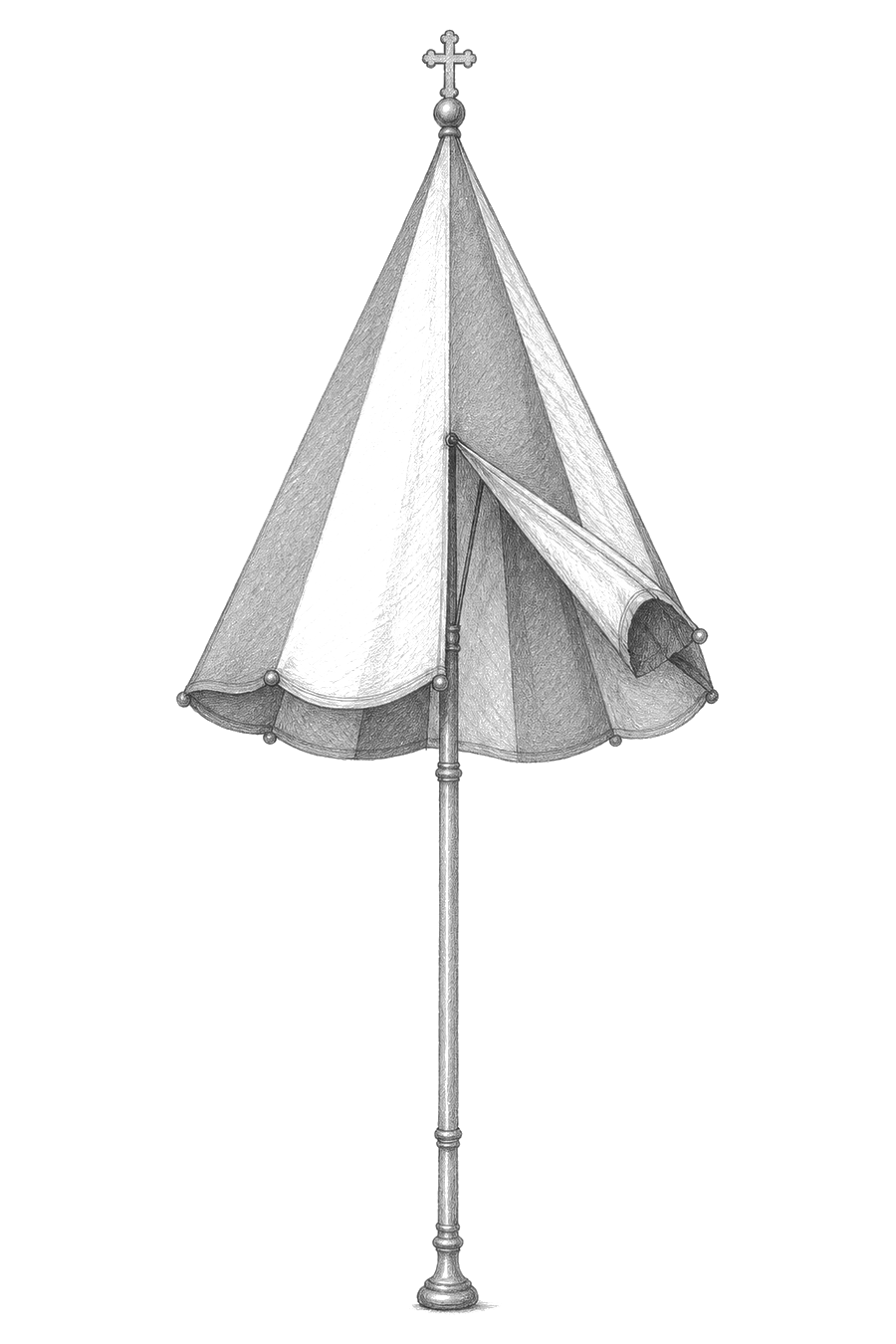 | Basilical conopaeum conopaeum Details |
Related rites and insignia | The checked 1918 and 1923 basilica grants identify the conopaeum and tintinnabulum as institutional basilical insignia; they do not make the conopaeum a generic Mass implement or Eucharistic canopy. |
More about Basilical conopaeumImage creditDeterministic alpha derivative of the project-generated predecessor; its provenance and rights disposition remain recorded. The 1918 grant permits the church's arms on the conopaeum; both checked grants exclude gold or silver ornament. The present unheralded graphite plate does not universalize those act-specific particulars. The plate shows one representative partially opened, conical, alternating-panel form on a single staff. That morphology is a historical secondary control and does not establish universal color, fabric, panel count, finial, dimensions, ornament, opening state, or construction. Handling: Do not infer a processional assignment from the object's presence; follow the basilica's exact privilege and ceremonial direction. Use and sourcesStatus: Institutional. Location: A basilica holding the privilege, with the institution's basilical insignia. Institutional basilical insigne associated in official grants with the tintinnabulum; not a generic Mass implement or Eucharistic canopy. Ordinary handler: other server, cleric. Server: recognizes only. Ceremonial presence: The checked grants confer the privilege of carrying the conopaeum and tintinnabulum; these passages do not specify a full processional order. Liturgical use: Its use belongs to the basilica's institutional privilege and exact ceremonial context; the official acts do not establish it as an ordinary altar, Mass, pontifical, or Eucharistic implement. Sacristan: Treat this as conditional institutional insignia. Prepare, place, or store it only under the basilica's actual privilege and local assignment; the plate prescribes no construction or method. Mc trainer: Teach this only in a basilical or institutional branch, paired conceptually with the tintinnabulum and kept distinct from every Eucharistic canopy. Pontifical: Cross-reference this as basilical institutional insignia only; it is not pontifical insignia and creates no pontifical ceremonial assignment.
| |||
About the illustrations and sources
This selection covers the checked, illustrated portion of the dictionary. Drawings are resized independently. The book marker and Communion rail are identified within their illustrated settings. Definitions and qualifications follow the cited sources; this is a study reference, not an official liturgical book or local direction.
Project-created content follows the Triptych licensing statement. Source and third-party material follows the third-party material notice; individual image credits appear with the enlarged drawings.